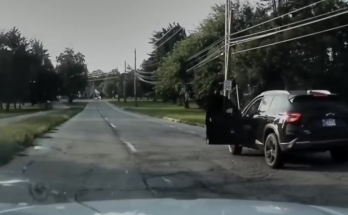
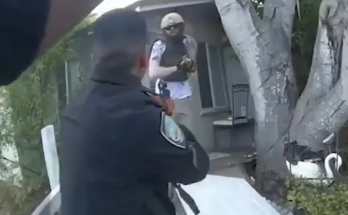
HOUSTON, TX — A tense encounter between Houston police officers and an armed suspect ended in gunfire when the man reached for a weapon during a confrontation, as shown in newly released bodycam footage. The video offers a gripping, real-time look at how an ordinary patrol stop spiraled into a life-or-death moment that lasted less than five seconds.
The Call That Started It All
Just after 9:00 p.m. on a Friday evening, officers from the Houston Police Department’s Southeast Patrol Division were dispatched to a gas station near Martin Luther King Boulevard following reports of a man “acting suspiciously” and “possibly armed.”
Witnesses told 911 operators that the man had been pacing near the pumps, appearing agitated and “lifting his shirt like he was showing a gun.”
When officers arrived, they spotted a man matching the description — later identified as 33-year-old Marcus Reed — standing beside a silver Nissan Altima.
One of the responding officers, Officer Andrew Morales, activated his body-worn camera as they approached the suspect. What began as a calm conversation quickly escalated into a deadly confrontation.
The Bodycam Footage: Calm Before the Chaos
The bodycam footage begins with Morales and his partner stepping out of their patrol vehicle, flashlights cutting through the dimly lit parking lot.
“Hey man, how’s it going? You mind taking your hands out of your pockets for me?” Morales says, his tone measured but firm.
Reed looks over his shoulder, visibly tense. He keeps one hand in his hoodie pocket, ignoring repeated commands.
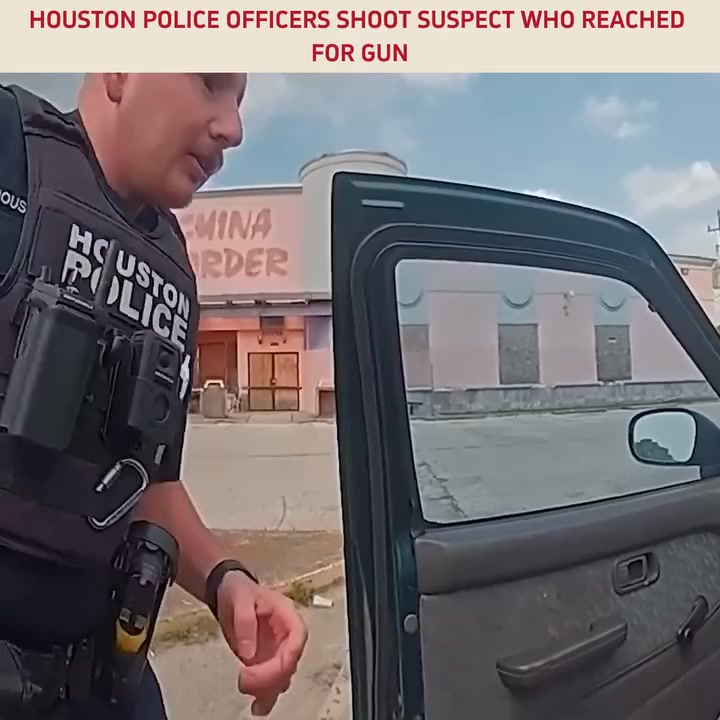
“Sir, take your hand out. We’re not here to hurt you, but we need to see your hands,” Morales says again.
The suspect hesitates, shifting his weight, eyes darting between the two officers. The tension builds palpably in the footage — the sound of traffic in the background, the officers’ flashlights reflecting off the car windows, the rhythmic hum of the gas pumps.
Then, Reed makes a sudden move.
He turns sharply toward the Nissan, reaching into his waistband.
“Gun! Gun! Gun!” Morales shouts.
Within a fraction of a second, both officers open fire.
Gunfire Erupts
The bodycam footage captures the deafening crack of gunshots — seven in total. Sparks fly as bullets strike the pavement. Reed collapses beside the driver’s door, his hand still near his waistband.
“Don’t move! Stay down!” one officer shouts as Morales radios for assistance. “Shots fired! Suspect down — send medical now!”
The officers cautiously approach, keeping their weapons trained on the suspect. One officer kicks away a black semi-automatic handgun lying beside Reed’s hand. The weapon later turned out to be loaded with a round in the chamber.
As sirens wail in the distance, the officers begin administering first aid. Morales presses gauze against Reed’s chest wound while his partner retrieves a trauma kit from the patrol car.
“Stay with me, man. EMS is coming,” Morales says, his voice shaking slightly.
Despite their efforts, Reed was pronounced dead at the scene by paramedics minutes later.
Police Department Statement
At a press conference the following day, Houston Police Chief Troy Finner addressed the incident, defending his officers’ actions as both “lawful and necessary.”
“The suspect ignored multiple verbal commands and made a deliberate movement toward a loaded firearm,” Finner said. “The bodycam footage clearly shows that our officers reacted in self-defense and to protect everyone in that parking lot.”
He confirmed that the two officers involved — both veterans with over seven years on the force — have been placed on standard administrative leave pending an internal and independent investigation.
Chief Finner also emphasized the importance of body-worn cameras in maintaining transparency:
“These cameras don’t just record what happens — they record why it happens. The public can see for themselves the danger and the speed at which these events unfold.”
Who Was Marcus Reed?
Court records show that Reed had a lengthy criminal history, including prior arrests for unlawful possession of a firearm, drug distribution, and aggravated assault. He was currently out on bond for a separate weapons charge.
Family members described Reed as troubled but not violent. His sister, Danielle Reed, told reporters that Marcus had struggled with mental health and addiction issues for years.
“He wasn’t in his right mind,” she said tearfully. “But he didn’t deserve to die like that.”
She also claimed that her brother carried a gun for protection after a previous robbery attempt, though investigators have not confirmed that claim.
What the Bodycam Reveals
The bodycam video released by HPD offers a comprehensive timeline of the event — from the officers’ arrival to the final moments after the shooting. Analysts say the footage provides key insight into the speed and volatility of police encounters involving firearms.
Use-of-force expert Lt. Jason McKenna (Ret.) explained:
“From the moment the suspect reaches for his waistband to the first shot, less than one second passes. That’s how fast officers have to process life-or-death decisions.”
He added that, given the lighting and the visible weapon, the officers’ actions were consistent with training and departmental policy.
“You can’t gamble with hesitation,” McKenna said. “A half-second delay can cost an officer’s life.”
Community Reaction
The release of the footage sparked strong emotions across Houston. Many residents praised the officers’ quick response, while others expressed frustration over yet another deadly police encounter.
Outside HPD headquarters, community activist Tyrone Wilson said:
“We understand the risk officers face, but it’s tragic every time a life is lost. We need better ways to defuse these situations before they turn deadly.”
In contrast, local resident Carla Ruiz, who witnessed the aftermath of the shooting, said the video made her appreciate the dangers of policing.
“I used to think they overreacted,” she said. “Now I see — it’s seconds, just seconds between talking and shooting. That officer could’ve been the one dead.”
Transparency and Training
The Houston Police Department has been under increased scrutiny in recent years over its use-of-force policies. However, experts note that the department’s bodycam program has significantly improved public trust.
Chief Finner reaffirmed that HPD officers receive annual de-escalation and crisis intervention training. Still, he acknowledged that not every situation allows for negotiation.
“We train for calm,” he said. “But when someone reaches for a loaded gun, there is no time for talk.”
Experts Emphasize Split-Second Decision-Making
Former FBI tactical instructor Renee Caldwell reviewed the footage and said it was a textbook case of “perceived imminent threat.”
“Officers aren’t required to wait until they’re fired upon,” she said. “When a suspect ignores clear commands and moves toward a gun, that’s the moment of danger. The law recognizes that reality.”
Caldwell noted that bodycam technology has been crucial in distinguishing between “what people think happens” and “what really happens.”
“Without this footage, critics might assume excessive force,” she said. “But the video shows truth in real time — chaos, fear, and the impossible choice officers face.”
Final Moments on Camera
In the final minute of the footage, after medics take over, Officer Morales steps away from the scene, his breathing heavy, hands trembling. He leans against his cruiser and speaks softly to his sergeant:
“He went for it, Sarge. I saw the handle. I didn’t want to, but I had to.”
The sergeant nods, placing a hand on his shoulder.
“You did what you had to do to make it home.”
The bodycam continues recording as Morales stares into the flashing red and blue lights — the reflection of tragedy flickering across his face.
Conclusion
The Houston bodycam footage captures more than a shooting — it captures the human struggle between instinct, fear, and duty. In just seconds, a tense standoff became a fatal encounter, leaving behind another reminder of the split-second nature of policing.
Chief Finner summed it up in his closing remarks:
“Our officers don’t get the luxury of hindsight. They only get the moment — and in that moment, they chose to protect their lives and the lives of everyone around them.”
The investigation continues, but the footage leaves no doubt about what happened that night: a confrontation that escalated too fast, a weapon drawn too soon, and a decision no officer ever wants to make.