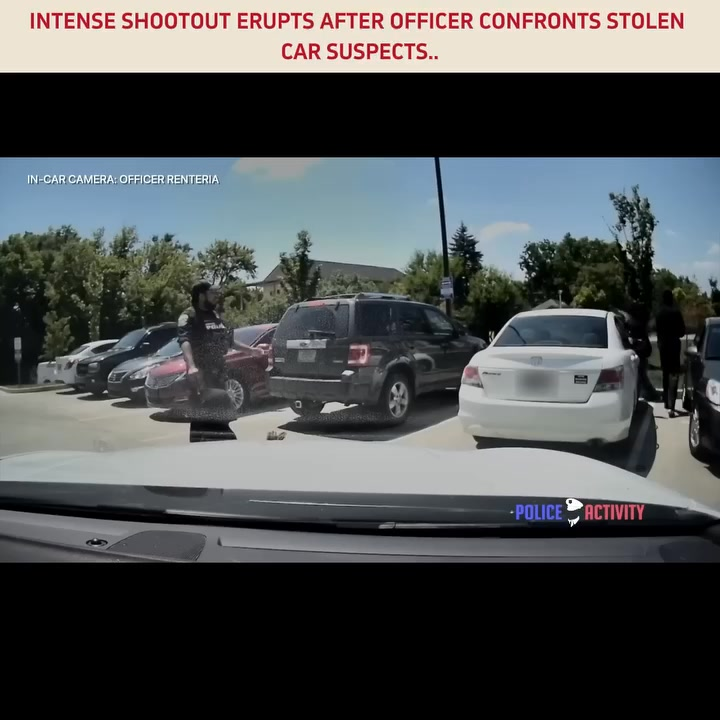
Intense Shootout Erupts After Officer Confronts Stolen Car Suspects
The night began like countless others — quiet streets, cold air, and routine patrols — until one officer’s body-worn camera captured the moment calm turned to chaos. Just after midnight, a confrontation over a stolen vehicle in San Bernardino County, California, escalated into a violent shootout that left bullets flying, glass shattering, and sirens wailing through the dark.
According to the San Bernardino County Sheriff’s Department, the incident began around 12:15 a.m. when a patrol officer spotted a silver Honda Civic idling outside a closed convenience store. A quick license plate check revealed it had been reported stolen earlier that evening from a gas station in Riverside. The officer pulled in quietly, intending to perform a routine stop. But as the bodycam footage shows, nothing about what followed was routine.
The Stop
The video begins with the officer stepping out of his cruiser, flashlight in hand. The street is nearly empty, the sound of crickets filling the background. As he approaches the vehicle, he radios dispatch:
“I’ve got eyes on the stolen Honda, occupied by two individuals — requesting backup.”
The camera light reflects off the car’s rear window. Inside, the driver appears nervous, shifting in his seat, while the passenger keeps glancing toward the glovebox.
“Evening,” the officer says. “Let’s keep your hands where I can see them.”
Before he can finish the sentence, the driver slams the gear into reverse. The engine roars, tires screech, and the car clips the patrol cruiser’s front bumper before speeding down the street.
“Suspects fleeing — westbound on Baseline!” the officer yells into his radio, sprinting back to his car.
The Pursuit
The dashcam footage picks up as the chase begins. The stolen Honda races through intersections, blowing past red lights. The officer maintains pursuit, headlights flashing, siren piercing the night. At one point, the suspects throw objects out of the window — later found to be stolen wallets and narcotics.
After two minutes, the Honda loses control on a curve, crashing into a chain-link fence near an abandoned parking lot. Smoke fills the air. The bodycam footage shakes as the officer exits the cruiser, weapon drawn.
“Hands up! Stay in the car!” he commands.
The passenger door opens slowly. Then, suddenly — muzzle flashes.
The Shootout
Gunfire erupts without warning. The bodycam captures the terrifying moment as bullets ricochet off metal and concrete. The officer dives behind his patrol car for cover, shouting into his radio:
“Shots fired! Officers under fire! Send backup!”
The suspects continue firing from inside the crashed vehicle. One round shatters the cruiser’s windshield. The officer returns fire, his weapon steady despite the chaos. The audio records his heavy breathing, the metallic ping of shell casings hitting the ground, and the deafening echo of gunfire in the empty lot.
As the exchange continues, the officer manages to reposition, using his spotlight to blind the suspects. The driver attempts to flee on foot, vaulting over a fence with his handgun still in hand. The officer fires again — striking the suspect in the leg. The man falls to the ground, dropping his weapon.
The passenger, meanwhile, refuses to surrender. The video shows him crawling out of the vehicle and firing wildly before being hit by returning fire. He collapses beside the car.
“Suspects down!” the officer calls out, his voice shaking but controlled.
Backup units arrive seconds later, lights flooding the scene in red and blue.
The Aftermath
When the gunfire stops, the camera captures a surreal silence — broken only by the crackle of the police radio. The officer cautiously approaches the suspects, weapon still drawn. He kicks the firearms out of reach and immediately begins first aid.
“Stay with me,” he says to the wounded driver, applying pressure to the leg wound. “Help’s coming.”
Paramedics arrive minutes later, treating both suspects. The driver survives; the passenger, later identified as 22-year-old Carlos Reyes, is pronounced dead at the scene.
Investigators recover two handguns — one reported stolen — along with a bag of methamphetamine and several fake IDs. The stolen Honda Civic was later confirmed to have been used in multiple burglaries across Southern California.
The Bodycam Footage
The Sheriff’s Department released the bodycam video one week later, citing transparency and public interest. The edited clip, about 10 minutes long, includes slowed segments showing muzzle flashes, tactical movements, and the officer’s clear commands throughout the ordeal.
Public reaction was swift. The video went viral, viewed millions of times on social media. Some praised the officer’s bravery, noting how he maintained composure while being ambushed.
“He stayed calm under literal fire,” one viewer wrote. “You can hear his training kick in — no panic, just focus.”
Others highlighted the intensity of modern policing. “This is why bodycams matter,” another commenter said. “You can see exactly what they’re up against — it’s chaos, not a movie.”
Official Statements
At a press conference, Sheriff Shannon Dicus commended the responding officer’s quick thinking.
“Our deputy faced a deadly ambush and responded with courage and professionalism,” Dicus said. “The bodycam footage shows restraint and adherence to protocol under extreme pressure.”
He also stressed that the officer’s decision to attempt first aid afterward reflected the department’s emphasis on preserving life — even those of suspects.
“He switched from combat mode to care mode in seconds,” Dicus added. “That’s what we train for.”
The injured suspect, 19-year-old Marco Vasquez, remains hospitalized and faces multiple charges, including attempted murder of a peace officer, vehicle theft, and possession of a stolen firearm.
Expert Analysis
Dr. Elaine Porter, a criminologist and use-of-force expert, analyzed the footage for a local news outlet.
“The video underscores how fast these encounters escalate,” she said. “From the time the officer approached to the first shot fired — less than five seconds. That’s not enough time for negotiation or backup. It’s pure survival instinct.”
She added that bodycam evidence not only protects officers from false accusations but also offers invaluable data for training and policy development.
“Every frame tells a story,” Porter noted. “The angles, the lighting, the officer’s tone — it’s raw documentation of real-world policing.”
The Human Side
In the final minute of the bodycam video, after the chaos subsides, the officer’s breathing slows. He leans against his cruiser, hands trembling, whispering into his radio:
“One suspect down, one detained… I’m okay.”
Backup officers place a reassuring hand on his shoulder as medics work nearby. The flashing lights reflect off puddles, illuminating spent casings scattered across the asphalt.
It’s a haunting image — a mixture of exhaustion, adrenaline, and disbelief.
The video ends with a simple, understated moment: the officer holstering his weapon, his face illuminated by the glow of his bodycam lens. No words — just silence.
Broader Implications
This shootout joins a growing number of bodycam-documented confrontations involving stolen vehicles and armed suspects across the U.S. Law enforcement agencies say such videos help strengthen transparency and public trust, showing that decisions in the field are often made in seconds, not minutes.
The San Bernardino County Sheriff’s Department confirmed that internal reviews found the officer’s actions justified and in compliance with policy. The footage will now be used in future tactical training programs for pursuit and ambush response.
Conclusion
The bodycam footage from that night on Baseline Street tells a story of courage, chaos, and control. What began as a routine traffic check turned into a firefight — a vivid reminder of how unpredictable policing can be.
For the officer involved, it was another shift that could have been his last. For the public, the video offers an unfiltered window into the dangers faced by law enforcement — the noise, fear, and split-second choices that define life on the line.
As Sheriff Dicus said, summing up the ordeal:
“It all happened in less than two minutes. But for that officer, those two minutes will stay with him forever.”