(Police Bodycam Footage Captures the Intense Seconds Before Officers Open Fire During a Violent Standoff in Colorado Springs)
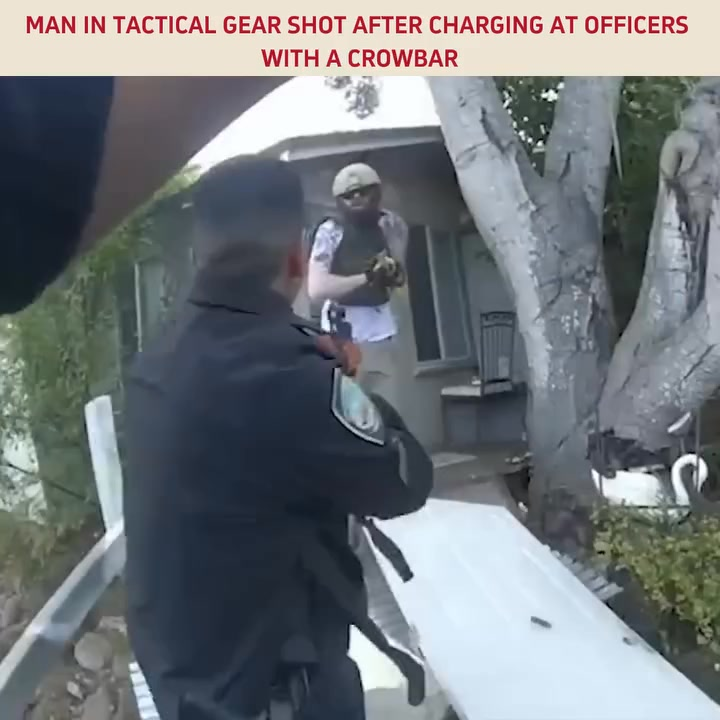
Colorado Springs — A tense confrontation between police and an armed man wearing tactical gear ended in gunfire after the suspect charged at officers wielding a metal crowbar, ignoring repeated commands to drop the weapon. Newly released police bodycam footage reveals the terrifying split-second decision officers were forced to make when the situation escalated beyond control.
The incident, which took place outside a suburban apartment complex on North Academy Boulevard, has reignited conversations about use of force, mental health, and officer safety — but also highlighted the professionalism and restraint officers displayed before being left with no choice but to shoot.
The Initial Call: “He’s Wearing Body Armor and Swinging a Metal Bar”
According to the Colorado Springs Police Department (CSPD), dispatchers received multiple 911 calls around 6:42 p.m. on a Sunday evening reporting a man “in full tactical gear,” “acting erratically,” and “banging on cars with a metal bar.”
One caller can be heard on the recording saying, “He’s scaring everyone. He’s got a vest on — like a bulletproof vest — and he’s screaming about being hunted.”
Officers David Rios and Morgan Kelly were among the first to arrive at the scene. Both are members of CSPD’s patrol division, equipped with standard issue Axon body cameras, which recorded the entire encounter from start to finish.
Arrival on Scene: A Dangerous Unknown
The bodycam footage begins with Officer Rios pulling up to the apartment complex parking lot. The sun is setting, casting long shadows across the pavement. In the distance, a man dressed in dark tactical gear — a vest, gloves, boots, and helmet — is pacing between parked cars, gripping a three-foot metal crowbar in his right hand.
“Dispatch, we’ve got eyes on the subject,” Rios reports. “Male, mid-30s, wearing black tactical vest, armed with a crowbar.”
As the officers exit their vehicles, they take cover behind open car doors and begin issuing loud verbal commands.
“Sir! Put the weapon down!”
“We just want to talk to you!”
The man doesn’t respond. Instead, he turns slowly toward the officers, tilting his head unnaturally. He appears agitated, mumbling incoherently as he slams the crowbar against the pavement, sending a metallic clang echoing across the lot.
Tense Negotiation: A Battle Against Time
The footage shows the officers maintaining distance, attempting to de-escalate.
“Let’s get you some help,” Officer Kelly calls out. “Put that down and talk to us.”
For nearly two minutes, they try to reason with him. The suspect, later identified as 35-year-old Aaron Blake, continues pacing, occasionally striking nearby car hoods.
Suddenly, he shouts:
“You can’t stop me! You’re not real cops — you’re demons!”
Moments later, he begins walking toward the officers — slowly at first, then faster — gripping the crowbar like a baseball bat.
“Drop it!” Rios yells. “Drop it now or we’ll shoot!”
Blake breaks into a full sprint.
The Moment of Impact: Split-Second Decision
The bodycam footage captures the terrifying moment in real time. The suspect charges straight toward Officer Rios, raising the crowbar over his head. The distance between them closes from 20 feet to five in less than two seconds.
“Gun! Gun! He’s coming at us!” someone shouts.
Four gunshots ring out in rapid succession. Blake collapses mid-stride, the crowbar clattering to the pavement beside him.
The officers immediately rush forward, weapons still trained, then transition into life-saving mode.
“Get the med kit! Hurry!” Kelly yells, kneeling beside the downed suspect.
Within seconds, she applies pressure to his wounds while Rios radios for paramedics. The man remains conscious for a short time, muttering incoherently as officers reassure him.
“You’re okay, buddy. Stay with me,” Rios says, voice shaking.
Aftermath: A Scene of Chaos and Control
Paramedics arrive within minutes and take over emergency care. Blake is transported to UCHealth Memorial Hospital, where he is later pronounced dead. No officers or civilians were injured.
Investigators recovered the metal crowbar, a tactical vest with steel plates, and a sheath containing a hunting knife strapped to Blake’s belt.
CSPD Chief Adrian Vasquez addressed the shooting during a press conference the following day.
“Our officers showed remarkable restraint and attempted multiple times to de-escalate the situation. When the suspect charged at them with a deadly weapon, they acted in defense of their lives and the lives of others nearby.”
The Bodycam Footage: Unfiltered Reality
The seven-minute bodycam clip, released by CSPD’s Office of Public Information, has since gone viral online. It provides a visceral, first-person look at the tension and fear officers face in fast-moving, unpredictable encounters.
Viewers can hear the officers’ steady, professional voices at the start — and their emotional tones shift as the confrontation unfolds. The final moments, showing them desperately providing medical aid, have been widely praised by both law enforcement professionals and civilian viewers.
“It’s easy to judge until you watch what they saw through that lens,” said retired police trainer Lt. Mark Daniels. “He was in full tactical gear, charging with a weapon. In that moment, you don’t get time to think — you get time to survive.”
Who Was Aaron Blake?
Public records show that Aaron Blake was a former Army reservist who had been discharged for behavioral issues in 2012. His family described him as a veteran struggling with severe PTSD and paranoia.
His mother, Linda Blake, told reporters,
“He wasn’t a monster. He was sick. He didn’t trust anyone anymore, and he needed help. I wish they could’ve talked him down.”
Police confirmed that Blake had been the subject of a welfare check earlier in the week after neighbors reported “bizarre and threatening behavior.”
Community Reaction: Sympathy and Division
The release of the footage has sparked mixed emotions throughout Colorado Springs. Some community members have expressed frustration that another mental health crisis ended in gunfire, while others have voiced support for the officers’ actions.
Resident James Thornton, who witnessed part of the incident, said,
“That man looked ready to kill somebody. I was five seconds from dialing 911 myself. The officers did what they had to do.”
Others, like mental health advocate Sarah Mendoza, argue the city needs more Crisis Intervention Teams (CITs) available to respond to such calls.
“We can’t expect patrol officers to also be mental health experts. We need trained clinicians alongside them. Maybe this could have ended differently.”
Ongoing Investigation
As is standard procedure in officer-involved shootings, the El Paso County District Attorney’s Office and the Colorado Bureau of Investigation (CBI) have opened parallel inquiries. Both officers involved are on administrative leave pending the results.
Preliminary findings show that the officers issued at least nine verbal commands before using deadly force, and that the crowbar — later measured at 36 inches and weighing nearly 10 pounds — was capable of inflicting fatal injuries.
Conclusion: The Weight of a Split-Second
The Colorado Springs bodycam footage of the Aaron Blake shooting is a haunting reminder of how quickly violence can erupt — and how police officers must make life-or-death decisions in fractions of a second.
For officers Rios and Kelly, the encounter was the kind of moment every cop dreads: an armed suspect rushing forward, the line between danger and tragedy blurred by adrenaline and chaos.
For Blake’s family, it was another painful chapter in America’s ongoing struggle to reconcile mental illness with public safety.
As Chief Vasquez said during his closing remarks,
“Our officers didn’t wake up that morning wanting to take a life. They woke up wanting to protect one — and sometimes, in this line of work, those two things collide.”
Keywords: Colorado Springs Police, bodycam footage, officer-involved shooting, tactical gear, crowbar attack, Aaron Blake, PTSD, law enforcement, mental health crisis, police transparency, use of force.