I was exactly twenty-four hours postpartum when the illusion of safety dissolved into ash.
My body was a map of fresh trauma. The C-section incision, a jagged, angry red line hidden beneath layers of gauze, burned with the intensity of a thousand lit matches every time I tried to shift my weight. My newborn son, Noah, slept in a wicker bassinet beside the guest bed, his tiny chest rising and falling in a rhythm that was the only thing tethering me to the earth.
I was staying at my parents’ house, a sprawling suburban colonial that smelled of lemon polish and judgment. I was there because my ex-partner had walked out during my third trimester, leaving me with a leased apartment I couldn’t afford and a shattering realization that I was alone. I had come home thinking, foolishly, that blood was thicker than inconvenience. I thought family meant sanctuary.
That fantasy died at 9:00 AM on a Tuesday.
My mother, Eleanor, stood in the doorway. She didn’t knock. She stood with her arms crossed over her chest, her posture rigid, her eyes devoid of the warmth grandmothers are supposed to possess.
“Your sister is coming,” she announced, her voice flat. “With her newborn. She needs the room more than you.”
I stared at her, blinking through the fog of exhaustion and pain medication. My older sister, Lauren, had delivered naturally two weeks prior. She lived in a four-bedroom house in a gated community with a husband who worshipped the ground she walked on.
“Mom,” I rasped, my throat dry. “I can barely move. I just had major abdominal surgery yesterday. Lauren has a home. I don’t.”
Eleanor stepped into the room, her face tightening with impatience. “Lauren is overwhelmed. She needs her mother. And frankly, this room is better suited for her. You’re taking up too much space.”
“I can’t leave,” I whispered, panic beginning to claw at my throat. “I can’t lift my suitcase. I can’t drive. If I walk too much, the stitches might tear.”
“You’re moving fine,” she scoffed. “Now pack your bag and stop your pathetic whining. You’ve always been the dramatic one.”
I tried to sit up, a reflex of defiance, but a bolt of white-hot agony shot through my abdomen. I gasped, doubling over, clutching the bedframe to keep from screaming.
That was when she moved.
She didn’t offer a hand. She didn’t ask if I was okay. She grabbed a fistful of my hair and yanked my head upright.
“I said, get up!” she hissed.
The shock was worse than the pain. My own mother. I froze, terrified that if I struggled, I would fall onto the bassinet, onto Noah.
From the hallway, a shadow appeared. My father, Robert. He held a mug of coffee, watching the scene with a detached, mild annoyance.
“Please get her out of here, Eleanor,” he said, taking a sip. “The noise is making me uncomfortable.”
Something inside me fractured then. It was a clean, silent break, louder than any bone snapping. I wasn’t a daughter to them. I wasn’t a new mother recovering from surgery. I was a stain on their perfect carpet. An inconvenience to be scrubbed away.
I begged. I am not proud of it, but I begged. “Just let me stay until my follow-up appointment on Friday. Please. I have nowhere to go.”
My mother released my hair, wiping her hand on her pants as if I were contagious. “Lauren has priorities. You have consequences. Deal with them.”
I packed with trembling hands. Every time I bent over to place a onesie in my duffel bag, I felt a warm, wet sensation against my bandage. Blood. I was bleeding through the dressing. Noah sensed the stress, his small face scrunching into a cry that sounded like a siren.
My father stood by the door, checking his watch. He didn’t offer to carry the bag. He didn’t look at his grandson. He just opened the front door to the biting November wind.
“Don’t scratch the floor with that suitcase,” he warned.
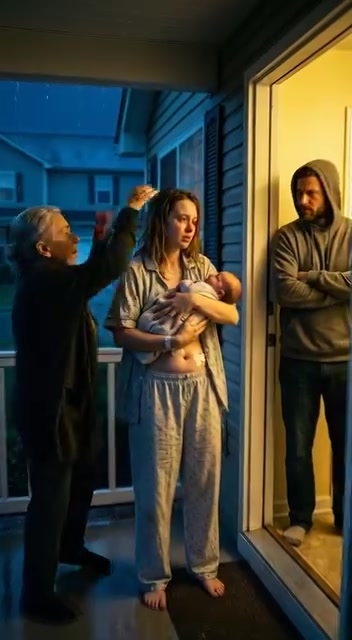
I shuffled to the porch, Noah clutched to my chest, my legs shaking so hard I thought they would collapse. The cold air hit me like a physical blow.
“Don’t make this harder than it has to be,” my mother called out, her silhouette dark against the hallway light.
The door slammed shut. The sound echoed in the cul-de-sac, final and absolute.
I stood there, shivering, bleeding, homeless. My phone buzzed in my pocket. I managed to pull it out with frozen fingers.
It was a text from Lauren.
“Mom told me you’re heading out. Thanks for understanding. You always overreact anyway, and I really need the quiet.”
I looked at the screen, then at the closed door of the house I grew up in. I realized then that this wasn’t just cruelty. It was a systemic erasure. They weren’t just kicking me out; they were discarding me.
I stumbled toward my car, parked on the street because the driveway was reserved for guests. As I strapped Noah into his car seat, my vision blurred. I sat in the driver’s seat, gripping the wheel, and realized I didn’t know how to turn the key.
Chapter 2: The Mercy of Strangers
I drove three blocks before I had to pull over. The pain was blinding, a serrated knife twisting in my gut with every bump in the road. I was in the parking lot of a 24-hour pharmacy, sobbing so hard I couldn’t breathe.
I didn’t call a friend. I didn’t call an ex. I called my obstetrician’s emergency line.
“I’m bleeding,” I choked out when the nurse answered. “My parents kicked me out. I don’t know where to go.”
“Come back,” the nurse said, her voice sharp with alarm. “Come back to the hospital immediately. Do not pass Go. We are waiting for you.”
The drive to the ER was a blur of tears and red lights. When I stumbled into the lobby, carrying Noah in his carrier, the triage nurse took one look at the blood soaking through my sweatpants and called for a wheelchair.
They examined me in a private room. The incision had opened slightly at the corner—a dehiscence caused by the strain of lifting luggage and the stress. But the physical damage paled in comparison to the horror on the doctor’s face when I explained why I wasn’t in bed.
“They put you on the street?” the doctor asked, checking my chart. “One day post-op?”
“My sister needed the room,” I said, the words sounding absurd even to my own ears.
I was readmitted. Not for the incision, mostly, but for “failure to thrive” and acute stress. They put me in a quiet room. A nurse named Sarah took Noah to the nursery for three hours so I could just sleep. Real sleep.
The next morning, a woman walked into my room. She wore a cardigan and held a clipboard, her eyes kind but assessing.
“My name is Denise,” she said softly. “I’m a hospital social worker. The nurses told me what happened.”
I turned my face away, shame burning my cheeks. “I’m fine. I just need to find a motel.”
“You are not fine,” Denise said, sitting down. “And you are not going to a motel. What your parents did—evicting a post-surgical patient and a newborn into freezing temperatures—qualifies as abandonment and endangerment. You are vulnerable, and we are not releasing you until you have a safe place to land.”
I looked at her. “I have no money. My ex cleared the accounts before he left.”
“We have resources,” she said. “There is a program. A transitional recovery apartment run by a nonprofit for postpartum women in crisis. It’s not the Ritz, but it’s secure. It’s warm. And your parents can’t find you there.”
Your parents can’t find you there.
The relief that washed over me was so profound I almost vomited.
Denise arranged everything. Two days later, I was discharged into the care of “The Haven.” It was a small apartment complex on the other side of the city. My unit was a studio with peeling paint, but it had a lock on the door that only I controlled. It had a crib. It had a fridge stocked with milk and frozen meals.
For the first week, I did nothing but heal. I lay in bed with Noah, tracing the lines of his face, listening to the sirens outside, and realizing that the silence in this shabby apartment was louder than any screaming match. It was the silence of peace.
But peace allows you to think. And when I started thinking, I started digging.
Denise helped me apply for emergency assistance. Part of that process involved pulling my financial records to prove my indigence. We sat at the small kitchen table, her laptop open, Noah cooing in his swing.
“Okay,” Denise mumbled, typing in my social security number. “Let’s check your credit report just to be safe.”
She paused. Her fingers stopped moving.
“What?” I asked, feeding Noah a bottle.
“Honey,” Denise said, turning the screen toward me. “Did you open a credit card with American Express six months ago?”
“No,” I said. “I’ve never had an Amex.”
“There’s a card here. It has a balance of $8,000. The billing address…” She hesitated. “The billing address is your parents’ house.”
I felt the room spin.
“And,” Denise continued, her voice turning steely, “according to the IRS transcript for last year… your father claimed you as a dependent. Even though you lived on your own and worked until the layoff.”
The betrayal wasn’t just emotional. It was financial. They hadn’t just kicked me out; they had been harvesting me. Using my identity to fund their lifestyle while calling me a burden.
“What do I do?” I whispered.
Denise closed the laptop. “We stop being the victim. We become the prosecution.”
Chapter 3: The Reconstruction
The rage didn’t come all at once. It came in waves, fueling me during the sleepless nights.
With Denise’s help, I connected with a pro-bono attorney named Mr. Henderson. He was a gruff, no-nonsense man who specialized in financial fraud.
“We file a police report,” Henderson said. “Identity theft. Credit card fraud. Tax fraud.”
“They’re my parents,” I said, the old conditioning rearing its head. “If I do that, they could go to jail.”
“They threw you out with a fresh surgical wound,” Henderson reminded me. “They didn’t act like parents. They acted like predators. You need to freeze your credit, dispute the charges, and file an affidavit of fraud. It’s the only way to clear your name so you can get an apartment of your own eventually.”
I did it. My hand shook as I signed the affidavit, but I did it.
While the legal gears turned, I focused on survival. I couldn’t go back to a physical office yet—childcare was too expensive—so I scoured the internet for remote work. I was a copywriter before the layoff. I updated my portfolio at 3:00 AM while Noah slept. I pitched clients with a ferocity I didn’t know I possessed.
I landed a contract with a tech startup three weeks later. It wasn’t much money, but it was my money.
I sent my parents a single email. No emotions. No pleading. Just an attachment of the fraud affidavit and a notification that I had reclaimed my tax status.
My mother replied four minutes later.
Subject: How Dare You
“You are ungrateful, spiteful, and embarrassing the family. After everything we did for you? Cancel this nonsense immediately or don’t bother coming to Christmas.”
I laughed. A dry, rasping sound. Christmas? She thought she still held the keys to the kingdom.
My father didn’t respond. But the bank notifications did. The credit card was shut down. The investigation began.
And then, Lauren blocked me on social media. I realized she must have known. She was part of the ecosystem, the golden child who thrived because the scapegoat absorbed the damage.
Three months passed. The snow melted. My scar turned from angry red to a dull pink. Noah started smiling, then rolling over. We were building a life in that tiny studio. A life made of spaghetti dinners, late-night typing, and absolute autonomy.
Then, the knock came.
It was a Saturday. I wasn’t expecting anyone. I checked the peepphole and my blood ran cold.
It was them.
My mother, holding a casserole dish covered in foil. My father, standing behind her, looking impatient.
They had found me.
I didn’t open the door. I checked the lock. I stepped back.
“Open up, we know you’re in there!” my mother called out, her voice muffled but unmistakably demanding. “We brought food. We need to talk about this legal mess you’ve created.”
My heart hammered against my ribs. The old fear—the instinct to appease, to open the door, to apologize for existing—surged up.
I looked at Noah, playing on his activity mat. He looked up at me and grinned, toothless and pure.
If I opened that door, I was letting the poison back in. I was teaching my son that abuse is acceptable if it comes with a casserole.
I walked to the door. I didn’t unlock it. I spoke through the wood.
“Go away,” I said.
“Don’t be ridiculous,” my father barked. “We’re your parents. Open this door.”
“You threw me out one day after surgery,” I said, my voice gaining strength, vibrating through the doorframe. “I almost died. I ended up back in the hospital. You stole my identity. You are not my parents. You are the people who broke me.”
“We didn’t realize it was that bad!” my mother cried, switching tactics to tears. “We were stressed! Lauren needed help! Can’t you forgive us? We can fix the credit card thing, just drop the charges!”
“It’s out of my hands,” I lied. “The police have the file. Now leave, or I’m calling them again to report a trespass.”
Silence.
“You’re making a mistake,” my father said, his voice dropping to a low threat. “You’ll need us one day.”
“I needed you three months ago,” I said. “And you weren’t there. I will never need you again.”
I watched through the peepphole. They stood there for a long minute, realizing that the latch wasn’t going to turn. They looked smaller than I remembered. Old. Pathetic.
They turned and walked away.
I slid down the door until I hit the floor, and I wept. Not from sadness, but from the sheer, overwhelming relief of realizing that the monster on the other side of the door couldn’t get in unless I let them.
Chapter 4: The Cost of Peace
Today, Noah is a year old.
We don’t live in the transitional apartment anymore. I saved every penny from my contracts, and three months ago, we moved into a two-bedroom garden unit in a quiet neighborhood. It has a small yard. It has a lease with only my name on it.
My credit score is recovering. The fraud investigation concluded in my favor. My father had to pay restitution to the credit card company to avoid prosecution. I heard through the grapevine—a cousin I still speak to occasionally—that they had to refinance their house to cover the legal fees and the tax penalties.
They tell everyone in our hometown that I “went crazy” and “cut them off for no reason.” They paint themselves as the martyrs, the abandoned grandparents.
Lauren had another baby shower last month for her second child. I wasn’t invited. I saw the photos on a mutual friend’s feed. My mother looked strained. My father looked older. The “happy family” veneer was cracking.
And honestly? I felt nothing. Not jealousy. Not anger. Just the indifference of a stranger passing a wreck on the highway.
Peace is expensive. It cost me my lineage. It cost me the safety net I thought I had. It cost me the dream of a big, happy family Christmas.
But chaos? Chaos costs more. Chaos costs you your soul.
What surprised me most wasn’t their cruelty—it was the community I found in the wreckage. Denise still checks in on us; she came to Noah’s first birthday party. The nurses from the hospital sent a card. The other women in the recovery apartment became my tribe, a sisterhood of survivors who know that blood doesn’t make a family—loyalty does.
I look at the scar on my stomach sometimes. It’s a silver line now, barely visible. It’s a reminder of how I was cut open, and how I stitched myself back together.
I didn’t lose a family that day on the porch. I didn’t lose anything.
I escaped.
Epilogue
If you are reading this, and you are holding onto people who hurt you because you share a last name… let go.
If you have been told that you must endure abuse “for the sake of the family,” or that your pain is an inconvenience to their comfort… walk away.
You are allowed to lock the door. You are allowed to press charges. You are allowed to be the villain in their story so that you can be the hero in your own.
I stood on a porch in the freezing cold with nothing but a newborn and a broken body. I thought it was the end of my life.
It turned out to be the beginning.
Does this story resonate with you? Do you believe there is a line that, once crossed, means family ties are severed forever? Let me know in the comments, and please share this if you think someone needs to hear that it’s okay to choose yourself.