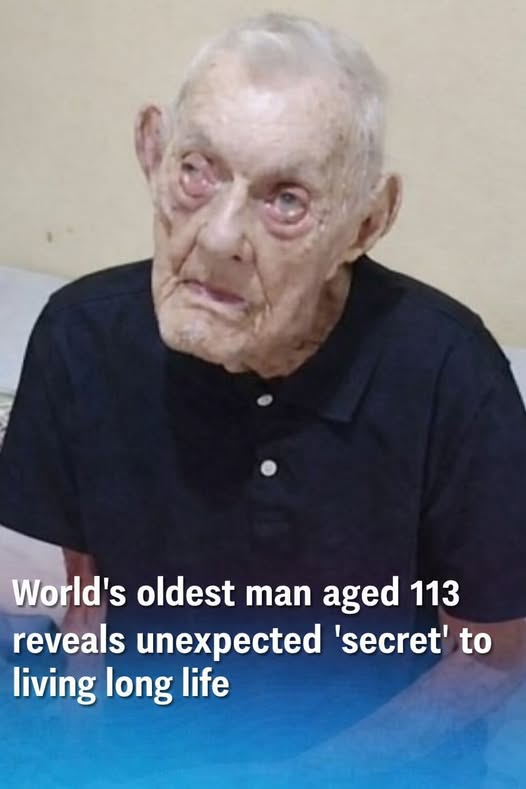
A Different Kind of Longevity Story: João Marinho Neto and the Quiet Power of Human Connection
We live in a moment in history that is intensely preoccupied with the idea of staying young. Across the world, billions of dollars are poured each year into technologies, supplements, and experimental treatments designed to slow aging, reverse cellular damage, and extend the human lifespan. From cryotherapy chambers to gene editing, from wearable devices that monitor every heartbeat to elite longevity clinics backed by venture capital, modern society has turned aging into a technical problem that must be solved. Youth is framed as something that can be engineered, purchased, or optimized through discipline and data.
Against this backdrop of scientific ambition and commercial obsession stands a figure whose life quietly undermines many of our assumptions. João Marinho Neto, at 113 years old, has been recognized as the oldest living man in the world. His extraordinary age alone would be enough to draw attention, but what truly captivates people is not the number of years he has lived—it is the way he explains how he lived them. When asked about the secret to his longevity, Neto does not point to a strict diet, a punishing exercise routine, or a cutting-edge medical intervention. Instead, he speaks about something far more ordinary and far more elusive: good people.
His story offers a striking counter-narrative to the prevailing beliefs of the twenty-first century. In an era that treats longevity as a puzzle to be solved through technology, Neto’s life suggests that the answer may lie in something deeply human and profoundly simple. Rather than hacking his biology, he nurtured his relationships. Rather than waging war against time, he learned how to live well within it.
A Life That Spans Eras
João Marinho Neto was born in Brazil at a time when the world looked radically different from the one we know today. His early years unfolded long before the rise of the internet, before air travel became commonplace, and before modern medicine transformed healthcare. Over the course of more than a century, he has witnessed seismic changes in nearly every aspect of human life. He lived through global conflicts that reshaped nations, economic crises that upended livelihoods, and technological revolutions that redefined communication, work, and culture.
Few people alive today can claim such a sweeping perspective on history. Neto’s life stretches across generations, linking the customs and rhythms of the early twentieth century with the hyperconnected, fast-moving reality of the present. He has seen traditions fade and new norms emerge. He has watched cities expand, industries rise and fall, and entire ways of life disappear.
Yet despite living through periods of profound uncertainty and upheaval, Neto’s approach to life remained remarkably consistent. He did not chase progress for its own sake, nor did he anchor his sense of purpose in external achievements or material accumulation. Instead, he remained rooted in his relationships—with family members, friends, neighbors, and the broader community around him. While the world transformed at an accelerating pace, his priorities stayed grounded in human connection.
The Search for a Secret
When someone reaches such an extraordinary age, curiosity is inevitable. Researchers, journalists, and health enthusiasts alike are eager to uncover the formula that allowed Neto to outlive his peers by decades. Many expect to find a hidden regimen or a rare genetic advantage. They anticipate meticulous routines, strict discipline, or perhaps a lifetime of abstention from pleasure.
What they encounter instead is disarming in its simplicity. Neto does not obsess over his body. He does not track metrics or follow elaborate protocols. He does not frame his life as an experiment in self-optimization. When he speaks about longevity, he speaks about people—about being surrounded by those he loves and trusts, about shared meals and shared laughter, about emotional closeness that endured across decades.
For Neto, the key to a long life was never something external or mechanical. It was relational. His “secret,” as he describes it, lies in the quality of the hearts he chose to keep close to his own.
Longevity as a Matter of the Heart
Neto’s philosophy challenges a deeply ingrained cultural narrative. In much of the modern world, health is framed as an individual responsibility. We are taught to manage our bodies like projects, optimizing inputs and minimizing risks. Diets are calculated down to the gram. Sleep is tracked by devices. Stress is treated as a personal failure of discipline rather than a systemic or social condition.
Within this framework, aging becomes a solitary struggle. The individual is expected to fight time alone, armed with information, products, and willpower. Connection, community, and emotional well-being are often treated as secondary concerns—pleasant but nonessential.
Neto’s life tells a different story. He understood, perhaps instinctively, that human beings are not designed to live in isolation. His longevity suggests that emotional bonds may play a more significant role in survival than many physical interventions. Where modern culture emphasizes control and optimization, Neto emphasized belonging and continuity.
He did not measure his life in achievements or milestones. He measured it in relationships. The people he loved were not distractions from a healthy life; they were the foundation of it.
The Hidden Cost of Isolation
As societies around the world become increasingly fragmented, Neto’s example feels especially relevant. Loneliness has emerged as a widespread public health concern, linked to higher rates of depression, cardiovascular disease, cognitive decline, and premature death. Despite unprecedented levels of digital connectivity, many people report feeling more isolated than ever.
Neto’s story invites us to reconsider the biological consequences of solitude. Chronic loneliness places the nervous system in a constant state of stress. It elevates cortisol levels, weakens immune responses, and accelerates aging at the cellular level. In this light, isolation is not merely an emotional hardship—it is a physiological burden.
By contrast, strong social bonds provide a powerful buffer against stress. Being seen, understood, and valued by others has measurable effects on the body. It regulates heart rate, lowers inflammation, and supports mental resilience. Neto may not speak in scientific terms, but his life aligns with a growing body of research suggesting that connection is not a luxury—it is a necessity.
A Collective Approach to Living
One of the most striking aspects of Neto’s worldview is his rejection of radical individualism. He did not see life as a personal quest for self-preservation. Instead, he understood it as a shared journey. His sense of identity was deeply intertwined with the people around him.
This perspective stands in contrast to contemporary ideals of independence and self-sufficiency. While autonomy has its virtues, it can also obscure the reality that human survival has always depended on cooperation and care. Neto’s longevity reminds us that we are strongest when we are embedded in supportive networks.
He did not pursue youth as an end in itself. He did not attempt to outsmart aging. He simply remained engaged—with conversations, with relationships, with the ongoing story of his family and community. In doing so, he gave his life continuity and meaning, which in turn gave his body a reason to persist.
Science Catches Up
Although Neto’s philosophy may sound intuitive or even sentimental, modern science is beginning to validate many of its implications. Researchers in fields ranging from neuroscience to epidemiology are increasingly recognizing the role of social connection in long-term health outcomes.
Studies have shown that people with strong social ties tend to live longer and experience better overall health than those who are socially isolated. Emotional support has been linked to improved recovery from illness, reduced risk of chronic disease, and greater cognitive resilience in old age.
Neto’s life represents a single data point, but it is a powerful one. While social connection may be difficult to quantify in laboratory settings, its effects are evident in the lived experience of those who reach extreme old age. Again and again, centenarians and supercentenarians point not to extraordinary habits, but to ordinary relationships sustained over time.
Rethinking the Pursuit of Longevity
If we took Neto’s insights seriously, our approach to longevity might change in fundamental ways. Instead of viewing aging as a technical failure to be corrected, we might see it as a relational process shaped by the quality of our connections. We might invest as much energy in cultivating friendships as we do in refining fitness routines.
Rather than spending endless hours monitoring our bodies, we might spend more time sharing meals, telling stories, and showing up for one another. Instead of obsessing over every ingredient in our food, we might pay closer attention to the emotional environments we inhabit.
A life extended by technology but emptied of meaning is a hollow victory. Neto’s example suggests that the true goal is not simply to add years to life, but to add life to years.
A Manifesto for Human-Centered Living
João Marinho Neto’s record is more than a biological achievement—it is a quiet manifesto. It argues for a way of living that values presence over performance, connection over control, and love over optimization. In a world racing toward an uncertain future, he serves as a reminder of what has always sustained us.
He does not rely on devices to tell him how his heart is doing. He feels it respond to the warmth of his family’s presence. He does not need constant reassurance of his health because he experiences it through the strength of shared bonds.
His life illustrates that the most advanced technology we possess is not artificial intelligence or genetic engineering, but our capacity for empathy, care, and mutual recognition.
Counting Faces, Not Years
As Neto reflects on more than a century of life, he does not tally accomplishments or count days. He remembers people—their voices, their gestures, their presence in his life. His memories are populated not by statistics, but by faces.
This way of remembering reveals something essential about what makes life worth living. Time, on its own, is empty. It gains meaning only through the relationships that fill it. Neto’s longevity is not just a matter of survival; it is a testament to sustained engagement with the human world.
A Lesson for the Future
Ultimately, the story of João Marinho Neto offers a lesson that feels both ancient and urgently modern. While science may help us extend the human lifespan, it cannot supply purpose. Only connection can do that. Only relationships can give us reasons to wake up each morning curious about what the day might bring.
Neto found his reason in good people. He continues to find it in shared moments, familiar faces, and the simple act of being present with those he loves. At 113, he stands as living evidence that to endure is not merely to persist, but to remain connected.
In our pursuit of longer lives, we would do well to remember his example. Perhaps the secret we have been searching for was never hidden in a lab or locked behind a paywall. Perhaps it has always been sitting across from us, waiting to be seen.