I never imagined that the trajectory of a human life could be altered so violently, so completely, in the span of a single morning.
My name is Lucía Morales. Seven months ago, I was living a life that felt less like living and more like holding my breath underwater. I resided in a cramped, humid rental apartment on the outskirts of Valencia, a city known for its blinding light and vibrant colors, though my world had faded to a dull, anxious gray.
I was heavily pregnant, carrying seven months of hope and terror in equal measure. My husband, Javier, had lost his job at a logistics company three months prior. The firing had changed him. The man I married—a man who used to laugh with his whole body—had been replaced by a silent, brooding stranger who haunted our hallway like a specter of resentment.
I was trying to keep us afloat with freelance graphic design gigs I scraped together online. I worked from a small corner of the living room, the glow of the monitor illuminating my swollen belly until the early hours of the morning. Financial uncertainty wasn’t just a worry; it was a constant, physical weight, sitting on my chest like a stone, making every breath a negotiation.
One Tuesday afternoon, the heat in the apartment was stifling. I went down to the street, ostensibly to buy milk, but really just to feel the air move. I stopped at a Tabacos shop on the corner. The old man behind the counter was listening to the radio. On a whim—a desperate, foolish whim—I bought a lottery ticket. I didn’t check the numbers. I didn’t pray over it. I simply tucked it into my wallet, wedged between expired coupons and unpaid bills, and forgot about it.
Two days later, I sat at my computer, sipping lukewarm water. I remembered the ticket. With trembling fingers, I typed the code into the website.
The screen refreshed.
I blinked. I wiped the screen, thinking it was a smudge. I refreshed the page again. The numbers remained.
€600,000.
A chill ran down my spine, starting at the base of my neck and radiating outward until my fingertips went numb. I didn’t scream. I couldn’t. The air left my lungs in a rush. I sat there, paralyzed, while hot tears began to spill down my cheeks.
For the first time in months, the crushing weight on my chest vanished. I saw the future unfold in a series of bright, vivid snapshots: Paying off the debts that were strangling us. A nursery with a proper crib, not a second-hand one. Maybe even a small apartment that belonged to us, where the landlord couldn’t threaten eviction.
I waited for Javier to come home. I cooked his favorite meal, my heart hammering a frantic rhythm against my ribs. When he walked in, tossing his keys on the table with that familiar exhausted clatter, I took his hands.
“Javier,” I whispered, “Look.”
I showed him the screen.
I expected a shout. I expected him to sweep me up in a hug. I expected the return of the man I loved.
Instead, he went still. Unnaturally still. He stared at the screen for a long time, his eyes narrowing, calculating. When he finally looked at me, there was no joy in his gaze. There was only a cold, predatory assessment.
“Finally,” he muttered. He didn’t say ‘we.’ He didn’t say ‘you.’ He just walked to the fridge and opened a beer.
That night, I slept fitfully, clutching my belly. I told myself he was just in shock. I told myself the pressure had broken him and this would fix it.
I was wrong. The pressure hadn’t broken him; it had revealed him.
Chapter 2: The Family Council
The next morning, a knock on the door shattered the fragile peace I was trying to maintain.
It was Isabel, Javier’s mother.
Isabel was a woman carved from granite. She had never approved of me. To her, I was too artistic, too independent, too soft for her son. She walked into our apartment without waiting for an invitation, her eyes scanning the messy living room with disdain.
“Javier called me,” she announced, placing her purse on the table.
Javier emerged from the bedroom. He wouldn’t meet my eyes. He stood next to his mother, crossing his arms, forming a united front that instantly made me feel small.
“Sit down, Lucía,” Isabel commanded.
I remained standing, my hand instinctively going to my stomach. “What is going on?”
“We need to discuss the logistics of the money,” Isabel said, as if she were discussing a business merger. “Javier needs to start his own transport business. He has plans. And obviously, the rest needs to be invested properly.”
“Invested?” I asked, my voice trembling slightly.
“Yes,” she continued, her tone dismissive. “You, Lucía, have no head for finances. You’re a creative. You’ll waste it on nonsense. The money needs to be transferred to a joint account managed by Javier and myself. To protect the baby’s future, of course.”
I looked at Javier. “Javier? You agreed to this?”
He finally looked at me, his jaw set. “It’s for the family, Lucía. My mother knows what she’s doing. You’re hormonal. You’re not thinking clearly.”
Hormonal. The word was a slap in the face.
“No,” I said. The word hung in the air, heavy and absolute.
Isabel’s eyes widened. “Excuse me?”
“No,” I repeated, my voice gaining strength. “I bought the ticket. It is my name on the receipt. I have plans for this money. We will pay our debts, yes. We will secure a home for the baby. But I am not handing over my future to you, Isabel. And I am certainly not funding a business venture that we haven’t even discussed.”
For the first time in a long time, I heard myself clearly. It wasn’t just fear speaking; it was a mother’s instinct. That money was the only shield my son had against the chaos of this family.
Javier’s face darkened, shifting from cold to crimson. He stepped forward, invading my personal space.
“Don’t be selfish, Lucía,” he spat. “You think you’re better than us now? Because of a lucky ticket? You’re nothing without me.”
“I am the mother of your child,” I said, backing away toward the dining table. “And I am telling you, the money stays with me.”
Isabel scoffed. “Ungrateful girl. We took you in when you had nothing.”
“Javier,” I pleaded, ignoring her. “Please. Think about Mateo. Think about us.”
“I am thinking about us!” he yelled, his control snapping. “I’m thinking about reclaiming my dignity! But you—you just want to control me.”
I backed away again, terrified by the rage radiating off him. I felt like I was in a cage with a wild animal. I turned to move toward the door, just to get some air, to escape the suffocating intensity of the room.
“Where do you think you’re going?” Javier roared.
I didn’t answer. I reached for the handle.
His hand flew out faster than I could process. It wasn’t a grab. It was a shove. A violent, deliberate shove aimed squarely at my shoulder.
My center of gravity was off. I spun. My feet tangled in the rug. I went flying backward, helpless to stop the momentum.
My lower back slammed hard against the edge of the heavy wooden dining table.
A sharp, blinding pain shot through my abdomen, tearing a scream from my throat that sounded inhuman. I crumbled to the floor, gasping for air, curling around my belly in a desperate attempt to protect the life inside.
And then, amidst the pain, I felt it.
A sudden, warm gush of liquid between my legs.
My breath caught in a strangled sob. I looked down. The puddle was spreading on the cheap laminate floor.
My water had broken.
Chapter 3: The Recording
The room went silent. The only sound was my own ragged breathing and the distant hum of traffic outside.
Isabel stared at me, her hand covering her mouth, her eyes wide with shock. Javier took a step back, looking at his own hands as if they belonged to someone else.
But the worst was yet to come.
The pain returned, not as an ache, but as a contraction that seized my entire body. It was too early. Two months too early.
“Help me,” I gasped. “Javier… please.”
He didn’t move. He stood there, muttering incoherently. “I didn’t… you fell. You just fell.”
“Call an ambulance!” I screamed, the contraction peaking.
The door to the bedroom opened. Marta, Javier’s younger sister, had been there the whole time. I hadn’t even known she was in the house. She walked out, phone in hand.
She wasn’t calling 112. She was holding the phone up, the camera lens pointed directly at me.
“Look at her,” Marta sneered, her voice dripping with disdain. “Acting like a victim. You provoked him, Lucía. Half the country is going to see what a hysteric you are.”
“Marta, please,” I begged, trying to pull myself up using the chair leg. “Something is wrong. The baby…”
“You should have thought about that before you tried to steal my brother’s money,” she said, circling me like a vulture. “Let’s see if you learn some respect.”
Javier seemed to snap out of his trance. But instead of rushing to my side, he bent down. Not to check on me. Not to touch the belly he had once kissed.
He reached for my purse, which had fallen to the floor.
“The bankbook,” he muttered, his hands trembling violently. “Where is the authorization code?”
“Javier!” Isabel shouted, her voice trembling. “Stop it! She is in labor!”
“She needs to sign the transfer!” Javier yelled back, his eyes wild, completely detached from reality. He pulled out a crumpled document he must have had prepared. He shoved it in my face as I lay on the floor in a puddle of amniotic fluid. “Sign it! You’re not going to ruin my life over a whim! Sign it now!”
I tried to push him away, but another contraction doubled me over. The pain was blinding, consuming. I was alone. Surrounded by family, yet completely, utterly alone.
“No,” I wheezed.
He raised his hand again.
“Stop!”
The shout didn’t come from the room. It came from the open window. A neighbor. Mrs. Garcia. She must have heard the screaming.
“I’m calling the police!” she yelled from the courtyard.
Javier froze. The color drained from his face. He stepped back, dropping the paper. He looked at me with pure hatred, as if my suffering was an inconvenience to his plans.
Minutes later, sirens wailed in the distance. When the paramedics burst through the door, followed by two police officers, I felt the first real sob escape my chest.
They rushed to me. “Ma’am? Can you hear me?”
“My baby,” I whispered. “Save my baby.”
“We’re going to take care of you,” the paramedic said. He looked up at Javier, who was trying to explain to the police that it was just a “domestic dispute.”
“She needs to go now!” the paramedic barked. “She’s in fetal distress.”
As they loaded me onto the stretcher, Javier tried to follow. “I’m coming with her. I’m the father.”
The paramedic blocked him. “Not in my ambulance, you’re not.”
As they wheeled me out, I saw Marta still holding her phone, though she had lowered it slightly. I saw Isabel sitting on the sofa, weeping—not for me, but for the scandal.
And I saw Javier, standing amidst the wreckage of our marriage, holding a piece of paper that was worth nothing compared to what he had just lost.
Chapter 4: The Viral Truth
The hospital was a blur of bright lights and urgent voices. La Fe Hospital. The massive complex loomed over me. I was rushed straight to the operating room.
“The baby’s heart rate is dropping,” a doctor shouted. “We need to do an emergency C-section. Now!”
I was terrified. I was alone in a room full of masked strangers, my body shaking uncontrollably from shock and adrenaline. As the anesthesia mask was lowered over my face, my last thought was of the video. Marta had recorded me. They would twist this. They would say I was crazy. They would take my son.
Darkness.
Then, a sound.
A cry. Thin, reedy, but fierce.
I fought through the fog of anesthesia. “Mateo?”
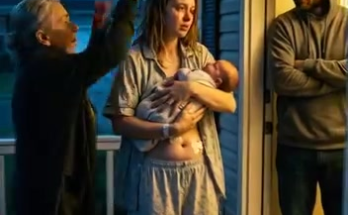
“He’s here, Mom,” a nurse said softly, hovering over me. “He’s small. He’s in the NICU. But he’s a fighter.”
I drifted back into sleep, exhausted.
When I woke up properly, hours later, I was in a recovery room. My body felt like it had been run over by a truck. The bruise on my back was throbbing. But my mind was surprisingly clear.
I asked for my phone. The nurse hesitated, then handed it to me.
“You have a lot of notifications,” she said gently.
I unlocked the screen. My social media was exploding.
I clicked on Twitter. The top trend in Valencia was #JusticiaParaLucia.
I clicked the link.
It was Marta’s video.
She had uploaded it, thinking she was exposing me as a greedy, hysterical wife. She thought her commentary—“Look at her, trying to steal the money”—would rally people to their side.
She couldn’t have been more wrong.
The internet saw the truth. They saw a pregnant woman terrified on the floor. They saw the water breaking. They heard Javier screaming about bankbooks while his wife was in labor. They saw the cruelty of a sister-in-law filming instead of helping.
The comments were a landslide of outrage.
“This is a crime. He is assaulting her.”
“He cares more about the money than his dying child.”
“Who records this? These people are monsters.”
The video had backfired in the most spectacular way possible. Marta had provided the police with irrefutable evidence of abuse, coercion, and failure to render aid.
The door to my room opened. It wasn’t Javier. It was two officers from the National Police.
“Mrs. Morales?” the female officer said softly. “We’ve seen the video. We have spoken to the paramedics. We are here to take your statement.”
“Is he here?” I asked, my voice trembling.
“We have arrested your husband, Javier, in the waiting room,” she said. “He is charged with assault, coercion, and endangering the life of a minor. His sister, Marta, is also being questioned regarding the distribution of the video and failure to assist.”
I closed my eyes and let out a breath I felt like I had been holding for years.
“He wanted the money,” I whispered.
“The money is yours, Lucía,” the officer said firmly. “And we are going to make sure he never gets near you or that baby again.”
Javier didn’t resist the arrest, apparently. He was too shocked that the narrative he tried to spin had collapsed so instantly. Isabel was outside, screaming that it was a misunderstanding, that I had “tripped,” but the video didn’t lie. The video showed the shove. The video showed the neglect.
That night, alone in the hospital bed, I wasn’t a victim. I was a witness to my own survival.
Chapter 5: The Shelter
The legal battle was ugly, but short.
With the video evidence and the medical report detailing the placental abruption caused by the trauma, Javier didn’t have a leg to stand on. He was convicted of gender-based violence and gross negligence. The judge issued a restraining order so severe that he couldn’t even be in the same zip code as Mateo and me.
Isabel tried to sue for grandparents’ rights. She had the audacity to claim I was “unstable.” But the judge, having seen the footage of her sitting on the sofa while I screamed for help, dismissed her claim with prejudice. She lost all access.
I spent the next month in the Neonatal Unit, watching Mateo grow stronger in his incubator. He was tiny, a little warrior fighting for every breath. I sat beside him, whispering promises. I will protect you. I will build a world where you are safe.
When I finally regained control of the lottery winnings—confirmed by the administration as my sole property due to the separation of assets regime we luckily had—I made a decision.
I didn’t just want to buy an apartment. I wanted to build a fortress.
I moved to Ruzafa, a vibrant, colorful neighborhood in Valencia filled with art and life. I bought a sunny apartment with a balcony overlooking the street, where the smell of orange blossoms drifted in the mornings.
But I didn’t stop there.
The trauma of that day—the feeling of being alone on the floor while those who should have loved me watched me suffer—haunted me. I knew I wasn’t the only one.
With a significant portion of the prize money, I founded “Refugio Valencia.”
It wasn’t just a shelter. It was a transition center for pregnant women and new mothers escaping domestic violence. I hired lawyers, therapists, and social workers. I wanted to create the support system I didn’t have.
I remember the first woman who walked through our doors. She was young, terrified, clutching a plastic bag with all her belongings. She looked at me with the same hollow eyes I had seen in the mirror for months.
“I have nowhere to go,” she whispered. “He says I’m useless.”
I took her hands. “You are not useless. You are safe here. And you are not alone.”
I learned that strength isn’t about not falling apart. It’s about what you do with the pieces after you shatter.
Today, Mateo is two years old. He has my eyes and a laugh that fills the entire apartment. He doesn’t know his father, and for now, that is a mercy.
Sometimes, when I walk through the park and see the Turia gardens blooming, I think about that lottery ticket. People say money changes you. They’re right.
Money didn’t buy me happiness. It bought me the ability to say “No.” It bought me the locks on my doors. It bought me the lawyer who silenced my abusers.
It bought me my life.
I still watch the video sometimes, not to hurt myself, but to remember. To remember the woman on the floor, begging for help. I look at her with compassion, and I tell her: Hold on. You are about to become dangerous.
My name is Lucía Morales. I was a victim, but now I am a survivor, a mother, and a fighter.
If you are reading this, and you feel like you are walking on eggshells in your own home… if you are scared of the person who sleeps beside you… please, listen to me.
You are stronger than you think. There is a life waiting for you on the other side of the fear.
If you know someone in danger, do not look away. Speak up. Share this story. A single voice can save a life.