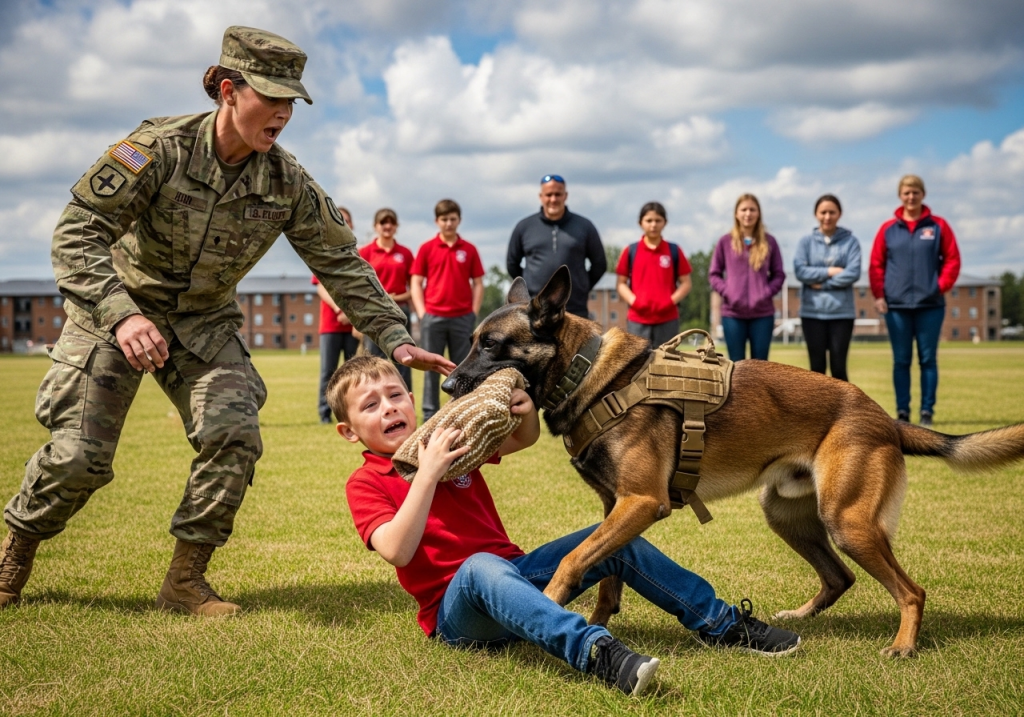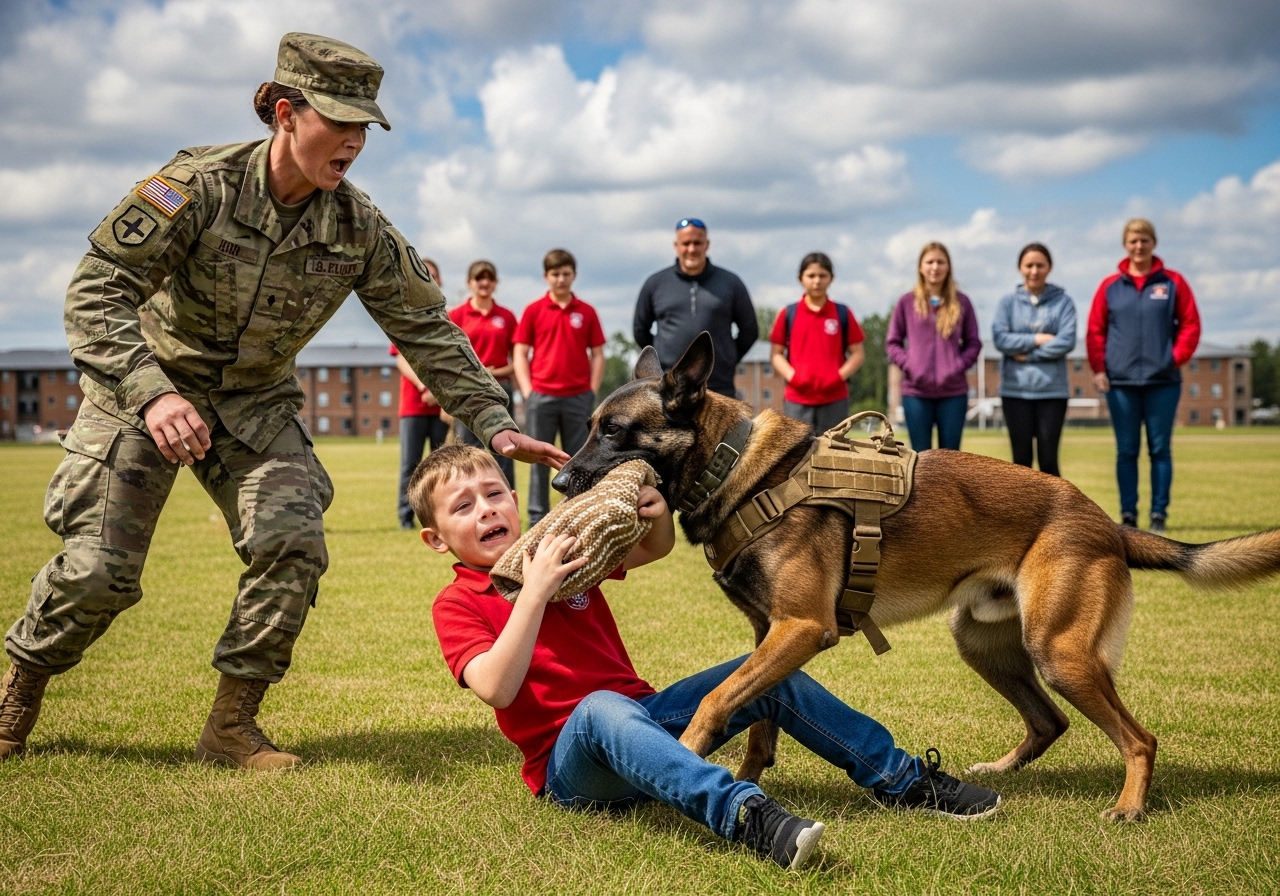
The sound of seventy pounds of trained muscle slamming into my six-year-old son’s fragile chest is a sound that will echo in my nightmares until the day I die.
It wasn’t a bark. It wasn’t a growl.
It was the sickening, breathless thud of a little boy having the air violently forced from his lungs.
And then, there were the teeth.
Gleaming white, razor-sharp, and resting less than an inch from my baby’s throat.
My name is Claire. I’m thirty-two years old, a widowed mother, and an overly cautious freelance graphic designer who lives in a quiet, aggressively normal suburb in Ohio.
My entire world revolves around one axis: my son, Leo.
Leo is six. He is made of scraped knees, a profound obsession with dinosaurs, and a heart so soft it practically bleeds for every stray cat and crushed worm he finds on the sidewalk.
He is my anchor. Since my husband, Mark, died in a car accident three years ago, it’s just been the two of us against the world.
I am fiercely, unapologetically protective of him. I double-check his seatbelt. I cut his grapes into quarters. I research every teacher, every babysitter, every playground.
But I never could have researched this. I never could have protected him from what happened on that Tuesday morning in early May.
It started like any other field trip day.
The air was already thick with that sticky Midwest humidity. Leo was vibrating with excitement, bouncing around our kitchen in his light-up sneakers.
“Mom! We’re gonna see real soldiers! And real army dogs!” he shouted, his mouth half-full of Eggo waffles.
I smiled, wiping a smear of syrup from his cheek, but a familiar knot of anxiety tightened in my stomach.
I don’t like the military. I don’t like bases.
My father was an Army Ranger. A harsh, uncompromising man who brought the war home with him and ran our house like a boot camp until the day he finally left us for good.
To me, uniforms mean screaming matches. Combat boots mean slamming doors.
But this was the end-of-the-year field trip for the first grade at Oak Creek Elementary.
Brenda, the aggressively cheerful PTA president who treats elementary school politics like a cutthroat corporate boardroom, had somehow pulled strings to get the kids a VIP tour of Fort Mercer, the sprawling military installation forty minutes outside of town.
“It’s going to be so educational, Claire,” Brenda had told me the day before, adjusting her designer sunglasses. “The kids need to learn about discipline and service. Besides, they have a demonstration with the working dogs! The boys will love it.”
I had agreed to chaperone solely because the thought of letting Leo go to a military base without me made my chest tight.
Mr. Garrison, Leo’s teacher—a tired but wonderfully kind man nearing retirement—had thanked me profusely when I boarded the yellow school bus that morning.
The drive to Fort Mercer was loud and chaotic. Twenty-two first graders hyped up on juice boxes and anticipation.
When we pulled up to the imposing front gates of the base, the mood shifted.
The tall chain-link fences topped with coils of razor wire cast harsh shadows. Heavily armed guards in tactical gear boarded the bus to check the adults’ IDs.
I watched Leo’s eyes go wide. He shrank back into his vinyl seat, suddenly grasping my hand.
“It’s okay, buddy,” I whispered, kissing the top of his head. “They’re just keeping everyone safe.”
I didn’t believe my own words. My father used to say the same thing.
We were escorted to a large, open training field bordered by concrete bleachers. The sun was beating down relentlessly.
The tour had been standard so far—looking at Humvees, trying on oversized Kevlar helmets, eating bagged lunches in a massive mess hall.
But the grand finale was the K9 unit demonstration.
We were instructed to sit on the lowest bleachers. The children were buzzing.
Out onto the field walked Staff Sergeant Hayes.
I disliked him the moment I saw him.
He was a tall, heavily muscled man with a high-and-tight haircut and an aura of arrogant swagger that felt deeply out of place in front of a group of six-year-olds.
He didn’t walk; he strutted.
And next to him, straining against a thick leather leash, was Brutus.
Brutus was a Belgian Malinois. He was terrifyingly beautiful—all lean muscle, alert ears, and intense, unblinking eyes. He didn’t look like a dog. He looked like a loaded weapon.
“Listen up, kids,” Hayes barked, his voice booming over the field without a microphone. He paced back and forth. “This here is Brutus. He’s not a pet. He’s not a good boy you give treats to. He is a soldier. He is a piece of government equipment designed to find bad guys and take them down.”
I frowned. Brenda, sitting two rows above me, was nodding approvingly. Mr. Garrison looked slightly uncomfortable.
Hayes was putting on a show. A macho, chest-puffing display of power.
He had another soldier put on a heavily padded “bite suit” and run across the field.
Hayes shouted a command in a language I didn’t recognize—Dutch or German, maybe.
Brutus launched forward like a missile.
The speed of the animal was staggering. He crossed the fifty yards in seconds, leaping into the air and clamping his jaws onto the padded arm of the decoy soldier, dragging the grown man to the dirt in a violent spin.
The children gasped. Some cheered. Leo whimpered, hiding his face in my shoulder.
“It’s too loud, Mommy,” Leo whispered.
“I know, baby. It’s almost over,” I soothed, glaring at Hayes.
Hayes recalled the dog, puffing out his chest as Brutus trotted back to his side, panting heavily.
“Now,” Hayes yelled, looking directly at our group of children. “Who wants to see how Brutus handles someone who tries to sneak up on us?”
He didn’t wait for an answer.
He turned his back to the bleachers, dropping Brutus’s leash entirely.
It was a show-off move. A demonstration of “perfect” off-leash obedience.
“Brutus, stay,” Hayes commanded, walking a few paces away to grab a water bottle.
At that exact, horrifying second, the wind picked up.
A piece of trash—an empty, crinkling foil wrapper from a kid’s lunch—blew across the grass.
It skipped across the ground, catching the sunlight, and fluttered right to the edge of the field, stopping exactly at the feet of the first graders.
Stopping exactly at Leo’s feet.
Leo, my sweet, helpful, innocent boy, who always picked up litter because we talked about saving the earth turtles.
Before I could grab his arm, before Mr. Garrison could speak, Leo slid off the bottom bleacher and took one single step forward to pick up the wrapper.
He crossed the invisible boundary onto the field.
He approached the dog from behind.
Brutus didn’t see a six-year-old boy. The dog’s hyper-vigilant brain, pumped full of adrenaline from the bite work, perceived a sudden, silent approach from the rear while his handler’s back was turned.
It happened faster than human thought.
Brutus spun around, a low, guttural snarl ripping from his throat.
“LEO! NO!” I screamed, my voice tearing my vocal cords.
I lunged forward, but I was on the second row. I tripped over a backpack, scraping my shins on the concrete.
Sergeant Hayes whipped around, his eyes going wide with sudden, catastrophic panic. He opened his mouth to yell a command, but he was too late.
He had lost control.
Brutus leaped.
Seventy pounds of canine muscle hit Leo square in the chest.
Leo didn’t even have time to cry out. The impact threw him backward, his small head bouncing off the dry earth with a sickening thwack.
A collective shriek erupted from the bleachers. Brenda was screaming. Mr. Garrison was frozen in horror.
I hit the dirt, scrambling on my hands and knees, my heart stopping dead in my chest.
Brutus stood over my son.
The dog’s heavy paws pinned Leo’s narrow shoulders to the ground. Brutus’s jaws were open, inches from Leo’s face, saliva dripping onto my son’s Paw Patrol shirt.
The dog let out a continuous, rumbling growl that vibrated through the ground beneath my hands.
“STAY BACK!” Hayes roared, his voice cracking with sheer terror. He was running toward us, but he was moving so slowly, like he was underwater. “DO NOT MOVE! NOBODY MOVE!”
“Get him off!” I shrieked, crawling frantically toward them. “GET HIM OFF MY BABY!”
“MA’AM, STOP!” Hayes yelled, pulling his sidearm from its holster. He didn’t aim it, but his hand was shaking violently. “If you rush him, he will bite! He is trained to protect his space! Stop moving!”
I froze, five feet away from my son.
Time stopped.
The world narrowed down to the sound of the dog’s growl and the sight of Leo’s terrified, tear-filled eyes staring up at me.
Leo wasn’t crying. He was too shocked to breathe. His little chest was heaving under the weight of the massive animal.
“Mommy,” Leo mouthed silently.
“I’m right here, baby. Don’t move. Don’t blink,” I sobbed, the tears blinding me.
Hayes reached the dog. “Brutus! Los! LOS!” he screamed the release command.
Brutus didn’t move.
The dog’s eyes were fixed on Hayes, but he remained rigid, locked in an aggressive standoff, confused by the chaos, the screaming children, and the handler’s sheer panic.
Hayes reached out a trembling hand to grab the dog’s collar.
Brutus snapped at him.
The mighty, arrogant handler jumped back, terrified of his own weapon.
“He’s overstimulated!” Hayes panicked, looking around wildly. “I… I need backup! Call the Provost Marshal!”
My blood turned to ice. The handler couldn’t control the dog.
My son was a hostage to a deadly weapon, and the man holding the trigger had no idea how to turn it off.
I looked at my watch. It was 11:14 AM.
For the next eleven minutes, hell reigned on that field.
Eleven minutes of me begging for my son’s life.
Eleven minutes of a heavily armed military police unit surrounding a first-grade field trip.
Eleven minutes of Brenda hyperventilating in the background while Mr. Garrison shielded the other crying children.
I didn’t know it yet, but as I knelt in the dirt, pleading with a snarling dog, an alarm was sounding in the base headquarters.
An incident report was being frantically typed up by a dispatcher.
And in exactly eleven minutes, a single name on that report was going to flash across the desk of the Base Commander.
A name from my past. A name I hadn’t spoken in fifteen years.
A name that was about to rain absolute, unholy fire down upon Sergeant Hayes and change the trajectory of three different careers before the sun even set.
But right then, all I cared about were the teeth resting against my son’s throat.
I braced my hands against the dirt. I didn’t care about the handler’s warnings. I didn’t care about the guns.
I was a mother. And I was going to get my son back.
chapter 2
The human brain is a bizarre and tragic instrument when subjected to absolute, unadulterated terror. It doesn’t speed up; it fractures. It breaks time down into agonizingly microscopic fragments, forcing you to live inside each millisecond as if it were an eternity.
As my knees sank into the sun-baked Ohio dirt, the world around me lost its color, fading into a washed-out, overexposed nightmare. The booming, authoritative voice of Staff Sergeant Hayes—the man who had strutted across the grass like a god just moments ago—shattered into panicked, high-pitched static.
The only thing that remained perfectly, devastatingly clear was the dog.
Brutus.
Seventy pounds of lethal, government-funded muscle, completely out of control.
He was standing squarely over my six-year-old son. His massive, clawed paws were planted firmly on either side of Leo’s ribs, pressing the boy’s fragile frame into the earth. The dog’s head was lowered, his ears pinned back flat against his skull, and his jaws were parted just enough to reveal a jagged row of gleaming white teeth. Saliva, thick and stringy, dripped from the dog’s black jowls, landing directly onto the faded yellow fabric of Leo’s favorite Paw Patrol t-shirt.
A low, continuous, rumbling growl vibrated in the dog’s chest. It wasn’t a warning anymore. It was a promise.
“Mommy,” Leo mouthed again. No sound came out. His chest was barely moving. He was trapped, crushed under the weight of an apex predator. His large brown eyes, normally so full of light and dinosaur trivia and unconditional love, were utterly hollowed out by a fear no child should ever know.
“I’m here, baby,” I whispered, the words scraping against my painfully dry throat. “Do not move, Leo. Do not even breathe too hard. Mommy is right here.”
“MA’AM! I SAID DO NOT MOVE!” Hayes bellowed again from his paralyzing distance of ten feet away. His sidearm was drawn, pointing down at the grass, his hand shaking so violently the metal rattled against his holster.
“Are you going to shoot him?” Brenda’s voice pierced the stifling air. The aggressively cheerful PTA president was standing on the top bleacher, her designer sunglasses pushed up into her blonde hair, her face drained of all its usual Botox-smoothed confidence. She was gripping the metal railing so hard her knuckles were white. “Oh my god, he’s going to shoot the dog! The kids are right here!”
“Shut up, Brenda!” I hissed, not taking my eyes off Brutus. If Hayes fired a weapon, if he missed, if the dog flinched—the bullet would go straight through my son.
Mr. Garrison, the tired, nearing-retirement teacher who usually smelled of peppermint and dry-erase markers, did something that I will never, ever forget. While Hayes stood frozen in his tactical gear, this sixty-year-old man in a rumpled cardigan slowly stepped off the bleachers.
“Sergeant,” Mr. Garrison said, his voice remarkably steady despite the tremor in his hands. He walked carefully, deliberately placing himself between the rest of the terrified first-graders and the lethal standoff. “I am going to walk forward. I am going to distract the animal. When he comes for me, you get the boy.”
“STAY BACK, CIVILIAN!” Hayes screamed, his voice cracking, completely losing whatever shred of military composure he possessed. “He’s in a heightened prey drive! If you move, he bites the kid! Nobody moves!”
I stared at Hayes. In that one, crystal-clear moment of adrenaline-fueled hyper-focus, I saw him for exactly what he was. He wasn’t a master handler. He wasn’t the alpha. He was a bully who relied on a heavy leather leash and a uniform to make him look strong. Now that the leash was gone, he was terrified of his own shadow. He had no bond with this animal. He had broken the golden rule of K9 handling—he had trusted an ego-driven showboat trick over the safety of civilians.
And my son was paying the price.
One minute down. Ten to go.
Four miles away, in the air-conditioned, windowless basement of the Provost Marshal’s Office, Corporal Jimmy Miller was staring blankly at a half-eaten ham sandwich.
Jimmy was twenty-two years old. He had a baby face, a fresh buzzcut, and a nervous habit of chewing the inside of his cheek until it bled. He had joined the Army right out of a dying rust-belt town in Pennsylvania, desperate for the steady paycheck and the comprehensive healthcare benefits. His younger sister back home had cystic fibrosis, and every single dime of Jimmy’s paycheck that didn’t go to base necessities was wired directly to his mother’s bank account.
Jimmy was a good kid. But he was terrified of making a mistake. He lived his life strictly by the Standard Operating Procedures manual. Protocol was his religion, because protocol meant he didn’t get yelled at, which meant he kept his rank, which meant his sister got her medication.
The heavy, black radio console on his desk suddenly erupted with a burst of frantic static.
“Dispatch, this is Post Four. We have a Code Red emergency at the parade field. I repeat, Code Red.”
Jimmy dropped his sandwich. He slammed his hand onto the talk button, sitting up perfectly straight. “Post Four, this is Dispatch. Confirm Code Red. What is your situation, over?”
“It’s Hayes! His dog, Brutus. He’s off-leash and out of control. We have a civilian casualty… no, wait, not a casualty. A hostage situation. The dog has a civilian minor pinned to the dirt. Handler cannot execute a release command. Handler has drawn his sidearm. It’s a mess down here, Dispatch. We need MPs right now!”
Jimmy’s blood ran cold. A civilian minor? A kid? On the base?
His hands flew across his mechanical keyboard, pulling up the incident report software. The clacking of the keys sounded like gunfire in the quiet room.
“Copy that, Post Four. Dispatching MP units One and Three to your location. Do not engage unless lethal force is required to save the civilian. I need names for the log. Who is the minor?”
There was a pause on the radio. Jimmy could hear the sound of children crying faintly in the background, a chilling soundtrack to the chaos.
“Hold on, checking the visitor manifest from the gate…” The guard’s voice was breathless. “It’s the Oak Creek Elementary field trip. The kid on the ground is Leo Davis. Age six. Mother is on the field with him. Claire Davis. Maiden name Harding on the ID check.”
Jimmy typed furiously. Incident: K9 loss of control. Handler: SSG Hayes. Victims: Minor Leo Davis (6), Civilian Claire Davis (Harding).
He hit save. A red warning banner flashed across his screen.
PROTOCOL 7A: ANY INCIDENT INVOLVING SEVERE INJURY OR LETHAL THREAT TO CIVILIAN MINORS ON INSTALLATION PROPERTY REQUIRES IMMEDIATE ESCALATION TO BASE COMMAND.
Jimmy swallowed hard. He hated Protocol 7A. It meant bypassing his immediate sergeant and sending a direct, screaming red alert to the very top of the food chain. To the Base Commander.
But Jimmy thought of his own little sister. He thought of a six-year-old kid trapped under a military dog.
He didn’t hesitate. He clicked the escalation button, routing the report directly to the command suite, and grabbed the microphone to dispatch the MP cruisers.
Three minutes down. Eight to go.
In the Base Commander’s office, located on the third floor of the pristine headquarters building, the air was cool, quiet, and perfectly still.
Colonel Marcus Thorne sat behind a massive mahogany desk, reviewing budgetary requests for the upcoming fiscal quarter. Marcus was forty-two, though the sharp, silvery gray at his temples made him look slightly older. He was a man carved out of granite, with piercing blue eyes, a jawline that looked like it could cut glass, and a posture so impeccably straight it seemed almost painful.
Marcus was a ghost of a man. He lived for the uniform, breathed the regulations, and systematically buried everything else.
His office was immaculate, devoid of personal touches, save for one single item resting on the corner of his desk. It was a small, tarnished silver picture frame. Inside was a faded photograph taken fifteen years ago. It showed a much younger Marcus, grinning widely, standing next to his fiercely intimidating mentor, Army Ranger Thomas Harding. And standing between them, her arms crossed, glaring defiantly at the camera, was Thomas’s seventeen-year-old daughter.
Claire.
Marcus stared at the photo for a long moment, a familiar, heavy stone of guilt settling in his gut.
He had practically grown up in the Harding house. Thomas Harding had been his commanding officer, his mentor, and the closest thing to a father Marcus had ever known. But Thomas had also been a monster behind closed doors. A harsh, abusive man who demanded perfection from his family and punished failure with psychological warfare and shattering violence.
Marcus had known. He had seen the bruises on Claire’s arms. He had heard the screaming through the thin drywall when he stayed over.
And he had done nothing.
He had chosen the military brotherhood over the girl he had secretly, desperately loved. When Thomas finally abandoned his family, leaving them bankrupt and broken, Marcus had followed Thomas to a new deployment, too cowardly to face the wreckage they left behind. He hadn’t spoken to Claire in fifteen years. The shame was a physical weight he carried every single day.
Suddenly, a harsh, blaring alarm tone erupted from his secure desktop terminal. The screen flashed bright red.
URGENT PRIORITY: INCIDENT REPORT – LETHAL THREAT TO CIVILIAN MINOR.
Marcus frowned, his military training instantly overriding his personal reflections. He clicked the notification, his eyes scanning the brief text drafted by Corporal Miller just seconds ago.
Location: Parade Field 4. Incident: K9 Unit Brutus (Handler: SSG Hayes) broken protocol. Aggressive pin on civilian minor. Handler has lost vocal command. Handler sidearm drawn. Civilian Minor: Leo Davis (Age 6). Civilian Chaperone: Claire Davis (Maiden name: Harding).
Marcus stopped breathing.
The air in the room simply vanished. The words on the screen blurred, then snapped back into razor-sharp focus.
Claire. Her son. On his base. Under his command. Under a dog he had authorized for demonstration.
The budgetary files scattered across the mahogany desk as Marcus shoved his chair back so violently it tipped over and crashed onto the polished hardwood floor. He didn’t bother to pick it up. He didn’t grab his cover. He simply bolted for the door.
His administrative assistant, a seasoned master sergeant sitting in the outer office, jumped to her feet as Marcus tore through the doorway, his face pale and terrifyingly set.
“Sir? Is everything all right?” she asked, alarmed.
“Call Master Sergeant Rostova,” Marcus barked, his voice carrying a lethal, commanding edge that sent shivers down the hallway. “Tell her to get to Parade Field Four right goddamn now. And tell the gate MPs to lock down the base. Nobody leaves.”
He didn’t wait for a response. He hit the stairwell, taking the concrete steps three at a time. The ghost from his past was back, and she was in the crosshairs of his own men.
Five minutes down. Six to go.
Back on the dirt field, the situation was deteriorating rapidly.
Leo was starting to cry. It wasn’t a loud wail; it was a pathetic, choked sobbing that ripped my heart completely out of my chest. With every small sob, his little chest expanded, brushing against the dog’s chest.
Brutus reacted to the movement. The dog shifted his weight, his heavy paws digging deeper into my son’s collarbones. The growl pitched higher, a sound of frustrated, confused aggression.
“Don’t cry, baby, please don’t cry,” I begged, tears streaming down my own face, mixing with the dust on my cheeks. “Look at me, Leo. Look at Mommy. Think about the T-Rex. Remember the T-Rex from the museum?”
Leo squeezed his eyes shut, a tear leaking from the corner and tracking through the dirt on his pale face.
“Hayes, do something!” I screamed at the handler. “He’s crushing him!”
“I… I can’t approach!” Hayes stammered, taking a step backward. His face was slick with terrified sweat. “If I grab the collar, he’ll redirect the bite! He’s over threshold!”
“You’re a coward!” Brenda shrieked from the bleachers, having finally found her voice. “You’re a pathetic excuse for a soldier! Shoot the damn dog!”
“No!” I yelled back, terrified that Brenda’s screaming would push the dog over the edge. “Nobody shoots! Just get him off!”
In the distance, the wailing scream of sirens cut through the heavy, humid air. Two white military police cruisers with flashing red and blue lights came tearing across the base, kicking up a massive plume of dust. They slammed to a halt at the edge of the grass, doors flying open before the vehicles had even completely stopped.
Four heavily armed MPs poured out, their hands hovering over their holsters.
“Secure the perimeter!” one of them shouted. “Get those kids back!”
Mr. Garrison immediately sprang into action, turning to the twenty terrified first-graders. “Alright, class, single file! We are walking back to the bus right now! Eyes on me! Do not look at the field!”
He expertly herded the sobbing, traumatized children away, shielding their view with his own body. Brenda scrambled down the bleachers and followed them, her bravado completely shattered.
But I stayed exactly where I was. Five feet away. Kneeling in the dirt.
Two of the MPs approached Hayes, their weapons drawn but aimed at the ground.
“Sergeant,” the lead MP, a stern-looking woman, said urgently. “What is the status? Can you call him off?”
“He blew off the release command,” Hayes panted, looking like he was going to vomit. “He’s locked on the kid. It was a sudden movement from the rear. He thought it was an ambush.”
“Do we have a clear shot?” the second MP asked, adjusting his grip on his pistol.
“No!” I shrieked, scrambling forward another foot. The dog snapped his jaws, the sound like a steel trap clamping shut, mere inches from Leo’s nose. I froze instantly. “If you miss, you kill my son! If you don’t kill the dog instantly, his jaws lock! You cannot shoot!”
The MPs hesitated. They knew I was right. A Belgian Malinois in full attack mode, shot but not instantly killed, would reflexively clamp down with bone-crushing force. The risk to the child was catastrophic.
“We need a decoy,” the lead MP said into her radio. “We need someone to take the bite.”
“I don’t have a suit,” Hayes whimpered. “The decoy from the demo is already back in the barracks.”
I looked at my son. His lips were turning a faint shade of blue. The weight of the animal was restricting his breathing. He was going to suffocate, or he was going to be torn apart.
I made a decision. It was the only decision a mother could make.
I didn’t care about the guns. I didn’t care about the teeth. I was going to lunge at the dog’s eyes. I was going to gouge them out, force the dog to turn on me, and give Leo a chance to run. I would gladly let this animal tear my throat out if it meant my boy survived.
I shifted my weight onto the balls of my feet, my muscles coiling like a spring. I locked eyes with Brutus.
I’m coming for you, I thought, a primal, animalistic rage surging through my veins.
“Ma’am, do not do it,” the female MP warned softly, seeing my body language change. “Please.”
I took a deep breath.
Before I could launch myself forward, the screeching of tires tore my attention away.
A battered, unmarked green jeep skidded onto the grass, nearly colliding with an MP cruiser. The driver’s side door kicked open violently.
Out stepped a woman who looked like she had walked straight out of a war zone.
She was in her mid-forties, wearing faded, dirt-stained tactical pants and a black t-shirt. Her short, graying hair was messy, and a thick, jagged burn scar crawled up the side of her neck, disappearing just behind her ear. She was missing the top half of the pinky finger on her left hand.
This was Master Sergeant Elena Rostova. The base’s head K9 trainer. The woman who had forgotten more about military dogs than Sergeant Hayes would ever learn in his entire pathetic life.
Elena didn’t run. She didn’t yell. She didn’t draw a weapon.
She simply walked onto the field with the terrifying, absolute calm of a bomb technician stepping up to a live explosive.
“Lower your weapons,” Elena commanded the MPs, her voice heavily accented with a thick, Eastern European roll. It wasn’t a request. It was an order that brooked zero debate.
The MPs immediately holstered their sidearms.
Elena walked past Hayes without even looking at him.
“Elena, he’s thresholded—” Hayes started to say, reaching out a hand.
Elena slapped his hand away with brutal force. “Shut your mouth, little boy,” she growled, her eyes locked on Brutus. “You have done enough.”
Eight minutes down. Three to go.
Elena stopped ten feet away from the dog. She didn’t look Brutus in the eye—that would be a challenge. Instead, she turned her body slightly sideways, presenting a non-threatening profile.
She took a deep breath, letting her own heart rate slow down, projecting an aura of absolute, unwavering calm. Dogs, especially highly trained military working dogs, do not respond to words. They respond to energy. Hayes had flooded the field with panic, fear, and incompetence.
Elena brought an ocean of stillness.
She slowly reached into her tactical vest and pulled out a small, heavily chewed, incredibly ugly rubber Kong toy attached to a short rope.
It was Brutus’s reward toy. The ultimate prize he associated with completing a successful mission.
“Hey, bubba,” Elena said softly. Her voice was entirely different now—high-pitched, melodic, and relaxed. “What are you doing over there? Is that a game?”
Brutus’s ears twitched. The continuous growl stuttered. He didn’t take his paws off Leo, but his intense focus shifted marginally toward the sound of Elena’s voice. He recognized her. She was the one who had trained him before Hayes had been assigned as his handler.
“You got the bad guy? Good boy. Such a good boy,” Elena cooed, taking one single, agonizingly slow step forward. “But I think we’re done playing now. Look what I have.”
She gave the rubber Kong toy a slight toss in her hand.
Brutus whined. It was a tiny, confused sound. His tail gave a microscopic, uncertain wag. The aggressive tension in his spine began to thaw. He was looking at Elena, waiting for direction. He wanted to be a good dog. He just hadn’t had a leader to tell him how.
“Brutus,” Elena said, her voice dropping back to a firm, commanding, but entirely calm tone.
She didn’t use the aggressive German command Hayes had been screaming. She used English. A soft release.
“Out.”
Time stood still.
The wind stopped blowing. The MPs held their breath. I dug my fingernails into my palms until they bled, praying to a God I hadn’t spoken to since my husband died.
Brutus looked down at Leo. Then he looked at Elena.
Slowly, deliberately, the massive Belgian Malinois lifted his left paw off Leo’s chest. Then his right paw.
He took one step backward.
“Here,” Elena said, tossing the rubber toy onto the grass halfway between them.
Brutus bounded off my son, trotting over to the toy and picking it up in his mouth, instantly transforming back into a dog.
“MINE!” I screamed.
I threw myself across the five feet of dirt. I practically tackled my own child, wrapping my arms around his small, trembling body and violently rolling us away from the animal, putting my back to the dog.
I crushed Leo to my chest, burying my face in his dusty neck.
He took a massive, gasping breath, the air rushing back into his lungs, and then he wailed.
It was the most beautiful sound I had ever heard in my entire life.
It was the sound of my son, alive, crying in my arms.
“I’ve got you,” I sobbed, rocking him violently back and forth in the dirt. “Mommy’s got you. You’re safe. You’re safe. I will never let anyone hurt you. I’m so sorry. I’m so sorry.”
“Mommy, it was so heavy,” Leo cried, his little hands clutching fistfuls of my shirt, burying his face in my shoulder.
“I know, baby, I know. It’s over.” I kissed his hair, his forehead, his tear-streaked cheeks, ignoring the dirt and the dog saliva.
Behind me, I heard the sharp, unmistakable sound of a heavy leather leash being snapped onto a metal collar.
“Good boy, Brutus,” Elena said, her voice calm.
Then, she turned to Hayes.
I looked over my shoulder, keeping Leo tightly shielded against my chest.
Elena walked right up to the towering, heavily muscled Sergeant Hayes. She didn’t say a word. She simply reached out, grabbed the front of his tactical vest, and shoved him backward with surprising, violent strength. Hayes stumbled, nearly falling over his own feet.
“You,” Elena snarled, pointing a scarred finger directly at his face, her calm demeanor evaporating into absolute fury. “Are a disgrace to this unit. You put a show-off parlor trick above the life of a child. You surrender your leash. Now. You are done handling dogs on this base. If I ever see you near the kennels again, I will put you in the bite suit and I will not call the dog off. Do you understand me?”
Hayes swallowed hard, pale and trembling. “Master Sergeant, it was an accident, the wind—”
“GIVE ME THE DAMN LEASH, HAYES!” she roared.
Hayes fumbled with his hands and handed over the secondary lead.
Two MPs rushed over to me, offering hands to help me up. I refused them. I didn’t want anyone in a uniform touching us. I finally stood up on my own, my knees shaking so badly I almost collapsed again, holding my sixty-pound son in my arms as if he weighed nothing at all.
“Ma’am, we need to get him to the base medical clinic,” the female MP said gently, keeping a respectful distance. “We need to check his ribs for bruising.”
“We are leaving,” I said, my voice trembling with a mixture of terror and white-hot, uncontrollable rage. “We are walking back to that bus, and we are going to the civilian hospital in town. Do not touch us.”
“Ma’am, please, protocol dictates—”
“Screw your protocol!” I screamed, the venom in my voice surprising even myself. I glared at the MP, then at Hayes, then at the sprawling, intimidating machinery of the military base around me. “You almost killed my son! You think I’m going to let one of your doctors touch him? Get out of my way!”
I turned, clutching Leo, prepared to march through an army if I had to.
But as I turned, I froze.
A sleek, black military SUV had pulled up onto the grass just behind the MP cruisers. The dust was still settling around its massive tires.
The door opened.
A man stepped out.
He was dressed in a pristine Class B uniform, the silver eagles of a Colonel gleaming on his shoulders. He was tall, imposing, and carried an aura of command that silenced the entire field instantly. Even Elena Rostova stood a little straighter.
I knew his walk. I knew the broad set of his shoulders. I knew the sharp angle of his jawline.
It was a face I hadn’t seen since I was seventeen years old. A face that belonged to the boy who used to sit on my porch and promise me that he would always protect me from my father’s wrath, right up until the day he broke that promise and abandoned me.
Colonel Marcus Thorne.
He stopped a few feet away from me. His piercing blue eyes swept over my dirt-stained clothes, my scraped knees, and finally landed on my tear-streaked face. He looked at Leo, clinging to my neck, and I saw a flash of raw, unfiltered agony crack through his stoic, granite facade.
“Claire,” Marcus said. His voice was deep, rough, and entirely devoid of military protocol. It was just a man, speaking to a ghost.
Eleven minutes ago, I was just a terrified mother kneeling in the dirt.
Now, holding my traumatized son, staring into the eyes of the man who represented everything I hated about this world, the fear vanished. It burned away, leaving behind a cold, sharp, unyielding fury.
The incident report had changed his career today. But my presence here, on his base, was about to change his entire life.
“Hello, Marcus,” I said, my voice eerily calm, the words slicing through the humid Ohio air like a scalpel. “You have exactly five seconds to move out of my way, or I am going to burn your entire command to the ground.”
chapter 3
The silence that fell over Parade Field Four was absolute, suffocating, and heavy with the ghosts of a past I had spent fifteen years trying to outrun.
“Hello, Marcus,” I had said, the words tasting like ash in my mouth. “You have exactly five seconds to move out of my way, or I am going to burn your entire command to the ground.”
Colonel Marcus Thorne did not flinch. He didn’t square his shoulders, puff out his chest, or rely on the intimidating weight of the silver eagles gleaming on his collar. He simply stood there, absorbing the full, unfiltered force of my hatred, his jaw tight, his piercing blue eyes fixed on my face.
For a fraction of a second, the formidable Base Commander vanished. I didn’t see the impeccably pressed uniform or the tactical entourage surrounding him. I saw the nineteen-year-old boy who used to sneak onto the roof of my house to smoke cheap cigarettes and promise me that we would escape my father’s tyranny together.
But that boy was dead. The man standing in front of me was the reason my son was currently covered in dirt, dog saliva, and the terrifying, cold sweat of near-death shock.
“Stand down,” Marcus said softly.
He wasn’t talking to me.
He didn’t take his eyes off my face, but he raised his right hand, a sharp, decisive motion that immediately commanded the attention of every single armed military police officer on the field.
“Colonel, protocol dictates we have the base medical unit examine the minor before they leave the installation,” the female MP started to say, taking a tentative step forward.
“I said stand down, Corporal,” Marcus repeated, his voice dropping an octave, carrying a lethal, icy authority that sent a visible shiver through the ranks. “Ms. Davis is leaving this installation. She is taking her son to the civilian emergency room at Oak Creek Memorial.”
He finally broke eye contact with me, turning his gaze to the MP cruiser.
“Corporal, you will provide a Code Three escort for her vehicle off this base and directly to the doors of that hospital,” Marcus ordered, his tone clipping every syllable with military precision. “You will clear every intersection. You will not stop for anything. If anyone attempts to intercept or delay her, you will inform them they are violating a direct order from the Base Commander. Do you understand me?”
“Yes, Sir!” the MPs responded in unison, the female officer immediately pivoting toward her vehicle to prime the sirens.
Marcus turned back to me. His expression was agonizingly unreadable, but I saw the slight tremor in his fingers before he curled his hand into a tight fist at his side.
“Go, Claire,” he said softly, his voice barely carrying over the idling engines of the tactical vehicles. “Get him checked out. I will handle the rot in my house.”
I didn’t say thank you. I didn’t acknowledge his help. I simply tightened my grip on Leo’s trembling body, turned my back on the Base Commander, and walked toward the yellow school bus where my minivan was parked.
The drive to the hospital was a blur of flashing red and blue lights and the deafening wail of the MP cruiser leading the way.
I sat in the backseat of my minivan, next to Leo’s booster seat, while Mr. Garrison—who had bravely volunteered to drive my car so I could hold my son—gripped the steering wheel with white knuckles.
Leo was eerily quiet. The adrenaline had completely worn off, leaving behind a terrifying, lethargic exhaustion. He was staring blankly at the back of the passenger seat, his little hands tightly gripping the hem of his ruined Paw Patrol shirt.
“Does your chest hurt, baby?” I asked for the tenth time, my fingers gently tracing the collar of his shirt, terrified of what I would find underneath.
“It feels tight, Mommy,” Leo whispered, his voice incredibly small. “Like an elephant sat on me.”
Tears pricked my eyes again, but I forced them back. “I know, sweetie. The doctors are going to make sure the elephant didn’t leave any bruises. You were so brave. You were the bravest boy in the whole world.”
When we arrived at Oak Creek Memorial, the military police escort proved its worth. The MPs bypassed the crowded waiting room entirely, flanking us as a team of triage nurses, alerted by the police dispatch, met us at the automatic doors with a pediatric wheelchair.
The next three hours were a sterile, terrifying descent into medical anxiety.
The harsh fluorescent lights of the emergency room felt like an interrogation. I stood in the corner of Trauma Room 3, my arms wrapped tightly around my own waist, watching as strangers in scrubs cut away my son’s shirt and gently probed his fragile chest.
When the fabric fell away, I had to bite the inside of my cheek until it bled to keep from screaming.
Spanning the entire width of Leo’s pale, narrow chest were two massive, deeply mottled bruises. They were the exact size and shape of a Belgian Malinois’s paws. The edges of the bruises were already turning a vicious shade of purple, a brutal physical map of exactly how close I had come to losing my entire world.
“Blunt force trauma to the thorax,” the attending pediatric physician, Dr. Aris, murmured, shining a penlight into Leo’s eyes to check for concussion protocols. “The weight of the animal essentially acted like a crushing mechanism. We need to rule out hairline fractures in the clavicle and sternum, and I want an ultrasound to check for pulmonary contusions or internal bleeding.”
“Is he going to be okay?” I asked, my voice cracking.
“Kids are incredibly resilient, Mom,” Dr. Aris said kindly, offering a reassuring smile that didn’t quite reach his tired eyes. “His vitals are stable, and his oxygen saturation is good. But we’re going to be thorough. I’m ordering the scans now.”
As they wheeled Leo away to Radiology, leaving me alone in the freezing, empty trauma room, the adrenaline that had been sustaining me finally snapped.
My knees buckled. I sank into the cheap, plastic visitor’s chair, buried my face in my hands, and sobbed.
I didn’t just cry for the terror of the afternoon. I cried for the sheer, unfair exhaustion of it all.
Since Mark died, my life had been an exercise in hyper-vigilance. I had built a fortress around my son. I worked from home. I monitored his diet. I screened his friends. I thought that if I could just control our environment tightly enough, I could keep the tragedy of the world from touching us a second time.
But I had forgotten the cardinal rule of my own childhood: The uniform always brings the violence to your front door.
Sitting in that hospital room, the smell of antiseptic and rubbing alcohol suddenly transported me back fifteen years, to the cramped, peeling bathroom of my childhood home.
I was seventeen. I was sitting on the edge of the bathtub, pressing a washcloth wrapped around a bag of frozen peas to my swollen eye. My father, Army Ranger Thomas Harding, had come home from a grueling training rotation in a foul, explosive mood. I had overcooked the meatloaf. That was all it took.
The back of his hand had sent me crashing into the kitchen cabinets.
My mother had stood by the sink, silently washing dishes, pretending not to see. She was too broken, too thoroughly terrorized by the man she had married, to intervene.
Later that night, Marcus had climbed through my bedroom window. He was twenty-one, fresh out of basic training, wearing his crisp new fatigues. He had looked at my face, and his blue eyes had filled with a mixture of rage and devastating sorrow.
“I’ll kill him,” Marcus had whispered, his hands hovering over my bruised cheek, afraid to touch me. “No, you won’t,” I had replied, my voice hollow and defeated. “You belong to his Army now, Marcus. He’s your commanding officer. You’re not going to do anything.”
“I’m taking you with me, Claire. When I get my assignment, I’m taking you away from him. I promise.”
But he didn’t. Three months later, my father discovered that Marcus had been sneaking into my room. Thomas Harding hadn’t just beaten me that night; he had systematically destroyed my life. He cornered Marcus the next morning on base. I never knew exactly what was said, what threats were leveled against Marcus’s fledgling career, but the result was immediate. Marcus requested a transfer. He shipped out to Germany without a single word of goodbye. He left me alone in a house that felt like a war zone, trapped with the monster who wore the same uniform. It took me three years to finally escape, running away in the middle of the night with nothing but a duffel bag and a bus ticket. I met Mark a year later. He was a civilian. He was an accountant. He wore soft sweaters, smelled like vanilla, and thought raising his voice was a moral failing. Mark was safe.
And then a drunk driver had run a red light on a rainy Tuesday, and safe was gone forever.
A sharp knock on the trauma room door yanked me violently back to the present.
I wiped my face frantically with the back of my hand, expecting Dr. Aris to return with the X-ray results.
Instead, the door swung open, and Brenda marched in.
The aggressively cheerful PTA president was no longer aggressive, nor cheerful. She looked absolutely frantic. Her designer sunglasses were missing, her blonde hair was disheveled, and she was clutching her expensive leather handbag against her chest like a shield.
“Claire,” Brenda gasped, scanning the empty hospital bed. “Oh my god, where is he? Is he alive?”
“He’s in X-ray, Brenda,” I said coldly, standing up and crossing my arms. I had zero patience for this woman’s performative panic. “What are you doing here? Where are the other kids?”
“Mr. Garrison took them back to the school. The district called all the parents for an early dismissal,” Brenda said, stepping into the room and closing the door behind her. She lowered her voice, her eyes darting around nervously. “Claire, listen to me. I just got off the phone with my husband. He’s a lawyer, you know.”
“I am aware of what your husband does, Brenda.”
“This is a disaster, Claire. An absolute public relations nightmare for the school,” she babbled, her polished veneer cracking completely. “I organized this trip. The PTA funded it. If you sue the school district, if this goes to the press… Oak Creek Elementary could lose its state funding. Mr. Garrison could lose his pension for taking the kids off the bleachers!”
I stared at her, genuinely stunned by the sheer, unadulterated selfishness radiating from her pores.
My son had been inches away from having his throat ripped out by a military attack dog less than three hours ago, and this woman was worried about the PTA’s public relations and a hypothetical lawsuit.
“Brenda,” I said, my voice dangerously low. I took a step toward her. “If you do not get out of this room in the next ten seconds, I am going to have hospital security physically remove you. And then, I am going to call the local news station myself and tell them exactly who forced this field trip on a group of first-graders.”
Brenda turned pale. She backed up against the heavy wooden door. “Claire, be reasonable. The base called the school. They’re saying Leo wandered onto a restricted field. They’re saying it was a failure of parental supervision.”
The air in the room suddenly turned freezing cold.
Failure of parental supervision.
“Who said that?” I demanded, the blood roaring in my ears.
“Some… some sergeant who called the principal’s office to file an official incident report,” Brenda stammered, terrified by the look on my face. “Sergeant Hayes, I think. He said the dog was performing a standard maneuver and an unsupervised minor breached the perimeter.”
My vision actually blurred at the edges.
Staff Sergeant Hayes.
The man who had lost control of his weapon, the man who had stood frozen in terror while my son suffocated under a seventy-pound animal, was trying to blame a six-year-old boy to save his own miserable career. He was trying to rewrite history before the dust had even settled on the field.
“Get out,” I snarled, pointing a trembling finger at the hallway.
Brenda didn’t need to be told twice. She practically tripped over her own feet scrambling out the door.
I stood in the center of the room, my heart hammering violently against my ribs.
I had wanted to just take my son and go home. I had wanted to hide under the blankets, order pizza, and pretend none of this had ever happened. I wanted to protect Leo from the trauma by erasing it completely.
But you cannot erase the military machinery once it sets its sights on you. I knew that better than anyone. They close ranks. They protect their own. They bury the truth under mountains of paperwork and official statements.
Hayes was going to try to paint my sweet, innocent boy as a delinquent rule-breaker who brought the attack on himself.
Not this time.
I pulled my phone out of my pocket, my fingers shaking as I unlocked the screen. I didn’t know who I was going to call—a lawyer, the press, my state representative. I just knew I was going to start a war.
Before I could dial a single number, the door to the trauma room opened again.
I whipped around, ready to scream at Brenda if she had dared to return.
But it wasn’t Brenda.
It was Marcus.
He had changed out of his immaculate uniform. He was wearing faded dark jeans, a plain black t-shirt, and a worn leather jacket. Without the silver eagles and the ribbons, he looked older. He looked exhausted. He looked exactly like the man who should have been sitting on my porch fifteen years ago.
He stood in the doorway, his hands in his pockets, looking at the empty hospital bed with a terrifying intensity.
“Where is he?” Marcus asked, his voice rough.
“Radiology,” I said, slipping my phone back into my pocket, my defenses instantly locking into place. “You shouldn’t be here, Colonel. Isn’t there a protocol against fraternizing with the hostile civilian you’re currently trying to frame?”
Marcus frowned, confusion flickering across his exhausted features. “Frame? What are you talking about?”
“Don’t play stupid with me, Marcus,” I snapped, stepping toward him. “Your attack dog, Sergeant Hayes, just called my son’s elementary school. He’s filing an official report claiming Leo breached a restricted perimeter. He’s blaming a six-year-old for the fact that your K9 unit is a lethal, uncontrollable liability.”
Marcus didn’t blink. He didn’t defend his man. He simply pulled a small, black military-issue smartphone from his jacket pocket and held it out to me.
“Look at it,” he said quietly.
I hesitated, suspicious, before taking the phone. The screen was open to a secure digital PDF document.
It was an official military separation and court-martial referral form.
At the top, in bold black letters, was the name: HAYES, DANIEL T. – STAFF SERGEANT.
Underneath, the charges were listed in clinical, devastating military terminology: Dereliction of Duty. Endangerment of a Civilian Minor. Conduct Unbecoming an Non-Commissioned Officer. Falsifying Official Records.
“What is this?” I breathed, staring at the screen.
“Ten minutes after you left the base, Hayes attempted to log into the Provost Marshal’s secure network to alter the dispatch notes,” Marcus said, his voice stripped of all emotion, a cold, clinical recitation of facts. “He tried to delete the audio recording of the incident where he admitted he lost verbal control of the animal.”
I looked up at him, stunned. “He tried to delete the evidence?”
“He tried,” Marcus corrected, his blue eyes hardening into chips of ice. “Unfortunately for Sergeant Hayes, he is an idiot. The dispatcher on duty, Corporal Miller, locked the system the moment the incident was flagged as a Code Red involving a minor. Every single radio transmission, every panicked breath Hayes took, was recorded, time-stamped, and permanently encrypted.”
Marcus stepped fully into the room, letting the door click shut behind him.
“Hayes is currently sitting in a holding cell in the military police station,” Marcus continued, his voice dangerously quiet. “He has been stripped of his rank, his weapon, and his handler status. Master Sergeant Rostova has taken custody of the dog for behavioral reassessment. By tomorrow morning, Hayes will be formally charged under the Uniform Code of Military Justice. His career is over. He will likely face federal prison time for reckless endangerment.”
I stared at the phone in my hand, the sheer speed and brutality of the military justice system leaving me breathless.
“He called the school,” I repeated, my brain struggling to process the information.
“He made a desperate phone call from his personal cell phone before the MPs confiscated it, trying to establish a false narrative in the civilian sector because he knew he was trapped on base,” Marcus explained. “I have already dispatched my Judge Advocate General to Oak Creek Elementary. The school board will be informed that Hayes’s statements were entirely fabricated and unauthorized. The United States Army is taking full, unconditional responsibility for the incident.”
He reached out and gently took the phone from my hands.
“There will be no cover-up, Claire,” Marcus said, his eyes locking onto mine, holding my gaze with an intensity that made my chest ache. “Not on my base. Not to you. Not again.”
The air between us suddenly grew incredibly heavy.
Not again. He had said the quiet part out loud. He had ripped the bandage off the fifteen-year-old wound that sat rotting between us.
“Don’t,” I whispered, taking a step back, wrapping my arms defensively around my stomach. “Do not try to play the hero now, Marcus. It’s fifteen years too late for that.”
“I know it is,” he said, his voice cracking slightly, the stoic military facade finally beginning to crumble. He looked down at the linoleum floor, his broad shoulders slumping under an invisible weight. “I know I don’t deserve your forgiveness. I don’t expect it.”
“Then why are you here?” I demanded, the anger bubbling up again, a desperate shield against the overwhelming vulnerability I felt in his presence. “You fired your bad apple. You protected the Army’s reputation. You can go back to your pristine office now.”
Marcus looked up, and the raw, unadulterated pain in his eyes actually took my breath away.
“I am here,” Marcus said, his voice thick with emotion, “because the last time I saw you, you were terrified, bleeding, and begging me not to leave. And I walked away. I walked away because I was a coward.”
“You were a soldier,” I spat bitterly. “You followed orders. My father gave you an ultimatum, and you chose the uniform.”
“Your father didn’t give me an ultimatum, Claire,” Marcus said softly.
I froze. The world seemed to stop spinning on its axis. “What?”
Marcus ran a hand over his face, looking suddenly ten years older. “Thomas didn’t threaten my career. He didn’t threaten to court-martial me. He threatened you.”
The humming of the hospital ventilation system seemed deafeningly loud. “What are you talking about?”
“The morning after he caught me climbing out of your window, your father pulled me into his office,” Marcus said, his voice trembling with a suppressed, ancient rage. “He told me that if I ever came near you again, if I ever tried to take you away, he would ensure that you never saw the light of day. He told me he would break you so thoroughly that there would be nothing left for me to take. He said he would lock you in the basement and tell the world you ran away.”
I felt the blood drain from my face. My knees went weak, and I had to grab the edge of the rolling medical tray to keep from collapsing.
He would break you so thoroughly… “I knew what he was capable of, Claire,” Marcus whispered, taking a desperate step toward me, his hands reaching out but stopping inches from my arms, terrified to touch me. “I knew he wasn’t bluffing. I was a twenty-one-year-old private. I had no money, no power, no leverage. If I tried to take you, he would have hunted us down, and he would have killed you just to punish me.”
A tear slipped down Marcus’s cheek, a startling, jarring sight on the face of a hardened combat veteran.
“So I left,” Marcus choked out. “I requested the transfer. I went to Germany. Because I thought… I thought if I removed myself from the equation, he wouldn’t have a reason to hurt you as badly. I thought leaving was the only way to keep you alive.”
“You left me with a monster,” I sobbed, the tears finally overflowing, hot and furious down my face. “You left me alone in the dark.”
“I know,” Marcus cried, the tears falling freely now. He didn’t bother to wipe them away. “I know I did. And I have hated myself for every single second of the last fifteen years. I tracked you, you know. I kept tabs on you. I knew when you ran away. I knew when you married Mark. I knew when you had Leo. I stayed away because you were safe. You were happy. And the moment I stepped back into your life, my command almost killed your son.”
He finally let his hands fall, stepping back, creating a devastating physical distance between us.
“I am a curse on your life, Claire,” Marcus whispered, his voice broken. “I always have been. I just came to make sure Leo was alive. I’ll leave now. I’ll process my retirement papers in the morning. I won’t ever bother you again.”
He turned toward the door, his hand reaching for the metal handle.
My brain was spinning. The narrative of my entire adult life—the foundational trauma that had shaped every decision I had made, the belief that Marcus had chosen ambition over my safety—was suddenly, violently upended.
He hadn’t chosen the Army. He had chosen my life. He had sacrificed his own soul to protect me from the one man who should have loved me.
“Marcus,” I called out, my voice trembling.
He stopped, his hand resting on the door handle. He didn’t turn around.
“They’re doing an ultrasound to check his lungs for internal bruising,” I said, wiping the tears from my cheeks with the back of my hand. “The doctor said it might take another hour to get the results read.”
Marcus slowly turned his head, looking at me over his shoulder, his blue eyes wide and painfully vulnerable.
“I don’t want to wait alone,” I whispered.
Marcus let go of the door handle. He took a slow, hesitant step back into the room. The Base Commander was gone. The intimidating military machine was gone.
It was just Marcus. The boy who had promised to protect me.
He walked over to the cheap plastic visitor’s chair, pulled it closer to the empty hospital bed, and sat down. He didn’t try to hold my hand. He didn’t crowd my space. He just sat there, a silent, immovable anchor in the storm.
Twenty minutes later, the door swung open, and two orderlies wheeled Leo’s bed back into the room. Dr. Aris followed closely behind them, holding a sleek digital tablet.
I rushed to the side of the bed. Leo looked exhausted, his eyes drooping, but the terrifying pallor had left his cheeks. He reached out a small hand, and I grabbed it, pressing his knuckles to my lips.
“Alright, Mom,” Dr. Aris said, looking down at his tablet. The tension in his shoulders was visibly relaxed. “I have excellent news. The X-rays show no fractures in the ribs, sternum, or clavicle. The ultrasound is completely clear. No pulmonary contusions, no internal bleeding.”
A massive, shuddering breath tore from my lungs. I felt like I was collapsing inward, the sheer relief threatening to crush me faster than the terror had.
“He’s okay?” I sobbed, burying my face in the crisp hospital sheets next to Leo’s legs.
“He is going to be incredibly sore,” Dr. Aris cautioned gently. “Those bruises are going to look much worse before they look better. He’s going to need rest, ibuprofen, and a lot of emotional support. Trauma takes time to process. But physically? He is exceptionally lucky. He’s a tough kid.”
“Thank you,” I cried, looking up at the doctor. “Thank you so much.”
Dr. Aris smiled. “I’ll get his discharge paperwork processed. You can take him home tonight.”
As the doctor left the room, Leo shifted on the bed, wincing slightly as his bruised chest muscles protested the movement. He opened his heavy eyes and looked past me, his gaze settling on the man sitting quietly in the corner of the room.
“Are you a soldier?” Leo asked, his voice sleepy and small.
Marcus sat up perfectly straight. The seasoned combat veteran, a man who had commanded thousands of troops in active war zones, suddenly looked utterly terrified of a six-year-old boy in a hospital gown.
“Yes, Leo. I am,” Marcus said, his voice incredibly gentle.
Leo frowned, thinking hard. “Do you know the dog? Brutus?”
I held my breath, terrified that the mention of the dog would trigger a panic attack in my son.
“I do know him,” Marcus answered honestly, leaning forward slightly. “And I am very, very sorry for what happened today. The man who was supposed to be watching Brutus made a terrible mistake. It wasn’t your fault, Leo. It was never your fault.”
Leo absorbed this information. He looked down at his own small hands. “Is Brutus going to get in trouble?”
Marcus looked at me, a silent question in his eyes. How much truth did a traumatized child need?
I nodded slightly.
“Brutus isn’t a bad dog, Leo,” Marcus explained softly. “But he forgot his training. He got scared and confused because his boss wasn’t doing a good job. So, Brutus is going to go to a special school. A lady named Elena is going to teach him how to be a good dog again, away from people. And his boss… his boss isn’t allowed to work with dogs anymore.”
Leo seemed satisfied with this answer. The profound empathy of a child never ceased to amaze me. He had been crushed under the weight of a predator, and his first concern was whether the animal was going to be punished.
“Okay,” Leo whispered, his eyes sliding shut again. “I want to go home, Mommy.”
“We’re going home right now, baby,” I promised, gently stroking his hair.
I looked over at Marcus. The crushing weight of the day hung between us, complicated by the devastating revelation of our past. There was no magical fix. Fifteen years of trauma and resentment could not be washed away in a single afternoon in an emergency room.
But as Marcus stood up to give us space to get Leo dressed, I realized something fundamental had shifted.
The military uniform had always represented terror, violence, and abandonment in my life. It was a symbol of the men who broke things and walked away.
But today, a man in that same uniform had burned down his own career to protect my son. He had dismantled his own command to ensure the truth saw the light of day. He had finally kept his promise to protect me, even if it meant destroying himself in the process.
“Marcus,” I said as he reached the door.
He stopped, looking back at me with those haunted blue eyes.
“You said you were going to process your retirement papers,” I said quietly.
“I am,” he confirmed, his jaw tightening. “I am responsible for what happens on that base. The buck stops with me. I failed to ensure the safety of civilians on my installation. It’s the only honorable thing to do.”
I looked at my son, breathing softly on the hospital bed. I looked at the dark, purple bruises mapping the trauma on his small chest. Then I looked at the man who had loved me enough to let me hate him for fifteen years, just to keep me alive.
“Don’t,” I said.
Marcus blinked, stunned. “Claire…”
“Don’t quit, Marcus,” I said, my voice gaining strength, the fractured pieces of my courage finally knitting back together. “If you quit, the military just replaces you with someone else. Maybe someone like Hayes. Maybe someone like my father. If you want to make this right, you don’t walk away. You stay. You fix the rot. You make sure a man like Hayes never gets to hold a leash, or a gun, or power over another human being ever again.”
Marcus stared at me, the air thick with unspoken promises. Slowly, the devastating resignation in his posture began to lift, replaced by a fierce, uncompromising determination.
“I will,” Marcus vowed, his voice a low, gravelly promise that echoed in the quiet room. “I will tear it down to the studs if I have to.”
“Good,” I said, offering him the smallest, most fragile ghost of a smile.
The nightmare wasn’t over. The physical bruises would take weeks to heal, and the psychological scars would likely take years. I knew there would be nightmares, panic attacks, and long, sleepless nights ahead of us. The fortress I had built around my son had been breached, proving that safety is an illusion we create to survive the daylight.
But as I bundled Leo into my arms, feeling the steady, rhythmic beating of his tiny heart against my own, I knew we were going to survive this.
Because for the first time in fifteen years, I wasn’t fighting the monsters alone in the dark.
chapter 4
The human body is an exquisite, heartbreaking map of the things it has survived.
For the first forty-eight hours after we brought Leo home from Oak Creek Memorial, I didn’t sleep. I couldn’t. I sat in the rocking chair in the corner of his bedroom, bathed in the soft, amber glow of his dinosaur nightlight, and I just watched his chest rise and fall.
I counted every breath. Every time the rhythm hitched, every time he whimpered in his sleep, my heart would slam against my ribs, throwing me violently back into the dirt of Parade Field Four.
Healing is not a beautiful process. It is ugly, terrifying, and profoundly exhausting.
The massive, paw-shaped bruises on my six-year-old son’s fragile chest blossomed from a vicious, angry purple into a sickly, necrotic-looking black before finally beginning to fade into a mottled, jaundiced yellow. For the first week, Leo couldn’t lift his arms above his head without wincing. He couldn’t hug me properly. Every time I helped him put on a t-shirt, I had to stare at the physical manifestation of my worst failure as a mother.
I had promised to keep him safe. I had built my entire life, my entire identity, around being the impenetrable shield between my son and the cruelty of the universe.
And yet, the universe had simply blown a plastic wrapper across the grass and completely shattered my illusion of control.
The psychological toll was far heavier than the physical one. Leo, who used to beg to pet every golden retriever and scruffy terrier we passed on the sidewalk, now froze in absolute terror if he even heard a dog bark on the television.
Two weeks after the incident, we were walking to the mailbox at the end of our driveway. Our neighbor across the street, an elderly woman named Mrs. Higgins, opened her front door to get her paper, and her tiny, asthmatic Shih Tzu trotted out onto the porch.
The dog didn’t bark. It didn’t even look at us.
But Leo let out a sound—a high-pitched, breathless, panicked gasp—and dropped straight to the concrete driveway, curling himself into a tight, defensive ball, his hands covering the back of his neck.
“Leo!” I dropped the mail, falling to my knees right there on the asphalt, gathering his shaking little body into my arms. “Baby, it’s okay. It’s just Mrs. Higgins’s dog. He’s tiny. He’s on a leash. He’s not coming over here.”
“Make it go away, Mommy,” Leo sobbed into my shoulder, his small fingers digging painfully into my collarbone. “Make the teeth go away.”
I sat on the hard concrete of my driveway, rocking my traumatized child in the middle of a perfectly manicured suburban neighborhood, and I wept. I wept because I couldn’t fix it with a band-aid. I couldn’t fix it with a popsicle or a new dinosaur toy.
The military base had broken something deep inside my boy, and I didn’t know how to put the pieces back together.
I enrolled him in play therapy the very next day.
Dr. Sarah Evans was a warm, soft-spoken woman whose office smelled like lavender and old paper. She didn’t wear a white coat. She sat on a plush carpet surrounded by dollhouses, blocks, and art supplies.
During their first session, while I sat nervously in the waiting room wringing my hands, Dr. Evans simply let Leo draw.
When she finally called me back in, Leo was sitting happily in a beanbag chair, eating a fruit snack. Dr. Evans handed me a piece of construction paper.
My breath caught in my throat.
It was a drawing done in heavy, aggressive strokes of black and red crayon. It depicted a massive, terrifying monster with jagged teeth taking up almost the entire page. In the corner, underneath the monster’s foot, was a tiny, microscopic stick figure.
“This is how Leo felt,” Dr. Evans explained gently, her voice low so Leo wouldn’t hear over the sound of his cartoon playing on the tablet. “He felt entirely eclipsed by the power of the animal. But look closer, Claire.”
She pointed to the top of the page.
Hovering over the monster, drawn in bright, vibrant yellow crayon, was another stick figure. This one was bigger. It had long, chaotic scribbles for hair, and its arms were stretched out wide, placing a glowing yellow shield between the monster and the tiny stick figure on the ground.
“I asked him who the yellow superhero was,” Dr. Evans smiled softly. “He said, ‘That’s my mom. She stopped the teeth.’”
I pressed a hand to my mouth, a fresh wave of tears burning my eyes. I had spent weeks drowning in guilt, convinced I had failed him. But in my son’s eyes, I wasn’t the mother who let him walk into danger. I was the superhero who pulled him out of it.
“He is processing the trauma perfectly, Claire,” the therapist assured me. “He is scared, yes. But he also knows, unequivocally, that he is safe with you. That is the foundation we build on.”
While Leo and I were fighting the quiet, grueling battles of healing in our living room, Colonel Marcus Thorne was waging an absolute, scorched-earth war inside the gates of Fort Mercer.
True to his word, Marcus didn’t resign. He stayed. And he burned the rot down to the studs.
A month after the field trip, a thick, heavily sealed manila envelope arrived in my mailbox via certified mail. Inside was a letter bearing the official seal of the Department of Defense, signed directly by the Base Commander.
It was an official update on the court-martial of former Staff Sergeant Daniel Hayes.
Marcus had ensured the process was swift, merciless, and entirely transparent. He had refused to let the military legal machine quietly sweep the incident under the rug with a simple demotion or an honorable discharge.
I sat at my kitchen table, nursing a cold cup of coffee, and read the transcripts Marcus had fought to have declassified for me.
During the hearing, Hayes had tried to play the victim. He had testified that the wind was unpredictable, that the child had moved too quickly, that it was a freak accident.
But Marcus had introduced the dispatcher’s unedited audio recordings. He had brought Master Sergeant Elena Rostova to the stand as an expert witness.
Elena’s testimony was printed in stark, black and white text, but I could practically hear her thick, rolling accent dripping with absolute contempt.
PROSECUTOR: Master Sergeant Rostova, in your expert opinion, did the K9 unit, Brutus, display unprovoked aggression?
ROSTOVA: No. The dog reacted exactly as he was conditioned to react by an incompetent handler. Sergeant Hayes violated fundamental safety protocols to perform an unauthorized off-leash obedience demonstration purely for his own ego. When the animal reacted to a perceived threat, Hayes abandoned his post, surrendered his vocal command due to cowardice, and drew a lethal weapon in the presence of twenty civilian children. The dog is not the criminal in this courtroom. The man holding the leash is.
Hayes broke down on the stand. Stripped of his uniform, his rank, and his false bravado, he was just a terrified, pathetic bully facing the terrifying reality of his own actions.
He was found guilty on all charges. He was dishonorably discharged, stripped of his pension, and sentenced to three years in a federal military penitentiary for reckless endangerment of a minor.
I traced my finger over the final sentence of the judge’s ruling. A profound, heavy silence settled over my kitchen.
The villain had actually faced the consequences. The system, notoriously designed to protect its own, had protected my son instead.
At the bottom of the envelope was a secondary, smaller note. It was handwritten on Marcus’s personal stationary.
Claire,
I promised you I would clean my house. The man who endangered your son will never wear this uniform again, nor will he ever be legally permitted to handle an animal. Furthermore, I have permanently suspended all civilian demonstrations involving the K9 unit at Fort Mercer. The dogs will do the jobs they were trained to do, away from the public eye.
I have enclosed a video file on the attached flash drive. Elena thought Leo might need to see it, when he is ready.
I hope the boy is healing. M. Thorne
My hands trembled as I plugged the small silver flash drive into my laptop.
When I clicked the file, a video opened. It was filmed on a cell phone, the camera slightly shaky.
It showed a massive, sprawling green pasture, far away from the concrete bleachers of the military base. The sun was shining.
In the center of the field was Brutus.
The seventy-pound Belgian Malinois didn’t look like a loaded weapon anymore. He was running in wide, joyful circles, his tongue lolling out of the side of his mouth, his ears floppy and relaxed.
Master Sergeant Elena Rostova walked into the frame. She wasn’t wearing tactical gear. She was wearing a pair of faded denim overalls and a t-shirt.
She threw a bright red tennis ball as hard as she could.
Brutus launched himself into the air, caught the ball with an athletic twist, and immediately bounded back to Elena, dropping the slobbery ball directly at her feet and offering a happy, high-pitched bark, his tail wagging so hard his entire back half wiggled.
He looked like a puppy. He looked like a good boy.
“Hey, little man,” Elena’s voice called out from the video, staring directly into the camera. The harshness in her eyes was completely gone, replaced by a warm, grandmotherly softness. “I wanted to show you something. Brutus isn’t a soldier anymore. Colonel Thorne signed the papers to give him an early retirement. He lives on my farm now. He eats too many hotdogs, he sleeps on my sofa, and he is very, very sorry he scared you. He was just a confused dog with a bad boss. But he’s safe now. And so are you.”
I closed the laptop and put my head down on the kitchen table, weeping until there was absolutely nothing left inside of me.
That night, after dinner, I asked Leo if he wanted to see something brave.
He sat on my lap, clutching his favorite stuffed triceratops, his little body tense as I opened the laptop.
I played the video.
Leo watched Brutus running in the grass. He watched the massive animal roll on his back to let Elena scratch his belly. He watched the terrifying monster from his nightmares transform back into a goofy, happy dog.
Leo didn’t speak for a long time after the video ended. He just stared at the black screen.
“He looks happy, Mommy,” Leo finally whispered.
“He is,” I said, kissing the top of his head. “He’s safe now. Just like you.”
“Can we watch it again?”
We watched it five times. And that night, for the first time in six weeks, Leo slept through the entire night without a single nightmare.
The consequences of that Tuesday in May didn’t just reshape the military base; they rippled through our civilian world as well.
Brenda, the aggressively cheerful PTA president, faced her own reckoning. Word had spread rapidly through the parent network about her behavior at the hospital—how she had prioritized the school’s PR and her own reputation over the life of a bleeding child.
At the next school board meeting, led by a furious Mr. Garrison—who had threatened to resign and take his story to the local news if sweeping changes weren’t made—the PTA held a vote of no confidence. Brenda was ousted from her throne. She spent the rest of the school year avoiding eye contact with me in the grocery store aisles, her designer sunglasses firmly in place, her influence permanently broken.
Mr. Garrison, on the other hand, received a formal commendation from the school district for his bravery in shielding the other students. When I dropped Leo off for his last week of first grade, I hugged the tired, rumpled teacher so hard he dropped his travel mug.
“You stepped off the bleachers, Mr. Garrison,” I had whispered into his shoulder. “You were going to take the bite for my son.”
“I’m a teacher, Claire,” the older man smiled, his eyes crinkling. “They’re all my kids when they’re on my watch. I just did what anyone would do.”
But I knew that wasn’t true. I knew exactly how rare it was for someone to step into the line of fire for another person.
Which is why, at the end of August, as the thick, sticky Ohio summer finally began to break into the crisp, golden days of early autumn, I found myself standing on my front porch, holding two glasses of iced tea.
A sleek, black civilian SUV was parked in my driveway.
Marcus Thorne was sitting on my porch swing.
He was wearing a faded gray t-shirt and dark jeans. His posture, normally so rigid and commanding, was loose and relaxed. He looked out over my quiet, suburban street, watching the neighborhood kids ride their bikes on the sidewalk.
It was a Saturday afternoon. He had called ahead. He had asked permission to come.
I walked out the front door, the screen door slapping shut behind me, and handed him a glass of cold tea.
“Thanks,” Marcus said, his deep voice rumbling quietly. He took the glass, his fingers briefly brushing mine. They were warm and calloused.
I sat down on the wicker chair opposite the swing, pulling my knees up to my chest.
For a long time, we just sat in silence, listening to the cicadas humming in the oak trees. It wasn’t the suffocating, terrifying silence of the hospital room. It was a comfortable, earned quiet.
“He looks good, Claire,” Marcus finally said, nodding toward the open living room window where we could hear the sounds of Leo watching a cartoon. “He looks happy.”
“He is,” I nodded, a genuine smile touching my lips. “The bruises are completely gone. He still gets a little nervous if a dog barks unexpectedly, but Dr. Evans says he’s processing it beautifully. He asked me last week if we could maybe, eventually, get a cat. So I think we’re going to be okay.”
Marcus smiled, looking down at his glass. “A cat is a solid tactical choice. Low ground clearance, highly independent.”
I let out a surprise laugh. It felt good. It felt like breathing fresh air after being underwater for fifteen years.
“Marcus,” I said softly, the amusement fading into something much deeper, much more vulnerable.
He looked up, his blue eyes locking onto mine.
“I received the transcripts from the court-martial,” I told him. “I saw what you did. I saw what it cost you.”
Marcus shrugged slightly, a modest deflection. “It cost me a few weeks of bureaucratic headaches and some political capital at the Pentagon. It was the right thing to do. It was the only thing to do.”
“No,” I challenged gently. “The easy thing to do would have been to let the military lawyers handle it quietly. You forced a public trial. You made sure the truth was documented. You burned your own man to protect my son’s narrative.”
I took a deep breath, the next words feeling like a physical weight lifting off my chest.
“I spent fifteen years hating you, Marcus. I spent my entire adult life believing that the uniform mattered more to you than I did. I built my whole worldview around the idea that men with power will always abandon the people they are supposed to protect.”
Marcus’s jaw tightened, the old pain flickering across his features. “Claire, you had every right to—”
“Let me finish,” I interrupted softly. I leaned forward, looking deeply into the eyes of the boy who had loved me, and the man who had finally saved me. “My father was a monster. He broke my mother, and he tried his hardest to break me. When you left, I thought he had won. I thought he had proven that I wasn’t worth saving.”
A single tear tracked down my cheek, but I didn’t wipe it away.
“But you didn’t leave because you didn’t care,” I whispered, my voice thick with emotion. “You left because it was the only tactical maneuver you had to keep me alive. You sacrificed your own heart, you sacrificed us, to protect me from the crossfire. And then, fifteen years later, when the universe put my son in the crosshairs of your command… you didn’t hesitate. You stepped off the bleachers.”
Marcus closed his eyes, his chest heaving silently, the heavy, emotional armor of his military life finally fracturing completely.
“I am so sorry, Claire,” Marcus choked out, his voice a broken whisper. “I am so damn sorry for everything you had to go through alone. If I could go back, if I could do it differently…”
“We can’t go back,” I said firmly.
I stood up from my wicker chair and walked over to the porch swing. I sat down next to him. I didn’t crowd him, but I sat close enough that our shoulders were almost touching.
“We can’t change the past, Marcus,” I told him, staring out at the golden afternoon sun. “My father is dead. Mark is gone. The things that happened to us… they formed the map of who we are right now. I am a fiercely protective mother because I know what it means to be unprotected. And you are a profoundly honorable commander because you know the cost of cowardly leadership.”
I reached out and gently laid my hand over his. He froze for a second before slowly turning his palm up, his large fingers intertwining with mine. His grip was tentative, terrified of breaking something, but incredibly warm.
“I’m not angry anymore, Marcus,” I whispered, the final remnants of the fifteen-year-old ice melting in my chest. “I forgive you. For leaving. And I thank you… for coming back.”
Marcus squeezed my hand, a silent, shuddering breath escaping his lips as years of crippling guilt finally washed away from his shoulders.
We sat there on the porch swing as the sun began to set, painting the Ohio sky in brilliant shades of bruised purple and healing gold.
We didn’t magically fall back in love. Life is not a fairy tale, and trauma does not evaporate with a single conversation. We were two profoundly scarred adults who had survived a war, trying to figure out how to navigate the peace.
But as the front door swung open and Leo bounded onto the porch, clutching a plastic T-Rex in one hand and a half-eaten graham cracker in the other, I realized something beautiful.
“Mommy! Look! The T-Rex can eat the cracker!” Leo shouted, demonstrating by mashing the cracker against the plastic dinosaur’s mouth, showering crumbs onto the porch.
Marcus laughed, a deep, genuine sound that echoed warmly in the evening air. “That is highly inaccurate, Leo. The T-Rex was a carnivore. He would demand a steak.”
Leo’s eyes went wide with fascination. He climbed onto the porch swing, wedging himself comfortably between me and the imposing, battle-hardened Colonel, absolutely unafraid.
“Do you know a lot about dinosaurs, Marcus?” Leo asked eagerly.
“I know a little,” Marcus smiled, looking down at my son with a tenderness that made my heart ache. “But I suspect you’re going to have to teach me the rest.”
I watched the two of them—the broken boy from my past and the beautiful boy of my present—arguing over the dietary habits of a prehistoric lizard.
For three years, I had tried to build a fortress around my son. I had believed that if I controlled every variable, if I kept the world locked outside our front door, I could keep him from ever feeling pain.
But the truth is, you cannot put a child in bubble wrap. You cannot control the wind, or the stray wrappers, or the unpredictable nature of the universe. The world is full of teeth, and eventually, everyone gets bitten.
The goal of parenting, I realized, isn’t to guarantee that your child will never fall into the dirt.
The goal is to ensure that when they do fall, they know exactly who will come running to pull them out.
I had spent my whole life running from the monsters in the dark, terrified of letting anyone close enough to hurt me. But looking at Marcus, seeing the fierce, unwavering loyalty in his eyes, and looking at Leo, whose spirit remained incredibly, miraculously unbroken, I finally understood.
Safety isn’t a fortress you build to keep the world out; safety is the people you choose to let inside.
And finally, after a lifetime of running, I was brave enough to stop, turn around, and hold on.
Author’s Note & Philosophy:
To the mothers who build fortresses: We exhaust ourselves trying to predict every danger, trying to absorb every shock before it reaches our children. We carry the crushing weight of hyper-vigilance because we love them so fiercely it hurts. But true resilience isn’t born from a life devoid of trauma or fear. True resilience is born in the aftermath.
You cannot control the chaos of the world, but you can be the unwavering anchor your child returns to when the storm hits. Your love is the shield that stops the teeth. Forgive yourself for the dangers you couldn’t predict, and find the courage to let the right people stand on the battlefield beside you. Healing doesn’t mean the damage never existed; it means the damage no longer controls your life.