The sound of a Belgian Malinois snarling is something you never forget. It’s not just a bark; it’s a vibrating, tectonic shift of air and aggression that tells every lizard-brain cell in your body to run. But today, standing in the middle of the Oak Ridge Farmer’s Market, that sound was the only thing standing between a six-year-old boy and a tragedy no one else could see.
“Cooper, HEEL!” I barked, but for the first time in four years, my partner ignored me.
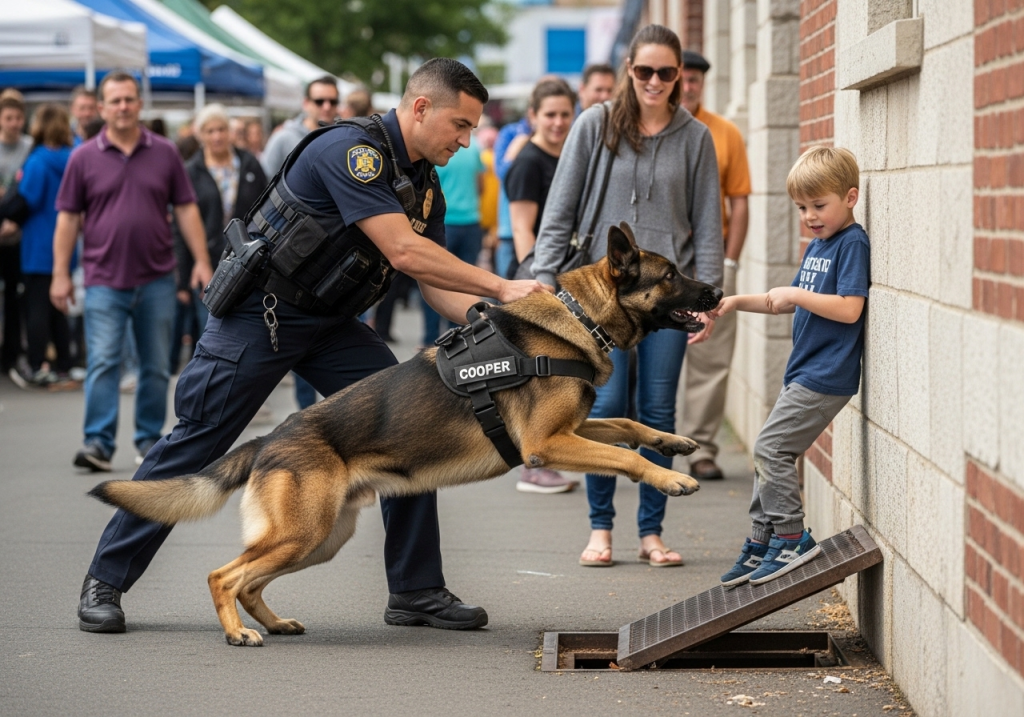
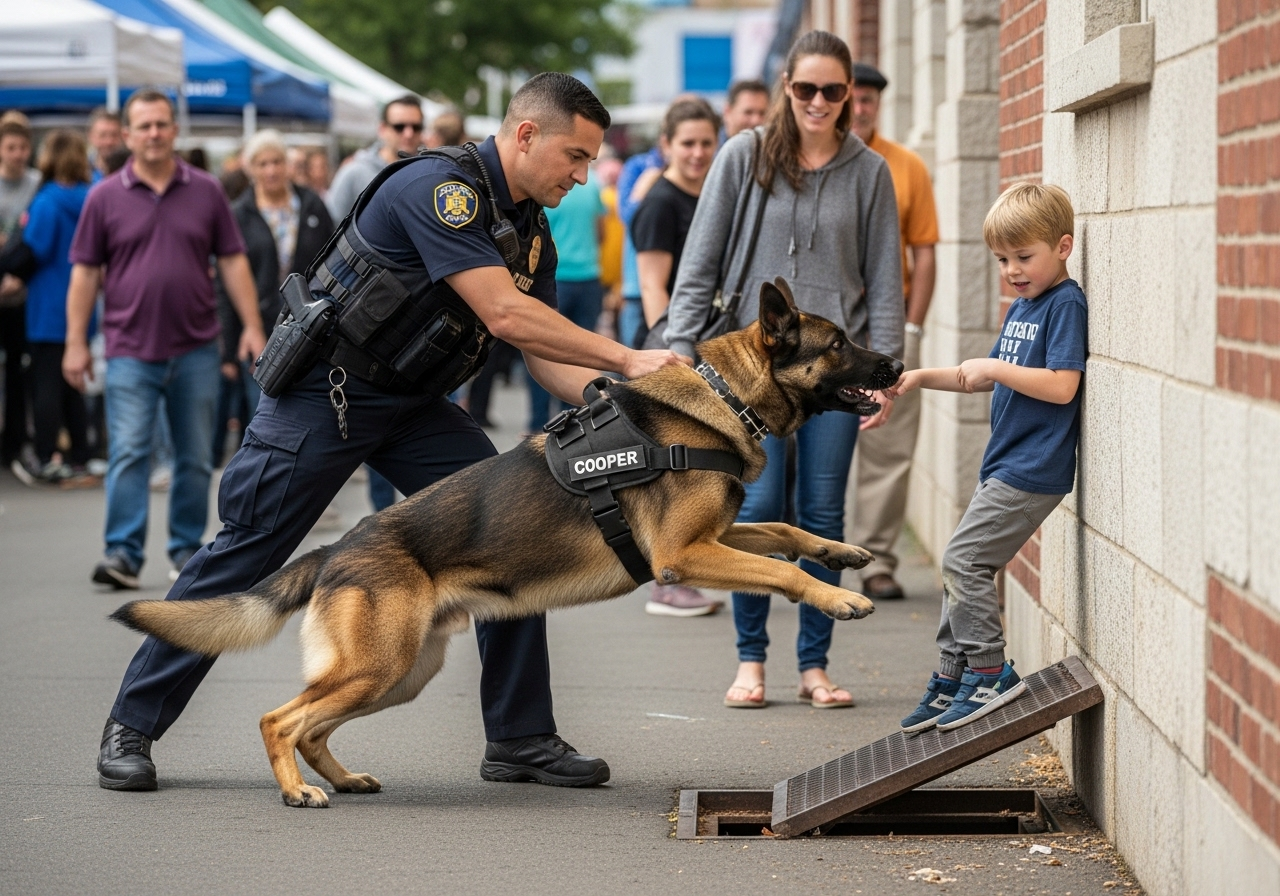
Cooper was a seventy-pound precision instrument of muscle and instinct. He had saved my life in back alleys in Detroit and tracked missing seniors through the dense woods of the Appalachian trail. He didn’t “glitch.” He didn’t lose his mind. But as I watched him lunge at the little boy in the bright red hoodie, my heart plummeted into my gut.
The boy, Leo, was backed against the old soot-stained brick of the Miller’s Bakery wall. He was small for his age, his eyes saucers of pure, unadulterated terror. Cooper wasn’t biting—not yet—but he was hovering inches from the kid’s throat, a low, gutteral rumble shaking his chest.
“Get that beast off him!” a man yelled from the crowd.
“He’s going to kill him! Someone call the police!”
I wanted to scream back that I was the police, but I was too busy trying to read the air. The crowd was a sea of pastel shirts and sun hats, people holding organic kale and artisan bread, now transformed into a panicked mob. Dozens of smartphones were already up, lenses pointed at us like miniature glass executioners.
“Jax, what the hell is he doing?!”
That was Dave, a rookie officer who’d been patrolling the perimeter. I saw him reach for his holster. His face was pale, his eyes darting between the dog and the screaming mother who was being restrained by two bystanders.
“Don’t draw, Dave! Stand down!” I commanded, my voice cracking with an urgency I couldn’t hide.
I stepped closer, my boots crunching on a dropped strawberry. The air felt heavy. Not just with the tension, but with something else—a faint, metallic scent I couldn’t quite place. Cooper’s ears were pinned back. He looked at me, just for a split second, and the look in his eyes wasn’t rage. It was a desperate, pleading intelligence.
He wasn’t looking at the boy’s throat. He was looking past him.
“Leo, honey, don’t move! Mommy’s here!” Sarah, the boy’s mother, was hysterical. She was a local kindergarten teacher, well-loved in the community. Seeing her child pinned by a “vicious” police dog was a nightmare being broadcast in real-time.
“Officer, shoot that dog or I will!” a man in a tactical vest shouted, reaching toward his own concealed carry.
The situation was spiraling. In the eyes of the public, this was a story of a broken K9 attacking an innocent child. In the eyes of the law, I was failing to control my weapon. But as I looked at the ground near Leo’s feet, I saw it.
Right behind the boy’s heels, hidden by the shadow of the bakery’s industrial trash bin and a pile of discarded crates, was a gaping black void. A circular sewer access cover had been removed for maintenance, but the crew must have been startled away or pulled into an emergency. It was a straight, twenty-foot drop into a concrete basin currently overflowing with high-pressure runoff from the morning’s flash floods.
But it wasn’t just the fall.
As I took another step, the smell hit me fully. It wasn’t just old water. It was the thick, rotten-egg stench of a massive natural gas leak. The boy was standing right over the vent. One more step back—just one—and he’d fall into a pocket of gas that would knock him unconscious before he even hit the water. Or worse, if he had any metal toy or a spark-producing gadget in his pocket, the whole corner of the market would become a crater.
“Cooper is holding him,” I whispered to myself, the realization chilling my blood.
The dog wasn’t attacking. He was using his body as a physical barrier. If Leo moved left, Cooper snarled and blocked him. If Leo tried to turn and run, Cooper lunged to keep him pinned against the safety of the solid brick wall.
“Dave, get the perimeter back! Now!” I yelled over the roar of the crowd. “There’s a gas leak! Tell everyone to put their phones away and move!”
“He’s biting the kid!” someone screamed from the back, completely ignoring me.
The crowd surged forward. Fear is a funny thing; it makes people brave in all the wrong ways. A man threw a heavy wooden crate at Cooper, hitting him in the ribs. Cooper whimpered, his hind legs buckling for a moment, but he didn’t move. He stayed locked in place, his snout inches from Leo, guarding the boy from the invisible death behind him.
“SHOOT THE DOG!” the man in the vest yelled, finally drawing his pistol.
I saw the barrel level. I saw Dave’s hand on his own Glock. I saw the mother collapse to her knees, her screams echoing off the buildings.
And I saw the first spark of a flickering pilot light from the bakery’s exterior vent, just three feet from the sewer opening.
“NO!” I lunged forward, not for the boy, but for my partner.
If they shot Cooper, the boy would fall. If the boy fell, he was dead. If I couldn’t stop that man from firing, the muzzle flash would ignite the air and we’d all be gone.
Everything slowed down. The smell of the market—the peaches, the honey, the popcorn—was replaced by the cold, biting scent of methane.
“Cooper, hold!” I roared.
The trigger finger of the man in the vest tightened.
Chapter 2
The world didn’t end with a bang, but with the terrifying, mechanical click of a safety being disengaged.
Mark, the man in the tactical vest, had the look of a man who had waited his entire life to be the hero of a story he didn’t understand. His knuckles were white, his stance was wide—the kind of posture you see at a shooting range, not in a crowded farmer’s market filled with the scent of organic honey and sun-warmed asphalt. He wasn’t a monster; he was worse. He was a terrified citizen convinced he was doing the right thing.
“Drop the dog, or I will!” Mark screamed. His voice was pitched high, cracking under the weight of his own adrenaline.
“Mark, put the gun down!” I roared, stepping into his line of sight.
I didn’t care about the badge on my belt or the procedure manual back at the precinct. All I saw was the glint of the sun on his barrel and the way it pointed directly at Cooper’s shoulder. If he fired, the bullet wouldn’t just kill my partner. At this range, with the angle of the brick wall and the open sewer grate behind Leo, that 9mm round would likely over-penetrate or ricochet. It would hit the boy. Or it would ignite the invisible cloud of methane currently swirling around Leo’s ankles like a ghostly shroud.
“He’s a police K9! He’s doing his job!” I yelled, my hands held out in a placating gesture, though every muscle in my body wanted to tackle Mark into a display of heirloom tomatoes.
“His job is to bite a kid?!” a woman in the crowd shrieked. “Look at him! He’s snarling!”
She wasn’t wrong. Cooper was a terrifying sight. His lips were pulled back, exposing ivory canines that could crush bone. His hackles were a jagged ridge of fur along his spine. He looked like a wolf from a nightmare, pinning a helpless lamb against the wall. But I knew Cooper. I knew the way his ears flicked toward the sewer opening every three seconds. I knew the way he kept shifting his weight to the left, physically nudging Leo away from the edge of the pit that the boy couldn’t see because of the crates.
“Leo, stay still!” I commanded, trying to keep my voice steady. “Leo, look at me, buddy. Don’t look at the dog. Look at Jax.”
The boy’s eyes shifted to mine. Tears were tracks of salt through the dust on his cheeks. He was hyperventilating, his small chest heaving under the red cotton of his hoodie. “He… he won’t let me move,” Leo sobbed.
“He’s keeping you safe, Leo. I promise. Just stay exactly where you are,” I said, my heart hammering against my ribs like a trapped bird.
I turned my head slightly, catching Dave’s eyes. My rookie partner was frozen, his hand hovering over his own weapon, his face a mask of indecision. He was twenty-three, three months out of the academy, and he had never seen a K9 go “rogue.”
“Dave,” I hissed. “The smell. Do you smell it?”
Dave blinked, sniffing the air. His eyes went wide. “Is that… rotten eggs?”
“Natural gas,” I said, loud enough for Mark to hear. “Mark, look at the bakery vent. Behind the boy. Look at the flickering pilot light.”
The man with the gun hesitated. His eyes darted to the right. Just three feet from the open sewer, an old industrial vent from Miller’s Bakery was clicking. A small, blue flame was struggling to stay lit in the wind, dancing dangerously close to the heavy, invisible vapor rising from the ground.
“If you fire that gun,” I said, my voice dropping to a low, deadly serious register, “the muzzle flash will act like a match in a room full of gasoline. You won’t just kill the dog. You’ll blow this entire corner of the block—and that little boy—to kingdom come. Put. It. Down.”
The silence that followed was heavy, broken only by the low, warning rumble in Cooper’s throat. The crowd, which had been a cacophony of outrage seconds ago, suddenly went still. They looked at the vent. They looked at the gaping black hole behind Leo’s heels. They looked at the dog.
Mark’s hands began to shake. The bravado drained out of his face, replaced by a hollow, sickening realization. He lowered the gun, his thumb fumbling to engage the safety.
“I… I didn’t know,” he whispered, his voice barely audible.
“Back away! Everyone, back away right now!” I took charge, my voice echoing off the brick facades. “Dave, call the Fire Department! Code Red. Gas leak, unsecured infrastructure. We need a perimeter of two hundred yards. Move!”
The panic shifted then. It wasn’t the chaotic, angry panic of a mob; it was the cold, sharp fear of an explosion. People began to scramble, dropping their grocery bags, the sound of glass jars shattering on the pavement punctuating the retreat.
But I couldn’t move. Neither could Cooper. And certainly not Leo.
“Sarah!” I called out to the mother. She was still on her knees, being held back by a woman in a sun hat. “Sarah, I’m going to get him. But I need you to stay quiet. If you scream, he might jump. If he jumps, he falls into the hole.”
Sarah nodded, her face a mask of agony, her hands over her mouth to stifle her sobs.
I began to crawl toward them. It was a slow, agonizing process. Every time I moved, the air shifted, bringing another waft of the nauseating gas. Cooper didn’t look at me. He was locked on the boy, his body a living shield.
“Good boy, Coop,” I whispered. “Good boy. Stay. Hold him.”
I reached the perimeter of the “kill zone.” The smell was overpowering now, making my eyes water and my throat itch. I could see the edge of the sewer grate. It wasn’t just a hole; it was a death trap. The heavy rains from the night before had turned the storm drain into a roaring flume of grey water, twenty feet below. If Leo fell, the current would sweep him into the subterranean network of the city before we could even get a rope down.
“Leo,” I said, reaching out a hand. “I’m going to grab your jacket, okay? On the count of three, I want you to jump toward me. Not back. Toward me.”
The boy looked at Cooper. The dog gave a short, sharp huff—not a growl, but a command. It was as if he was telling the boy, Listen to him.
“One,” I counted.
I saw a spark. The pilot light on the bakery wall flared as a gust of wind caught it. A small “whoosh” sound echoed in the vent. My skin crawled.
“Two.”
Cooper leaned in closer, his wet nose touching Leo’s cheek. It was the gentlest thing I’d ever seen, a stark contrast to the violence of his snarl only moments before. He was anchoring the boy, giving him a physical point of contact to lean on.
“Three! JUMP!”
I lunged forward, grabbing the scruff of Leo’s red hoodie. At the same instant, Cooper barked—a thunderous, deafening sound—and used his massive head to shove the boy toward my chest.
I tackled Leo, rolling backward onto the hard pavement, tucking the boy into my arms.
Clang.
The sound of metal on concrete. In the chaos of the jump, Leo’s sneaker had kicked one of the loose crates, sending it tumbling down into the dark void of the sewer. A second later, there was no splash—just the hollow, echoing thud of it hitting something deep and metallic. Then, a hiss. A real hiss, like a giant serpent.
“COOPER, OUT!” I screamed.
The dog didn’t hesitate. He lept away from the hole just as a gout of pressurized grey water and a foul-smelling mist erupted from the opening, like a geyser from hell.
I scrambled back, dragging Leo with me, until we were thirty feet away. Sarah broke free from the crowd and sprinted toward us, collapsing into a heap as she pulled her son from my arms. They were a tangle of limbs and salt-streaked faces, sobbing in the middle of the street.
I stayed on the ground, gasping for air that didn’t taste like chemicals.
Cooper walked over to me. He wasn’t the apex predator anymore. He was limping, his gait hitched from where the wooden crate had struck his ribs. He sat down heavily next to my shoulder and let out a long, shuddering sigh. He leaned his head against my arm, his fur damp with the mist from the sewer.
“You crazy son of a bitch,” I whispered, burying my hand in the thick fur of his neck. “You saved him.”
The fire trucks were screaming in the distance, their sirens a mournful wail that drew closer by the second. Dave was ushering the last of the bystanders away, his face etched with the shock of what had nearly happened.
But as I looked around, the warmth of the rescue began to fade, replaced by a cold, sinking feeling.
The man in the tactical vest, Mark, was gone. He had slipped away in the confusion. But the phones? The phones were still there.
I looked at a teenager standing near the police cruiser, his arm extended, his thumb tapping furiously at his screen. He wasn’t looking at the boy or the gas leak. He was looking at his recording.
“Did you see that?” the kid said to his friend, his voice buzzing with excitement. “The dog totally lost it. It looked like he was trying to rip the kid’s throat out. That’s gonna get a million views by dinner.”
“Hey!” I shouted, trying to stand up, but my knees were like jelly. “That dog just saved that boy’s life! Delete that! You didn’t see the whole thing!”
The teenager didn’t even look at me. He just turned and started walking away, his head down, already crafting the caption that would define our lives for the next forty-eight hours.
I looked down at Cooper. He was licking a small scratch on his paw, blissfully unaware of the digital storm gathering over his head. To him, the world was simple: there was a threat, and he had neutralized it. He didn’t know about “optics.” He didn’t know about “excessive force.” He didn’t know that to the world watching through a four-inch screen, he wasn’t a hero.
He was a liability.
By the time we got back to the K9 unit headquarters, the world had already decided who we were.
My captain, a man named Miller who had the personality of a cinder block and twice the grit, was waiting for me in the parking lot. He wasn’t holding a “Job well done” cigar. He was holding a tablet.
“Jax,” he said, his voice grim. “Tell me you have bodycam footage that looks better than this.”
He turned the screen toward me. It was a TikTok video, already watermarked with a dozen “Breaking News” logos. The angle was perfect—for a horror movie. It started right as Cooper lunged at Leo. It showed the bared teeth, the boy’s terrified face, and the crowd screaming in the background. It cut off right before I tackled the boy, and right before the gas geyser erupted.
The caption read: POLICE DOG ATTACKS CHILD AT FARMER’S MARKET. COPS DO NOTHING.
“It’s out of context, Cap,” I said, feeling a familiar heat rising in my neck. “There was a gas leak. The boy was inches from a twenty-foot drop into a flooded sewer. Cooper was blocking him. He saved that kid’s life.”
“I believe you,” Miller said, and for a second, I felt a spark of relief. Then he continued. “But the Mayor’s office just got three hundred calls in twenty minutes. The ‘Justice for Leo’ hashtag is trending. People are calling for Cooper to be put down, Jax. Tonight.”
The world went gray at the edges. “Put down? For what? For doing exactly what he was trained to do? He didn’t even break the skin, Cap! Not a scratch on the kid!”
“It doesn’t matter,” Miller sighed, looking at Cooper, who was currently sniffing a patch of clover near the precinct door. “In this climate, a K9 that triggers a public panic is a K9 we can’t afford to keep on the streets. Internal Affairs is already in my office. They want your statement, your logs, and they want Cooper moved to a holding kennel at the city pound. Pending investigation.”
“The pound?” I felt my voice rising. “He’s an officer of the law! He stays with me. That’s the rule.”
“The rule changed five minutes ago when the Governor’s wife retweeted the video,” Miller said, his eyes filled with a rare flash of sympathy. “I’m sorry, Jax. If you fight this right now, they’ll take your badge too. Go home. Let the dust settle. We’ll find a way to fix this.”
But as I looked at Cooper, who wagged his tail at the sound of his name, I knew better. I had seen this play out before. The public doesn’t want the truth; they want a sacrifice. They wanted a “dangerous animal” punished to make their world feel safe again.
I led Cooper toward my truck, my hands shaking as I opened the crate. He hopped in, circling twice before settling onto his sheepskin rug. He looked at me through the wire mesh, his brown eyes deep and trusting.
I didn’t go home.
I drove to a quiet park on the edge of town, the kind of place where the suburban sprawl gives way to the rolling hills of the Midwest. I sat on the tailgate of my truck, the engine ticking as it cooled, and watched the sun dip below the horizon.
My phone buzzed in my pocket. A text from Elena, my wife.
“Jax, don’t look at the comments. Please. Just come home. We’ll figure it out.”
But I did look. I couldn’t help it.
“That dog is a monster. Why do we even have them in our cities?” “The officer should be fired for letting that happen. Poor kid will be traumatized for life.” “Hope they put it out of its misery soon. Safety first.”
I threw the phone onto the passenger seat. My mind drifted back to three years ago, when Cooper and I were just starting out. I remembered a rainy night in a derelict warehouse district. We were tracking a suspect who had just robbed a convenience store at gunpoint.
The guy had hopped a fence and disappeared into a maze of shipping containers. I was young, arrogant, and I had outrun my backup. I turned a corner, and the suspect was there, waiting with a lengths of heavy rebar. He swung for my head. I didn’t even have time to draw my service weapon.
Cooper had been twenty yards behind, tracking a different scent trail, or so I thought. But he had sensed the shift in the air, the spike in my heart rate. He didn’t wait for a command. He launched himself through the air, taking the blow from the rebar on his shoulder so I didn’t have to take it on my skull. He pinned the man until the sirens arrived, never once letting go, even though his own leg was fractured in two places.
He had bled for me. He had nearly died for me. And now, because of a thirty-second video and a group of people who wouldn’t know courage if it bit them, I was supposed to hand him over to a concrete cell and a lethal injection.
“Not today,” I whispered to the empty park. “Not ever.”
I looked back into the crate. Cooper was asleep, his paws twitching as he chased something in his dreams. Probably a tennis ball. Or maybe he was back at the market, holding the line, being the hero that nobody wanted.
I started the truck. I wasn’t going to the precinct. And I wasn’t going to the city pound.
I had a friend, an old trainer named Silas who lived three hours north, deep in the woods where the Wi-Fi didn’t reach and the law was a suggestion. If I could get Cooper there, I could buy us some time. Time to find the evidence. Time to prove that the “horror in the sewer” was real.
As I pulled onto the highway, my headlights cutting through the gathering dark, I saw a black SUV pull out from the shadows of the park entrance. It didn’t have its lights on. It just trailed me, a silent shadow in the rearview mirror.
Internal Affairs? Or someone worse?
The gas leak at the market hadn’t been an accident. I knew it the moment I saw the “maintenance” crates. They were too clean. No city logo. No work order numbers. Someone had opened that grate on purpose. Someone had wanted that gas to build up.
And Cooper hadn’t just saved a boy. He had interrupted a crime.
I gripped the steering wheel until my knuckles popped. The viral video wasn’t the problem. It was the distraction. The world was busy hating a dog, while the real monsters were still out there, finishing what they started.
I pushed the accelerator down. The chase was on, but for the first time in my career, I wasn’t the one wearing the handcuffs. I was the one protecting the only witness who couldn’t testify in court.
A seventy-pound Belgian Malinois with a heart of gold and a target on his back.
Chapter 3
The interstate was a ribbon of wet asphalt cutting through the darkness of the Michigan wilderness. My knuckles were white against the steering wheel, the skin stretched so tight it felt like it might snap. Every few seconds, my eyes flicked to the rearview mirror. The black SUV was still there, maintaining a disciplined distance—exactly three car lengths back. They weren’t trying to pull me over. They weren’t using sirens. They were just there, a predatory shadow in the mist.
“Hang in there, Coop,” I muttered.
In the back, I heard the soft, rhythmic thumping of his tail against the crate. He was awake now, probably sensing the spike in my cortisol. K9s don’t just smell fear; they translate the very frequency of your soul. He knew we were in trouble.
My mind was a chaotic storm of images: the flickering pilot light, the pristine “maintenance” crates, the kid’s red hoodie, and that teenage boy’s face as he uploaded a death sentence to the internet. Something was deeply wrong. Oak Ridge was a quiet suburb, the kind of place where the biggest crime was usually a noise complaint or a teenager lifting a pack of cigarettes. A massive gas leak in the heart of the town square, during the busiest hour of the week, wasn’t just “infrastructure failure.” It was a setup.
But for what?
I took the exit for Highway 42, a winding, two-lane road that bled into the dense pine forests. The SUV followed, its headlights cutting through the fog like twin surgical lasers. I didn’t have much time. If I didn’t lose them soon, I’d be leading them straight to Silas, and Silas was too old to be caught in a crossfire.
I reached for my phone and dialed a number I hadn’t touched in years.
“Yeah?” The voice on the other end was like gravel being crushed in a tin can.
“Silas. It’s Jax.”
There was a long pause. I could hear the sound of a woodstove door creaking shut. “I saw the news, kid. You’re all over the ‘Live at Five’ segments. They’re saying your dog is a man-eater.”
“You know better than that,” I said, my voice tight. “He was blocking a gas leak. Someone opened a sewer grate and let it vent. Cooper saved a kid, and now the city wants to put him down to save face. I’m being followed, Silas. Black SUV. Professional.”
Another silence. Silas was a man who measured his words in ounces. “Take the logging road past the old mill. The one with the washed-out bridge. If you can clear the gap in that heavy truck of yours, they won’t follow in a suburban cruiser. I’ll leave the gate unlatched. And Jax?”
“Yeah?”
“If they get close, don’t shoot. Just drive. I don’t need the feds crawling over my acreage because you got trigger-happy.”
“Copy that.”
I slammed the phone into the cup holder and floored it. The Ford’s engine roared, the turbocharger whistling as it sucked in the cold night air. I saw the turn-off—a jagged break in the treeline marked by a rotted wooden sign. I dived into the trees, the truck bouncing violently as the tires hit the rutted dirt.
Behind me, the SUV lunged after me. They were bold, I’ll give them that.
The logging road was a graveyard of machinery and fallen branches. I pushed the truck to sixty, the back end fishtailing as I fought for traction. Ahead, the “bridge” appeared—a skeletal structure of rusted steel and loose timber spanning a fifteen-foot ravine. It was barely a bridge anymore; it was a dare.
I didn’t slow down. I felt Cooper’s crate shift in the back.
“Hold on, buddy!”
The truck hit the planks with a bone-jarring thwack. For a split second, we were weightless. The world was just the roar of the wind and the white glare of my headlights hitting the opposite bank. Then, gravity reclaimed us. The suspension bottomed out with a scream of tortured metal, but the tires bit into the mud on the far side.
I checked the mirror. The black SUV had slammed on its brakes at the edge of the ravine. A man stepped out—tall, wearing a tactical windbreaker, his face obscured by the shadows. He didn’t pull a gun. He just stood there, watching me disappear into the pines.
He wasn’t disappointed. He looked like a man who had already achieved his objective.
Silas’s cabin was a fortress of cedar and stone tucked into a valley that the sun only visited four hours a day. Silas himself was waiting on the porch, a 12-gauge shotgun resting casually across his knees. He was seventy, with skin like cured leather and eyes that had seen too many wars—both foreign and domestic. He had been the lead trainer for the state’s K9 program for thirty years before the politics drove him into the woods.
“Get him inside,” Silas commanded, not bothering with a greeting.
I opened the truck bed. Cooper hopped out, but as his front paws hit the ground, he let out a sharp, pained yelp. He scrambled to find his balance, his left side trembling.
“He’s hurt,” I said, the guilt hitting me like a physical blow. “A guy threw a crate at him at the market. He didn’t move. He stayed on the boy.”
We hurried into the cabin. The air inside smelled of pine resin, peppermint, and old dog. Silas pointed to a heavy rug in front of the hearth. “Lay him there. Jax, get the kit from the kitchen. The one marked with the red cross.”
For the next hour, we worked in a silence broken only by the crackle of the fire and Cooper’s heavy breathing. Silas’s hands were surprisingly steady as he palpated Cooper’s ribs.
“Two cracked,” Silas grunted. “Maybe three. He’s got internal bruising, but his lungs sound clear. He’s a tough bastard, Jax. Most dogs would have snapped at the person who threw that. He didn’t even growl at you, did he?”
“Never,” I said, sitting back on my heels. I looked at my hands; they were covered in Cooper’s fur and a bit of dried blood from a scratch on his leg. “He knew what was at stake. He knew that kid was a second away from dying.”
Silas walked over to an old wooden desk and turned on a laptop. The screen glowed, illuminating the deep wrinkles in his forehead. He tapped a few keys, and the viral video started playing—the same one that was ruining our lives.
“Look at the comments,” Silas said, his voice dripping with disdain. ” ‘Monster dog.’ ‘Aggressive breed.’ They’re calling for a ban on K9s in public spaces. Did you see who started the hashtag?”
I leaned in. The original post didn’t come from the teenager I saw. It had been shared and boosted by an account called Oak Ridge Safety First.
“It’s a PAC,” I whispered. “A political action committee.”
“Run by a man named Harrison Thorne,” Silas added. “He’s a real estate developer. He’s been trying to buy up the downtown district for a decade, but the local businesses—like Miller’s Bakery—wouldn’t budge. They have those old-school long-term leases.”
The pieces began to click together, forming a picture that made my blood run cold. “If there’s a massive gas leak—an ‘accident’ caused by ‘negligent city infrastructure’—the insurance premiums for those small shops skyrocket. Or worse, the city declares the buildings condemned for public safety.”
“And if a police dog ‘attacks’ a child during the incident?” Silas looked at me. “It creates a smokescreen. The news isn’t talking about why the sewer grate was open or why the gas was venting. They’re talking about the ‘dangerous dog.’ It’s a classic diversion. While the world is screaming at you and Cooper, Thorne is probably in the Mayor’s office right now, signing a redevelopment contract.”
I looked at Cooper. He was sleeping now, his head resting on Silas’s boots. He was a pawn in a game of millions of dollars, and his life was the collateral damage.
“I have to go back,” I said, standing up.
“You go back now, you’re getting arrested,” Silas warned. “IA has a warrant for ‘obstruction’ and ‘theft of city property.’ They’re calling Cooper ‘property,’ Jax. Don’t forget that.”
“I don’t care. Sarah—the boy’s mother—she’s the only one who can change the narrative. If she tells the truth about what happened, if she confirms there was a gas leak…”
“She’s scared, kid,” Silas interrupted. “I looked her up while you were cleaning the dog. She’s a single mom. Her kid almost died. Who do you think she’s going to listen to? The ‘rogue’ cop on the run, or the billionaire offering her a ‘trauma settlement’ to keep her mouth shut?”
I felt a wave of helplessness wash over me. In the movies, the hero always finds the smoking gun. In the real world, the smoking gun is usually buried under a pile of NDAs and legal fees.
I walked to the window, looking out into the dark forest. Somewhere out there, the man in the black SUV was waiting. He wasn’t just following me to find Cooper. He was following me to make sure I didn’t talk to anyone who mattered.
“I have a friend in the FD,” I said suddenly. “A fire inspector named Marcus. He was on the scene today. If there was a gas leak, he’d have the readings. He’d have the proof that the levels were lethal.”
“Then call him,” Silas said.
I reached for my phone, but as I turned it on, the screen exploded with notifications. Not just news—messages. Hundreds of them.
“We know where you are, Jax.” “Give up the dog and maybe you’ll keep your pension.” “The boy is in the hospital. He’s ‘traumatized.’ Hope you’re happy.”
And then, a video message from an unknown number.
I pressed play. It was a shaky, low-light shot of a suburban house. My house.
I saw Elena, my wife, walking from her car to the front door. She looked tired, her head down, her phone to her ear. In the shadows of the bushes, a man was watching her. He didn’t move, didn’t attack. He just filmed her, a silent threat captured in ten seconds of digital video.
The text below the video read: “The dog isn’t the only thing that can be ‘put down.’”
My breath hitched in my chest. I felt the room spinning. I had spent my career protecting people I didn’t know, and now, the woman I loved was in the crosshairs because I couldn’t let go of a dog.
“Jax?” Silas was at my side, his hand heavy on my shoulder. “What is it?”
I showed him the screen. Silas’s jaw tightened, a muscle jumping in his cheek. He looked at Cooper, then back at me.
“They’re coming for everything,” I whispered. “They don’t just want the dog. They want to bury the truth so deep no one ever finds it. If I don’t give them what they want…”
“If you give them what they want, they’ll kill the dog and then they’ll come for you anyway,” Silas said, his voice cold and hard as iron. “Witnesses don’t get happy endings in stories like this. You know that.”
I looked down at Cooper. He had woken up and was watching me, his tail giving one weak, hopeful wag. He didn’t know about the real estate deals. He didn’t know about the threats to Elena. He just knew that I was his person, and he was my partner.
“I’m not giving him up,” I said, my voice cracking but firm. “But I can’t stay here.”
“No,” Silas agreed. “You can’t. But you’re not going to your house either. That’s exactly what they want.”
“Then where do I go?”
Silas reached into his desk and pulled out a set of keys and a map. “There’s an old fishing camp on the North Shore. It’s registered to my brother who passed away five years ago. No one looks for dead men. You take my old truck—the beat-up Chevy out back. It’s got a canopy and no GPS. You take the dog. You stay off the main roads.”
“What about Elena?”
“I’ll handle Elena,” Silas said, and for the first time, I saw a flicker of the man he used to be—the man who ran covert K9 operations for the government. “I have friends who still owe me. She’ll be out of that house and in a safe zone before the sun comes up. You just focus on the proof, Jax. You find Marcus. You get those gas readings. And you don’t stop until you have enough to burn Harrison Thorne to the ground.”
I grabbed my gear, my heart heavy. I knelt down beside Cooper and whispered in his ear, “One more move, buddy. Just one more. I promise, I’m going to get us home.”
Cooper struggled to his feet, his breath hitching from the pain in his ribs, but he stood. He leaned his weight against my leg, a silent promise of his own.
As I drove the old Chevy out of Silas’s gate, I looked in the mirror one last time. Silas was standing on his porch, the shotgun back in his lap, a lone sentinel against the darkness.
I headed north, toward the lake, toward the truth. But as I drove, the radio began to play a local news update.
“…Police are reporting a break-in at the Oak Ridge Fire Department’s evidence locker. Several files and digital sensors related to this morning’s gas leak investigation have been reported stolen or destroyed. Authorities are seeking Officer Jax Miller for questioning in connection with the theft…”
They were already ahead of me. They weren’t just erasing the truth; they were pinning the eraser on me.
I gripped the steering wheel so hard I thought the plastic might crack. The viral video was just the beginning. The world hated Cooper. Now, the law hated me. We were two ghosts in a stolen truck, chasing a ghost of a chance.
But as I looked at the dog sitting in the passenger seat beside me, his head resting on the dashboard, I knew I couldn’t quit.
Because if the world was going to be this dark, it needed a beast like Cooper to keep the monsters at bay.
Chapter 4
The North Shore of Lake Michigan was a graveyard of jagged limestone and skeletal pines, a place where the wind didn’t just blow—it screamed. I sat in the cab of Silas’s rusted Chevy, the heater rattling like a box of nails, watching the grey expanse of the water churn under a bruised sky.
Beside me, Cooper was restless. His breathing was shallow, his ribs clearly paining him with every bump in the road. I had given him a dose of the canine anti-inflammatories Silas had packed, but they weren’t enough to dull the betrayal. He kept looking at the door, then at me, his ears twitching at every gust of wind. He was waiting for the command to go to work. He didn’t understand that he was a fugitive. He didn’t understand that the “work” now involved dodging the very people he had been trained to protect.
My phone buzzed. A private number.
“Jax?” It was Marcus, the fire inspector. His voice was a frantic whisper, shadowed by the sound of heavy rain. “Jax, where the hell are you? The precinct is crawling with feds, and Thorne’s people are everywhere. They’re saying you’re armed and dangerous.”
“I’m safe for now, Marcus. Did you get the readings?”
“I got more than that,” Marcus said, and I could hear his teeth chattering. “I went back into the sewer after the FD cleared the gas. They thought it was a leak from the main line, Jax. But it wasn’t. Someone had installed a bypass valve—a remote-detonated one. They weren’t just venting gas; they were pooling it. If that market hadn’t been interrupted, that entire corner of the city would have gone up in a chain reaction.”
My grip tightened on the wheel. “Interruptions like a six-year-old boy walking into the blast zone?”
“Exactly. The boy, Leo… he wandered off from his mom toward the crates. If he’d stepped on the grate, the weight would have triggered the secondary igniter. It was a pressure-plate system. Cooper didn’t just smell the gas, Jax. He smelled the explosives. He wasn’t pinning the kid to keep him from falling—he was pinning him to keep him from triggering the bomb.”
The air left my lungs in a cold rush. Cooper hadn’t just been a shield; he’d been a bomb technician. He had stood on the edge of an inferno, holding a child back with nothing but his teeth and his courage, while a mob screamed for his death.
“I have the data on a drive, Jax,” Marcus continued. “But I can’t get it to you. My house is watched. They’ve already wiped the city servers. If I try to upload this, they’ll kill the connection before it hits the cloud. You have to come to me. The old pier at the North Basin. Midnight. I’ll leave the drive in the tackle box by the bait shop.”
“Marcus, wait—”
The line went dead.
I looked at Cooper. “One last ride, buddy. One last time to show them who you really are.”
The drive back toward Oak Ridge felt like entering a war zone. I bypassed the main checkpoints, taking the service roads that cut through the industrial flats. The city was a glow of artificial light on the horizon, but it felt hollow, like a stage set waiting to be dismantled.
As I neared the North Basin, the rain began to fall in earnest—a cold, stinging deluge that turned the world into a blur of grey and black. I parked the Chevy half a mile from the pier, hiding it behind a row of abandoned shipping containers.
“Stay, Cooper,” I whispered, but as I opened the door, he pushed his way out. He limped, his left side stiff, but his eyes were clear and focused. He wasn’t staying. We were a team. We had always been a team.
We moved through the shadows of the docks, the scent of diesel and dead fish heavy in the air. The pier was a long, rotting finger of wood reaching out into the dark water. At the end sat the small, weathered bait shop, its windows boarded up for the season.
“Clear,” I signaled, though I knew it was a lie. The silence was too heavy.
I reached the tackle box. My fingers fumbled with the latch. Inside was a small, silver flash drive wrapped in a plastic baggie. I grabbed it, the cold metal feeling like a holy relic in my palm.
“Got it. Let’s move, Coop.”
I turned, but Cooper didn’t follow. He was standing at the edge of the pier, his nose high in the air, his hackles rising. A low, vibrating growl started in his chest.
“What is it?”
Then, the floodlights hit us.
Four black SUVs roared onto the gravel at the base of the pier, their headlights blinding. Men in tactical gear spilled out, weapons drawn. In the center of the formation stood Harrison Thorne, looking remarkably dry under a large black umbrella held by a subordinate.
“Officer Miller,” Thorne’s voice carried over the sound of the rain, amplified by a megaphone. “You’ve made this far more difficult than it needed to be. Give us the drive, and we can discuss a peaceful resolution.”
“A peaceful resolution?” I shouted back, my hand moving to my holster, though I knew I was outgunned ten to one. “You tried to blow up a city block for a real estate deal! You used a child as a trigger!”
“Collateral damage is a part of progress, Jax,” Thorne replied, his voice devoid of emotion. “The world has already decided that your dog is the villain. If you die here tonight, it will be reported as a tragic suicide-by-cop. A broken officer and his rabid beast, finally put to rest.”
“Cooper, HEEL,” I whispered.
The men began to advance. They weren’t cops. They were mercenaries, the kind of men who didn’t care about “optics.”
I had one chance.
“You want the drive?” I pulled my service weapon and aimed it not at the men, but at the gas tank of the vintage outboard motor leaning against the bait shop wall. “One spark, Thorne. We all go into the lake.”
The mercenaries hesitated. Thorne’s face twisted in rage. “Kill the dog first,” he commanded. “Make him watch.”
A laser dot appeared on Cooper’s chest.
I didn’t think. I didn’t plan. I lunged in front of my partner, my body a shield just as his had been for Leo.
CRACK.
The sound of the rifle shot was swallowed by the wind. I felt a searing heat tear through my shoulder, the force of the impact spinning me around. I hit the wet wood of the pier, the world turning into a kaleidoscope of pain and shadow.
“NO!” I gasped, trying to reach for my gun, but my arm wouldn’t obey.
Cooper didn’t wait. Despite the cracked ribs, despite the exhaustion, he became a blur of black and tan fur. He launched himself into the darkness, not toward the shooters, but toward the shadows behind the bait shop.
He had sensed the flank.
I heard screams. Not the screams of a child, but the raw, guttural cries of men who had never faced a Belgian Malinois in the dark. Cooper was a ghost, a whirlwind of teeth and fury, striking and disappearing before they could level their weapons.
I dragged myself toward the edge of the pier, my blood mixing with the rainwater. I saw a figure approaching me—Thorne himself, stepping over my fallen gun.
“It’s over, Jax,” he said, reaching for the drive in my hand. “Nobody is coming to save you.”
But Thorne was wrong.
From the darkness of the parking lot, a new set of sirens erupted. Not the high-pitched wail of the police, but the deep, rhythmic roar of fire engines.
Marcus hadn’t just left the drive. He had called in the only people who still believed in the truth. The Oak Ridge Fire Department, forty men strong, swept into the basin, their massive trucks ramming through the mercenaries’ SUVs.
“Drop the weapon!” Dave’s voice cracked over a loudspeaker. My rookie partner was there, leading a line of patrol cars that had broken ranks with the precinct’s orders.
In the chaos, Thorne turned to run, but he didn’t get far.
Cooper emerged from the shadows. He didn’t bite. He didn’t snarl. He simply stood in Thorne’s path, his chest heaving, his eyes fixed on the man’s throat. Thorne froze, the umbrella falling from his hand as he stared into the face of the “monster” he had created.
Thorne collapsed to his knees, his hands in the air, as Dave and Marcus swarmed the pier.
Two Months Later
The sun was warm on the back of my neck as I sat on the porch of our new home, far from the concrete and shadows of Oak Ridge. My shoulder still ached when the weather changed, a permanent reminder of the night the world went dark.
Inside the house, I could hear Elena laughing as she talked to Sarah on the phone. Leo was doing well. He still had nightmares, but he had a new hero now. He sent Cooper a drawing every week—pictures of a big brown dog wearing a cape.
The “Justice for Cooper” fund had raised enough money to pay for his surgeries and then some. The viral video had been replaced by a new one: the bodycam footage Marcus had recovered, showing the moment Cooper shoved Leo away from the pressure plate. It had been viewed fifty million times. The world didn’t hate Cooper anymore. They wanted to buy him a steak.
But Cooper didn’t care about the fame.
He was lying at my feet, his muzzle beginning to show the first flecks of grey. He was officially retired, his badge framed on the wall inside, next to my own. We were both out of the job, but for the first time in ten years, I could breathe.
I looked down at him. “Hey, Coop.”
His tail gave a slow, rhythmic thump-thump against the wooden floorboards.
I reached down and scratched that spot behind his ears that always made him lean into me. He let out a long, contented sigh and closed his eyes.
The crowd in the market had shouted for the police to shoot him. They had seen a beast because they were afraid. They had seen a monster because it was easier than seeing the truth.
But as I watched my partner sleep, safe and whole, I knew the truth.
The world is a dangerous place, full of open sewers and hidden sparks. But as long as there are hearts like Cooper’s, there is a chance for the rest of us to make it home.
He wasn’t just a dog. He wasn’t just a weapon.
He was the thin, furry line between us and the dark.
And he was, beyond any shadow of a doubt, a very good boy.
END