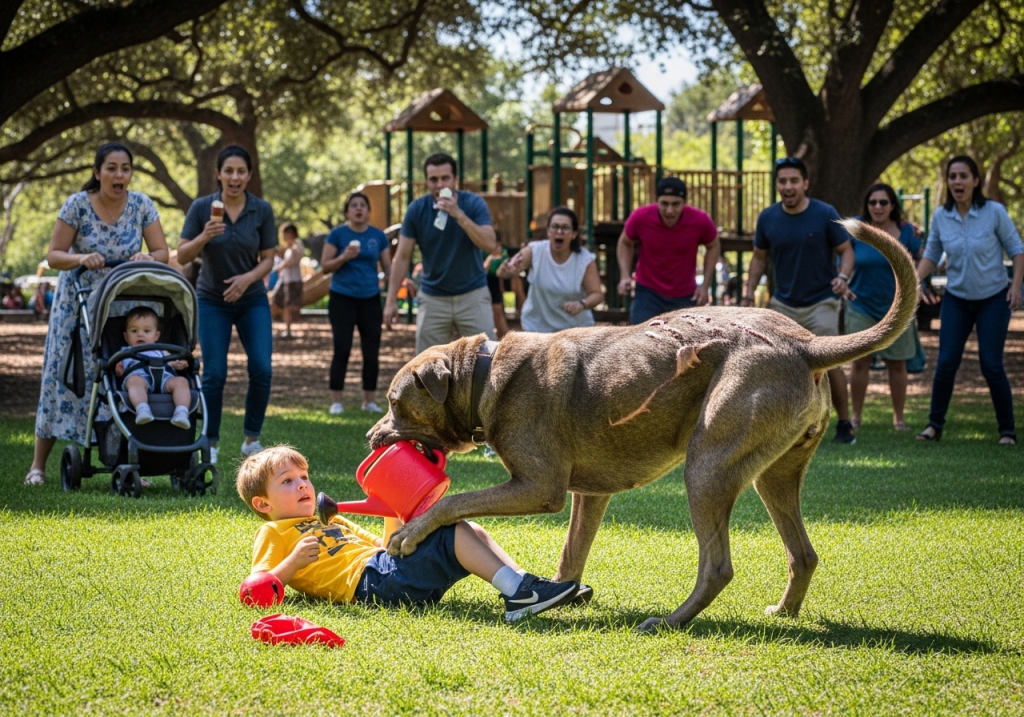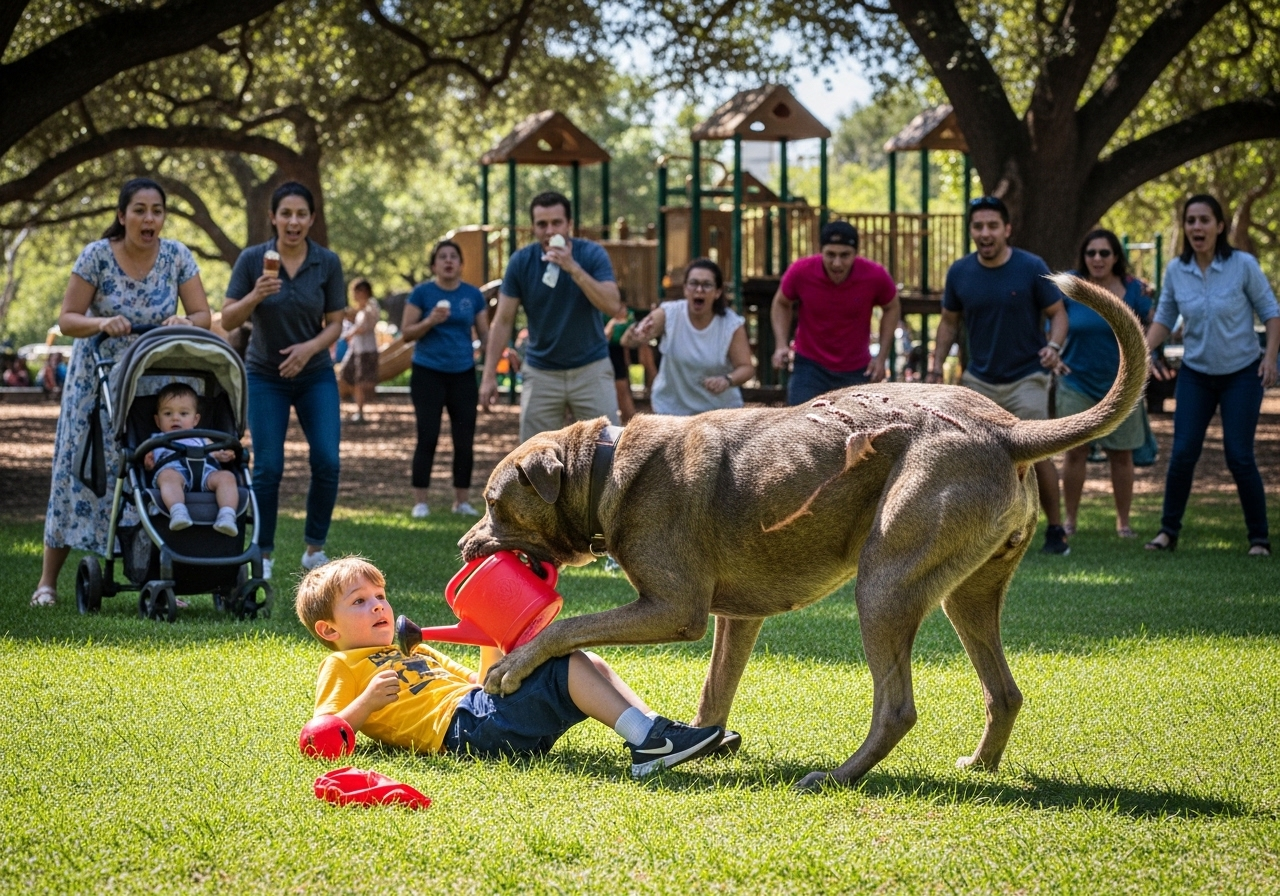
“Somebody get a gun! Get that monster off him!”
The scream shattered the perfect Saturday afternoon. It was the kind of raw, throat-tearing shriek that makes your blood freeze in your veins.
I turned around, dropping my $6 iced coffee onto the blazing hot pavement of Oak Creek Park. My heart didn’t just drop; it stopped entirely.
Fifty yards away, near the edge of the tall grass by the community picnic tables, a massive, muscular, scarred dog had my six-year-old son, Leo, pinned flat to the ground.
I couldn’t breathe. I couldn’t form words. My legs moved before my brain could process the nightmare unfolding in front of me.
“Leo!” I screamed, the sound tearing from my chest like broken glass.
It had been exactly eight months since my husband, Mark, passed away. Cancer doesn’t care if you’re only thirty-two. It doesn’t care if you have a little boy who just learned how to ride a bike without training wheels. It just takes.
Since the funeral, Leo had completely retreated into himself. My sweet, bubbly, loud little boy had gone entirely mute. The child psychologist called it selective mutism triggered by profound grief. I just called it a broken heart. I was a single mother, drowning in medical debt, trying to hold together the shattered pieces of our lives in a picturesque Ohio suburb where all the other moms seemed to have perfect marriages and perfect golden retrievers.
Coming to the park today was supposed to be a victory. It was the first time in weeks I had convinced Leo to leave his bedroom. He had been quietly collecting acorns near the oak trees, wearing his oversized red hoodie—the one that used to belong to his dad.
And now, a beast was on top of him.
As I sprinted across the manicured lawn, the world blurred. The dog was a terrifying mix of breeds—part pit bull, part mastiff maybe. It was covered in dirt, its ribs showing through a patchy brown coat, and a thick, jagged scar ran down the side of its snout. It looked like a dog that had fought for every single day of its miserable life on the streets.
And its massive chest was pressed directly against my fragile, sixty-pound son.
A crowd was already swarming. This is America, so of course, half the people had their phones out, recording the tragedy for social media rather than stepping in. But a few men were rushing forward.
Greg, a local guy who lived two doors down from me—a man who was always too loud, too aggressive, and loved to play the neighborhood hero—got there first.
“I got him, Sarah! I got the bastard!” Greg roared.
He lunged, grabbing the thick scruff of the stray dog’s neck. He yanked backward with all of his two-hundred-pound weight.
Any normal dog would have snapped. Any aggressive dog would have turned its jaws on Greg, or worse, clamped down on Leo in the panic.
But this dog didn’t.
Instead, it let out a sound I will never, ever forget. It wasn’t a snarl. It wasn’t a growl. It was a high-pitched, desperate whine. A cry of pure distress.
Greg yanked again, cursing violently. “Help me pull this freak off the kid!” he yelled to another father running up.
“Don’t hurt him! Just get him off!” I sobbed, finally reaching the edge of the circle. I dropped to my knees, reaching desperately for Leo’s arm. “Leo! Mommy’s here, baby, Mommy’s here!”
Leo wasn’t crying. His eyes were wide, fixed on the dog’s face just inches from his own.
The second man arrived, grabbing the dog’s hindquarters. They were stretching the animal, pulling it with enough force to dislocate its joints.
The dog screamed—a terrible, very human-like scream of pain.
But it refused to move its front paws. It dug its chipped nails into the Ohio dirt, locking its elbows tight. It was taking the physical abuse, allowing these grown men to tear at its flesh, but it would not uncover my son.
“Kick him, Greg! Kick his ribs!” a woman in the crowd shrieked. It was Mrs. Gable, the HOA president, clutching her pristine toy poodle to her chest. “It’s going to kill the boy!”
Greg drew his heavy construction boot back. His face was red, sweating, contorted in rage. He was aiming squarely for the dog’s exposed stomach.
“No! Stop!” I screamed, but my voice was lost in the chaos.
The dog looked at me.
I swear to you, in that fraction of a second, the world went dead silent. The dog’s amber eyes locked onto mine. They weren’t the eyes of a killer. They were wide, terrified, and pleading. It was looking at me the way a mother looks at a doctor when they hand over a sick child.
I’m trying, the eyes seemed to say. I’m trying to hold on.
Greg’s boot was swinging forward. The death blow was coming.
And that’s when Leo, who hadn’t spoken a single word in eight torturous months, suddenly pushed his small hand against the dog’s scarred cheek and screamed at the top of his lungs.
“STOP! HE’S HOLDING IT DOWN!”
The sheer shock of hearing Leo’s voice made Greg freeze. His boot stopped inches from the dog’s ribs. The crowd went dead silent. The only sound was the rustling of the oak leaves in the summer breeze.
“Holding what down, buddy?” I choked out, crawling frantically toward them.
The dog, trembling violently, bleeding from where Greg’s fingernails had dug into its neck, slowly shifted its weight just an inch to the right.
A collective gasp ripped through the crowd. Mrs. Gable dropped her phone. Greg stumbled backward, his face draining of all color, suddenly looking like he was going to vomit.
There, trapped firmly beneath the dog’s heavy, scarred front paw, less than three inches from where my son’s face had been resting in the grass, was the thick, coiled, diamond-patterned body of a massive Timber Rattlesnake.
Chapter 2: The Weight of a Miracle
The silence that followed Leo’s scream wasn’t just quiet; it was heavy. It was the kind of silence that rings in your ears like a flashbang had gone off. For a heartbeat, the only thing I could hear was the frantic, thumping rhythm of my own pulse against my eardrums.
Greg was still frozen in his mid-swing, his heavy boot hovering inches from the dog’s ribcage. His face, which had been a mask of righteous fury just seconds ago, was now a pale, sweating canvas of pure horror. He looked down at the grass, at the thick, scaly coil of the Timber Rattlesnake pinned beneath the dog’s mangled paw, and he made a small, pathetic sound in the back of his throat.
The snake was massive—at least four feet of thick, muscular diamond-back, its head flattened and triangular, its lidless eyes fixed on the dog’s leg with murderous intent. Its rattle was vibrating so fast it was just a blur of tan and grey, making a sound like dry cicadas in a midsummer heatwave. But it couldn’t strike. The dog had it pinned just behind the head with surgical precision, a feat of instinct that seemed impossible for a creature so battered and broken.
“Move,” I whispered, though I’m not sure who I was talking to. “Everyone, move back!”
The crowd, which had been pressing in like a pack of hungry wolves, suddenly recoiled. People tripped over their own feet, scrambling away from the edge of the tall grass. Mrs. Gable let out a strangled yelp and retreated toward the parking lot, her poodle tucked under her arm like a football.
“Greg, get back!” I yelled, finally finding my voice.
Greg didn’t move. He was staring at the dog’s neck—at the deep, bloody gouges his own fingernails had left in the animal’s skin when he’d tried to rip it away. He looked at his hands, then at the snake, and finally at my son.
Leo was still on the ground, his small body framed by the dog’s legs. He wasn’t shaking. He wasn’t crying. He was looking at the dog with a level of intensity I hadn’t seen in him since the day we buried his father. His hand was still resting on the dog’s scarred flank.
“Leo, honey, come to Mommy. Slowly,” I breathed, reaching out my hand. My fingers were trembling so violently I had to tuck them into my palm.
The dog didn’t look at me this time. It was focused entirely on the snake. Its entire body was vibrating—not with aggression, but with the sheer effort of holding down a creature that was pure, undulating muscle. I could see the dog’s breathing; it was shallow, ragged, and wet.
Suddenly, the snake made a violent lunge, trying to twist its body free. The dog let out a sharp, pained whimper and shifted its weight, pressing down harder. In that movement, I saw it.
On the dog’s left foreleg, just above the paw that held the snake captive, were two neat, oozing punctures. The fur around them was already beginning to mat with dark, thickened blood.
My heart did a slow, sickening somersault. He’d already been bitten. He wasn’t just protecting Leo; he was dying for him.
“Officer! Over here!” someone shouted.
Two local police officers, who had been patrolling the far end of the park for the weekend festival, came sprinting across the grass. One was a younger man, his brow furrowed in confusion, but the older one—a man named Officer Miller with a face like a crumpled road map—took one look at the scene and drew his sidearm.
“Don’t shoot the dog!” I screamed, throwing myself in front of Leo. “He’s holding a snake! Look at the grass! Don’t shoot him!”
Miller skidded to a halt, his eyes darting from me to the dog to the rattling tail in the grass. He swore under his breath, a low, guttural string of words that didn’t sound at all like the “protect and serve” manual.
“Everyone back up! Now!” Miller barked at the lingering crowd. He looked at Greg. “Greg, get out of the way before you get bit or I taser you. Move!”
Greg stumbled back, tripping over a stray acorn and falling onto his backside. He didn’t even try to get up; he just crawled away on his hands and knees, his eyes never leaving the dog.
Miller approached slowly, his gun holstered now, replaced by a long, telescopic baton he used for animal control calls. He looked at the dog. “Easy, big guy. Easy.”
The dog’s eyes were starting to glaze over. The venom was already working, attacking its nervous system. Its head began to droop, its snout dipping toward the grass.
“Leo, now! Come to me!” I lunged forward, grabbing Leo under the armpits and hauling him back.
Leo didn’t resist, but he didn’t look at me either. “He’s sick, Mommy,” he said. His voice was small, rusty from months of disuse, but it was the most beautiful sound I had ever heard in my life. “The doggy is sick because of the bad noodle.”
I pulled Leo into my chest, burying my face in his hair, sobbing into his red hoodie. I held him so tight I was afraid I’d bruise him, but I couldn’t stop. He was alive. He was talking. And it was all because of a monster that everyone wanted to kill.
Officer Miller acted with the cold efficiency of a man who had grown up on a farm. He waited for the exact moment the snake tried to lash out again, and with one swift, brutal strike of his baton, he crushed the serpent’s head against the hard-packed Ohio clay.
The rattle stopped instantly. The silence returned, but this time, it was broken by the sound of the dog collapsing.
It didn’t fall over gracefully. It just… let go. Its legs gave out, and it slumped into the dirt, its chest heaving in great, agonizing gulps. The snake, now a limp cord of scales, lay beneath its paw.
“Is it dead?” someone whispered from the crowd.
“The snake is,” Miller said, wiping his brow. He looked down at the dog. The animal was lying on its side now, its tongue lolling out of the side of its mouth. The swelling in its leg was already visible, the skin puffing up like a dark, bruised balloon.
I stood up, holding Leo’s hand. I looked at the dog, then at the crowd. The people who had been screaming for its blood were now murmuring in hushed, guilty tones. Greg was standing by a tree, his face buried in his hands.
“We need to get him to a vet,” I said. My voice was surprisingly steady.
“Sarah,” Miller said softly, stepping toward me. “It’s a stray. A pit-mix stray with a rattlesnake bite… the antivenom alone is going to cost three, maybe four thousand dollars. That’s if he even survives the trip.”
I looked at Miller. I knew what he was saying. He knew my situation. He knew about the mountain of bills on my kitchen table, the “Final Notice” stickers on my mailbox, the way I’d been skipping meals to make sure Leo had new shoes for school. He was telling me to let it go. To let the dog die “humanely” right there in the dirt.
“He saved my son,” I said.
“I know he did,” Miller replied, his voice full of a pity that made me want to scream. “But look at him. He’s a mess. Even before the bite, he was half-starved. He’s covered in old scars. This dog has been a fighter his whole life. Maybe… maybe this is just his time to stop fighting.”
I felt Leo’s grip tighten on my hand. He looked up at me, his eyes brimming with tears. “Mommy, Daddy said heroes don’t leave people behind.”
The mention of Mark hit me like a physical blow to the stomach. Mark, who had spent his last months in a hospital bed, still trying to crack jokes to make Leo laugh. Mark, who had fought until his very last breath, not because he was afraid of death, but because he didn’t want to leave us alone.
I looked back at the dog. He was looking at us. Even through the haze of the venom, his eyes were searching for Leo.
“I’m not leaving him,” I said to Miller. “Where’s the nearest emergency vet?”
“The 24-hour clinic is over on 5th,” Miller said, sighing. He reached into his pocket and pulled out his keys. “My cruiser is right there. I’ll drive you. But Sarah… be prepared.”
I didn’t need to be prepared. I’d been living in a state of ‘prepared’ for a year. I was prepared for the worst; what I wasn’t prepared for was giving up on the only thing that had brought my son back to me.
As Miller and another bystander—a young guy who looked like a college student—carefully lifted the heavy dog onto a mover’s tarp, the crowd parted like the Red Sea. They watched in silence as we carried the dying hero toward the black-and-white police car.
Greg stepped forward as we passed. “Sarah, I… I didn’t know. I thought—”
“I know what you thought, Greg,” I said, not even looking at him. “You thought he was a monster because he looked like one. But the only thing scary in this park today was us.”
We slid into the back seat of the cruiser, Leo sitting right next to the dog’s head. As Miller flipped on the lights—no sirens, just the silent, spinning blues—Leo reached out and stroked the dog’s tattered ear.
“It’s okay, Buddy,” Leo whispered. “We’re going to the place that fixes heroes.”
The dog let out a long, shuddering breath, and for the first time, his tail gave one, tiny, weak thump against the vinyl seat.
The waiting room of the Tri-County Veterinary Emergency Center smelled of industrial lavender and underlying anxiety. It was 4:00 PM on a Saturday, and the place was humming with the minor tragedies of suburban life—a golden retriever with a torn dewclaw, a cat that had eaten a lily, a frantic teenager holding a box with a stunned sparrow.
But when we burst through the double doors, followed by a uniformed police officer carrying a bloody, unconscious mastiff-mix on a tarp, the room went dead.
“Rattlesnake bite!” Miller shouted over the counter. “Multiple punctures. He’s crashing.”
The staff moved with a synchronized urgency that reminded me of the ICU where Mark had spent his final days. A tall, silver-haired woman in green scrubs—Dr. Aris, according to her badge—vaulted over the low swinging door of the reception area.
“Get him to Room 4! I need a tox screen and two vials of CroFab immediately!” she barked.
They whisked the dog away, his limp tail disappearing behind the heavy steel doors.
Leo and I were left standing in the center of the lobby, covered in dirt, sweat, and the dog’s blood. My hands were still shaking. I looked down at Leo, expecting him to collapse, to retreat back into his shell. But he just walked over to one of the plastic chairs, sat down, and folded his hands in his lap.
“He’s going to be okay, Mommy,” he said. It wasn’t a question. It was a statement of fact.
I sat down next to him, pulling him into my side. “We don’t know that, Leo. He’s very sick.”
“He stayed for me,” Leo replied, looking at the steel doors. “The snake was gonna get my ankle. He saw it from the bushes. He ran so fast, Mommy. He didn’t even bark. He just… got him.”
I closed my eyes, picturing the scene. This dog, a stray that had likely been kicked, shot at, and chased away from every porch in the county, had seen a little boy in danger and didn’t hesitate. He hadn’t asked if we were “dog people.” He hadn’t asked if we had a backyard or a brand of expensive kibble. He just saw a life worth saving and decided his own was a fair trade.
An hour passed. Then two.
Officer Miller stayed for a while, bringing us two lukewarm cups of water from the cooler and a pack of crackers for Leo. He patted my shoulder before he left to go file his report.
“I put it in the log as a public safety intervention,” he whispered. “Maybe the city will pick up some of the cost. I can’t promise anything, Sarah, but… I’ll try.”
“Thank you, Miller,” I said, though I knew the city of Oak Creek didn’t have a “hero dog” fund.
Around 7:00 PM, Dr. Aris came out. She looked exhausted. She was wiping her hands on a paper towel, her expression unreadable.
“Are you the owners?” she asked.
“No,” I said, then paused. I looked at Leo. “We’re… we’re the ones he saved.”
Dr. Aris pulled up a chair across from us. She didn’t offer a smile, which terrified me. “He’s a miracle, I’ll give him that. The snake was a mature Timber Rattler. The amount of venom he took would have killed a human in under an hour. Because of his size and his… well, his stubbornness, he’s still with us.”
I felt a massive weight lift off my chest, but Dr. Aris wasn’t finished.
“We’ve stabilized him, but the necrosis in the leg is significant. He’s going to need round-the-clock monitoring for the next forty-eight hours. He needs more antivenom, blood thinners, and a lot of wound care. He’s also severely malnourished, has an old fracture in his hip that never healed right, and he’s heartworm positive.”
She sighed, looking at the clipboard in her hand. “The initial bill, including the antivenom we’ve already administered, is currently at $4,200. To get him through the weekend… you’re looking at another three to five thousand.”
She looked up at me, her eyes kind but professional. “I know he saved your son. I heard the story from the officer. But I have to ask… what do you want to do? We can make him comfortable, and we can… we can end it peacefully. No one would blame you.”
The numbers felt like physical blows. Nine thousand dollars. That was my rent for a year. That was Leo’s college fund—the tiny, pathetic one I’d managed to save from my waitressing tips. That was the money I needed to fix the leaking roof before winter hit.
I looked at Leo. He was watching me, his eyes wide and trusting. He wasn’t thinking about rent or roofs or “Final Notice” stickers. He was thinking about his friend.
Then, I thought about the crowd at the park. I thought about the phones recording, the screams of “monster,” and the way that dog had looked at me while Greg was trying to break his ribs.
He had taken the hits. He had taken the venom. He had taken the hate of an entire neighborhood, all to keep a silent little boy safe.
How do you put a price on that?
“Fix him,” I said.
Dr. Aris blinked. “Ms. Cooper, I don’t think you understand. This is a lot of money for a dog that might still have permanent mobility issues—”
“I don’t care,” I said, my voice cracking but firm. “He didn’t check my bank account before he jumped on that snake. He just did it. So, you do your job. Fix him. I’ll figure out the rest.”
Dr. Aris stared at me for a long moment. Then, for the first time, a small, genuine smile touched her lips. “Okay. We’ll keep fighting if he does.”
As she walked away, I felt a hand on my arm. I turned to see an older couple who had been sitting in the corner with a carrier. The woman was dabbing her eyes with a tissue.
“We heard,” the woman whispered. “Our grandson is about your boy’s age. If that dog… if he did that…”
She reached into her purse, pulled out a checkbook, and scribbled something down. She tore out the leaf and pressed it into my hand.
“It’s not much,” she said. “But heroes shouldn’t have to worry about the bill.”
I looked down at the check. It was for five hundred dollars.
“I can’t take this,” I stammered.
“Yes, you can,” the husband said, his voice gruff. “In this world, Sarah, you have to reward the good ones. Otherwise, they stop coming around.”
They walked away before I could say anything else. I sat there, clutching the piece of paper, feeling the first spark of something I hadn’t felt in a very long time.
Hope.
But as the night deepened and the reality of the situation set in, I realized that the battle at the park was only the beginning. The snake was dead, but the “monsters” of the suburbs—the gossip, the fear, and the cold reality of money—were still very much alive.
And they were coming for us.
Chapter 3: The Trial of Public Opinion
The morning sun in Oak Creek didn’t feel warm; it felt invasive. It cut through the thin polyester curtains of our rented two-bedroom cottage, highlighting the dust motes dancing in the air and the stack of medical bills on the kitchen island that I’d been ignoring for months.
I woke up at 6:00 AM, my neck stiff from sleeping on the floor next to Leo’s bed. He hadn’t wanted to sleep alone. For the first time in eight months, he hadn’t just stared at the ceiling in silence; he had asked me to tell him stories about his dad. Then, he’d fallen asleep clutching a plastic dog figurine he’d found at the bottom of his toy chest.
My phone, which I’d left on the nightstand, was vibrating so hard it was buzzing against the wood. I picked it up, expecting another “Final Notice” call from the hospital’s billing department.
Instead, I had 147 notifications from Facebook.
Someone—likely the girl in the sundress who’d been standing near the picnic tables—had uploaded a video. It wasn’t just a clip; it was a high-definition, three-minute journey into the heart of our nightmare. The caption read: “MONSTER OR MIRACLE? You won’t believe what this stray did to a 6-year-old boy in Oak Creek Park today.”
I watched it with my stomach in my throat. The video started with the dog already on top of Leo. From that angle, it looked horrifying. You couldn’t see the snake. You only saw a massive, scarred, dirty beast pinning a tiny, screaming child to the dirt. You heard Greg’s roar: “Get that monster off him!” You heard my own shrill, panicked screams.
But then, the video caught the moment of truth. It caught the dog’s eyes—those wide, amber pools of pure terror and devotion. It caught the moment Leo screamed, “STOP!” and the camera zoomed in, shaky and blurred, on the mangled head of the rattlesnake beneath the dog’s paw.
The comments section was a battlefield.
- User123: “This is why we shouldn’t judge! That dog is a literal angel. Look at his face!”
- SafetyFirstMom: “I don’t care what it ‘saved’ him from. That breed is unstable. If it can pin a child like that, it’s a danger to the community. What if it decides to ‘save’ someone else next week by mauling them?”
- RealTalkOhio: “The HOA needs to step in. Stray pit-mixes shouldn’t be roaming our parks. This was a fluke. The dog was probably trying to kill the snake for food and the kid got in the way.”
I threw the phone onto the bed. My hands were shaking. In a world where everything is content, my son’s brush with death had become a debate topic for people who didn’t even know his middle name.
“Mommy?”
Leo was sitting up, rubbing his eyes. His hair was a mess of blonde tangles. “Is Buddy okay?”
“We’re going to go check on him right now, honey,” I said, forcing a smile that felt like it was cracking my face. “Let’s get dressed.”
The drive to the vet was quiet. The silence in the car used to be heavy and suffocating, but today, it felt different. It felt like we were both holding our breath, waiting for the other shoe to drop.
As we pulled into the parking lot of the emergency clinic, I saw a black SUV parked near the entrance with a local news logo on the side: Channel 5 News – Serving Greater Cleveland.
“Oh, no,” I whispered.
A man in a sharp navy suit and a woman holding a large shoulder-mounted camera were standing near the doors. As soon as they saw my beat-up 2014 Ford Focus, they started moving.
“Ms. Cooper? Sarah Cooper?” The reporter shouted, thrusting a foam-covered microphone toward my window as I tried to step out. “I’m Ben Miller from Channel 5. Can you tell us about the ‘Hero of Oak Creek’? Is it true the dog is being euthanized because of the medical costs?”
I shielded Leo with my body, pushing through them. “I have no comment. Please, my son is six years old. Just let us through.”
“The community is divided, Sarah!” Ben called after me, his voice professional and relentless. “The Oak Creek HOA just released a statement regarding ‘Vicious Animal Ordinances’ in the park. Do you have a response?”
I froze at the door. “Vicious Animal Ordinances?”
Ben nodded, sensing an opening. “They’re claiming the dog—regardless of the snake—violated the safety codes of the park. They’re saying that since he has no owner, he’s a liability and should have been ‘neutralized’ on-site.”
The word neutralized made my blood run cold. It was a sterile, suburban word for killed.
I didn’t answer. I pulled Leo into the clinic and the heavy glass doors hissed shut behind us, cutting off the noise of the world.
Dr. Aris was in the hallway, looking at a digital chart. When she saw us, her expression softened, but the dark circles under her eyes told me it had been a long night.
“How is he?” I asked, my heart hammering.
“He’s a fighter, Sarah. I’ll give him that,” she said, gesturing for us to follow her to the ICU ward. “The second round of antivenom stabilized his heart rate. The swelling in the leg is still bad, and we’re worried about the tissue damage, but he’s awake.”
She opened the door to a small, sterile room. There, in a large stainless steel kennel lined with soft grey blankets, sat the “monster.”
He looked smaller than he had in the park. Without the adrenaline of the fight, he looked like what he truly was: a tired, broken soul. His left front leg was wrapped in thick white gauze, and an IV line was taped to his other paw. A plastic “cone of shame” was around his neck, making him look slightly ridiculous, which somehow made the whole thing more heartbreaking.
The moment he saw Leo, something incredible happened.
The dog didn’t bark. He didn’t even stand up—he couldn’t. But his tail, that thick, scarred tail, hit the bottom of the metal kennel. Thump. Thump. Thump.
“Buddy!” Leo cried out. He ran to the cage, pressing his small face against the bars.
The dog leaned forward, as far as the IV would allow, and licked Leo’s nose through the wire.
I stood back, watching them. Tears pricked my eyes. Eight months. For eight months, I had tried everything to get Leo to engage with the world. I’d bought him every toy, taken him to every specialist, begged him to just be there with me. And all it took was a stray dog with a rattlesnake bite to bring my boy back from the dead.
“He’s not a ‘Buddy,’” Leo whispered, turning back to me. “Mommy, his name isn’t Buddy.”
“No?” I asked, kneeling beside him. “What do you think his name is?”
Leo looked back at the dog, his eyes searching the animal’s face. “He looks like a Copper. Like the pennies Daddy used to put in the jar.”
I looked at the dog’s coat—the dusty, brownish-red hue that was now visible under the fluorescent lights. “Copper. I like that.”
“Copper it is,” Dr. Aris said softly. She checked the IV drip. “But Sarah… we need to talk about the ‘liability’ issue. Officer Miller called me this morning. The HOA is putting pressure on the police department. They’re saying that because the dog has no proof of rabies vaccination and because he’s a ‘bully breed mix,’ he has to be held in quarantine for ten days. After that…”
“After that, what?” I asked.
“If no one claims him, and if he’s deemed a public safety risk, the county animal control is required to take him. And in this county… dogs like him don’t usually make it out of the shelter.”
I looked at Copper. He was resting his chin on Leo’s hand, his eyes closing in a moment of pure, unadulterated peace.
“I’ll claim him,” I said.
Dr. Aris sighed. “Sarah, your bill is already at six thousand dollars. To officially adopt him, you have to prove you can provide a safe environment. The HOA in your neighborhood has a strict ‘no-pit-bull’ policy. If you bring him home, they could evict you. You’re renting, right?”
“I don’t care,” I said, though my voice lacked the confidence I wanted. “I’ll find a way.”
The “way” started to crumble the moment I got home.
As I pulled into the driveway, I saw a white envelope taped to my front door. It wasn’t a bill. It was a formal notice from the Oak Creek Homeowners Association.
NOTICE OF VIOLATION Property: 422 Maple Lane Tenant: Sarah Cooper Violation: Possession or harboring of a prohibited animal. Public endangerment. Action Required: You are hereby notified that the presence of the ‘vicious animal’ involved in the August 14th incident is strictly prohibited on this property. Failure to comply will result in immediate termination of the lease agreement.
I crumpled the paper in my hand. They hadn’t even waited for the dog to leave the hospital.
“Is that a letter from Daddy?” Leo asked, watching me from the car.
“No, baby,” I said, stuffing the paper into my pocket. “Just more junk mail.”
I spent the next four hours on the phone. I called the HOA office, only to be told that the president, Mrs. Gable, was “unavailable.” I called the police department, but Officer Miller was off duty. I called legal aid, but they told me that as a tenant in a private HOA, my rights were limited when it came to breed-specific legislation.
By 3:00 PM, I was sitting at my kitchen table, my head in my hands. The GoFundMe I’d started had raised $1,200—a drop in the bucket compared to the rising vet bills and the potential legal costs.
A knock at the door startled me.
I opened it to find a woman I didn’t recognize. She looked to be in her late fifties, wearing a sensible linen suit and holding a leather briefcase. Behind her, leaning against the railing of my porch, was Ben Miller, the reporter from Channel 5.
“Ms. Cooper?” the woman said. “My name is Elena Vance. I’m an attorney with the Animal Legal Defense Fund. And this is Mr. Miller, who I believe you’ve met.”
“I told you I have no comment,” I said, starting to close the door.
“Wait,” Elena said, placing a gentle hand on the doorframe. “I’m not here for a soundbite, Sarah. I’m here because I saw the video. And I’m here because I think you should know who that dog really is.”
I paused, my heart skip-beating. “What do you mean, who he is?”
Elena looked at Ben, who nodded. He pulled out a tablet and showed me a photo. It was grainy, taken from a security camera in a neighboring town about twenty miles away.
In the photo, a man in a camouflage jacket was walking down a sidewalk. Beside him, leaning against his leg, was a younger, healthier version of Copper. He wasn’t scarred then. His coat was shiny, and he was wearing a bright red harness.
“That’s Thomas Reed,” Elena said. “He was a Marine sergeant. Served three tours in Iraq. He suffered from severe PTSD. That dog—whose name was actually ‘Sarge’—was his unofficial service animal. He wasn’t professionally trained, but he was all Thomas had.”
I stared at the photo. “What happened?”
“Thomas passed away three months ago,” Ben took over, his voice dropping the reporter’s edge and becoming human. “Overdose. It happens too often with our vets. When the landlord found him, the dog refused to leave the body. The animal control officers had to use a catch-pole to get him out. He was sent to the county shelter, but he was so traumatized he was labeled ‘unadoptable’ and ‘aggressive.’ He escaped from the transport van on the way to be put down.”
I looked at the screen, tears blurring the image of the dog.
“He’s been living in the woods near the park for months,” Elena continued. “Waiting for someone. Looking for someone. When he saw Leo… he didn’t just see a kid. He saw a mission. He saw a reason to keep fighting.”
I leaned against the doorframe, the weight of the story crashing down on me. This dog wasn’t just a stray. He was a veteran. He was a survivor of a different kind of war, just like we were.
“The HOA wants him dead, Sarah,” Elena said, her voice turning sharp. “And they have the law on their side right now. But if we can prove his history, if we can show he was a service animal in training, we can fight the ‘vicious animal’ label. We can save him. But I need you to be the face of it. I need you to let Ben tell the real story.”
I looked toward the living room, where Leo was sitting on the rug, coloring a picture of a red dog with a golden heart.
“If I do this,” I whispered, “they’ll come after us. Mrs. Gable, the neighbors… they’ll make our lives miserable.”
“They’re already doing that, Sarah,” Ben said softly. “The question is, are you going to let them win?”
I thought about the “Final Notice” on the fridge. I thought about the empty chair at the dinner table where Mark used to sit. I thought about the way Copper had looked at me in the park—that silent plea for trust.
“What do we do first?” I asked.
The “Real Story” aired that night at 6:00 PM.
Ben Miller did a masterful job. He spliced the footage of the park incident with the photos of Sergeant Thomas Reed. He interviewed a veteran’s advocate who talked about the bond between soldiers and their dogs. He interviewed Dr. Aris, who spoke about Copper’s injuries and his calm temperament.
And then, he showed a clip of me.
I was sitting on my porch, holding Leo’s hand. I looked tired. I looked like a woman who had lost everything and was clinging to the last shred of a miracle.
“This dog didn’t see a ‘prohibited breed’ or a ‘liability’ when he looked at my son,” I said on camera, my voice trembling but clear. “He saw a life. And he chose to save it. If we can’t find room for a hero like that in our neighborhood, then what kind of community are we really?”
By 8:00 PM, the GoFundMe had jumped to $15,000.
By 10:00 PM, a hashtag was trending on Twitter: #SaveCopper.
But as the world rallied around us, the local backlash grew even more vicious.
I was woken up at midnight by a loud thud on the porch. I jumped out of bed, my heart racing, and grabbed the heavy flashlight I kept under the bed.
I crept to the front door and peered through the window.
Someone had spray-painted the front of my house. In jagged, angry red letters, the word “DANGER” was splashed across my white siding. A bag of trash had been ripped open and scattered across the lawn.
In the distance, I saw the taillights of a car speeding away.
I stood there in the dark, shivering. The internet loved a hero, but the people living next door were terrified of change. They were terrified of anything that didn’t fit into their manicured, HOA-approved lives.
My phone buzzed. A text from an unknown number.
“Move out while you still can, Sarah. We don’t want that killer in Oak Creek. If the dog comes back, it won’t be a snake that finishes him.”
I gripped the phone so hard my knuckles turned white.
I looked at the “DANGER” sign on my home. I looked at the dark street where my neighbors—the people I’d waved to at the mailbox for years—were hiding behind their locked doors, judging us.
“We aren’t moving,” I whispered to the empty room. “And he’s coming home.”
The next forty-eight hours were a blur of legal maneuvers and media circus.
Elena Vance filed an emergency injunction to stop the county from seizing Copper. She used his history with Sergeant Reed to argue for “Service Animal” status, which would bypass the HOA’s breed restrictions.
The HOA responded by hiring their own high-priced attorney, arguing that “past service” didn’t excuse “present danger.” They scheduled an emergency community meeting at the town hall for Thursday night.
The fate of Copper—and our future in the only home Leo had ever known—was going to be decided in front of the entire town.
On Wednesday afternoon, I went back to the vet to pick up Copper. He had been cleared for “home-based recovery,” provided he remained in a secure area.
As I walked into the clinic, the staff wasn’t just working; they were cheering. The waiting room was filled with flowers, bags of high-end dog food, and “Get Well” cards from all over the country.
“He’s ready for you,” Dr. Aris said, her eyes bright.
When they brought him out, he was walking—limping, but walking. The gauze on his leg was clean, and he looked like he’d been given a dozen baths. His coat was soft, and he smelled like medicated shampoo and hope.
Leo ran to him, and Copper let out a low, happy “woo-woo” sound that made everyone in the room laugh.
“Come on, Copper,” I said, clipping a new, sturdy blue leash to his collar. “Let’s go home.”
As we walked out to the car, a group of about twenty people were standing on the sidewalk. I braced myself for more “Danger” signs.
But they weren’t protesters.
They were veterans. Some were in uniform, others in tattered jackets with unit patches. They stood in a silent line, and as Copper passed, an older man in a “Vietnam Vets” cap snapped a crisp salute.
“Welcome home, Sergeant,” the man whispered.
I felt a lump the size of a baseball in my throat. I helped Copper into the back seat, where Leo was already waiting with a brand-new blanket.
As we drove back into Oak Creek, the atmosphere shifted. The “DANGER” graffiti was still on my house—I hadn’t had time to scrub it off—and several neighbors were standing on their lawns, arms crossed, watching us with cold, hard eyes.
Mrs. Gable was there, standing on her porch with a clipboard, looking like a queen surveying a conquered territory. She didn’t say a word, but the way she looked at Copper—with pure, unadulterated disgust—spoke volumes.
I led Copper into the house. He walked through the rooms slowly, sniffing every corner, his tail wagging tentatively. When he reached Mark’s old leather recliner, he paused. He sniffed the cushion, then looked up at me with an expression of profound recognition.
He didn’t jump on it. He simply laid down at the base of the chair, rested his head on his paws, and let out a long, contented sigh.
He knew. He knew he was in a house of grief, but he also knew he was in a house of love.
“We have to go to the meeting tomorrow night, don’t we?” Leo asked, sitting on the floor next to the dog.
“Yes, baby,” I said, looking at the two of them. “We have to tell them the truth.”
“What if they don’t like the truth?”
I looked at the graffiti on the wall, then at the dog who had taken a rattlesnake’s venom for a child he didn’t know.
“Then we’ll make them hear it anyway.”
But as I tucked Leo into bed that night, I couldn’t shake the feeling that the most dangerous part of this journey wasn’t the snake in the grass. It was the people who believed that safety was more important than soul.
And they were waiting for us in the town hall.
Chapter 4: The Sound of a Beating Heart
The morning of the town hall meeting, the air in Oak Creek was thick and humid, the kind of heavy Ohio summer day where the sky looks like a bruised plum. I spent three hours on my hands and knees in the driveway, scrubbing at the red “DANGER” graffiti with a bucket of bleach and a wire brush. My knuckles were raw, bleeding slightly into the soapy water, but I couldn’t stop. I wouldn’t let Leo see that word one more time.
Every time a car drove past, I felt their eyes. Some slowed down, the drivers staring with a mix of pity and morbid curiosity. Others sped up, their tires kicking up gravel as if they were afraid the “viciousness” of my house might jump onto their pristine SUVs.
Inside, Copper was lying on the rug by the front door. He didn’t pace. He didn’t bark at the passing cars. He just watched me through the screen door, his amber eyes following my every movement. He looked like a gargoyle carved from weathered stone—still, silent, and immensely protective.
“Mommy, why are you washing the house?” Leo asked, stepping out onto the porch. He was wearing his favorite shirt—a faded blue one with a rocket ship that Mark had bought him at a museum gift shop three years ago.
“Just cleaning up, baby,” I said, wiping my forehead with the back of my hand, leaving a streak of grey grit. “Go back inside and keep Copper company. It’s hot out here.”
“Mrs. Gable is looking at us,” Leo whispered.
I looked across the street. Mrs. Gable was standing in her flower bed, pruning her prize-winning hydrangeas with a pair of silver shears that glinted in the sun. She wasn’t even pretending to work. She was staring straight at me, her face a mask of pinched, suburban righteousness. When she saw me look up, she didn’t flinch. She just turned back to her flowers and clipped a bloom with a sharp, final snip.
I knew what that snip meant. It meant she thought she had already won.
The Oak Creek Town Hall was a colonial-style building with white pillars and a manicured lawn that looked like it had been trimmed with a pair of nail scissors. By 6:30 PM, the parking lot was overflowing. There were news vans with satellite dishes, police cruisers, and hundreds of residents carrying signs.
Some signs said: OUR CHILDREN’S SAFETY FIRST. Others said: HEROES HAVE NO BREED.
The atmosphere was electric, humming with the kind of tension that usually precedes a riot or a revival. As I pulled my Focus into a spot near the back, I felt a hand on my window. It was Elena Vance.
“Are you ready?” she asked, her eyes sharp behind her glasses. She was holding a thick accordion folder of legal documents.
“I’m terrified,” I admitted.
“Good,” she said. “Use that. People don’t listen to statistics, Sarah. They listen to hearts. And right now, yours is the only one in that room that isn’t made of stone or red tape.”
Leo was in the back seat, sitting next to Copper. Under the emergency injunction Elena had secured, Copper was legally allowed to accompany us as a “Service Animal in Training” under the ADA, pending the final hearing. He was wearing a sturdy new harness, and I’d spent an hour brushing his coat until it shone like an old copper penny.
“Leo, remember what we talked about,” I said, turning around. “Stay close to me. Don’t let go of Copper’s leash.”
“I won’t, Mommy. He’s my partner,” Leo said. His voice was steady—stronger than it had been in months.
As we walked toward the entrance, the crowd parted. It was a sea of faces I had known for years. My grocery store cashier. My mail carrier. The parents from Leo’s preschool. Some looked away, ashamed. Others glared.
“Look at that thing,” I heard a voice hiss. “It’s a ticking time bomb.”
Copper didn’t react. He walked with a slight limp, his head held level with Leo’s shoulder. He didn’t sniff the ground. He didn’t growl. He just walked, his presence commanding a strange, heavy sort of respect.
The meeting room was packed. The air conditioning was struggling against the heat of three hundred bodies. At the front of the room, behind a long mahogany dais, sat the Board of the Oak Creek HOA and a representative from the County Animal Control. Mrs. Gable sat in the center, her hands folded neatly on a stack of papers.
“This meeting of the Oak Creek Homeowners Association will now come to order,” Mrs. Gable said, her voice amplified by a microphone that gave it a metallic, shrill edge. “The agenda for tonight is simple: The permanent removal of a public safety hazard from our community and the enforcement of Article 4, Section 2 of our bylaws regarding prohibited breeds.”
She looked directly at me. “Ms. Cooper, you have been invited here to show cause why the animal currently in your possession should not be seized and destroyed by the county.”
Destroyed. The word hit me like a physical punch.
For the next forty-five minutes, I had to sit there and listen as my neighbors stood up to testify against a dog they didn’t know.
First was Greg. He stood up, looking uncomfortable in a suit that was too tight around the neck. “Look, I’m the one who was there,” he said, gesturing vaguely. “I saw it. The dog had the kid pinned. It was… it was primal. Yeah, there was a snake. I get that. But what happens next time when there isn’t a snake? What if a kid just runs too fast or drops a ball? This dog is a fighter. You can see it in the scars. You can’t train that out of them.”
Then came Mrs. Gable’s sister, a woman who lived three streets over. “I have a three-month-old grandson. I can’t even take him to the park anymore without looking over my shoulder. We moved to Oak Creek for peace of mind. If we allow this ‘hero’ narrative to bypass our safety laws, we’re opening the door to chaos. Property values will plummet. Families will leave.”
On and on it went. They talked about “bite force statistics,” “unpredictable temperaments,” and “liability insurance.” They spoke about Copper as if he were a defective piece of machinery, a broken appliance that needed to be hauled to the dump.
Copper sat perfectly still at Leo’s feet. He didn’t move a muscle, even when people pointed at him and raised their voices. He was the calmest person in the room.
Finally, Mrs. Gable tapped her gavel. “Ms. Cooper, your counsel may speak.”
Elena stood up, her voice cool and professional. She laid out the facts of Sergeant Thomas Reed’s life. She showed the photos of Sarge—Copper—serving as a lifeline for a man who had seen the worst of humanity. She spoke about the legal protections for service animals and the fact that Copper had no history of unprovoked aggression.
“The only thing this dog is guilty of,” Elena concluded, “is being more courageous than the humans in this room.”
A few people in the back clapped, but Mrs. Gable quickly silenced them. “The history of a previous owner is irrelevant to the current danger. Does the Board have any further questions?”
“I do,” I said, standing up. My legs felt like jelly, but I forced myself to walk to the podium.
The room went silent. I could hear the hum of the overhead lights.
“I’m not a lawyer,” I started, my voice cracking. I cleared my throat and tried again. “And I’m not a dog expert. I’m just a mother. And for the last eight months, I haven’t really been a mother. I’ve been a ghost. I lost my husband to cancer last November.”
I looked out at the crowd. I saw a few women lower their heads.
“When Mark died, he took my son’s voice with him. Leo stopped talking. He stopped playing. He stopped… being a little boy. I watched him fade away right in front of me, and there was nothing I could do. No doctor, no therapist, no amount of love could reach him.”
I looked down at Leo, who was watching me with wide, serious eyes. He reached out and stroked Copper’s head.
“Then we went to the park. And a ‘monster’ jumped on my son. I was one of you. I was screaming. I wanted that dog dead. I thought my nightmare had finally reached its end.”
I took a deep breath, the air in the room feeling thinner. “But while we were all screaming and recording videos and looking for stones to throw, that dog was taking a death sentence for a child he didn’t know. He stayed. He stayed when Greg was pulling his neck. He stayed when people were threatening to kick him. He stayed when the venom was already in his blood.”
I turned to Mrs. Gable. “You talk about property values. You talk about ‘peace of mind.’ But what about the value of a life? What about the peace of mind of a six-year-old who finally feels safe enough to speak again?”
“Ms. Cooper, please stick to the—” Mrs. Gable started.
“No,” I interrupted, my voice growing stronger. “You want to know if he’s a danger? Look at him. He’s been in this room for an hour. People have yelled at him, insulted him, and called for his death. Has he growled? Has he bared his teeth?”
I looked back at the crowd. “We spend so much time building fences and writing rules to keep the ‘bad’ out. But in doing that, we’ve forgotten how to recognize the good. This dog isn’t a liability. He’s a reminder of who we’re supposed to be. He’s a soldier who never stopped serving. He’s a hero who doesn’t need a medal.”
I felt a tug on my skirt. Leo had stood up and walked to the podium. He had to stand on his tiptoes to reach the microphone.
The room was so quiet you could hear the ticking of the clock on the back wall.
“He’s not a bad dog,” Leo whispered into the mic. His voice was small, but it echoed in the rafters. “He’s my friend. And my Daddy sent him to watch me because he couldn’t stay.”
A sob broke out from somewhere in the middle of the room. A woman—the same one who had talked about her grandson—was crying into her hands.
Mrs. Gable looked uncomfortable. She cleared her throat, her face tightening. “Emotional appeals do not supersede the law, Leo. We have a responsibility to the entire community.”
“Then I have something you should see,” a voice boomed from the back.
Everyone turned. Standing in the doorway was a man I recognized from the vet’s office—the veteran in the Vietnam cap. Behind him were ten other men and women, all wearing hats or jackets that marked them as veterans.
The man walked down the aisle, his boots thumping on the carpet. He held out a folded piece of paper.
“My name is Commander Robert Halloway, VFW Post 422,” he said. “We spent the last forty-eight hours doing some digging into Sergeant Reed’s records. It turns out, Sarge—this dog here—wasn’t just an ‘unofficial’ service animal.”
He handed the paper to Mrs. Gable. “Those are the registration papers from a program in North Carolina that trains dogs for veterans with combat-related PTSD. Sarge graduated top of his class. He was a certified Service Animal before Sergeant Reed fell through the cracks of the VA system. Under Federal law, you can’t touch him. And under the laws of common decency, you shouldn’t want to.”
Mrs. Gable took the papers, her eyes scanning them quickly. Her face went from pale to a mottled, angry red. She looked at the other board members. They were whispering frantically among themselves. One of them—a younger man who had been silent the whole time—leaned over and said something into the microphone.
“I move that we drop the charges and grant a permanent waiver for the animal known as Copper,” the man said.
“I second that,” another board member added immediately.
Mrs. Gable looked like she wanted to scream. She looked at the veterans. She looked at the cameras. She looked at me and Leo. She knew she was beaten. If she fought this now, she wouldn’t just be the neighborhood “enforcer”—she would be the woman who tried to kill a veteran’s service dog on the evening news.
She didn’t even look at the crowd. She just slammed her gavel down one last time.
“Motion carried. The meeting is adjourned.”
The walk out of the town hall was a blur. People were reaching out to pet Copper, to shake my hand, to apologize. Even Greg came up, looking down at his shoes.
“I’m sorry, Sarah,” he mumbled. “I… I just didn’t see it. I’ll come over this weekend and help you get that paint off your house.”
“Thanks, Greg,” I said. And I meant it. In Oak Creek, that was as close to a miracle as you could get.
As we reached the car, the air had cooled. The storm had passed, leaving the world smelling of rain and fresh earth. The moon was beginning to peek through the clouds, casting a silver light over the parking lot.
We drove home in a comfortable silence. Leo fell asleep halfway there, his head resting on Copper’s flank. The dog sat tall, his ears perked, watching the road ahead as if he were still on duty.
When we pulled into the driveway, I didn’t go inside right away. I sat in the car, watching the lights of the neighborhood. The “DANGER” sign was still there, but in the dark, you couldn’t see the red paint. You only saw the house—the home where my husband had lived, where my son was growing up, and where a hero was finally going to rest.
I helped Leo inside and tucked him into bed. Copper followed us, his claws clicking softly on the hardwood. He waited for me to finish before he walked over to the side of Leo’s bed and laid down.
I went into the kitchen and sat at the table. I looked at the stack of bills. They were still there. My life was still hard. I was still a widow with a mountain of debt and a leaky roof. Copper’s medical bills would take me years to pay off.
But then, I heard it.
Through the baby monitor I still kept in Leo’s room, I heard a soft, rhythmic sound.
Thump. Thump. Thump.
It was Copper’s tail, hitting the floor in his sleep.
And then, I heard Leo’s voice, a soft mumble from the depths of his dreams. “Goodnight, Copper. Goodnight, Daddy.”
I leaned back in the chair and let out a breath I felt like I’d been holding since the day Mark died. The silence in the house wasn’t empty anymore. It was full. It was vibrant. It was alive.
We had all wanted to pull the dog away. We had all wanted to destroy the thing we didn’t understand. But in the end, the “monster” hadn’t just saved Leo’s life.
He had saved mine, too.
I walked to the front door and looked out at the street. The lights were on in the houses. People were going about their lives, safe in their routines. They would probably never understand the bond between a broken boy and a scarred dog. They would never understand that sometimes, the things we fear the most are the only things that can fix us.
I reached out and turned off the porch light.
“Welcome home, Sergeant,” I whispered.
And in the darkness of the hallway, a pair of amber eyes caught the moonlight, watching over us with a love that didn’t need a pedigree.
THE END