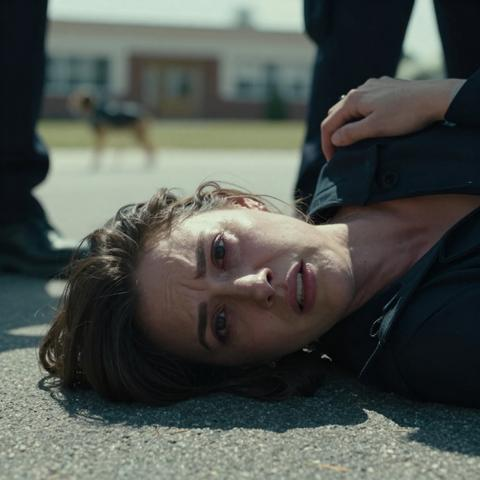
The asphalt of the Oak Creek Elementary parking lot was radiating the brutal, suffocating midday heat of early September, the kind of heat that makes the horizon shimmer and distorts the edges of reality. But in that exact fraction of a second, I felt absolutely nothing but a cold, paralyzing terror. My heart stopped. The world stopped. Everything ceased to exist except the massive, muscular frame of a police K9 standing directly on top of my seven-year-old son.
To understand how a community outreach event turned into the defining nightmare of my life, you have to understand Oak Creek. This is the kind of affluent American suburb where danger is treated as an abstract concept, something that happens to other people in other zip codes. We live in a bubble of manicured lawns, neighborhood watch apps, and security theater. Our biggest daily conflicts involve PTA politics and navigating the line of luxury SUVs in the school drop-off zone. We don’t experience actual violence. We just endlessly prepare for it.
That was the entire point of the assembly. It was billed as a ‘Community Safety and Awareness Drill.’ Following a string of unsettling news reports from across the country, the school board decided that what our children really needed to feel secure was a display of law enforcement presence. They wanted to show the parents that Oak Creek was fortified, protected, and impenetrable.
The morning had started with mundane perfection. I remember waking Leo up. He is a quiet, fragile boy, prone to asthma and crippling shyness. He doesn’t command a room; he blends into it. While other boys his age were obsessed with superheroes or sports, Leo loved history and old things. Just three weeks prior, I had taken him to an estate sale a few towns over. While I was browsing mid-century furniture, Leo had found a vintage, heavy-duty olive green canvas backpack. It looked like an old military surplus bag, covered in faded patches. He was mesmerized by it. I bought it for four dollars. From that day on, he refused to use his standard school bag. That heavy canvas sack went everywhere with him, filled with his colored pencils, his inhaler, and a collection of smooth rocks he found in our garden.
When I dropped him off that morning, I adjusted the thick straps of the canvas bag on his narrow shoulders, kissed his forehead, and told him I’d see him at the assembly at noon. He gave me a small, brave smile and walked into the brick building. That was the last moment of normalcy I will ever experience.
By 12:30 PM, the entire school—over four hundred students and dozens of parents—was gathered on the vast blacktop behind the gymnasium. The sun was directly overhead, beating down mercilessly. I was standing in the designated parent viewing area, surrounded by the familiar faces of the Oak Creek PTA. Brenda, the PTA president, was standing next to me, fanning herself with a laminated program. We were all casually chatting, entirely unaware of the invisible countdown clock ticking down to zero.
Mrs. Gable, the principal, stood at a portable podium. Her voice echoed over the PA system, bouncing off the brick walls of the school. She spoke about vigilance, about the unbreakable bond between the community and the local police department. Then, she introduced the guests of honor: the regional K9 unit.
Two squad cars pulled onto the blacktop, their tires crunching loudly against the loose gravel. The crowd of children erupted into excited cheers. Officer Miller stepped out of the lead vehicle. He was a tall, broad-shouldered man with a stern face and dark sunglasses. He walked to the back door of his cruiser and opened it. Out leaped Titan.
Titan was a Belgian Malinois. He wasn’t just a dog; he was a precision instrument of law enforcement. He was composed entirely of lean muscle, sharp angles, and relentless kinetic energy. He wore a thick tactical harness emblazoned with the word ‘POLICE’ in bold white letters. Even from fifty feet away, I could see the intense intelligence in the dog’s eyes. He didn’t look around like a pet. He scanned the crowd like a soldier.
Officer Miller took the microphone. He explained that Titan was a dual-purpose dog, trained for both apprehension and detection. ‘Today, we are going to demonstrate Titan’s detection capabilities,’ Miller announced. ‘We have hidden a canvas dummy infused with a specific training scent inside one of these five orange traffic cones. Titan will find it in seconds.’
The children were seated cross-legged in neat rows on the burning asphalt. Leo was in the third row of the second-grade section. I could see the top of his head, his dark hair shining in the sun. He had his vintage canvas backpack resting in his lap, his small hands clutching the straps. He looked nervous, overwhelmed by the noise and the sheer size of the animal.
Officer Miller unclipped Titan’s leash. ‘Seek!’ he commanded.
The dog shot forward like a bullet. The crowd murmured in awe at his speed. Titan went to the first cone, sniffed it for a fraction of a second, and bypassed it. He moved to the second cone. Nothing. He approached the third cone.
And then, the atmosphere shattered.
It wasn’t a gradual shift. It was a violent, instantaneous fracture of reality. Titan didn’t sniff the third cone. He stopped dead in his tracks. His head snapped up, turning directly toward the rows of seated children. The wind had shifted, blowing across the children and straight into the dog’s sensitive snout.
Titan’s entire posture transformed. The playful, focused energy of a training exercise vanished, replaced by an ancient, predatory stillness. His ears pinned flat against his skull. The hair along his spine stood up.
‘Titan, no. Here!’ Officer Miller commanded, his voice suddenly sharp, completely devoid of its previous performative warmth.
The dog ignored him. A highly trained police K9, drilled thousands of times to obey his handler’s voice over everything else in the universe, completely ignored the command.
Titan lowered his head and began to move toward the children. He wasn’t walking; he was stalking. The crowd of parents fell into a dead, horrifying silence. The children didn’t know what was happening, but the adults felt the shift in the air. The hairs on my arms stood up. Something was terribly wrong.
‘Titan, heel!’ Miller shouted, breaking into a jog.
It was too late. The dog bolted. He didn’t charge wildly; he moved with terrifying, laser-focused precision. He wove through the first row of terrified first graders, knocking over a small girl in a pink dress. He ignored the screaming teachers. He ignored the approaching handler. He had locked onto a target in the third row.
He had locked onto Leo.
The impact was the most horrifying thing I have ever witnessed. Titan leaped, striking Leo squarely in the chest with the blunt, heavy force of a battering ram. My seventy-pound son didn’t stand a chance against ninety pounds of airborne muscle. Leo was thrown backward, his head violently smacking against the brutal heat of the asphalt. The vintage canvas backpack remained strapped to his chest, acting as a bizarre, twisted shield.
Titan landed directly on top of him. The dog planted his massive front paws firmly on the canvas bag, pinning Leo to the ground.
My brain short-circuited. My body moved entirely on primal instinct. The sound that tore out of my throat was raw, guttural, and unrecognizable. It wasn’t a scream; it was the sound of a soul being ripped from a body.
‘Get off him!’ I shrieked, sprinting forward.
Chaos erupted. Hundreds of parents started screaming simultaneously. Children were crying, scrambling backward like a retreating tide, leaving Leo isolated in a circle of empty asphalt with the massive beast standing over him.
I pushed past Brenda, knocking her Stanley cup out of her hand. It hit the ground with a loud, metallic clatter that sounded like a gunshot. I elbowed another father in the ribs to get past him. My vision tunneled. All I could see were my son’s terrified, wide eyes staring up at the sky, his small chest heaving, struggling to draw breath under the crushing weight of the animal.
I expected blood. I expected to see the dog tearing at his clothes, acting out of some sudden, feral rage. But as I broke through the inner circle of parents and rushed onto the blacktop, I realized something even more terrifying.
Titan wasn’t biting. He wasn’t growling. He wasn’t aggressive at all.
The dog was perfectly, unnervingly still. He was standing over my son like a statue, his nose pressed firmly against the faded fabric of the vintage canvas backpack. He was looking directly back at Officer Miller, waiting. Waiting for a reward.
‘Get him off!’ I screamed at the officer, who was now sprinting across the blacktop, his heavy duty boots thudding against the ground.
I was ten feet away from my son. I lunged forward, extending my hands, intent on grabbing the dog’s collar, intent on fighting the beast with my bare hands if I had to. I didn’t care if I got bitten. I didn’t care if I was torn apart. I just needed the weight off my child’s chest.
But I never reached him.
A heavy, immovable force slammed into me from the side. It was Officer Miller. He didn’t just grab my arm; he tackled me. The momentum carried us both downward, and I hit the boiling asphalt with bone-jarring force. The skin on my elbows instantly tore open, scraping against the rough gravel.
‘Let me go!’ I thrashed wildly, screaming with a ferocity that scared even me. I scratched at the thick Kevlar of his tactical vest. I kicked his legs. ‘He’s killing him! Get your dog off my son!’
‘Stop moving!’ Miller roared, his voice cracking with a panic that completely shattered his professional facade.
He used his entire body weight to pin me down, roughly five feet away from where Titan was still standing over Leo. The crowd was in absolute hysterics. The principal was shouting into a dead microphone. Sirens were suddenly blaring from the front of the school, though I didn’t know who had called them.
‘Why aren’t you getting him off?!’ I sobbed, my face pressed into the hot tar, my tears instantly evaporating on the burning surface. ‘He’s just a little boy! Please!’
Officer Miller grabbed both of my wrists, his grip like iron. He leaned his face down until it was mere inches from my ear. I could smell the metallic tang of pure fear radiating off his skin. His eyes weren’t looking at me; they were locked onto the vintage canvas bag strapped to my son’s chest.
When he spoke, his voice was a ragged, terrified whisper that cut through the roaring noise of the crowd and echoed directly into my bones.
‘He’s not attacking,’ Miller whispered, his breath trembling against my cheek. ‘He’s alerting.’
I stopped struggling. A cold wave of confusion washed over the burning heat of my panic.
‘What?’ I gasped, my voice breaking.
Miller’s jaw clenched. He looked at my seven-year-old boy, then back at me. The color had completely drained from his face.
‘Do not touch that bag,’ he whispered, the three words dropping like anvils onto my chest. ‘He smells explosives.’
The world went completely silent. The screaming crowd, the blaring sirens, the oppressive heat of the sun—it all vanished into a suffocating vacuum. I stared at the vintage canvas backpack, the one I had bought for four dollars at an estate sale. The one my innocent son had been carrying everywhere for three weeks. The one currently resting directly over his heart.
My eyes locked with Leo’s. He was too terrified to cry. He was just looking at me, waiting for his mother to save him. But I couldn’t move. The officer wouldn’t let me move. And in that horrifying, endless second, surrounded by the paralyzed gaze of a hundred suburban parents, my entire world simply collapsed.
CHAPTER II
The sirens didn’t just sound; they tore the air into jagged strips. I was still on the asphalt, the grit pressing into my palms, while the world I knew—the world of PTA meetings, bake sales, and Tuesday morning drop-offs—shattered. The school gate, usually a symbol of safety and boundary, was pushed aside by the massive, blunt nose of a BearCat armored vehicle. It didn’t feel like a rescue. It felt like an invasion. The regional Bomb Squad had arrived with a mechanical, cold efficiency that turned the playground into a theater of war in less than sixty seconds.
I tried to crawl toward Leo. He was still pinned, not by the dog anymore—Titan had been pulled back, standing taut and vibrating at the end of a short lead—but by the sheer weight of the command. Officer Miller’s hand was a leaden weight on my shoulder. “Stay down,” he hissed, and his voice wasn’t a warning anymore; it was an order. “Do not move your hands. Do not reach for the boy.”
“He’s seven!” I screamed, my voice cracking against the roar of the engines. “He’s seven years old, Miller! You’re terrifying him!”
Miller didn’t look at me. His eyes were fixed on the canvas backpack, the one I’d found at that dusty estate sale three weeks ago. It sat there on the blacktop, a harmless-looking thing of olive drab and brass buckles, looking small and pathetic in the middle of a fifty-foot radius of empty space. The other parents were being herded back like cattle, their faces masks of confusion and growing hostility. I saw Brenda, the PTA president, her phone held high, recording everything. Her eyes met mine for a split second, and in them, I didn’t see sympathy. I saw the look people give to a car wreck—a mix of morbid curiosity and the self-righteous relief that it wasn’t them in the driver’s seat.
Then came the agents. They weren’t in blue; they were in windbreakers with yellow letters that caught the midday sun. They didn’t run; they moved with a predatory stillness. One of them, a man with a face like carved granite and eyes that seemed to record rather than see, walked straight toward us. This was the moment the scale tipped. This wasn’t local police business anymore.
“Sarah Jenkins?” the man asked. It wasn’t a question. He knew who I was. He had probably seen my tax returns and my elementary school grades in the time it took to drive from the field office.
“I need to get my son,” I said, my voice trembling. “Please, just let me take him home. It’s a backpack. It’s an old bag from a garage sale.”
“Agent Vance, FBI,” he said, ignoring my plea. He gestured to two other men who were already erecting a portable shield between us and the crowd. “We are securing the blast zone. You and the child are currently within the perimeter of a Tier 1 threat. You will remain here until the bag is neutralized and the preliminary sweep is complete.”
“Blast zone?” The words felt like lead in my mouth. “He’s a child. Leo, honey, look at me.”
Leo was crying silently now, his small body curled into a ball. He wasn’t looking at me. He was looking at the robot—a multi-jointed, metallic insect that was crawling toward his favorite bag. To him, it was a monster. To them, it was a necessity. I felt a surge of ancient, maternal rage, but as I shifted my weight to lung, Miller’s grip tightened until I felt my collarbone might snap.
“Don’t make this a physical altercation, Sarah,” Miller whispered, and for the first time, I heard a flicker of something like pity in his voice. “If you fight, they’ll treat you like an active combatant. Think about Leo.”
I went limp. The concrete was hot under my knees. I watched the robot’s claw reach for the bag. I thought about how I’d haggled for that bag. Ten dollars. It had been in a box in the back of a damp garage in the Heights. The house had belonged to an old man who had died alone, a veteran or a collector, I hadn’t asked. I just thought Leo would like it for his rocks and his notebooks.
As the robot lifted the bag, Vance stepped closer, blocking my view of Leo. He pulled out a tablet. “The estate sale on 44th Street, three weeks ago. The Miller estate?”
I nodded, my breath coming in shallow hitches. “Yes. Why?”
“Do you know who Elias Miller was, Sarah?”
“An old man? He died of a stroke. The neighbors said he was a recluse.”
Vance’s expression didn’t change, but I saw a glimmer of something—satisfaction? “He was a chemist for the Vanguard movement in the seventies. He spent fifteen years in Leavenworth for his role in the procurement of blasting caps. We’ve been looking for his ‘lost’ inventory for decades. And today, your son walks into a school with a bag that triggers a K9 alert for PETN and TATP.”
My heart stopped. The world went silent, the sirens fading into a dull hum in my ears. An old wound, one I had spent ten years trying to cauterize, suddenly ripped open. This wasn’t just about a bag. It was about my own history. Ten years ago, I had been a different person. I had been young, angry, and involved with people who thought that changing the world required breaking things. I had never broken anything myself—I had just been the one who drove the car, the one who didn’t ask questions. I had done my time in a different way, a quiet, shameful plea deal that stayed off the public record but lived in the back of my mind every time I saw a police cruiser.
“I didn’t know,” I whispered. “I didn’t know who he was. I just wanted a bag for my son.”
“A bag that was modified, Sarah. It has a false lining. We found the residue on the interior canvas. Now, we have to ask ourselves: did a suburban mother accidentally find the one piece of evidence we’ve been missing for thirty years? Or did she seek it out?”
“That’s insane,” I said, but the logic was already closing in around me. To them, I wasn’t Sarah the graphic designer. I wasn’t Sarah the mom who brought organic grapes to soccer practice. I was Sarah with the ‘associative history.’ I was a link in a chain they had been trying to pull taut for a generation.
The moral dilemma began to churn in my gut. I knew the woman who had organized that estate sale. She was a friend—Elena. She had been the one to tip me off about the ‘cool vintage stuff’ in the garage. If I told them that, if I pointed them toward Elena, they would descend on her house next. Her kids, her life, her reputation—all of it would be tossed into the same blast zone I was currently sitting in. But if I didn’t, if I stayed silent, I was the one holding the smoking gun.
“Mommy?” Leo’s voice was small, barely audible over the clanking of the robot. “Mommy, why are they taking my bag?”
“It’s okay, Leo. They just… they need to check something. Close your eyes, baby. Just for a second.”
“He’s not closing his eyes, Sarah,” Vance said, his voice dropping to a low, intimate level that was more terrifying than a shout. “Because he needs to see what happens when his mother makes a choice. We can do this here, in the dirt, or we can do this at the field office. But the media is already at the perimeter. Look at them.”
I looked past the yellow tape. There were the news vans, their telescopic masts rising like silver spears into the sky. I could see the reporters with their microphones, their faces animated as they spoke into cameras. I could almost hear the headlines: *Local Mother Brings Explosives to School.* *Terror Plot Foiled at Oak Creek.* My life, the one I had built so carefully, brick by boring brick, was being dismantled in real-time.
“Is there anyone else involved?” Vance asked. “Did someone give you the money for the bag? Did someone tell you to go to that specific sale?”
I thought of Elena. I thought of the way she’d whispered, *’Check the garage, Sarah, there’s stuff in the back they haven’t cataloged yet.’* Had she known? Or was she just trying to help a friend find a bargain? If I gave them her name, I might get to take Leo home today. If I didn’t, we were both going into a black van.
“It was just a sale,” I lied. The words felt like ash. “I saw the sign on the corner. I walked in. I liked the bag.”
Vance leaned in closer. “We checked your phone records while we were waiting for the BearCat, Sarah. You called Elena Rossi three times the morning of that sale. You spent forty minutes in her kitchen afterward. You want to try that again?”
I felt a cold sweat break across my neck. They weren’t investigating a bag; they were building a conspiracy. The secret I had kept—my past affiliation—wasn’t a secret to them. It was a roadmap. They were looking for a cell, and I had just walked into their trap with my son’s hand in mine.
Suddenly, a muffled *thud* echoed across the playground. The robot had moved the bag into a containment vessel, and a small, controlled detonation had been triggered to see if there was a primary charge. The bag—Leo’s bag—disappeared in a puff of gray smoke and shredded canvas.
Leo screamed. It was a high, thin sound that cut through the mechanical noise of the scene. He thought his bag had just blown up. He thought he was in danger. He scrambled to his feet, trying to run toward me, but a technician in a heavy blast suit caught him by the waist.
“Let him go!” I lunged, and this time, I made it past Miller. I didn’t get far. Two agents tackled me, pinning me against the side of the police cruiser. My face was pressed against the hot metal.
“Sarah Jenkins, you are being detained under the National Security Act for questioning regarding the possession and transport of prohibited materials in a school zone,” Vance announced, his voice amplified by a megaphone so the entire crowd could hear.
I looked up through the window of the cruiser. I saw my reflection. I looked like a criminal. My hair was matted with sweat and dirt, my eyes were wild, and my clothes were torn. Across the playground, I saw Brenda. She was still filming. She was shaking her head, a look of performative tragedy on her face. She would be the first one interviewed. She would tell them how I was ‘always a bit quiet’ and ‘never quite fit in with the other moms.’
They didn’t put Leo in the car with me. They put him in a separate SUV with a woman who looked like a social worker but wore an agent’s badge.
“Where are you taking him?” I screamed, kicking against the door as they shoved me into the back seat of the cruiser. “He’s my son! You can’t take him!”
“He’s being taken to a secure facility for a medical evaluation and forensic questioning,” Vance said, standing by the door. “He was in direct contact with the materials. He’s a witness now, Sarah. And depending on what you tell us, he might be the only one who walks away from this clean.”
The door slammed shut. The glass was thick, muffled, and tinted. I watched through the dark window as the school—my son’s school—was cordoned off with miles of red tape. I saw the principal, Mr. Harrison, talking to a group of men in suits, gesturing wildly toward the classrooms. I saw the playground where I had watched Leo play every day, now a forensic site under the glare of industrial lights that were being unloaded from a truck.
My mind raced back to the bag. I remembered the feeling of the canvas. It had been heavy. I’d assumed it was just high-quality material. But there had been a seam, a slight bulge along the bottom that I’d ignored because I wanted it to be perfect for him. I had ignored the signs because I wanted to be a normal mother giving her son a normal gift. And in that desire for normalcy, I had invited the very ghost I had been running from for a decade.
The car began to move. We drove past the gates, past the mob of parents who were now shouting and throwing things at the police—not out of support for me, but out of fear for their own children. I saw a sign someone had already scrawled on a piece of poster board: *PROTECT OUR CHILDREN FROM TERROR.*
I wasn’t Sarah anymore. I was the Threat.
I looked at my hands. They were shaking. I had a choice to make. I could tell them about Elena. I could tell them about the others I still knew from the old days, the ones who had actually been dangerous. I could trade their lives for a chance to hold Leo again. Or I could hold onto the shred of loyalty I had left, even if it meant I would never see my son grow up outside of a visitation room.
As we turned the corner, I saw Leo’s face in the back window of the SUV ahead of us. He was looking back, his hand pressed against the glass. He looked so small. He looked like he was waiting for me to do something, to save him, to tell him it was all a mistake.
But the mistake had been made years ago, in a basement in Seattle, when I decided that some things were worth more than the law. I had thought I’d paid that debt. I had thought the world had forgotten.
I was wrong. The world never forgets. It just waits for the right moment to collect.
The siren of the lead car let out a final, triumphant wail as we cleared the school zone and headed for the highway. The suburban streets, with their manicured lawns and identical mailboxes, blurred into a streak of green and gray. I closed my eyes and leaned my head against the cold plastic of the partition.
I had wanted to give Leo a piece of history. Instead, I had given him my cage.
I thought of the man at the estate sale, Elias Miller. I remembered the way his house had smelled—like old paper and something sharp, like vinegar. I remembered a box in the corner of the garage, labeled *’Research.’* I had almost opened it. If I had, would I be here? Or would I have found something even worse?
The weight of the secret I was keeping—the fact that I knew exactly what PETN was, that I knew how to recognize the smell of it, and that I had chosen to ignore it because I was tired of being afraid—pressed down on me until I couldn’t breathe. I hadn’t just bought a bag. I had recognized a relic of my past and I had brought it into my son’s life because I wanted to believe that the past could be just a bag. A thing you carry. A thing you can put down.
But you can’t put it down. It’s stitched into the lining. It’s part of the weight. And now, the weight was going to crush both of us.
As the car picked up speed, the reality of the legal system began to set in. This wasn’t a misunderstanding. This was a narrative. The FBI needed a win. The school board needed a scapegoat. The media needed a monster. I was all three.
I thought of my father. He used to say that the truth is the first thing they bury, and they use the biggest shovels for the people they’re afraid of. I had never understood what he meant until I saw the look in Vance’s eyes. He wasn’t looking for the truth. He was looking for a confession that fit the story he had already written.
“I want a lawyer,” I said, my voice sounding hollow in the small space of the car.
The driver didn’t respond. He didn’t even look in the rearview mirror. He just kept driving, taking me further and further away from the life I had tried so hard to deserve.
The moral dilemma wasn’t just about Elena anymore. It was about Leo. If I confessed to everything—even the things I hadn’t done—could I negotiate his release? Could I take the fall so completely that they would leave him alone? Or would my confession only ensure that he was forever marked as the son of a terrorist, a child to be watched, a boy who would never be allowed to be normal?
There was no clean way out. There was only the choice between different kinds of ruin.
I looked out at the passing trees, the sun filtering through the leaves in beautiful, indifferent patterns. Somewhere back at Oak Creek, the school day was over. Parents were taking their children home, hugging them a little tighter, whispering about the ‘woman with the bag.’ They would go home to their dinners and their bedtime stories.
And I would go to a room with no windows and a man who wanted to know why I had tried to destroy their world.
I whispered Leo’s name, but the sound was lost in the hum of the tires on the road. The silence that followed was the heaviest thing I had ever carried.
CHAPTER III
The room smelled of old paper and the kind of chemical cleaner that is meant to mask the scent of human panic. It didn’t work. I could smell myself—sour, sharp, the scent of a woman who had spent six hours realizing her life was being dismantled piece by piece. Agent Vance sat across from me. He hadn’t raised his voice once. That was the most terrifying part. He treated the destruction of my world like a routine administrative task.
He pushed a folder toward me. It was thick. Inside were grainy black-and-white photos. Me, at a coffee shop three weeks ago. I was talking to a man with graying hair and a heavy coat. We looked like two people discussing the weather, or perhaps a bill. But Vance didn’t see it that way. He saw a ‘meeting.’ He saw a ‘contact.’ He saw a ghost from the radical circles I had tried to bury twenty years ago.
‘Who is he, Sarah?’ Vance asked. His voice was a low hum, like a machine. ‘We know about the Miller estate. We know the history of that house. We know what was in your son’s bag. We just want to know who gave it to you.’
‘I told you,’ I whispered. My throat felt like it was lined with glass. ‘I bought it at a sale. It was five dollars. Five dollars for a bag for my son.’
Vance leaned in. The light from the overhead fixture caught the edges of his teeth. ‘Leo is in a separate room, Sarah. He’s confused. He keeps asking for you. But the social worker is already filling out the intake forms. Once those are signed, he’s a ward of the state. Domestic terrorism investigations take years. He’ll be eighteen before you get a supervised visit.’
The air left my lungs. It wasn’t a threat; it was a map. He was showing me the road I was already on. I could see Leo’s face, his small hands gripping the straps of that backpack, the way he looked at me with such absolute trust when I told him everything would be okay. I had lied to him then. I was lying to myself now.
I looked at the photo of the man again. It was Marcus. An old friend from the university days. Someone who had nothing to do with this. He was a librarian in a different city now. He was safe. He was quiet. He was the perfect sacrificial lamb because he had a record from the same protests I did. If I gave them Marcus, maybe they would stop looking at me. Maybe they would let Leo go.
‘His name is Marcus Thorne,’ I said. The words felt like lead in my mouth. I didn’t recognize my own voice. It was thin and brittle, the sound of someone breaking. I began to build the lie. I told Vance that Marcus had contacted me. I told him the backpack wasn’t from a sale, but a hand-off. I gave them dates, times, locations—all of them half-truths woven into a narrative of conspiracy. I watched Vance’s eyes. They were hungry. He was recording everything, his head nodding slightly as I fed the beast.
I told him Marcus had access to the old Miller lab notes. I told him there was a cache of materials hidden in an old storage unit on the outskirts of the county. I didn’t even know if the unit existed, but I described it with the vivid detail of a novelist. I was writing my own damnation. I thought if I gave them a bigger fish, they would let the small one—my son—swim away.
Vance stood up abruptly. He didn’t say thank you. He didn’t promise me anything. He just looked at his watch and stepped out of the room. I was left alone with the hum of the fluorescent lights. My heart was a drum in my ears. I had done it. I had saved Leo. Or so I told myself. I leaned my head back against the cold wall and closed my eyes, trying to picture Leo’s face, but all I could see was Marcus, sitting in his quiet library, unaware that the sky was about to fall on him.
Twenty minutes passed. Or maybe it was an hour. Time in that room was a liquid thing, stretching and compressing. The door swung open again, but it wasn’t Vance. It was Superintendent Sterling, the man who ran the school district. He wasn’t in a suit; he was in a tactical vest, looking like a man who had finally found the war he had been looking for. He wasn’t law enforcement, but he had the keys to the kingdom. He represented the Board, the parents, the collective fear of the town.
‘We’re moving,’ Sterling said. He didn’t look at me as a person. He looked at me as a problem to be solved. ‘Your information was actionable, Sarah. We’ve authorized an immediate tactical response at the location you provided. The Governor has been briefed. This is no longer a drill.’
I stood up, my chair screeching against the floor. ‘Wait,’ I said. ‘What about Leo? You said if I talked—’
Sterling finally looked at me. His eyes were cold, filled with a righteous fury that left no room for negotiation. ‘Leo is being handled. But you? You just admitted to a conspiracy that puts every child in this district at risk. Did you really think naming an accomplice would make you a hero?’
He turned and walked out. I followed him to the door, but a guard blocked my path. Through the small window in the heavy door, I saw the hallway erupt into motion. Men in black gear, carrying shields and specialized equipment, were jogging toward the exit. I heard the crackle of radios—names being shouted, coordinates being confirmed. They were going to the storage unit. They were going to find nothing, and in their frustration, they would tear the world apart.
I collapsed back into the chair. My mind was racing. If they found nothing, the lie would be exposed. If they found *anything*—even something unrelated—it would be used to bury me. I had tried to play their game, and I had lost before the first move. I felt a cold sweat break out across my skin. I had betrayed a friend. I had betrayed my own integrity. And for what?
Suddenly, the television mounted in the corner of the room flickered to life. It was a local news feed. The ticker at the bottom read: ‘DEVELOPING: MAJOR TERRORIST CELL UNCOVERED AT OAK CREEK.’ There was a photo of me—a mugshot I didn’t even remember taking. And then, a photo of Marcus. They had found him already. They were showing his face to the entire world, calling him a ‘known extremist’ and an ‘associate of Sarah Jenkins.’
The screen cut to a live feed of a residential street. I recognized it. It wasn’t the storage unit. It was the apartment complex where Marcus lived. The FBI hadn’t waited for the storage unit. They had gone straight for the person. I watched, paralyzed, as tactical teams swarmed the building. There were flashes of light—flashbangs—and the sound of shouting that even the low-quality audio couldn’t muffle. Then, silence. A long, agonizing silence.
A reporter’s voice broke through the static. ‘We are receiving reports of shots fired. One suspect is down. Repeat, one suspect is down.’
My heart stopped. Marcus. He wouldn’t have known what was happening. He would have reached for his glasses, or a book, or his phone. He was a man of words, not weapons. And now he was ‘down’ because of a name I had spit out in a moment of cowardice. The tragedy wasn’t just the blood on the floor; it was the fact that the entire town was cheering for it. The comments scrolling on the social media feed at the bottom of the screen were a bloodthirsty roar. ‘Kill them all.’ ‘Protect our kids.’ ‘No mercy for monsters.’
Vance walked back into the room. He looked tired, but satisfied. He sat down and folded his hands on the table. ‘The situation is contained,’ he said. ‘Marcus Thorne is dead. We found what we needed in his apartment. A laptop, some old blueprints. It’s enough to tie it all together.’
‘He was innocent,’ I whispered. ‘I made it up. I lied to save my son.’
Vance didn’t even blink. He leaned forward, his voice a ghost of a whisper. ‘It doesn’t matter what the truth is, Sarah. It matters what the records show. And the records show you gave us a name, we followed the lead, and we found a threat. The public feels safe tonight. The Superintendent looks like a leader. And you? You’re the reason a terrorist is off the streets.’
‘But he wasn’t a terrorist,’ I screamed, lunging across the table. The guard grabbed my arms, pinning me back. ‘I lied! Do you hear me? I lied!’
Vance stood up and straightened his tie. ‘Then you’ve just confessed to obstructing a federal investigation and contributing to the death of an individual. Either way, Sarah, you’re never seeing Leo again. He’s already been moved to a facility three counties away. They’re changing his name. For his own protection, of course. From you.’
He walked out, leaving the door open this time. I could see the chaos of the precinct beyond. People were celebrating. Phones were ringing. The machine was humming perfectly. I looked back at the television. They were showing a clip of Leo. He was being led into a black SUV, a small blanket over his head. He looked so small. He looked like a ghost.
I realized then that the ‘Old Wound’ wasn’t my past. It was my present. It was the hole where my soul used to be. I had sacrificed everything—my friend, my son, my truth—on the altar of a system that didn’t care about guilt or innocence. It only cared about the narrative. And I had written the perfect ending for them.
The weight of the silence in the room was heavier than any physical blow. I sat there, a woman who had tried to be a mother and ended up a monster. The lights stayed on, bright and unforgiving, as the world outside moved on, satisfied with the blood I had provided. I had no more names to give. I had no more lies to tell. I was just a hollow shell, waiting for the final judgment to fall.
I thought about the backpack. That five-dollar bag of canvas and zippers. It had been the catalyst, but the explosion had happened inside me. I had been the one to pull the pin. I looked at my hands. They were shaking. I wondered if Leo was crying. I wondered if he knew that his mother had traded him for a lie. The thought was a physical pain, a sharp blade twisting in my gut. I closed my eyes, but the images wouldn’t stop. Marcus falling. Leo disappearing. The world turning black.
This was the climax of my life. Not a heroic stand, but a whimpering collapse. I had been broken not by violence, but by my own fear. I had become exactly what they said I was: a danger to everyone I loved. The door remained open, a mockery of freedom, because there was nowhere left for me to go. My son was gone. My friend was dead. My name was a curse. And the night was only beginning.
CHAPTER IV
The television flickered, but I barely registered the images. A rotating cast of talking heads, each more certain than the last. They dissected me, my past, my choices. They called me a danger, a liar, a failed mother. I was the convenient monster, the reason for everyone’s fear, the justification for everything that had gone wrong.
The trial hadn’t even started, not the real one in a courtroom. But the trial by public opinion was well underway, and I was already condemned. I sat in the sterile, sparsely furnished apartment they’d given me – a purgatory between jail and something resembling freedom. The silence was deafening, broken only by the incessant drone of the news.
I reached for the remote, then stopped. Maybe I deserved to hear it. Every insult, every accusation. Maybe it was penance.
The door buzzed. My heart leaped, then plummeted. Visitation rights were suspended indefinitely. It couldn’t be Leo. It was probably another social worker, checking to see if I was suicidal, if I’d finally cracked.
It was Agent Vance. He stood in the doorway, his expression unreadable. He hadn’t changed his suit. Looked as if he hadn’t slept. “Can I come in, Ms. Jenkins?”
I stepped back, numbly. What now? Had they found another reason to twist the knife?
**PHASE 1: The Visit**
Vance didn’t sit. He stood in the center of the small living room, radiating a contained energy that made the space feel even smaller. He cleared his throat. “I need to ask you some questions about Oak Creek’s security.”
Oak Creek’s security? After everything? After Marcus? After Leo?
“Why? What does it matter now? You got what you wanted. You got your terrorist.”
Vance’s jaw tightened. “Marcus Thorne was not a terrorist, Ms. Jenkins. And you know that.”
“Then why is he dead?”
He didn’t answer, or couldn’t. I pressed on. “Why are you here, Agent Vance? Is this some kind of sick joke?”
“We’ve been reviewing the school’s security protocols,” he said, his voice flat. “Specifically, the company they contracted – Sentinel Security. Do you know anything about them?”
I shook my head. “Just the usual guys in cheap suits, trying to look important.”
“They ran the bomb drills. They certified the school as safe. They were responsible for the K-9 unit that flagged your son’s backpack.”
I felt a cold dread creep up my spine. “What are you saying?”
Vance hesitated. “There were… inconsistencies in their report. Discrepancies in the readings from the explosives detector. It’s possible the trace elements found on the bag weren’t what they seemed.”
“Planted?” The word escaped my lips, a bare whisper.
He didn’t confirm it, but he didn’t deny it either. His silence was an admission. Sentinel Security. I remembered Sterling’s smug face, his unwavering confidence throughout the whole ordeal.
“Sterling,” I said. “He knew, didn’t he? He was using me. He was using Leo.”
Vance sighed. “Superintendent Sterling authorized the contract with Sentinel. He pushed for the increased security measures after the last school board election. He stood to gain a lot from all of this.”
My head swam. It was all so calculated, so cynical. And I had played right into their hands. I had given them Marcus. I had lost Leo.
“Why are you telling me this?” I asked, my voice hollow.
“Because you deserve to know the truth,” Vance said, his gaze finally meeting mine. “And because I made a mistake. A big one.”
He turned to leave, then paused at the door. “I’m going to try and fix this, Ms. Jenkins. I don’t know if I can. But I’m going to try.”
He was gone. The television droned on, oblivious to the earthquake that had just shifted beneath my feet. The lie I told, the one I thought I’d manufactured to protect Leo, was now revealed as an infinitely more tragic thing: a contribution to a plot already in motion. My confession had simply served to speed up and secure a pre-existing agenda.
**PHASE 2: The Cost**
The news cycle shifted. Sarah Jenkins, the terrorist, became Sarah Jenkins, the victim. But it wasn’t a redemption arc. It was just a different kind of spectacle. The talking heads now debated whether I was a pawn, a patsy, or just plain stupid. Some even suggested I should be released, that I had suffered enough.
But none of it mattered. The damage was done. Marcus was dead. Leo was gone. And the world, it seemed, was perfectly content to dissect my pain from a safe distance.
My lawyer, a weary woman named Ms. Davies, tried to sound optimistic. “The charges might be dropped, Sarah. There’s a chance. With Agent Vance’s testimony…”
But I didn’t care about the charges. I didn’t care about freedom. All I cared about was Leo. And every day that passed, he slipped further away from me.
I pictured him in that sterile foster home, surrounded by strangers. Did he still remember me? Did he still ask for me? Or had they managed to erase me from his life already?
The thought was a physical blow, leaving me gasping for air.
Ms. Davies cleared her throat. “There’s something else,” she said, her voice hesitant. “The Millers… Marcus Thorne’s family… they’re suing you.”
The Millers. Marcus’s family. Of course they were. I had destroyed their lives, too.
“I don’t blame them,” I said, my voice flat. “I deserve it.”
“Sarah, you need to fight this. You need to clear your name. For Leo.”
For Leo. The words echoed in my head, hollow and meaningless. What name was left to clear? What future was left to fight for?
That night, I dreamt of Marcus. He was standing in his apartment, surrounded by books and art. He smiled at me, a sad, knowing smile. And then he faded away, leaving me alone in the darkness.
**PHASE 3: The New Event**
The phone rang. I stared at it, paralyzed. It was an unlisted number, provided only to my lawyer and the social worker assigned to Leo’s case. I picked it up, my hand trembling.
“Hello?”
A small voice, hesitant and fragile, came through the line. “Mom?”
It was Leo. My heart stopped. Then started again, pounding in my chest like a drum.
“Leo? Oh, God, Leo, is that really you?”
“Mommy, I miss you.” His voice was thick with tears.
“I miss you too, baby. So much. Where are you? Are you okay?”
“I’m… I’m at a new school. It’s… okay. But I want to come home.”
“I know, baby. I know. I’m trying. I’m trying so hard to get you back.”
There was a long silence. Then, another voice came on the line, cold and professional.
“Ms. Jenkins, this is Mrs. Henderson, Leo’s foster mother. I’m afraid I have to terminate this call. You are not authorized to contact Leo directly.”
“Please,” I begged. “Just let me talk to him for a few more minutes. Please.”
“I’m sorry, Ms. Jenkins. That’s not possible.” The line went dead.
I sat there, the phone still clutched in my hand, tears streaming down my face. I had heard his voice. I knew he was alive. But he was further away than ever.
Then a knock on the door. Mrs. Davies stood with an exhausted expression. “They’ve filed a new motion, Sarah. To terminate your parental rights.”
My breath caught in my throat. Terminate my parental rights. It was the final nail in the coffin. The ultimate, irreversible loss. They were going to erase me from Leo’s life completely.
“Based on your confession, your past associations, and the potential for psychological harm to the child… they believe it’s in Leo’s best interest.”
I stared at her, numb. All the fight drained out of me. What was the point? I was trapped. I had no power. No hope.
**PHASE 4: Moral Residues**
The legal proceedings were a blur. Ms. Davies fought valiantly, but it was a losing battle. Agent Vance testified, confirming the inconsistencies in the security report, hinting at a larger conspiracy. But it didn’t matter. The damage was done. My reputation was ruined. My credibility was nonexistent.
The judge ruled in favor of the state. My parental rights were terminated. Leo was gone. Officially, legally, irrevocably gone.
Sterling remained in power, unscathed. Sentinel Security continued to operate, securing contracts with other schools, profiting from fear. The world moved on, forgetting about Sarah Jenkins, the woman who had briefly become the face of terror.
I returned to the sterile apartment, the silence heavier than ever. The television was off. The news no longer interested in my story. I was yesterday’s scandal, a forgotten footnote in the ongoing narrative of fear and paranoia.
I walked to the window and looked out at the city. It was a beautiful, vibrant city, full of life and hope. But I couldn’t see it anymore. All I saw was darkness.
I thought about Leo, his small voice on the phone. “Mommy, I want to come home.” The words echoed in my head, a constant, unbearable ache.
Home. What did that even mean anymore? I had no home. I had no family. I had nothing.
I remembered the vintage backpack, the one that had started it all. It was gone now, destroyed. But the memory of it remained, a symbol of my past, my mistakes, my irreversible loss.
I closed my eyes, and I saw Leo’s face. He was smiling, reaching out to me. And then he was gone, swallowed by the darkness. I was alone. Utterly, completely alone. Not just in that apartment, but in the world.
And in that moment, I understood the true cost of my lie. It wasn’t just Marcus’s life. It wasn’t just my freedom. It was Leo’s future. And I had destroyed it.
CHAPTER V
The silence in the apartment was a thick, suffocating blanket. It pressed down on me, a constant reminder of the life that used to fill these rooms – Leo’s laughter, the clatter of his toys, the comfortable murmur of us just being together. Now, there was only the hum of the refrigerator and the occasional whoosh of a car passing on the street below. Each sound was a sharp, painful jab.
I sat on the worn sofa, the same sofa where Leo and I used to cuddle up and read stories. My fingers traced the faded floral pattern, each touch a ghost of memories. Ms. Davies still called every week. She said she was trying to find grounds for an appeal, some loophole, some crack in the wall that had been erected between me and my son. I appreciated her efforts, but I could hear the weariness in her voice, the same weariness I felt in my own bones. The truth was a heavy weight, and it was crushing us both.
Days bled into weeks, each one a mirror image of the last. I’d wake up, the image of Leo’s face from that last phone call burned into my mind. I’d go through the motions of eating, showering, existing, but my heart wasn’t in it. It was as if a vital part of me had been ripped away, leaving behind a hollow shell.
The news still ran stories about Sterling, about Sentinel Security, about the supposed threat to our children. Each report was a fresh wound. They talked about safety, about security, but all I could see was the fear they were peddling, the lies they were building their power on. And I, Sarah Jenkins, had helped them lay the foundation.
One afternoon, Agent Vance called. His voice was strained, hesitant. He told me he’d testified before some committee, laid out everything he knew about Sentinel, about Sterling’s involvement, about the planted evidence. He said he’d done everything he could. I thanked him. It was a small consolation, a whisper of truth in a hurricane of lies, but it was something. But it didn’t bring Leo back. It didn’t erase what I had done to Marcus.
I started having dreams about Marcus. Not the Marcus I knew from the protests, the fiery activist with the booming laugh. But the Marcus I betrayed, the one who died with my lie on his name. In my dreams, he didn’t shout or accuse. He just looked at me with a profound sadness that cut deeper than any anger could have.
I knew I couldn’t stay here, not in this apartment filled with ghosts. I packed a small bag, mostly clothes. I didn’t bother with photos or mementos. Those were all in my heart, etched there forever.
PHASE 1
I drove. I didn’t have a destination in mind, just a need to move, to escape the suffocating weight of my life. I ended up in a small town a few hours away. It was quiet, unremarkable, the kind of place people passed through without noticing. I found a small room in a boarding house, a place as anonymous and unremarkable as I felt.
The days turned into a monotonous routine. I got a job at a local diner, washing dishes. The work was mindless, repetitive, but it kept my hands busy, kept me from thinking too much. The grease, the hot water, the endless piles of plates – it was a strange kind of penance.
I didn’t talk to anyone, didn’t make friends. I was just the quiet woman in the back, the one who kept her head down and did her job. Sometimes, I’d catch snippets of conversations – about school board meetings, about local politics, about the things that mattered to people here. And I’d feel a pang of guilt, a reminder of the life I had lost, the life I had destroyed.
One evening, after my shift, I saw a flyer posted on a telephone pole. It was an announcement for a town hall meeting about school safety. The words jumped out at me, a cruel twist of fate. I stood there for a long time, staring at the flyer, the faces of the smiling children a stark contrast to the fear that had consumed my own life.
I thought about going to the meeting, about standing up and telling my story, about exposing Sterling and Sentinel for what they were. But the fear held me back. The fear of being recognized, of being judged, of reliving the nightmare. And the fear that it wouldn’t matter anyway, that the lies had taken root too deep.
I walked back to my room, the silence heavier than ever. I sat on the edge of the bed, staring at my hands, the skin rough and red from the endless dishwashing. I wondered if I would ever be able to wash away the stain of what I had done.
PHASE 2
Weeks turned into months. The diner became my whole world. I found a strange comfort in the routine, in the predictability of it all. But the dreams of Marcus persisted, his sad eyes a constant reminder of my betrayal.
One day, a new waitress started working at the diner. Her name was Maria, and she was young, full of life, with a bright smile that seemed to light up the room. She was also a single mother, struggling to make ends meet. I saw a flicker of myself in her, a reminder of the woman I used to be, the woman I had lost.
We started talking during our breaks. She told me about her son, about his dreams of becoming a firefighter, about the struggles of raising him alone. I listened, offering words of encouragement, sharing small tips I had learned as a mother. I didn’t tell her about my past, about Leo, about the nightmare that haunted me. But I felt a connection to her, a sense of shared humanity that had been missing from my life for so long.
One afternoon, Maria came to work looking distraught. Her son had gotten into trouble at school, suspended for fighting. She was worried, scared, unsure of what to do. I listened, my heart aching for her. And then, without thinking, I offered to help.
I told her I’d be happy to talk to her son, to listen to his side of the story. She hesitated, surprised by my offer. But she was desperate, and she agreed. That evening, I met Maria’s son, a shy, troubled boy named Miguel. We sat at a table in the diner, the only two people there besides the cook. I listened as he told me about the fight, about the bullying he had been enduring, about the frustration and anger that had boiled over.
I didn’t offer easy answers or simple solutions. I just listened, really listened, the way I wish someone had listened to Leo. And I saw in Miguel’s eyes the same fear and confusion that I had seen in my own son’s.
PHASE 3
Over the next few weeks, I spent time with Miguel, talking, listening, offering guidance. I helped him with his homework, took him to the park, just tried to be a positive influence in his life. And slowly, he started to open up, to trust me.
Maria was grateful for my help. She told me I was making a difference in Miguel’s life, that he was happier, more confident. I felt a flicker of something I hadn’t felt in a long time – a sense of purpose, a sense of hope. But the guilt was always there, lurking beneath the surface, a constant reminder of what I had lost.
One day, Miguel asked me about my son. He had heard Maria mention him. I hesitated, unsure of what to say. But I couldn’t lie to him. I told him about Leo, about the school, about the events that had torn us apart. I didn’t go into all the details, but I told him enough to understand.
He listened in silence, his eyes filled with compassion. When I was finished, he reached out and took my hand. “I’m sorry,” he said. “That must be really hard.” His simple words touched me more than any grand gesture could have.
That night, I had a different dream about Marcus. He was still sad, but there was something else in his eyes, a hint of understanding, perhaps even forgiveness. I woke up with a sense of peace I hadn’t felt in years. I realized that I couldn’t undo what I had done, but I could try to make amends. I couldn’t bring Leo back, but I could help Miguel. I couldn’t erase the past, but I could try to build a better future, one small act of kindness at a time.
I knew that I could no longer hide in the shadows. I had to face my past, to take responsibility for my actions. I decided to contact Ms. Davies, to ask her to help me find a way to tell my story, to expose Sterling and Sentinel for what they were. I knew it wouldn’t be easy, that it would bring more pain and scrutiny. But I also knew that it was the right thing to do, the only way to honor Marcus’s memory and to protect other children from the same fate as Leo.
PHASE 4
Ms. Davies was surprised to hear from me, but she agreed to help. She found a journalist willing to listen to my story, to investigate the evidence, to expose the truth. It was a long and arduous process, filled with fear and anxiety. But I persevered, driven by a newfound sense of purpose.
The story was published, and it created a firestorm. Sterling and Sentinel were exposed, their lies and manipulations laid bare for all to see. There were investigations, lawsuits, and political fallout. It wasn’t a happy ending, not by any means. But it was a start.
I knew that I would never be completely free from the guilt and pain of my past. But I had found a way to live with it, to channel it into something positive. I continued to work at the diner, to help Miguel, to advocate for school safety. I didn’t try to forget Leo, but I learned to carry his memory with love and strength, rather than despair.
One day, a package arrived at the boarding house. It was a tattered, worn-out backpack. I recognized it instantly. Leo’s vintage backpack. I opened it carefully, my hands trembling. Inside, there was nothing but a single, folded piece of paper.
I unfolded it, my heart pounding. It was a drawing, a simple crayon drawing of a mother and son holding hands. It was Leo’s. On the back, scrawled in his childish handwriting, were two words: “Come Home.”
I closed my eyes, tears streaming down my face. I knew I couldn’t go home, not in the way he meant. But I also knew that I had found a new home, a home within myself, a home in the act of trying to make the world a little bit better, a little bit safer, for children like Leo and Miguel. I carefully folded the drawing and tucked it into my pocket, close to my heart.
I don’t know if Leo will ever understand what happened, if he will ever forgive me. But I will never stop trying to earn his forgiveness, to honor his memory, to be the kind of mother he deserves. The court never reversed its ruling. Leo stayed with Mrs. Henderson. I made sure, through Ms. Davies, that a trust was set up, ensuring his care and future. I sent letters and small gifts on birthdays and holidays, never knowing if they reached him. But I hoped.
The diner doors chimed, and Maria walked in with Miguel. He ran up to me, his face beaming. “Sarah, guess what? I got an A on my math test!”
I smiled, a genuine smile that reached my eyes. “That’s wonderful, Miguel! I’m so proud of you.”
He threw his arms around me, and I hugged him tight. In that moment, I felt a glimmer of hope, a flicker of redemption. Maybe, just maybe, I could find a way to heal, to forgive myself, to live a life worthy of the love I had lost. Maybe the world was not as cruel as Sterling and Sentinel Security, not as cruel as it had been to me. Maybe.
Maybe the responsible thing to do is try to repair a broken world, even if you’re the one who helped break it.
END.