Chapter 1
There is a specific kind of silence that happens right before your life is destroyed.
It isn’t actually quiet. It’s a vacuum. All the ambient noise—the laughter of children, the upbeat pop music playing from cheap PA speakers, the rustling of dry autumn leaves—gets sucked out of the atmosphere, leaving only the deafening roar of your own blood rushing in your ears.
I experienced that silence at exactly 2:14 PM on a perfectly crisp Tuesday afternoon.
I can tell you the exact time because I had just checked my phone, mentally calculating how much longer I had to force a smile before I could pack my son, Leo, into the safety of my SUV and lock the doors to the world.
When you lose your husband to a drunk driver on a random Tuesday morning, you stop believing in safety. Mark had just run out to get milk. He kissed my forehead, ruffled Leo’s curls, and 45 minutes later, a police officer was standing on my porch with his hat in his hands.
Since that day, 14 months ago, my entire existence has been distilled down to a single, exhausting mission: keep Leo breathing. Keep him safe. Keep him within arm’s reach.
My friends call me a helicopter parent behind my back. I know they do. I’ve heard the whispers at school drop-off. But they don’t know what it feels like to have the universe arbitrarily decide to rip your heart out of your chest. They don’t know the terror of realizing how fragile human life really is.
So, I hovered. I monitored. I anticipated every possible danger.
Except the one that came barreling across the elementary school athletic field.
It was the annual Oak Creek Elementary Fall Festival. The air smelled of hot apple cider, crushed pine needles, and the distinct, dusty scent of hay bales. It was supposed to be a day of innocent joy. A bounce house vibrated in the center of the lawn, a makeshift petting zoo was set up near the baseball diamond, and thirty-two parents milled about, holding lukewarm coffees in Styrofoam cups.
Leo was having a good day. For a five-year-old boy who had stopped speaking for three months after his dad died, seeing him giggle as he balanced a tiny, lopsided pumpkin in his hands felt like a miracle. He was wearing his favorite mustard-yellow corduroy jacket, the one that made him look like a little woodland creature.
“Look, Mommy! It’s perfectly round!” he had shouted just moments before, his big brown eyes—Mark’s eyes—shining with unadulterated pride.
“It’s beautiful, baby. Don’t go too far, okay? Stay where I can see you,” I called back, my voice tight.
I was standing near the ticket booth, cornered by Evelyn Vance, the PTA President. If anxiety had a human form, it was me. If judgmental perfectionism had a human form, it was Evelyn.
Evelyn was a woman held together by hairspray, expensive Botox, and sheer, terrifying willpower. She wore a pristine white cashmere sweater to a field day, which told you everything you needed to know about her. Her engine in life was control. She needed to orchestrate every bake sale, every reading drive, every school event, because behind closed doors, her life was a spectacular mess.
Everyone in our small suburban Pennsylvania town knew her husband, Richard, a high-profile real estate attorney, was carrying on a painfully obvious affair with his 25-year-old paralegal. Evelyn’s pain was public, and her weakness was her desperate, clawing need to pretend everything was perfect. If the Fall Festival went flawlessly, maybe she wasn’t a failure.
“I just don’t understand why Coach Dave allowed that thing onto the grounds,” Evelyn was saying to me, her perfectly manicured fingernail tapping angrily against her coffee cup. Her voice dripped with thinly veiled disgust. “This is an elementary school, Sarah. Not a dog park.”
I followed her gaze across the sprawling green field.
Standing near the edge of the tree line was Marcus.
Marcus was a new face in town. He had moved in two months ago, taking over the small, run-down rental property at the end of my street. He was a veteran. You didn’t need to ask to know; you could read it in the rigid way he carried his shoulders, the pronounced limp in his left leg, and the haunted, far-off look in his eyes when he thought no one was watching.
He was medically discharged after an IED in Kandahar took the lives of three of his men and left his body shattered. His engine was simple survival—trying to figure out how to be a civilian in a world that felt completely alien. His pain was survivor’s guilt, a heavy, suffocating blanket he wore every single day. His weakness was his severe social anxiety; he practically vibrated with discomfort in crowds.
He only came to the festival because Coach Dave had practically begged him to help supervise the potato sack race. Coach Dave was the school’s physical education teacher. He was a sweet, slightly bumbling man who meant well but cracked easily under pressure. Three years ago, a second-grader had broken his collarbone falling off the monkey bars while Dave was tying another kid’s shoe. Dave still carried that guilt. He overcompensated by obsessively recruiting adult volunteers for everything.
But Evelyn wasn’t staring at Marcus. She was staring at Buster.
Buster was Marcus’s service dog. But Buster was not your typical golden retriever in a neat red vest.
Buster was a Great Dane.
And not just a Great Dane. He was a 150-pound, jet-black monolith of muscle and bone. When he stood on all fours, his head easily reached a grown man’s chest. He looked less like a dog and more like a mythical beast, a hellhound pulled straight from a dark fairy tale.
Despite the bright blue “SERVICE ANIMAL – DO NOT PET” harness strapped across his massive chest, the other parents gave Marcus and Buster a wide berth. Mothers physically pulled their toddlers away when they walked past. Fathers puffed out their chests, eyeing the animal with suspicion.
I had spoken to Marcus a few times at the neighborhood mailboxes. I knew Buster was a psychiatric and mobility support dog. I knew that despite his terrifying exterior, the dog had a soul made of marshmallows. When I had a panic attack by the communal dumpsters on the anniversary of Mark’s death, Buster had broken away from Marcus, gently pressed his massive head against my chest, and applied deep pressure therapy until I could breathe again.
“He’s a highly trained service animal, Evelyn,” I said, my voice defensive but quiet. I hated confrontation. “Marcus needs him for balance. And for his PTSD.”
Evelyn scoffed, adjusting her designer sunglasses. “PTSD or not, a dog that size is a liability. One loud noise, one kid pulls its tail, and that beast could snap a child in half. It’s wildly irresponsible of Dave to allow it. I’m bringing it up at the next board meeting.”
I didn’t answer her. My eyes were scanning the field, completing my mandatory 30-second check for Leo.
Bounce house. Clear.
Face painting station. Clear.
Apple bobbing. Clear.
Where was the mustard-yellow jacket?
Panic, sharp and familiar, spiked in my chest. “Leo?” I muttered, taking a step away from Evelyn.
“Sarah, are you even listening to me?” Evelyn huffed.
“I don’t see Leo,” I said, my voice rising an octave. My heart began to drum a frantic rhythm against my ribs.
I spun around. The crowd of parents and children suddenly looked like a chaotic, swirling mess. Every shadow looked like a threat. Every adult stranger looked like a predator. This is what trauma does to you. It rewires your brain to see the absolute worst-case scenario in every missing second.
“He was just by the pumpkins,” I said, my breathing growing shallow.
“Oh, relax, Sarah,” Evelyn said, rolling her eyes. “He’s five. He’s probably behind the hay bales. You need to stop suffocating the boy.”
I ignored her. I started walking, then jogging. “Leo!” I yelled out, the pitch of my voice cutting through the cheerful festival music.
A few parents turned to look at me, their expressions a mix of pity and annoyance. There goes the crazy widow again, I could practically hear them thinking.
Then, I spotted him.
He was far from the main cluster of games. He had wandered out toward the far edge of the athletic field, near the old, sprawling oak trees that lined the property’s border. The area was cordoned off with flimsy yellow caution tape because the ground there was notoriously uneven and prone to flooding. Today, the grass was exceptionally high, thick with fallen autumn leaves that had blown in from the woods.
Leo was crouched down, his little yellow back to me, fascinated by something on the ground.
“Leo! Get away from there! Come back to Mommy!” I yelled, breaking into a run. It was probably just a cool bug or a shiny rock, but my chest felt tight. I hated him being so far away.
At the exact same moment, about fifty yards to my left, Marcus dropped his coffee cup.
I didn’t see it happen, but I heard the wet smack of paper hitting the grass and the hot liquid splashing.
I instinctively glanced over.
Marcus was standing frozen, his eyes wide, staring intensely in Leo’s direction. The leash in his hand had gone completely taut.
At the end of that leash, Buster was no longer sitting calmly.
The massive Great Dane was standing rigidly, the hair on the back of his neck standing up in a thick, jagged ridge. His ears, usually floppy and relaxed, were pinned straight back against his skull.
He let out a sound I had never heard before. It wasn’t a bark. It wasn’t a growl. It was a deep, resonating rumble that seemed to vibrate through the soles of my shoes. It was a primal, ancestral sound of absolute alarm.
“Buster, no. Leave it,” Marcus commanded, his voice shaking. He tugged hard on the leash, leaning his weight back on his good leg.
But 150 pounds of pure instinct is stronger than a broken man.
With a sudden, explosive jerk, Buster lunged forward. The heavy nylon leash ripped violently through Marcus’s grip, leaving a friction burn across his palm.
Marcus stumbled forward, falling hard onto his bad knee with a cry of pain. “BUSTER! STOP!” he roared, his voice cracking with terror.
The dog didn’t stop.
Buster was running. He wasn’t just running; he was sprinting with the terrifying speed and power of a wild predator. His massive paws tore up chunks of damp earth as he accelerated across the open grass.
And he was running straight toward my son.
“LEO!” I screamed. The sound tore from my throat, raw and bloody. It didn’t sound like my voice. It sounded like an animal dying.
Time snapped. Everything slowed down to an excruciating, agonizing crawl.
I saw Evelyn drop her clipboard. I saw Coach Dave blow his whistle, his face draining of all color. I saw thirty-two parents freeze, turning their heads in unison to watch the nightmare unfold.
“Dog attack! THE DOG IS ATTACKING!” someone shrieked from the crowd.
I was running as fast as my legs could carry me, but it felt like I was moving through waist-deep water. My lungs burned. My vision tunneled.
“Leo! Run! LEO!” I kept screaming.
Leo heard me. He stood up from his crouch and turned around. His little face looked confused. He blinked his big brown eyes, first looking at me, running toward him like a madwoman, and then looking to his left.
He saw the dog.
Buster was closing the distance terrifyingly fast. Thirty yards. Twenty yards.
“Somebody shoot that thing! Call 911!” Evelyn was screeching hysterically behind me. “It’s going to kill him!”
Ten yards.
Leo froze. He didn’t run. He didn’t cry. He just stood there, paralyzed by the sheer size of the beast hurtling toward him like a freight train.
Five yards.
“NO! PLEASE GOD NO!” I wailed, stretching my arms out uselessly, still too far away. I was going to watch my son die. I was going to lose him, too. The universe was taking the only piece of my heart I had left.
Buster didn’t slow down. He didn’t bare his teeth. He didn’t bark.
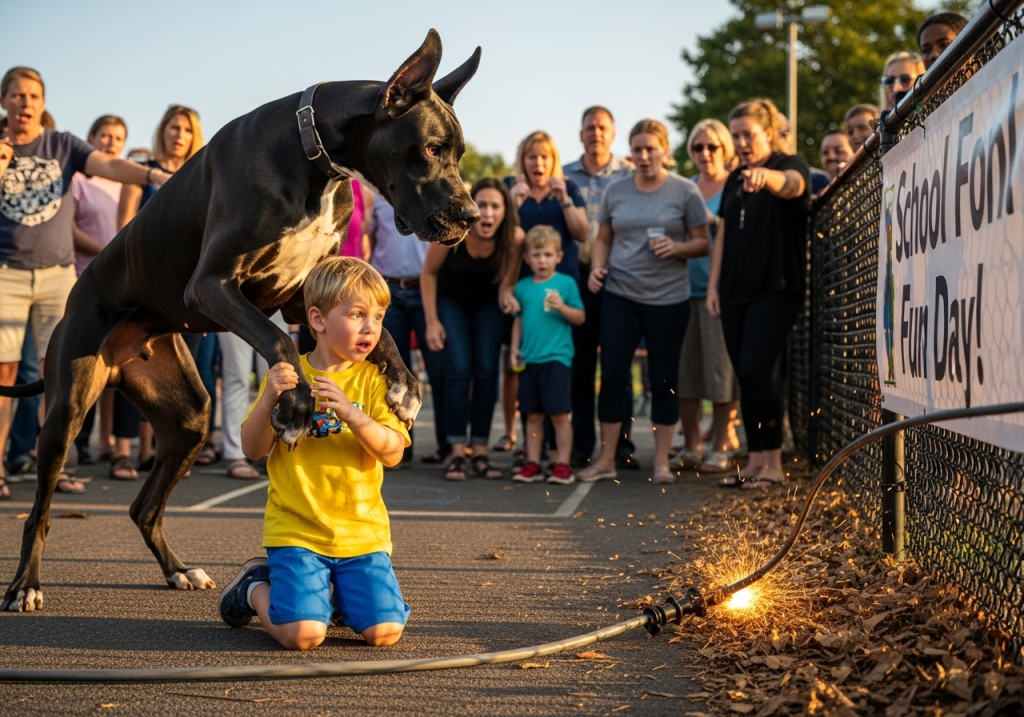
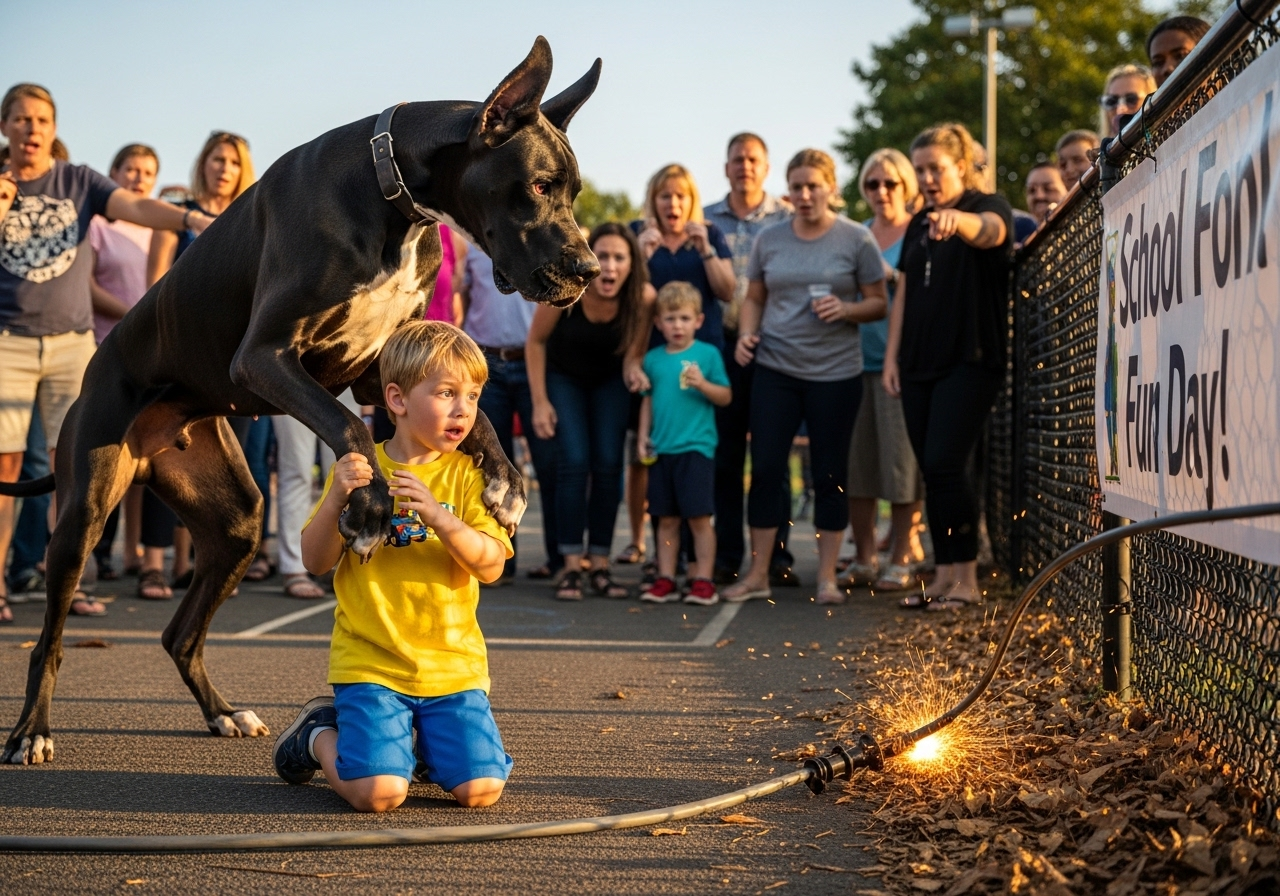
At the last possible second, the massive dog launched himself into the air. His huge black body blocked out the afternoon sun, casting a horrific, long shadow over my tiny boy.
Buster hit Leo square in the chest.
The sheer force of the 150-pound animal crashing into the 40-pound child was sickening. I heard the sharp, violent thud of impact.
Leo was thrown backward off his feet, his little body flying through the air before slamming brutally into the damp earth, disappearing completely beneath a mountain of black fur and thrashing limbs.
A cloud of dust, dry leaves, and dirt exploded upward, obscuring them from view.
Then, total chaos erupted.
Mothers were screaming hysterically. Fathers were sprinting across the field. Coach Dave was yelling into his two-way radio. Marcus was dragging himself across the grass, sobbing.
I reached the spot where my son had vanished, falling to my knees in the dirt, my hands shaking so violently I could barely form fists.
I was ready to fight the dog to the death. I was ready to plunge my bare hands into its jaws to get my son out.
But as the dust settled, the scene in front of me made absolutely no sense.
And it would be another 8 agonizing, heart-stopping minutes before any of us realized that the monster we were trying to kill was actually the only thing keeping my son alive.
<chapter 2>
The human brain is a bizarre, cruel instrument when it is plunged into the abyss of absolute terror.
It doesn’t speed up to help you survive. It slows down. It dissects every agonizing millisecond, forcing you to consume the horror drop by drop.
As I hit the damp earth, my kneecaps slamming into hidden rocks beneath the autumn grass, the world fractured into a chaotic mosaic of sound and color. The upbeat, synthesized rhythm of “Walking on Sunshine” was still blasting cheerfully from the PA speakers over by the bounce house. I could smell the sickly-sweet aroma of spun sugar from the cotton candy machine.
And right in front of me, a nightmare was unfolding in complete, terrifying silence.
The dust was just beginning to settle over the spot where my five-year-old son had been standing. Where my entire world had been standing.
My hands plunged blindly into the dry, brittle leaves and damp soil. My fingers were splayed wide, desperately seeking the familiar, soft fabric of Leo’s mustard-yellow corduroy jacket. I was expecting to feel the wet, warm slickness of blood. I was preparing my soul to touch the torn flesh of my only child.
I had already lived through the sudden, violent theft of my husband. I knew what the immediate aftermath of a shattered life felt like. It feels like falling backward into a freezing, black ocean with no bottom.
“Leo!” I gasped, the word tearing the lining of my throat.
My hands connected with something solid. It wasn’t corduroy. It was coarse, thick hair stretched tight over a mountain of vibrating muscle.
It was Buster.
The 150-pound Great Dane was flattened against the ground, his massive black body completely obscuring my son. He wasn’t thrashing. He wasn’t shaking his head the way dogs do when they catch a toy.
He was incredibly, unnervingly still.
“Get off him! Get off my baby!” I screamed, a primal, guttural noise that I didn’t know I was capable of making.
I grabbed handfuls of the dog’s thick black coat and pulled with all the adrenaline-fueled strength a mother possesses. I dug my heels into the dirt, leaning back, trying to pry the beast off my child.
It was like trying to move a parked car with my bare hands. Buster was a monolith of dead weight. He didn’t budge a single inch.
But he did react.
A deep, resonating growl began to vibrate in his chest. I could feel the sound waves traveling through my own arms. It was a terrifying, ancient sound that triggered every evolutionary survival instinct in my DNA.
“Oh my God! It’s killing him! The dog is killing him!”
The shrill, hysterical shriek belonged to Evelyn Vance. I didn’t have to turn around to know she was standing there, probably clutching her cashmere sweater, her eyes wide with the horrifying validation of her own prejudice. She had warned us. She had said the dog was a liability.
Behind her, the thundering footsteps of a dozen panicked parents shook the ground. The mob was arriving.
“Hey! HEY! GET AWAY FROM HIM!”
It was Coach Dave. His voice was cracking, laced with the frantic desperation of a man who was watching his career, his reputation, and a child’s life evaporate on his watch.
I snapped my head back. Dave was sprinting across the uneven grass, holding a heavy, wooden baseball bat he must have grabbed from the equipment pile near the petting zoo. His face was beet red, a vein pulsing dangerously in his temple.
Behind him, I saw a sight that broke whatever fragments of my heart were still intact.
Marcus.
The veteran was dragging himself across the field. He had fallen hard when the leash was ripped from his hands, and his bad leg—the one held together by titanium pins and sheer willpower—had completely given out. He was crawling. His hands clawed at the dirt, pulling his body forward, his face contorted in an agony that was far more emotional than physical.
“Don’t hurt him!” Marcus sobbed, his voice raw and broken. “Please! He’s a good boy! Buster, LEAVE IT!”
Marcus was reliving a nightmare. I could see it in his eyes. He wasn’t in a suburban Pennsylvania schoolyard anymore. He was back in the desert. He was watching his world explode all over again, and once again, he was powerless to stop it.
I turned my attention back to the dog.
“Leo? Baby, talk to Mommy! Say something!” I pleaded, my face inches from Buster’s massive, panting jaws.
There was no sound from beneath the dog. No crying. No whimpering.
Just silence.
The black ocean of grief I had fought so hard to swim out of for the past 14 months rose up and swallowed me whole. He was gone. The thought hit me with the physical force of a sledgehammer to the ribs. My son was dead.
I stopped pulling at Buster’s fur. My hands dropped to my sides, useless and trembling. I let out a low, agonizing wail that joined the chorus of screaming parents surrounding us.
“Sarah, move!” Coach Dave yelled, arriving behind me. He was breathless, raising the baseball bat high above his right shoulder. “I’m going to hit it! I have to get it off him!”
Evelyn was right beside him, her perfectly manicured hands covering her mouth, her eyes wide with morbid fascination. “Do it, Dave! Hit the monster!”
The mob mentality is a terrifying thing. Thirty-two highly educated, civilized, suburban parents had instantly transformed into a pack of frightened, reactive animals. They saw a giant, scary dog on top of a small boy. The math was simple. The dog was the villain. The dog had to be destroyed.
Dave tightened his grip on the bat, preparing to bring it down with crushing force onto Buster’s skull.
But as I knelt there, paralyzed by grief, something brushed against my left knee.
It was weak. It was small.
I looked down.
Sticking out from beneath Buster’s massive ribcage, entirely untouched and unbloodied, was a tiny hand wearing a mustard-yellow corduroy sleeve.
The fingers twitched.
“Mommy?”
The voice was muffled, practically suffocated by the heavy blanket of black fur, but it was unmistakably Leo’s. He wasn’t screaming in pain. He sounded thoroughly confused, completely annoyed, and entirely alive.
“He’s too heavy, Mommy. I can’t get up.”
The universe slammed back into its axis. Oxygen rushed back into my lungs so fast it burned.
He’s alive. I leaned closer, my nose practically touching the dog’s thick coat. I peered into the small gap between the ground and Buster’s chest.
Leo was pinned completely flat. Buster had his front legs splayed wide, distributing his massive 150-pound frame in a way that trapped the boy securely, but didn’t crush him. It was a precise, calculated hold.
And then I saw something else.
I looked at Buster’s face.
The Great Dane was not looking down at Leo. His jaws were shut tight. There was no blood on his muzzle. No foam at his mouth.
His massive head was turned away from us, facing the tall, overgrown grass at the very edge of the tree line. His ears were still pinned flat against his skull. His amber eyes were locked onto a spot about three feet away, burning with a ferocious, unwavering intensity.
The deep, rumbling growl I had felt earlier wasn’t directed at me. And it wasn’t directed at Leo.
Buster was warning something else to stay away.
“Dave, WAIT!” I screamed, throwing my arms up over the dog’s head just as the baseball bat began its downward arc.
Dave tried to check his swing, stumbling awkwardly. The heavy wooden bat whistled through the air, stopping mere inches from my raised forearm.
“Are you crazy, Sarah?!” Dave yelled, his eyes bulging. “Move! It’s got him pinned!”
“He’s not hurting him!” I shrieked, my voice cracking wildly. “Dave, he’s not hurting him! Leo is fine! He’s just lying on him!”
The crowd of parents hesitated. The screaming dialed back to a chaotic murmur of confusion.
“What is she talking about?” Evelyn scoffed, stepping forward, her authority challenged. “The dog tackled him! It’s a vicious animal! Move out of the way, Sarah, you’re in shock!”
“I said BACK OFF!” I roared.
I didn’t recognize my own voice. It wasn’t the voice of the fragile, grieving widow who apologized when people bumped into her at the grocery store. It was the voice of a mother bear defending her cub. I scrambled to my feet, straddling the massive dog, putting my own body between the mob and the animal they wanted to kill.
“Sarah, please,” Dave begged, holding the bat nervously. “We don’t know what that thing will do next. You have to let me—”
“Listen!” I hissed, cutting him off.
I pointed a trembling finger toward the spot where Buster’s eyes were locked.
The sudden silence from the crowd wasn’t immediate, but as my manic energy radiated outward, they slowly stopped talking. The parents exchanged confused, frightened glances. Dave lowered the bat slightly.
“Listen to what?” Evelyn asked, clearly exasperated.
“Just shut up and listen!” I snapped.
The autumn wind rustled through the dying oak leaves. The upbeat music from the festival still played in the background, a cruel juxtaposition to the tension radiating in the grass.
Then, we all heard it.
It wasn’t a loud noise. It was a dry, continuous, papery sound. It sounded like seeds shaking inside a hollow gourd, or water sizzling violently on a hot frying pan.
Ch-ch-ch-ch-ch-ch-ch. It was coming from the thick, knee-high grass just three feet from where Buster’s massive front paws were planted firmly in the dirt.
My blood ran completely cold. The hair on my arms stood up.
I slowly, agonizingly, turned my head to follow the sound.
The grass was a mess of brown, yellow, and green. It was the perfect camouflage. But as my eyes adjusted to the shadows cast by the afternoon sun, I saw the pattern.
Thick, dark brown, V-shaped crossbands over a yellowish-grey body.
It was thick. Disgustingly thick. At least the circumference of a softball.
It was a Timber Rattlesnake.
And it wasn’t just passing through. It was coiled tight, a massive spring of muscle and venom, reared up in a defensive strike posture. Its triangular head was pulled back, its tongue flickering rapidly, tasting the air, tasting the panic, tasting the enormous black dog that had suddenly fallen from the sky to block its path.
The rattle at the end of its tail was a blur of motion, vibrating with furious, lethal warning.
A collective, synchronized gasp sucked the oxygen right out of the crowd.
Someone in the back row whimpered. Evelyn Vance took three rapid steps backward, her face draining of all its expensive color, her designer sunglasses slipping down her nose.
Dave dropped the baseball bat. It hit the dirt with a dull thud. His hands started shaking uncontrollably.
“Oh my God,” Dave whispered, his voice trembling. “Oh my God, Sarah. It’s a Timber. It’s huge.”
I looked from the snake, back down to Buster.
The puzzle pieces snapped together with a velocity that made my head spin.
Leo had wandered over to the tall grass. He had seen something interesting. “Look, Mommy! It’s perfectly round!” he had said earlier about the pumpkin. He loved shapes. He loved nature.
He had crouched down to look at the snake.
A five-year-old child, eye-to-eye with one of the most dangerously venomous vipers in North America. A snake whose bite delivers enough hemotoxic venom to destroy tissue, stop a heart, and kill a small child in a matter of hours.
Buster hadn’t attacked my son.
Buster, with his highly trained service dog instincts, had seen the danger from fifty yards away. When his warnings to Marcus failed, when he realized the humans were too slow, too oblivious, he took matters into his own paws.
He had sprinted across the field, not to maul Leo, but to move him out of the strike zone.
He had tackled my tiny boy, throwing him backward out of the snake’s lethal reach, and then he had used his own massive, 150-pound body as a physical shield. He pinned Leo to the ground to keep him from getting up, from running, from making any sudden movements that would trigger the snake to strike.
Buster was currently staring down death, daring the viper to bite him instead.
“Nobody move,” a low, strained voice croaked from behind us.
It was Marcus.
He had finally dragged himself over to the edge of the circle. His jeans were covered in mud, his palms bleeding from the friction burn of the leash. Tears were streaming down his weathered, scarred face, cutting tracks through the dust.
He wasn’t looking at the parents. He wasn’t looking at me.
He was looking at his best friend.
“Buster,” Marcus whispered, his voice laced with an agonizing mixture of pride and absolute terror. “Hold. Good boy. Hold.”
Buster’s ears twitched at the sound of his master’s voice, but he didn’t break eye contact with the snake. He remained a statue of pure, unadulterated devotion.
“Call 911,” I whispered, not daring to move my head. I spoke out of the corner of my mouth to Dave. “Tell them we need Animal Control. Tell them we have a trapped child and a rattlesnake.”
“I’m on it,” Dave breathed, slowly reaching into his sweatpants pocket for his phone, his movements exaggeratedly slow.
“And an ambulance,” Evelyn added. Her voice was barely a squeak. The facade of the perfect, controlling PTA president had completely shattered. She looked like a terrified, small child. “Just in case.”
“Mommy?” Leo’s muffled voice came from beneath the dog again. “Why is the doggy lying on me? It’s heavy. I want to get up.”
Panic flared again. If Leo struggled, if he kicked Buster, Buster might shift. If Buster shifted, the snake would strike.
“Leo, listen to Mommy,” I said, trying to force a calmness into my voice that I absolutely did not feel. I kept my eyes locked on the snake’s triangular head. “We are playing a very special game right now. It’s called the Statue Game. You know that game, right?”
“Yeah,” Leo said, his voice small.
“Okay, baby. You have to be the best statue you have ever been. Do not move a single muscle. Do not wiggle your toes. Do not try to push the doggy off. The doggy is giving you a very special, heavy hug.”
“Okay, Mommy.”
I closed my eyes for a fraction of a second, sending up a desperate, silent prayer to Mark. Keep him still. Please, Mark. Keep our boy still.
The next eight minutes were the longest, most agonizingly slow minutes of my entire existence.
Every second felt like an hour. Every rustle of the wind sounded like a strike.
The parents formed a wide, silent semicircle around us. Nobody spoke. Nobody checked their phones, except Dave, who was whispering frantically to the 911 dispatcher. We were all trapped in a suspended animation of pure terror.
I knelt there, straddling the great black beast, watching the muscles in Buster’s hind legs begin to tremble under the strain of holding the position. The dog was exhausted. He was panting heavily, drops of saliva hitting the dry leaves beneath his jaws.
But he never wavered.
The snake remained coiled, its rattle continuing its relentless, maddening hiss. It was locked in a standoff with the giant black shadow that had stolen its prey.
I looked over at Marcus. He had pulled himself up onto his good knee, his hands clasped together as if in prayer. He was murmuring under his breath, repeating the same words over and over.
“You’re a good boy, Buster. You’re the best boy. Hold the line, buddy. Just hold the line.”
I realized then, with a profound, heart-wrenching clarity, what true sacrifice looked like.
Marcus, a man who had already given a piece of his body and his soul for his country, was now forced to watch his only source of comfort, his lifeline back to sanity, risk his own life for a child he didn’t even know.
If that snake struck, it would hit Buster directly in the face or the neck. With a venom load that size, a dog—even one as massive as a Great Dane—would have very little chance of surviving without immediate, miraculous veterinary intervention.
Buster knew it. You could see the fear in his amber eyes. But his loyalty was stronger than his fear.
I slowly lowered my trembling hand and gently rested it on Buster’s muscular back. I felt his immense heat. I felt the powerful, rapid thud of his giant heart against my palm.
“Thank you,” I whispered to him, my tears finally breaking free, falling hot and fast onto his black coat. “Thank you, thank you, thank you.”
Off in the distance, cutting through the crisp autumn air, the faint, rising wail of police sirens began to echo down the suburban streets.
Help was coming.
But as the sirens grew louder, the snake’s behavior abruptly changed.
The noise, the vibrations of the approaching heavy vehicles, sent a new wave of panic through the reptile.
The rattle intensified, reaching a fever pitch that sounded like a high-voltage electrical wire snapping. The snake tightened its coil, pulling its triangular head even further back.
It wasn’t holding its ground anymore. It was preparing to launch.
“Marcus,” I choked out, my heart hammering violently against my ribs. “Marcus, it’s going to strike.”
<chapter 3>
There is a terrifying concept in physics regarding time dilation—the idea that time is not a constant, but rather a flexible fabric that warps and bends depending on your proximity to massive gravity or incredible speed. Trauma has its own gravity. When you are staring down the barrel of your own worst nightmare, the universe decides to stretch a single second into an agonizing eternity, forcing you to memorize every horrific detail of the moment your life fractures.
The police sirens were no longer a distant promise. They were a screaming, high-pitched wail tearing through the crisp suburban Pennsylvania air, bouncing off the brick facade of Oak Creek Elementary. The flashing red and blue lights began to strobe against the treeline, casting harsh, unnatural shadows across the overgrown grass.
For the Timber Rattlesnake, those sirens were the final, intolerable threat.
The vibration of heavy tires tearing over the schoolyard lawn sent a shockwave through the ground. I felt it in my knees. Buster felt it in his massive, trembling paws. And the viper felt it in its scales.
The rattling, which had already been a maddening, high-voltage hum, suddenly peaked into a frantic, chaotic screech.
I saw the snake’s musculature tighten. The yellowish-grey coils compressed, flattening out like a spring loaded with lethal intent. Its triangular head, with those cold, slit-pupil eyes, pulled back just a fraction of an inch further.
“Marcus,” I choked out, the word scraping against my throat like broken glass. “Marcus, it’s going to strike.”
“Buster, NO! AWAY!” Marcus screamed, his voice shattering completely, abandoning the calm command of a veteran and reverting to the sheer, desperate panic of a man about to lose his best friend.
But Buster didn’t move away.
In a display of loyalty that defied every natural instinct of self-preservation, the 150-pound Great Dane didn’t flinch backward. He didn’t try to dodge.
He leaned in.
He widened his stance over my five-year-old son, lowering his massive black chest even closer to the dirt, effectively sealing any possible gap where a fang could slip through to reach the boy beneath him. He made himself the absolute, undeniable target.
The snake launched.
It was a blur of motion, a violent, ugly whip-crack of muscle and scale. The human eye can barely track the speed of a pit viper’s strike. It happens in less than half a second. But my trauma-warped brain recorded it in agonizing slow motion.
I saw the viper’s jaws unhinge, opening impossibly wide to reveal the pale, fleshy pink of its mouth and the two translucent, needle-sharp fangs folding out, dripping with a deadly cocktail of hemotoxic venom. I saw the thick, muscular body uncoil like a released heavy-duty spring, propelling the head forward with terrifying, precise velocity.
It didn’t go for Buster’s legs. It aimed high.
The snake slammed into the thick, muscular ridge of Buster’s left shoulder, right where the black fur met the edge of his blue “SERVICE ANIMAL” harness.
The impact was shockingly violent. It wasn’t a bite; it was a collision. The snake hit the dog with such force that the reptile’s body contorted backward from the sheer momentum.
Buster let out a sound I will never, ever forget.
It wasn’t a bark. It wasn’t a growl. It was a high-pitched, agonizing yelp—a sharp, sudden scream of absolute pain that tore through the autumn air and silenced the entire field. It was the sound of an innocent creature realizing it had just been deeply, horribly wounded.
“NO!” I shrieked, throwing my body forward, my hands instinctively grabbing the snake’s thick, heavy tail as it tried to recoil. I didn’t care about the danger anymore. I didn’t care about the venom. The maternal, protective rage that had been boiling in my blood exploded.
But before I could rip the viper away, chaos descended.
A heavy pair of black boots slammed into the dirt right beside my head. A thick, metal snare pole—the kind used by animal control—slammed down onto the grass, the reinforced wire loop slipping expertly over the snake’s thrashing, triangular head and pinning it to the earth.
“Got it! I got it! Step back, ma’am! STEP BACK!” a booming, authoritative voice bellowed over the screaming sirens.
It was a police officer, his face flushed with adrenaline, his hands gripping the metal pole with white-knuckled intensity as the thick snake writhed and hissed furiously against the wire.
Another officer was suddenly there, grabbing me by the shoulders of my sweater and physically hauling me backward, away from the strike zone.
“My son! My son is under the dog!” I screamed, thrashing against the officer’s grip, my eyes locked on the mountain of black fur.
The immediate threat was contained, pinned beneath the snare pole, but the nightmare was far from over.
Buster remained frozen for three agonizing seconds after the strike. His massive head was turned toward the left, his amber eyes wide with shock, looking at the puncture wounds on his shoulder.
Then, the adrenaline began to fade, and the reality of the 150-pound animal’s sacrifice took over.
With a low, pitiful groan, Buster’s massive front legs buckled. The rigid muscles that had held him steady for eight impossible minutes finally gave out. He collapsed, his giant body rolling heavy and loose off of Leo, hitting the damp grass with a dull, sickening thud.
The moment the weight was lifted, I broke free from the officer’s grasp and threw myself onto the ground.
Leo was lying on his back, his little mustard-yellow jacket covered in dirt, dog hair, and dry leaves. He looked completely bewildered, his brown eyes blinking up at the sky, his curls plastered to his forehead with sweat.
I scooped him up with a ferocity that made him gasp. I crushed his small, forty-pound body against my chest, burying my face in his neck, inhaling the sweet, dusty scent of his skin. I ran my shaking hands over his arms, his legs, his torso, frantically searching for blood, for puncture wounds, for any sign that the nightmare had reached him.
Nothing. He was perfect. He was whole. He was alive.
“Mommy, you’re squeezing me too tight,” Leo whimpered softly, squirming in my desperate embrace.
“I know, baby. I know. I’m sorry. I’m so sorry. I love you,” I sobbed, the tears pouring down my face in hot, stinging rivers. The dam had broken. The 14 months of suppressed terror, the constant, suffocating fear of losing him just like I lost Mark, all of it came flooding out in harsh, ugly, breathless sobs.
But my relief was instantly shattered by the sound of a man’s heart breaking in half.
“Buster. Oh god, Buster, no. Look at me, buddy. Look at me.”
I turned my head.
Marcus had dragged himself across the final few feet of grass. He was kneeling beside the massive dog, his hands covered in mud and his own blood from the leash burn, cradling Buster’s enormous head in his lap.
The transformation in the dog was terrifyingly rapid. The venom of a Timber Rattlesnake is designed to break down tissue and blood cells instantly, causing catastrophic swelling and internal bleeding.
Within seconds of the bite, the left side of Buster’s face and shoulder was already visibly distorted. The skin beneath his black fur was swelling rapidly, puffing out with angry, toxic fluid. His breathing, which had been heavy from exertion, was now ragged and wet, sounding like a broken bellows.
His amber eyes, usually so bright and full of soulful intelligence, were glassing over, rolling back slightly in his head.
“Medic! We need a medic over here NOW!” Coach Dave was screaming, jumping up and down, waving frantically at the ambulance that was just bumping over the curb onto the grass.
But paramedics are trained to save humans.
Two EMTs leaped from the back of the rig, grabbing their trauma bags and sprinting across the field. They took one look at the massive, dying dog and the frantic veteran weeping over him, and they froze.
“Sir, are you bitten? Is the child bitten?” the lead EMT asked, dropping to his knees beside me and shining a penlight over Leo’s face.
“No! No, we’re fine. It’s the dog! You have to help the dog!” I yelled, pointing a trembling finger at Buster.
The EMT looked at Marcus, then back at me, his face tight with helpless regret. “Ma’am, we don’t carry antivenom for animals. We don’t have the equipment to intubate a dog that size. We can’t…”
“You have to do something!” Marcus roared, his voice cracking with a terrifying, raw desperation. He pulled Buster’s heavy head tighter against his chest, rocking back and forth in the dirt. “He saved him! He saved the boy! You can’t let him die! Please! I don’t have anyone else! I don’t have anything else!”
The agonizing truth of Marcus’s words hung in the air, thick and suffocating. This dog was his lifeline. This dog was the only reason the veteran got out of bed, the only reason he could walk to the mailbox, the only shield he had against the crippling night terrors of Afghanistan. If Buster died on this field, Marcus’s spirit would die with him.
The crowd of parents, who just ten minutes ago had been a bloodthirsty mob screaming for the dog to be beaten with a baseball bat, were now standing in stunned, horrified silence.
Some of the mothers were weeping openly, clutching their own children tightly against their legs. The fathers looked down at their shoes, their faces flushed with the profound shame of their own misjudgment. They had almost killed a hero.
Then, the crowd parted.
Evelyn Vance stepped forward.
The pristine, unapproachable PTA president was gone. Her white cashmere sweater was smeared with mud and crushed leaves. Her expensive blowout was windblown and chaotic. Her makeup was streaked with tears she hadn’t bothered to wipe away.
She looked at Marcus, then at the dying dog, and finally at me. In her eyes, I saw a profound, shattering realization. She saw the absolute fragility of life, and she saw the devastating consequences of her own cynical assumptions.
“Where is the nearest emergency veterinary hospital?” Evelyn demanded, her voice cutting through the panic with surprising authority. She wasn’t asking; she was commanding.
“BluePearl Specialty on Route 30,” Coach Dave stammered, his hands still shaking. “But it’s twenty minutes away with traffic.”
“Not the way I drive,” Evelyn snapped.
She turned and sprinted toward the parking lot, her designer flats kicking up dirt. “Dave! Pick up the dog’s back half! Marcus, can you walk?”
Marcus looked up, dazed, tears tracking through the dirt on his face. “My leg… it gave out.”
“Officer!” Evelyn barked, pointing at the cop who had just secured the snake in a heavy plastic container. “Help the man up! Get him to my car! Now!”
The sheer force of her will jolted everyone out of their paralysis.
Dave dropped his clipboard and rushed over, grabbing Buster’s hind legs. The police officer hauled Marcus to his feet, throwing the veteran’s arm over his shoulder to support his weight. I gently set Leo down, ordering him to stay right next to an EMT, and rushed to grab Buster’s midsection.
The 150-pound dog was complete dead weight. As we hoisted him into the air, he let out a weak, agonizing groan, his heavy head lolling to the side, thick ropes of bloody saliva dripping from his jowls onto my shoes.
We practically ran across the grass toward the parking lot. Evelyn had already backed her massive, black Lincoln Navigator over the curb, throwing the rear doors wide open. She didn’t care about the custom leather interior. She didn’t care about the mud.
“In the back! Lay him flat!” she yelled, climbing into the driver’s seat and gunning the engine.
We shoved the massive animal into the spacious cargo area. Marcus scrambled in right behind him, ignoring his ruined knee, collapsing onto the floorboards so he could pull Buster’s swelling head back into his lap.
I turned back to look at Leo. The EMT was holding his hand, wrapping a foil thermal blanket around his small shoulders. He looked scared, but safe.
“Go with them, Sarah,” Dave said, putting a heavy, comforting hand on my shoulder. His eyes were red-rimmed and wet. “I’ll stay with Leo. I promise you, on my life, I won’t let him out of my sight. Go help Marcus.”
I didn’t hesitate. The bond of trauma is instantaneous and unbreakable. Marcus had sacrificed everything to save my child. I owed him my presence. I owed him my strength.
I climbed into the back seat of the Navigator, slamming the door shut just as Evelyn slammed her foot on the gas.
The heavy SUV leaped forward, tires squealing on the asphalt as we tore out of the school parking lot.
The drive was a blur of terrifying speed and sickening tension. Evelyn drove with a reckless, terrifying precision, laying on the horn, blowing through red lights, and swerving around slow-moving minivans. She was a woman possessed, desperately trying to outrun her own guilt.
In the back, the situation was rapidly deteriorating.
Buster’s breathing was growing incredibly shallow. The swelling had spread from his shoulder up his neck, compressing his airway. His beautiful black fur was hot to the touch, radiating the fever of the venom ravaging his bloodstream.
“Stay with me, buddy. Please, please stay with me,” Marcus sobbed, burying his face in the dog’s neck. He was rocking back and forth, entirely consumed by his grief. “You promised. You’re my good boy. You’re my only boy.”
I unbuckled my seatbelt and climbed over the center console, squeezing into the cargo area beside Marcus. It was cramped, smelling sharply of wet dog, copper blood, and sheer panic.
I didn’t know what to do. I wasn’t a doctor. I couldn’t stop the venom. But I knew what it felt like to sit in a moving vehicle, watching the life drain out of someone you loved, praying for a miracle that you knew deep down wasn’t coming. I remembered the sterile smell of the ambulance the day Mark died. I remembered the cold, clinical look on the paramedic’s face when they stopped doing chest compressions.
I couldn’t let Marcus be alone in that dark place.
I reached out and placed my hand firmly over Marcus’s trembling, blood-stained fingers, resting them gently on Buster’s heaving flank.
“He’s fighting, Marcus,” I whispered, my voice thick with tears. “He’s a soldier, just like you. He knows how to fight.”
Marcus looked up at me, his eyes hollow and haunted. The tough exterior of the combat veteran was completely stripped away, leaving only a broken, terrified boy.
“I can’t lose him, Sarah,” he choked out, his chest heaving with dry sobs. “If he goes… I go. I can’t do this world without him. It’s too loud. It’s too much.”
“He’s not going anywhere,” I lied, squeezing his hand so hard my knuckles turned white. “We’re almost there. Evelyn is driving fast. Just keep talking to him. Let him hear your voice. Tell him he’s a good boy.”
Marcus nodded frantically, leaning his forehead against Buster’s snout. “You hear that, B? You’re a good boy. Best boy in the whole damn world. You hold the line, buddy. Hold the line.”
Evelyn swerved violently, the tires screeching as we careened into the parking lot of the BluePearl Specialty Emergency Vet. She didn’t bother parking in a spot; she threw the SUV into park directly in front of the sliding glass doors, blocking the entire entryway.
Before the car even fully settled, Evelyn was out of the driver’s seat, sprinting toward the entrance.
“We have an emergency!” she screamed, bursting through the sliding doors into the waiting room. “Rattlesnake bite! Large breed dog! He’s dying! We need a gurney NOW!”
Within seconds, the sterile, quiet atmosphere of the clinic erupted into organized chaos.
A team of four veterinary technicians in blue scrubs rushed out the front doors, pushing a heavy-duty stainless steel gurney. They took one look at the massive, swollen lump of black fur in the back of the SUV and their professional composure tightened into grim determination.
“Let’s go, let’s go! Lift on three!” a tall, muscular tech barked.
I scrambled out of the way, pulling Marcus back as the team efficiently hoisted Buster’s limp, 150-pound body onto the metal table.
As they pulled the gurney away, Buster’s head lolled to the side. His tongue, swollen and dark purple, slipped out of his mouth. His chest wasn’t moving.
“He’s stopped breathing!” one of the techs yelled, grabbing a pediatric ambu-bag from his pocket and forcefully fitting it over Buster’s massive snout, aggressively pumping air into the dog’s failing lungs. “Code red! Trauma one! We need antivenin prepped immediately!”
They burst through the double doors leading into the surgical bay, the heavy wooden doors swinging shut behind them with a definitive, terrifying thud.
And just like that, he was gone.
The silence that fell over the waiting room was heavier than the silence on the field. It was the crushing, suffocating silence of absolute helplessness.
Marcus stood frozen in the automatic doorway, his hands still hovering in the air where Buster had been just seconds before. The blood from his leash burn and the mud from the field covered him completely. He looked like a ghost.
Then, his good leg gave out.
He collapsed onto the pristine tile floor of the veterinary clinic, wrapping his arms around his head, and let out a long, low wail of sheer agony. It was the sound of a man completely breaking apart.
I dropped to my knees beside him, wrapping my arms tightly around his shaking shoulders, pulling him against my chest. I didn’t say anything. There were no words that could fix this. I just held him, letting my tears soak into his dusty shirt, sharing the unbearable weight of the gravity we were both trapped in.
Evelyn stood a few feet away, leaning heavily against the receptionist’s counter. The woman who built her entire identity on being perfectly put-together was openly weeping, her face buried in her muddy hands.
“I’m so sorry,” Evelyn whispered, her voice barely audible over Marcus’s sobs. “I’m so, so sorry. I called him a monster.”
“He’s not a monster,” I whispered back, staring blankly at the closed surgical doors. “He’s an angel. And if there is any justice in this universe, God will not take him today.”
We sat there on the cold tile floor, a shattered veteran, a grieving widow, and a broken perfectionist, bound together by the blood and sacrifice of a dog.
The clock on the wall above the receptionist’s desk ticked loudly.
3:15 PM.
The nightmare had started less than an hour ago.
And now, all we could do was wait. Wait to see if the venom had reached the dog’s heart. Wait to see if the antivenin would work. Wait to see if a man who had already lost so much would lose the very last piece of his soul.
The sliding glass doors behind us hissed open.
I turned my head. Coach Dave was standing there, holding Leo in his arms. My son looked around the bright, sterile waiting room, his big brown eyes landing on Marcus weeping on the floor.
Leo wriggled out of Dave’s grasp, his little sneakers hitting the tile. He walked over to us slowly, his mustard-yellow jacket still covered in the dirt from the field.
He didn’t ask what was wrong. He didn’t cry. Children have a profound, instinctual understanding of grief that adults often forget.
Leo knelt down on the tile next to Marcus. He reached out his small, perfectly clean hand, and gently rested it on the veteran’s shaking shoulder.
“Don’t cry,” Leo whispered, his voice impossibly gentle. “Buster gave me a heavy hug. Now the doctors will give him a heavy hug. He’s a good boy.”
Marcus lifted his head, his eyes bloodshot and swollen, staring at the tiny boy who was alive simply because his dog chose to take a bullet for him. He reached out with a trembling, blood-stained hand and gently cupped Leo’s cheek.
“Yeah, kid,” Marcus choked out, a fresh wave of tears spilling over his lashes. “He’s the best boy.”
Suddenly, the heavy wooden double doors of the surgical bay swung open.
A veterinarian, wearing a lead apron and blue scrubs smeared with blood, stepped into the waiting room. Her face was grim, her eyes exhausted. She pulled her surgical mask down beneath her chin and took a deep breath.
“Are you the owner of the Great Dane?” she asked, her voice tight.
Marcus scrambled to his feet, ignoring the pain in his knee, his entire body rigid with terror.
“I am,” Marcus said, his voice dropping to a terrified whisper. “Please… please tell me…”
The doctor looked at him, and then she looked down at the clipboard in her hands.
<chapter 4>
The veterinarian, Dr. Aris Thorne—her name badge hung slightly crooked on her blood-smeared scrubs—looked down at the aluminum clipboard in her hands. The silence in the waiting room was absolute. You could hear the faint, mechanized hum of a refrigerator in the back, the ticking of the wall clock, and the ragged, shallow breathing of a combat veteran waiting to find out if he had to bury his best friend.
Dr. Thorne took a slow, deep breath and finally looked up, meeting Marcus’s bloodshot eyes.
“He’s alive,” she said, her voice gravelly from exhaustion. “But we are nowhere near out of the woods.”
The collective exhale that left the four of us—me, Marcus, Coach Dave, and Evelyn—felt powerful enough to shift the air pressure in the room. Marcus didn’t cheer. He didn’t smile. He simply closed his eyes, and a single, heavy tear tracked a clean line through the dried mud and blood on his cheek. He swayed slightly on his bad leg, and I reached out, bracing my hand against his lower back to keep him upright.
“Tell me everything,” Marcus whispered, his voice trembling but laced with the sudden, fierce focus of a soldier receiving a situational brief. “Don’t sugarcoat it, Doc. I need to know exactly what we are fighting.”
Dr. Thorne nodded, appreciating his directness. She stepped further into the waiting room, letting the heavy wooden doors swing shut behind her.
“The strike was a direct hit to his left shoulder, entering deep into the trapezius muscle,” she explained, her professional tone doing little to mask the grim reality of her words. “Timber Rattlesnake venom is highly hemotoxic. It’s designed to destroy red blood cells, break down muscle tissue, and cause massive internal hemorrhaging. Because Buster is a giant breed, his heart pumps a massive volume of blood very quickly. By the time you got him here, the venom had already begun to systemically compromise his vascular system. He went into anaphylactic shock and cardiac arrest on the table.”
My hand flew to my mouth. I looked down at little Leo, who was leaning against Coach Dave’s leg, his wide brown eyes taking in the terrifying adult conversation.
“But you got him back,” I choked out.
“We pushed a heavy dose of epinephrine and performed chest compressions. He responded,” Dr. Thorne confirmed, offering a tight, cautious smile. “He has an incredibly strong heart. But the venom load he took was massive. We believe the snake emptied its entire reserve into him. Right now, his throat is severely swollen, which is why he stopped breathing in the car. We had to perform an emergency tracheotomy to secure an airway. He’s intubated, heavily sedated, and on a ventilator.”
Marcus swallowed hard, his Adam’s apple bobbing. “What’s the next step? How do we fix him?”
This was the moment the doctor’s professional facade faltered. She looked down at the floor, then back up at Marcus, her eyes filled with a profound, helpless sympathy.
“We need to administer CroFab, the antivenin,” she said softly. “And we need to do it immediately to stop the tissue necrosis before it reaches his vital organs or requires amputation of the foreleg. Because of his sheer size—150 pounds—and the severity of the envenomation, a standard dose won’t touch this. He is going to need a minimum of six to eight vials over the next twenty-four hours just to stabilize his blood pressure and clotting factors.”
“Then do it,” Marcus said immediately, waving his mud-caked hand. “Give him ten. Give him whatever he needs. Pump him full of it.”
Dr. Thorne didn’t move. She gripped her clipboard tighter. “Mr. Evans… Marcus. I need you to understand the reality of this treatment. CroFab is incredibly difficult to source, and it is astronomically expensive. A single vial costs approximately $1,200. For an eight-vial course, plus the emergency surgery, the ventilator, the plasma transfusions he will inevitably need, and the ICU hospitalization… we are looking at an initial estimate of fifteen to eighteen thousand dollars. And I require a fifty percent deposit to pull the vials from the lockbox.”
The air in the room instantly turned to lead.
Fifteen thousand dollars.
I watched the color completely drain from Marcus’s face. The fierce, determined soldier vanished, replaced once again by the broken, terrified man. He was living on a fixed VA disability pension. He rented the smallest, most run-down house in our neighborhood. I knew, just by looking at the frayed cuffs of his flannel shirt and the worn-out soles of his boots, that he didn’t have fifteen thousand dollars. He probably didn’t have fifteen hundred.
“I…” Marcus stammered, his chest beginning to heave with the onset of a full-blown panic attack. He began frantically patting down the pockets of his muddy jeans, pulling out a worn leather wallet. “I have… I have a credit card. The limit is two thousand. I have a truck. It’s a 2014 Chevy, it runs good, I can sign the title over to you right now. I can get a loan. I can call the VA. Please, Doc. Please. You can’t let him die because I’m broke. Please.”
He was begging. A man who had bled into the sand of Kandahar, a man who had sacrificed his body for a country that largely ignored him when he came home, was standing in a brightly lit veterinary clinic, sobbing, begging to trade his used pickup truck for the life of his dog.
It was the most unjust, heartbreaking thing I had ever witnessed.
I stepped forward, reaching for my own purse. I had Mark’s life insurance money. I had sworn to keep it in a high-yield savings account for Leo’s college fund, but this was a life. “Marcus, I can help. I have some savings—”
“Put your purse away, Sarah.”
The voice cut through the despair like a perfectly sharpened diamond blade.
We all turned. Evelyn Vance pushed herself off the receptionist’s counter.
She looked entirely unhinged. Her pristine white cashmere sweater was ruined, streaked with mud, dog saliva, and her own smeared makeup. Her expensive blowout was matted with sweat. But as she walked toward the reception desk, her posture was ramrod straight, radiating the terrifying, commanding aura that made her the undisputed, feared queen of the Oak Creek PTA.
She walked straight past Marcus, straight past me, and slammed a heavy, matte-black American Express card onto the stainless steel counter of the reception desk. The metal-on-metal clack echoed loudly in the quiet room.
“Run it for twenty thousand dollars,” Evelyn ordered, locking eyes with the stunned receptionist sitting behind the glass. “Right now.”
Marcus stared at her, his mouth slightly open, completely paralyzed by the sudden intervention. “Ma’am… Evelyn… you don’t have to do that. I can’t pay you back. I’m on a fixed income, I—”
Evelyn spun around to face him. Her eyes were blazing, swimming with unshed tears and a ferocious, awakened clarity.
“Shut up, Marcus,” she said, her voice shaking but undeniably firm. “Just shut up. Two hours ago, I stood in the middle of a school field and told a crowd of thirty people that your dog was a monster. I advocated for a man to beat him to death with a baseball bat because I was too blind, too arrogant, and too obsessed with control to see what was actually happening.”
She pointed a trembling, perfectly manicured finger toward the surgical doors.
“That dog,” she continued, her voice cracking, “threw his body over a five-year-old boy to take a lethal dose of venom that was meant for him. He did it without hesitating. He did it because he possesses more honor and goodness in a single hair on his giant, black head than I have shown in the last ten years of my miserable, perfectly curated life.”
Evelyn let out a harsh, wet laugh, wiping roughly at her mascara-stained cheeks. “My husband, Richard, bought his twenty-five-year-old paralegal a fifteen-thousand-dollar Cartier diamond tennis bracelet last Tuesday. I found the receipt in his golf bag. Do you know what I did? Nothing. I smiled at him at dinner and asked him how his day was, because I am a coward who would rather live in a beautiful lie than face an ugly truth.”
She turned back to Dr. Thorne, her expression hardening into absolute steel.
“I am done being a coward,” Evelyn stated. “Run the card. Pull the vials. Save the damn dog. If you need more money, you call me, and I will drain every joint account Richard and I have before he even wakes up tomorrow morning.”
Dr. Thorne stared at Evelyn for a long, heavy second. Then, a small, genuine smile touched the corners of the veterinarian’s mouth. She nodded once, a gesture of profound respect.
“I’ll pull the antivenin right now,” Dr. Thorne said, turning on her heel and practically sprinting back through the double doors.
Marcus collapsed into one of the hard plastic waiting room chairs. He buried his face in his hands, his shoulders shaking with silent, overwhelmed sobs. Evelyn walked over to him and, to my absolute shock, this woman—who usually refused to hug people for fear of wrinkling her silk blouses—sat down next to the muddy, bleeding veteran and awkwardly, tentatively, placed her arm around his shoulders.
The universe has a strange, twisted sense of humor. It takes an absolute tragedy to strip away the suffocating masks we all wear.
The next forty-eight hours were a masterclass in agonizing suspense.
We didn’t leave. Coach Dave eventually took Leo home, promising to let the little boy sleep in his own bed, guarded by my mother who had rushed over the moment I called her. I kissed my son’s forehead a hundred times before he left, whispering my desperate, endless gratitude into his curls.
After Dave and Leo left, it was just the three of us: the widow, the veteran, and the broken socialite. We claimed a corner of the waiting room, existing on a diet of terrible vending machine black coffee, stale peanut butter crackers, and sheer, unfiltered adrenaline.
During the deep, quiet hours of the night, when the clinic was empty save for the emergency staff, the walls between us completely dissolved. Trauma is an aggressive solvent; it burns away small talk and pretense, leaving only the raw, exposed nerve of human truth.
Sitting on the uncomfortable vinyl chairs, Marcus finally told us his story.
He told us about the night in the Arghandab River Valley when his Humvee hit the pressure plate. He talked about the deafening roar, the smell of cordite and burning metal, and the profound, crushing guilt of waking up in a hospital in Germany to find out his three best friends were going home in flag-draped transfer cases.
“I came back, but I didn’t survive,” Marcus whispered, staring at his muddy boots. The fluorescent lights overhead buzzed quietly. “I was a ghost. I couldn’t sleep. The night terrors were so violent I’d wake up on the floor with my hands bruised from punching the walls. I pushed away my family. I isolated myself. I was just… waiting for my body to catch up to the fact that I was already dead.”
He looked up at the surgical doors.
“Then the VA paired me with Buster. They warned me he was big. They didn’t tell me he was half-horse,” Marcus offered a weak, tearful smile. “The first night I had him, the terrors hit. I woke up screaming, throwing punches at the dark. Buster didn’t bark. He didn’t run away. He just climbed onto the bed, walked right through my swinging arms, and laid his entire 150-pound body directly on top of my chest. The deep pressure… it grounded me. He forced me back into my body. He absorbed my panic. He’s done it every single night for three years.”
Marcus looked over at me, his eyes full of a haunting understanding. “He saved my life, Sarah. Long before he saved Leo’s.”
I understood. Oh God, I understood so deeply it physically ached.
“When Mark died,” I started, my voice soft, echoing in the quiet room. Evelyn and Marcus both turned to me, giving me their complete, unbroken attention. “When the police officer told me he was gone, my brain simply rejected the information. It didn’t make sense. One minute we were arguing over whose turn it was to buy laundry detergent, and the next minute, a drunk teenager in a stolen Honda Civic crossed the centerline and turned my husband into a memory.”
I pulled my knees to my chest, wrapping my arms around them. “Since that day, I have lived in a constant state of anticipatory grief. I look at Leo, and I don’t just see my son. I see a fragile piece of glass that the universe is inevitably going to drop. I smothered him. I made him afraid of the world because I was terrified of it. But today…”
I paused, swallowing the lump in my throat. I pictured the massive black dog soaring through the air, completely disregarding his own safety.
“Today, I realized that I can’t control the chaos. The snake was hidden. It was always going to be there. But so was Buster. If I spend the rest of my life only looking for the snakes, I’m going to miss the angels.”
Evelyn was crying again, silent tears tracking down her face. She reached out and grabbed my hand, squeezing it tightly.
“We build these perfect little fortresses,” Evelyn whispered, staring blankly at the vending machine. “We buy the right houses, we join the right committees, we wear the right clothes, thinking it will protect us from the ugliness of the world. But it’s just drywall and cashmere. It doesn’t stop the pain. It just traps you inside with it.”
She took a deep breath, her spine straightening. “I’m leaving him, Sarah. Richard. I’m going to file the papers on Monday. I’m going to sell that massive, empty house, and I’m going to start over. I don’t want to be the woman who hates a dog because she hates her own life ever again.”
We sat in silence after that. Three vastly different people, permanently bonded by a giant dog fighting for his life in the room next door.
At 6:00 AM on the second day, Dr. Thorne walked through the double doors. She didn’t look grim. She looked exhausted, but her eyes were shining.
“He’s extubated,” she announced, leaning against the doorframe. “He’s breathing on his own. The antivenin neutralized the hemotoxins. The swelling in his neck has gone down significantly. We managed to save the muscle tissue in the shoulder. It’s going to be a long road to recovery, and he’s going to have a wicked scar, but… he’s going to make it.”
Marcus let out a sob that sounded like a prayer. He dropped his head between his knees, his entire body shaking with the violent release of a crushing emotional burden.
Evelyn let out a sharp, joyful laugh, burying her face in her hands.
I just cried. I cried for Marcus, I cried for Buster, and for the first time in fourteen months, I cried tears of genuine, unadulterated hope.
The community reaction over the next few weeks was a staggering display of human redemption.
Guilt is a powerful motivator, but when channeled correctly, it can move mountains. Coach Dave and the Oak Creek PTA—led fiercely by a newly single, dramatically softer Evelyn Vance—mobilized like an army.
They started a GoFundMe to cover any additional rehabilitative costs, physical therapy, and special dietary needs for Buster. The goal was $5,000. It hit $42,000 in three days. People from all over the state, who had heard the story through the panicked Facebook posts of the festival parents, donated in droves.
The parents who had stood on that field, the ones who had yelled for the dog to be put down, showed up at Marcus’s small rental house. They didn’t come with excuses. They came with casseroles, with apologies, and with offers to mow his lawn or fix his broken gutters while he spent his days at the veterinary clinic. They realized how quickly their fear had turned to prejudice, and they were desperate to make amends.
Three weeks later, on a brisk Friday afternoon, Buster finally came home.
The Oak Creek Elementary school bus dropped Leo off at the corner of our street. I was waiting for him. Together, we walked down the sidewalk toward the end of the cul-de-sac.
Marcus’s 2014 Chevy pickup was parked in the driveway. Marcus was sitting on the front porch steps.
Beside him, looking significantly thinner, with a massive, shaved patch on his left shoulder revealing a long, jagged, angry pink scar, was Buster.
He looked tired. He looked battered. He looked exactly like his owner—a wounded warrior carrying the physical evidence of his own bravery.
When Buster saw us walking up the driveway, his amber eyes brightened. He didn’t jump up. He was still too weak, and his left leg carried a pronounced, heavy limp. But his massive, whip-like tail began to thump rhythmically against the wooden porch boards. Thump. Thump. Thump.
Leo let go of my hand. He didn’t run. I had taught him over the last three weeks exactly how to approach a recovering animal. He walked slowly, carefully, up the driveway.
Marcus smiled, his eyes shining with unshed tears, and gently patted the spot beside him on the step.
Leo climbed up and sat down between the combat veteran and the giant black dog. Buster let out a soft, rumbling sigh, leaning his massive head forward until it rested heavily in Leo’s small lap.
Leo didn’t flinch. He just wrapped his tiny arms around the dog’s massive snout, burying his face in the soft black fur near Buster’s ear.
“Thank you for the heavy hug, Buster,” Leo whispered, his voice carrying perfectly in the crisp autumn air. “You’re the best boy.”
Buster closed his eyes, leaning into the child’s touch, completely at peace.
I stood at the bottom of the driveway, watching my son, a fatherless boy who had learned to stop speaking out of fear, whispering secrets to a battle-scarred dog who had looked death in the eye and refused to blink.
We are all carrying unseen wounds. We are all walking through fields of tall grass, terrified of the snakes we cannot see. The world is incredibly fragile, and it is undeniably cruel. It will take your husband on a Tuesday morning. It will take your friends in a foreign desert. It will force you to face your own hypocrisy on a school playground.
But if you look closely, past the fear, past the judgment, and past the blinding panic of your own grief, you will find that the universe also provides shields.
Sometimes that shield is a mother’s desperate love. Sometimes it is the unexpected grace of a woman who decides to finally be brave.
And sometimes, that shield is 150 pounds of black fur, unconditional loyalty, and a heart large enough to absorb the darkest terrors of the world so that a little boy can live to see another autumn.
As I stood there watching the afternoon sun catch the edge of Buster’s jagged scar, I felt the heavy, suffocating armor I had worn since Mark’s death finally crack, break, and fall away.
I realized that to truly live, you must accept that you might get bitten, but you must also trust that somewhere in the chaotic, terrifying field of life, there is always going to be a hero waiting in the grass.
The End