The heavy thud of eighty pounds of muscle hitting the polished linoleum floor is a sound that will echo in my nightmares for the rest of my life.
It was a typical Saturday afternoon at the Westfield Mall. The air was thick with the overwhelming scent of cinnamon pretzels and roasted coffee. My seven-year-old son, Leo, was walking a half-step behind me, his small hand tucked safely into mine. He had been quiet all morning, complaining of a “fuzzy head,” which I had brushed off as simple exhaustion from staying up too late the night before playing video games. I had promised him a new Lego set if he just ran a few errands with me. I was mentally checking off my grocery list, distracted by the sea of weekend shoppers, when the leash was violently yanked from my grip.
It happened in a fraction of a second.
A blur of dark fur and tactical nylon erupted from the crowd near the center fountain. I didn’t even have time to register what it was before it crashed into Leo. My son’s small frame was instantly swallowed by the sheer mass of a fully grown Belgian Malinois police dog. Leo’s back hit the floor with a sickening smack, his small sneakers skidding against the tiles.
“Leo!” The scream that ripped from my throat didn’t even sound human. It was primitive, guttural, born from the absolute deepest well of maternal terror.
I dropped my shopping bags. Glass shattered as a bottle of perfume hit the ground, sending a sickeningly sweet floral scent into the air, mixing with my panic. I threw myself forward, my fingernails instantly turning into claws, ready to tear the animal apart bare-handed to save my little boy.
I expected blood. I expected the horrific sound of tearing fabric and flesh. I expected my son to be screaming in agony.
But the scene in front of me froze my blood in a completely different way.
The dog wasn’t biting him. Its jaws were wide open, panting heavily, but its teeth were nowhere near Leo’s skin. Instead, the massive animal had positioned its front paws firmly on either side of Leo’s shoulders, effectively pinning him to the ground. The dog’s broad chest was pressed flush against my son’s torso, acting like a heavy, suffocating weighted blanket.
Leo wasn’t screaming. He was staring straight up at the ceiling, his small chest heaving, his eyes wide and unblinking, filled with a blank, terrifying emptiness.
“Get him off! Get him off my baby!” I shrieked, lunging for the dog’s thick leather collar.
Before my fingers could even graze the fur, a strong hand clamped around my wrist like an iron vice. I was physically violently jerked backward.
“Ma’am, do not touch the dog. Stand back!”
The voice was commanding, booming over the ambient noise of the mall. I looked up to see a tall, broad-shouldered police officer in dark tactical gear. The gold badge on his chest caught the harsh overhead lights. He was the K9 handler. He held the thick leather leash in one hand, but there was no tension on the line. He wasn’t pulling the dog back. He was letting the animal crush my son.
“Are you out of your mind?!” I thrashed against his grip, kicking wildly, my vision blurring with hot, terrified tears. “Shoot it! Pull him off! He’s hurting my baby! He’s seven years old, please!”
The crowd around us had shattered outward, forming a wide, terrified circle of fifty or more onlookers. Nobody intervened. To my absolute horror, I saw dozens of smartphones rising into the air, little glass lenses aimed squarely at my family’s worst moment. Whispers rippled through the crowd.
*”Is that a police dog?”*
*”What did the kid do?”*
*”Why isn’t the cop doing anything?”*
The humiliation and helplessness were suffocating. The entire world was watching my child be pinned down like a violent criminal, and I was entirely powerless to stop it. I felt the cold, hard reality of absolute vulnerability. I was just a mother in a sweater and jeans, completely outmatched by state authority and a trained apex predator.
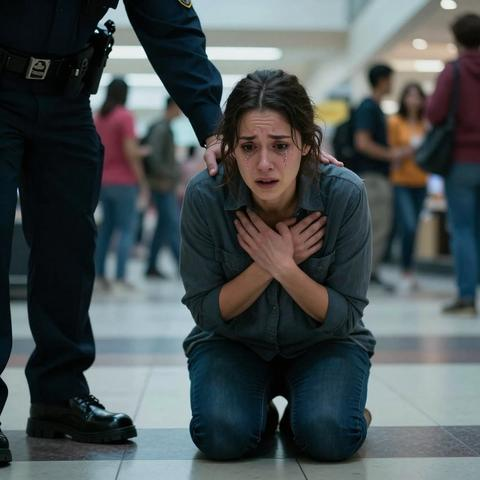
“Please,” I sobbed, my voice breaking, dropping my aggression as I realized fighting the officer was futile. I fell to my knees, holding my hands up in a desperate prayer. “Please, I’m begging you. He’s just a little boy. He didn’t do anything wrong. Just get the dog off him.”
I looked at Leo again. Something was terribly wrong. His face had drained of all color, turning an ashen, sickly gray. His lips were parting, taking in short, shallow gasps of air. The “fuzzy head” he had complained about that morning suddenly flashed through my mind like a warning siren I had ignored.
The K9, still draped over my son’s chest, let out a sharp, high-pitched whine. It wasn’t an aggressive growl; it was a sound of extreme distress. The dog nudged its wet nose forcefully under Leo’s chin, tilting my son’s head back to open his airway, maintaining that crushing downward pressure on his body.
I looked back at the officer, preparing to scream again, preparing to beg for someone, anyone in the crowd to call 911.
But the officer wasn’t looking at me with the cold, detached authority I expected. He wasn’t reaching for a weapon. He wasn’t telling me to calm down.
He released my wrist. He dropped to his knees right beside me, placing himself perfectly between the wall of staring strangers and my son. The harsh, tactical exterior of the policeman suddenly vanished, replaced by the deeply human, devastatingly sad face of a man who recognized a tragedy unfolding before it had fully begun.
His eyes, framed by the dark brim of his uniform cap, were filled with an overwhelming, sorrowful sympathy. He reached out, his heavy, calloused hand gently hovering over my shaking shoulder.
He leaned in close, blocking out the flashes of the cameras, the whispers of the crowd, the terrible pop music still playing cheerfully over the mall’s speakers.
He looked directly into my terrified eyes, and in a voice so soft it was almost drowned out by the dog’s anxious whining, he whispered three words that shattered my entire reality.
“He’s protecting him.”
CHAPTER II
The world didn’t come back with a bang. It came back with a rhythm. A wet, heavy, rhythmic thudding that I felt in my own marrow before I understood what it was. Leo’s body, usually so light and limber, had become a frantic machine of electricity and muscle. He wasn’t just shaking; he was vibrating with a violence that seemed impossible for a seven-year-old.
And the dog—the beast I had just been screaming for someone to kill—was no longer a predator. He was a shock absorber. The Belgian Malinois had wedged his thick, muscular torso directly beneath Leo’s head. Every time Leo’s skull would have cracked against the polished marble of the Westfield floor, it instead met the dense, tawny fur of the animal’s shoulder. The dog, whom I later learned was named Bear, didn’t flinch. He let out a low, mournful whine, his eyes fixed on the officer, but his body remained an unyielding mattress for my son’s trauma.
“He’s protecting him,” the officer’s voice drifted over me again, like a life raft in a dark sea.
I stopped screaming. The silence that followed was worse than the noise. Around us, the mall had frozen. I could see the glint of dozens of smartphone lenses, a sea of black glass eyes capturing my undoing, capturing my son’s most vulnerable moment, capturing the ‘crazy woman’ who had tried to punch a police dog. I didn’t care about the cameras. I only cared about the blue tinge creeping into Leo’s lips.
“He’s not breathing,” I choked out, my hands hovering over Leo, terrified to touch him, terrified that I would break the fragile equilibrium the dog had created.
“He is,” the officer said, kneeling beside me. His name tag read *Miller*. He wasn’t looking at me; he was watching Bear. “The dog is keeping his airway tilted. If Bear moves, Leo chokes. Just stay still, Ma’am. The paramedics are coming through the North entrance. Three minutes.”
Those three minutes were an eternity. I watched the clock on a nearby jewelry store display. Each second hand tick felt like a physical blow. I looked at Leo’s eyes—they weren’t there. Only the whites remained, flickering like a dying television screen. This was the moment the ‘Old Wound’ ripped wide open.
For months, I had been telling myself the headaches were just growth spurts. I told myself the way he tripped over his own feet was just clumsiness. My ex-husband, Mark, had told me I was ‘over-mothering’ again. My own mother had whispered that I was looking for problems where none existed because I couldn’t handle the quiet of our new, smaller apartment. I had started to believe them. I had buried the maternal instinct that told me something was rotting at the center of my son’s health because it was easier to be ‘fine’ than to be the ‘hysterical woman’ again. I had carried that dismissal like a hidden bruise, pressing on it in the middle of the night, wondering if I was the one who was broken.
Now, as I watched my son’s life leak out onto a mall floor, I realized my silence had been a betrayal.
“I knew,” I whispered, not to Miller, but to the air. “I knew something was wrong.”
The paramedics arrived in a blur of red bags and radio static. They worked with a clinical coldness that was both terrifying and comforting. When they tried to move Leo, Bear refused to budge at first. He looked at Miller, waiting for a command.
“Easy, Bear. Release,” Miller said softly.
As the dog backed away, I saw the damp patch on his fur where Leo’s head had rested. It was a perfect circle of sweat and saliva. Bear shook himself, his tags jingling, and retreated to Miller’s side, his job done. He looked exhausted.
They loaded Leo onto the gurney. The crowd parted like the Red Sea, but they didn’t stop filming. I saw a teenager in a hoodie narrating into his phone: “Yo, the mom literally tried to fight the dog, she’s losing it.” I wanted to turn and explain. I wanted to tell them I was just a mother. But there was no time.
I climbed into the back of the ambulance, and the doors slammed shut, cutting off the mall’s artificial light and the judgmental hum of the crowd.
***
The hospital was a different kind of nightmare. St. Jude’s Regional wasn’t the place for ‘fuzzy heads.’ It was the place for endings.
By the time we reached the ER, Leo had stabilized, but he hadn’t fully regained consciousness. He was in what they called a ‘post-ictal state,’ a heavy, dark sleep that looked too much like death for my comfort. I sat in a plastic chair in Room 4, the fluorescent lights humming a low, maddening B-flat.
Dr. Aris, a woman with tired eyes and a voice like gravel, came in two hours later. She held a tablet like it was a weapon.
“Mrs. Vance?” she asked.
“Just Sarah,” I said. My voice felt like it had been scraped with sandpaper.
“Sarah. The CT scan shows a significant amount of swelling in the temporal lobe. But it’s not a standard seizure disorder. We’re looking at something called Rasmussen’s Encephalitis. It’s an inflammatory neurological disease. It’s rare, and in Leo’s case, it’s progressing with terrifying speed.”
I felt the air leave the room. “Rare? How do we fix it?”
“There are treatments. Immunosuppressants, plasmapheresis. But because of the severity of this afternoon’s event, we need to move to a specialized pediatric neuro-ICU. We need a hemispherectomy consultation. That means surgery, Sarah. Potentially removing or disconnecting half of his brain to save the other half.”
I gripped the edges of the plastic chair. “Okay. Do it. Move him. Whatever it takes.”
Dr. Aris didn’t look away, but her posture shifted. This was the moment of the ‘Secret.’
“There’s a complication,” she said. “Our facility is out-of-network for your primary provider. And because this is a ‘pre-existing condition’ investigation—given the history of headaches you mentioned in the intake—the insurance company has placed a hold on the transfer to the specialty center in the city. They’re claiming the mall incident was an acute episode that can be managed here with basic observation.”
“Managed here?” I stood up, my voice rising. “You just said he needs his brain cut open to save his life! This isn’t a broken arm!”
“I know that,” Aris said, and for a second, I saw the human behind the white coat. “But the administration won’t authorize the transport without a guarantee of payment or an override from the board. The cost for the specialized unit alone is forty thousand dollars a day. The surgery is in the mid-six figures.”
My stomach turned. My ‘Secret’ wasn’t just the medical neglect I’d practiced on my son. It was the fact that I had exactly four hundred and twelve dollars in my savings account. I had lost my job as a legal secretary four months ago. I’d been working part-time at a dry cleaner, paying for COBRA insurance that I knew was about to lapse. I had been hiding the cancellation notices in the bottom of the kitchen junk drawer, praying that if I didn’t open them, they weren’t real.
“I can’t pay that,” I whispered. “But he’ll die if he stays here, won’t he?”
Aris didn’t answer. Her silence was a ‘Yes.’
***
I walked out to the waiting room to find a phone charger. I needed to call Mark, though I knew he’d just blame me. I needed to call someone.
As I stepped into the lobby, I saw him. Officer Miller. He was sitting on a low bench, his tactical vest gone, wearing just his dark uniform shirt. Bear was at his feet, ears pricked.
“How is he?” Miller asked, standing up.
“He’s… he’s dying in a very expensive way,” I said, the bitterness leaking out of me before I could stop it.
Miller frowned. “What does that mean?”
I told him. I told him about the encephalitis, the surgery, and the cold, hard wall of the insurance company. I told him about the junk drawer full of notices. I bared everything to this stranger because he was the only person who had seen the truth of the moment.
“They won’t move him,” I sobbed, finally breaking down in the middle of the sterile lobby. “They’re going to let him sit in Room 4 until his brain just… stops.”
Miller looked at Bear, then back at me. “Do you have any idea how many people have seen that video of you two?”
I shook my head. “I don’t want to see it. I look like a monster.”
“No,” Miller said, pulling out his own phone. “You look like a mother who thought her son was being eaten by a wolf. And Bear? Bear looks like a saint. The internet loves a hero dog. But they love a fight even more.”
He showed me the screen. The video had four million views. The comments were a war zone. Half the people were calling for my arrest for ‘assaulting a K9.’ The other half were questioning why a police dog was ‘attacking’ a child in the first place.
“The department is getting heat,” Miller said quietly. “They want to put out a statement. They want to show that Bear did his job. But I told them I wouldn’t sign off on a ‘justified use of force’ report because there was no force. There was a rescue.”
He leaned in closer. “If we tell the real story—the whole story—the department looks like heroes. The dog looks like a miracle. And the hospital? The hospital looks like the villain who’s holding a hero’s kid hostage for a check.”
“You want to use the video?” I asked.
“I want to use the leverage,” Miller corrected. “But it means you have to go on camera. You have to tell the world about the insurance. You have to admit you were wrong about the dog, publicly. You’ll be the face of the ‘Westfield Karen’ meme for a while, Sarah. But it might force their hand.”
This was the Moral Dilemma. To save Leo, I had to destroy the last shred of my dignity. I had to become the public villain, the woman who attacked a dog, the woman who failed to get her son medical help until it was a viral event. I had to expose my poverty and my negligence to the entire world.
“They’ll hate me,” I said.
“They already do,” Miller said bluntly. “But they’ll help him. People are strange that way.”
***
By midnight, the plan was in motion. Miller had contacted a local news reporter he trusted, a woman named Claire who specialized in ‘human interest’ stories that usually involved kittens or veterans. This was different.
We met in the hospital cafeteria. The fluorescent lights were even more unforgiving here.
“Sarah,” Claire said, her voice practiced in its empathy. “We have the footage from the mall. We have a statement from the police chief praising Bear’s training. Now we need you. We need you to tell us what it felt like when you realized the dog wasn’t hurting him.”
I looked at the camera lens. It felt like the barrel of a gun.
“I was terrified,” I started, my voice trembling. I thought about the ‘Old Wound’—all those doctors who told me I was crazy. I thought about the ‘Secret’—the unpaid bills in the drawer. “I was terrified because I’ve been failing my son for months. I ignored the signs because I couldn’t afford for them to be real.”
Claire signaled for the cameraman to zoom in. This was the ‘hook.’
“And today,” I continued, tears streaming down my face, “a dog saw what I refused to see. He saved my son from the floor, but now the hospital is letting him slip away because of a billing code. They won’t let him go to the specialists who can save his life.”
I looked directly into the camera. “My name is Sarah Vance. I’m the woman from the video. I’m the woman who tried to hit a hero. You can hate me. You can call me whatever you want. But please, don’t let my son pay for my mistakes. Don’t let him die because I’m poor.”
As we finished, Miller’s radio chirped. He stepped away to take the call. When he came back, his face was grim.
“The hospital administrator is on her way down,” he said. “She’s not happy. She says we’re violating HIPPA and hospital policy by filming.”
“Is she going to move him?” I asked, hope flared like a match in a windstorm.
“She’s going to try to shut us down,” Miller said.
Five minutes later, Mrs. Gable, the administrator, arrived. She was a woman built of sharp angles and expensive wool. She didn’t look like a villain; she looked like a spreadsheet.
“Mrs. Vance, Officer Miller,” she said, her voice tight. “This spectacle is highly inappropriate. We are doing everything within our protocols to care for Leo.”
“Your protocols are a death sentence,” I said, surprised by the sudden strength in my own voice.
“We have rules for a reason,” Gable snapped. “We cannot simply bypass the financial and legal requirements for a high-risk neurological transfer based on a social media trend.”
“It’s not a trend,” Miller said, stepping forward. Bear let out a low, vibrating growl. It wasn’t an attack; it was a warning. “It’s a life. And right now, the whole city is watching you decide what that life is worth.”
Mrs. Gable looked at the camera, then at me, then at the dog. I could see the calculation happening behind her eyes. She wasn’t thinking about Leo’s brain; she was thinking about the hospital’s brand. She was thinking about the PR disaster of being the woman who said ‘No’ to the K9 hero.
“I will speak to the board,” she said finally, her voice cold as ice. “But if we do this, Sarah, you should know—there is no guarantee. The surgery itself has a fifty-percent survival rate. You might be fighting all this just to say goodbye in a more expensive room.”
“I’ll take those odds,” I said.
As she walked away, I felt a hand on my shoulder. It was Miller.
“We got the transfer,” he said.
“But she’s right,” I whispered, looking toward Leo’s room. “I might have just traded my reputation for a more expensive funeral.”
I looked down at Bear. The dog sat back on his haunches, his tongue lolling out, looking perfectly content. He had done his part. He had broken the world open. Now, I had to live in the ruins and wait to see if my son would wake up to join me.
But the dilemma wasn’t over. As Miller walked me back to Leo’s room, my phone buzzed. It was a message from an unknown number. A link to a new video.
It wasn’t the mall video. It was a video from three years ago. A video of me at a different hospital, screaming at a different nurse. The ‘Old Wound’ wasn’t just my history; it was my digital footprint. Someone was digging. Someone didn’t want the ‘Westfield Karen’ to be the victim.
I looked at Leo, sleeping under the harsh lights, and I knew the real fight hadn’t even started yet. The world had given me what I wanted, but it was going to take everything else I had in exchange.
CHAPTER III
The silence at the Metropolitan Neurological Institute was different from the noise at the county hospital. It was the silence of money. It was the hum of expensive air filtration and the soft squeak of rubber soles on polished white stone. I sat in a chair that cost more than my car, watching the digital clock on the wall.
Leo had been in surgery for four hours.
Officer Miller sat three seats away. He was out of uniform, wearing a faded hoodie that made him look smaller, more human. Bear was at his feet, a heavy shadow on the marble. The dog was still. He knew this wasn’t a place for work, but he remained alert, his ears twitching at every chime of the elevator.
I felt like a ghost. The viral video of me attacking Miller had reached ten million views. People online were calling me a ‘Warrior Mom’ and a ‘Hysterical Menace’ in the same thread. My face was a meme. My trauma was a GIF.
Then the man in the charcoal suit appeared.
He didn’t look like a doctor. He looked like an ending. He walked toward me with a leather-bound folder tucked under his arm. This wasn’t Dr. Aris. This was the institution itself.
“Ms. Vance? I’m Julian Sterling, Chief Legal Counsel for the Institute.”
He didn’t offer his hand. He gestured toward a private glass-walled office. Miller started to stand, but Sterling gave him a look that froze him in place. This wasn’t about public safety. This was about the ledger.
Inside the office, the air was cold. Sterling laid the folder on the desk. He didn’t waste time with tea or sympathy.
“We have reviewed the secondary records leaked from your previous clinic,” Sterling said. His voice was like a razor. “It appears that three years ago, a pediatrician flagged Leo for ‘neurological irregularities.’ You failed to follow up on the MRI referral.”
My throat went dry. “I was working double shifts. I didn’t have the insurance then. I thought he was just tired.”
“The insurance company calls that ‘willful medical non-compliance,’” Sterling replied. “They are rescinding the authorization for the surgery currently taking place. As of twenty minutes ago, you are personally liable for the four-hundred-thousand-dollar surgical fee. And the Institute is being advised to file a report with Child Protective Services regarding the initial neglect.”
I couldn’t breathe. The room felt like it was shrinking.
“However,” Sterling continued, sliding a single sheet of paper toward me. “The Board is willing to intervene. We recognize the ‘Hero Dog’ narrative is a significant PR asset for this facility. We will cover all costs. We will bury the CPS report. We will ensure Leo receives the best post-operative care in the country.”
“What’s the catch?” I whispered.
“You sign this. A full non-disclosure agreement. You retract all statements made against Mrs. Gable and the previous hospital. You grant us exclusive rights to your story for our marketing materials. And most importantly, you waive any right to sue for future complications. You become our success story. Or you become a criminal. Choose.”
I looked through the glass. Miller was watching us. He knew something was wrong. In the distance, I saw a gurney being wheeled out of the OR suite. Leo.
I didn’t read the fine print. I didn’t care about my soul. I grabbed the pen and signed my name so hard the paper tore. I sold the truth to save the boy.
“Good choice,” Sterling said, taking the paper. He didn’t smile. He just left.
I ran to the ICU.
Leo was a tangle of tubes and wires. His head was wrapped in a thick white turban of gauze. He looked like a doll, not a child. Dr. Aris was there, looking exhausted.
“The resection went well, Sarah,” he said, but he didn’t look me in the eye. “We removed the focal point of the seizures. Now we monitor. The next twelve hours are critical.”
They moved him into a private glass-walled recovery bay. Because of the ‘Hero Dog’ arrangement Sterling had just secured, they allowed Miller and Bear to come into the hallway for a ‘therapeutic photo op.’ A hospital photographer was already there, snapping shots of the K9 looking through the glass at the recovering boy. It was nauseating. It was a staged miracle.
Miller looked at me, his eyes searching. “Sarah? What happened in that office?”
“I saved him,” I said. My voice sounded dead. “I did what I had to do.”
For two hours, the monitors hummed a steady, rhythmic song. Green lines danced across the screens. Heart rate stable. Oxygen stable. Intracranial pressure within limits. The nurses checked him every fifteen minutes. Everything was perfect.
But Bear began to change.
He had been lying flat, but now he stood. He pressed his nose against the glass of the ICU bay. A low, vibrating growl started in his chest.
“Bear, sit,” Miller commanded.
The dog ignored him. He began to pace. His hackles were up. He wasn’t looking at us. He was staring at Leo’s neck.
“He’s just stressed,” the floor nurse said, adjusting a clip on Leo’s IV. “The monitors are all green, honey. He’s fine.”
Bear didn’t stop. He let out a sharp, piercing bark that echoed through the sterile hall. Then another. He began to scratch at the glass door, his claws screeching against the surface.
“Miller, get that dog under control or he’s out of here!” a security guard shouted, moving toward them.
“Something’s wrong,” I said. I felt a cold spike of adrenaline. I remembered the mall. I remembered how Bear knew before I did.
I looked at the monitors. They were still green. The numbers hadn’t changed.
“The equipment says he’s stable, Sarah,” Miller said, struggling to hold Bear’s leash. The dog was lunging at the door now, desperate. “Bear! Down!”
Bear didn’t go down. He let out a sound I’ll never forget—a mournful, high-pitched howl that cut through the hospital’s artificial peace.
I didn’t wait for permission. I pushed past the nurse and burst into the ICU bay.
“Get her out of there!” someone yelled.
I ignored them. I grabbed Leo’s hand. It was warm. His chest was rising and falling. But I looked at his neck, where Bear had been staring.
There was a small bulge near the base of his skull, just below the bandage. It was pulsing. It wasn’t a normal pulse. It was a slow, heavy throb.
“Dr. Aris!” I screamed.
“Ms. Vance, step back!” a nurse shouted, grabbing my arm.
I fought her off. I ripped the sheet back. Leo’s right leg gave a tiny, involuntary twitch. Then his left. It wasn’t a seizure. It was something else.
“The monitors!” I yelled. “Look at the monitors!”
“They’re normal!” the nurse insisted, pointing to the screen.
Bear was throwing his entire weight against the glass now. The glass was spider-webbing. Miller couldn’t hold him. The dog wasn’t being a ‘hero’ for the cameras. He was a predator scenting a kill—and the kill was inside my son.
Dr. Aris ran into the room. He looked at the screens, then at me. “Sarah, calm down.”
“The dog knows!” I screamed, pointing at Bear. “He knows! Check the site! Check the shunt!”
Aris looked at the dog, then at the pulsing bulge on Leo’s neck. He reached out and touched it. His face went white.
“He’s got a silent hematoma,” Aris whispered. “It’s trapped behind the primary monitor sensor. The pressure is building inward, not outward. That’s why the sensors aren’t picking it up.”
Suddenly, the ‘green’ monitors went into a frenzy. The heart rate flatlined. The oxygen levels plummeted to thirty. The machines were finally catching up to the reality Bear had known five minutes ago.
“Code Blue!” Aris yelled. “Get the crash cart! Re-open the tray! Now!”
Everything became a blur. Hands shoved me against the wall. The photographer who had been taking ‘feel-good’ photos was now recording the chaos. Security guards were trying to tackle Miller and Bear in the hallway.
“Let him stay!” I shrieked. “The dog saved him!”
They ignored me. They were cutting into Leo’s neck right there in the bed. Blood sprayed onto the white turban.
I saw Sterling, the legal counsel, standing at the end of the hall. He wasn’t helping. He was looking at his watch. He was calculating the liability. He saw the photographer. He saw the chaos. He saw his ‘success story’ bleeding out while a police dog screamed in the hallway.
I realized then that I had signed the paper for nothing. The institution didn’t care if Leo lived. They cared if the story lived.
“Push ten of mannitol!” Aris shouted. “He’s herniating!”
Leo’s body arched off the bed. His eyes flew open, but they were rolled back, showing only the whites. He looked like he was being pulled away by an invisible tide.
I looked at Miller. He had let go of the leash.
Bear didn’t attack anyone. He ran to the glass door, sat down, and put his head on the floor. He stopped barking. He stopped fighting. He just waited.
In that moment, I knew. The dog wasn’t trying to save Leo anymore. He was mourning him.
I looked back at the bed. The room was full of blue scrubs and the smell of copper. The steady beep of the flatline was the loudest thing I had ever heard.
Sterling walked away. He had seen enough. The contract was signed. The liability was shifted. The PR disaster was being managed in real-time.
I fell to my knees. The cold marble felt like ice. I reached out for Leo, but there were too many bodies in the way. I couldn’t even see my son’s face.
I looked at the camera lens of the photographer. He was still filming.
“Help him,” I whispered.
But the photographer just adjusted his focus.
I had sold my right to the truth. I had sold my right to justice. I had handed my son over to a system that saw him as a line item on a spreadsheet, and now that line was being erased.
Dr. Aris stopped pumping Leo’s chest. He looked at the clock.
“No,” I breathed. “No.”
Miller walked into the room. He didn’t look at the doctors. He didn’t look at the machines. He walked over to me and put a heavy, trembling hand on my shoulder.
“Sarah,” he said.
I looked at the hallway. Bear was gone. A security guard had finally managed to drag him away.
I was alone in a room full of people. I was the mother of a hero, a villain, and a ghost.
I looked at the signed NDA sitting on the counter, splattered with my son’s blood. I reached out and grabbed it. I didn’t tear it. I didn’t scream. I just folded it and put it in my pocket.
They thought they had bought my silence. They thought the story ended when the heart stopped.
They were wrong.
I stood up. My legs felt like lead, but I stood. I walked over to Leo. The doctors moved aside now. There was no more urgency. There was only the heavy, expensive silence of the Institute.
I touched his cheek. It was still warm.
I looked at Dr. Aris. “Tell me the truth.”
“The hematoma was… it was a surgical complication, Sarah. It happens.”
“No,” I said. I looked at the trash can where they had thrown the packaging from the surgical tools. I saw the labels. I saw the dates. “It didn’t just happen.”
I saw the fear in his eyes. He knew.
I walked out of the ICU. I didn’t look back. I walked past Sterling, who was on his phone, likely briefing the board. I walked past the security guards.
I found Miller in the lobby. He was holding Bear’s harness. The dog looked exhausted, his head low.
“It’s over,” Miller said.
“It’s not over,” I said. I pulled the bloody NDA from my pocket and handed it to him. “They didn’t pay for the ending they’re going to get.”
I walked out of the Institute and into the night. The city was bright, indifferent, and loud. I had lost everything. I had no son, no money, and no reputation.
But as I stood on the sidewalk, I realized I had one thing left.
I had the dog’s witness. And the dog didn’t sign a contract.
CHAPTER IV
The silence in the apartment was a physical thing. It pressed on me, heavy and damp, like a shroud. Leo’s absence wasn’t just a lack of noise; it was the missing half of every breath I took. I kept expecting him to burst through the door, a whirlwind of tangled hair and boundless energy, asking for a snack or wanting to show me some newly discovered treasure – a rock, a feather, a brightly colored leaf. But the door remained stubbornly, cruelly closed.
The news spread like wildfire. The local news picked it up first – ‘Hero Dog Fails to Save Boy,’ the headline blared, insensitive and gut-wrenching. Then the national outlets followed, twisting the narrative to fit their agendas. Some painted me as a grieving mother wronged by a heartless corporation. Others hinted at my initial hostility toward Bear, suggesting I somehow deserved this outcome. The online forums were a cesspool of speculation and judgment. I deleted all my social media accounts, but the screenshots and accusations still found their way to me through forwarded emails and anonymous texts.
I barely ate. Sleep was a torment, haunted by images of Leo’s final moments, the frantic beeping of machines, the doctors’ grim faces. I replayed every decision, every conversation, every moment leading up to his death, searching for a way I could have changed things, a path that would have led to a different outcome. But there was none. Leo was gone, and the weight of that reality threatened to crush me completely.
The phone rang. I ignored it. It rang again. And again. Finally, I picked it up. It was Julian Sterling.
‘Sarah,’ he said, his voice smooth and oily, ‘I understand you’re going through a difficult time. But I must remind you of the non-disclosure agreement you signed. Any breach of that agreement will have serious legal consequences.’
I hung up. The threat, veiled as concern, only fueled my resolve. I couldn’t stay silent. Leo deserved better. He deserved the truth.
I called a lawyer. A real one, not someone hand-picked by the hospital. Her name was Ms. Alvarez. She listened patiently as I recounted everything – the faulty surgical tools, the delayed response, Sterling’s blackmail, the NDA. When I finished, she leaned back in her chair and sighed.
‘This is a difficult case, Ms. Vance,’ she said. ‘The hospital has deep pockets and a powerful legal team. And the NDA… it’s a significant obstacle.’
‘I don’t care about the obstacles,’ I said, my voice trembling but firm. ‘I care about the truth. I care about justice for Leo.’
Ms. Alvarez agreed to take the case, but she warned me it would be a long and arduous battle. She also told me to be prepared for the hospital to attack my character, to try to discredit me in any way they could. I knew she was right, but I was ready. I had nothing left to lose.
My days became a blur of legal consultations, depositions, and media inquiries. The hospital’s PR machine went into overdrive, releasing carefully crafted statements denying any negligence and praising their commitment to patient safety. They even trotted out Dr. Harding, who gave a tearful interview about how deeply affected he was by Leo’s passing. I wanted to scream. He hadn’t cared about Leo. He had only cared about protecting his reputation.
Then, a glimmer of hope. Officer Miller contacted me. He had been following the news and was outraged by what had happened. He told me about the body cam footage, how it had captured everything – Sterling’s blackmail, the doctors’ dismissive attitude, the chaos in the operating room. He was willing to testify on my behalf and provide the footage as evidence.
‘I can’t promise it will be easy,’ he said, ‘but I believe in what you’re doing. Leo deserves justice.’
His support gave me the strength to keep fighting. But the fight took its toll. I was exhausted, emotionally drained, and constantly on edge. I missed Leo terribly. Every morning, I woke up with a fresh wave of grief, a sharp, stabbing pain in my chest. I found myself talking to him, telling him about the case, about the people who were helping me, about my determination to get justice for him. I knew he couldn’t hear me, but it helped me feel like he wasn’t completely gone.
I found a small measure of comfort in visiting Bear. Officer Miller arranged for me to see him at the police kennel. When I arrived, Bear bounded towards me, tail wagging furiously. He licked my face and nuzzled my hand, as if he understood my pain. I hugged him tightly, burying my face in his fur. He was the only one who truly understood what I had lost. The only one who had been there, trying to help, when everyone else had failed.
The trial was a circus. The media descended on the courthouse, eager to witness the spectacle. The hospital’s lawyers were ruthless, attacking my credibility at every turn. They questioned my parenting skills, my mental stability, even my motives for seeking treatment at the Metropolitan Neurological Institute. They tried to portray me as a hysterical, attention-seeking mother who was exploiting her son’s death for personal gain.
But Ms. Alvarez was brilliant. She systematically dismantled their arguments, presenting a clear and compelling case of negligence. She called expert witnesses who testified about the faulty surgical tools and the hospital’s inadequate protocols. And then, she played the body cam footage.
The courtroom went silent as the video played. Everyone watched in stunned silence as Sterling blackmailed me, as the doctors dismissed my concerns, as the monitors flatlined while Bear desperately tried to alert them. The footage was damning. It exposed the hospital’s lies and revealed the truth about what had happened to Leo.
The hospital’s lawyers tried to argue that the footage was inadmissible, that it had been obtained illegally. But the judge ruled that it was relevant to the case and that its probative value outweighed any potential prejudice.
The atmosphere in the courtroom shifted. The jury, who had seemed skeptical of me at first, now looked at me with sympathy and understanding. I could feel the tide turning.
Then came my testimony. I took the stand and told my story, from the moment Bear saved Leo at the mall to the moment he died in the operating room. I spoke about my love for Leo, my hopes for his future, and the devastating loss I had suffered. I didn’t hold back my emotions. I cried, I trembled, I poured out my heart. And the jury listened.
‘I’m not doing this for myself,’ I said, my voice choked with tears. ‘I’m doing this for Leo. I’m doing this so that no other child has to suffer the same fate. I’m doing this so that no other parent has to experience this kind of pain.’
My testimony lasted for hours. By the time I stepped down from the stand, I was exhausted. But I knew I had done my best. I had told the truth, and I had honored Leo’s memory.
The jury deliberated for three days. The waiting was agonizing. I barely slept, I barely ate, I barely breathed. I was consumed by anxiety and uncertainty.
Finally, the verdict came. The jury found the hospital guilty of negligence and awarded me a substantial sum in damages.
A collective gasp filled the courtroom. I closed my eyes and took a deep breath. It was over. I had won.
But as the cheers and applause erupted around me, I felt no joy. Only a hollow sense of relief. The money meant nothing to me. It couldn’t bring Leo back. It couldn’t erase the pain. It couldn’t fill the emptiness in my heart.
I walked out of the courthouse, surrounded by reporters and cameras. I answered their questions, but my mind was elsewhere. I was thinking about Leo, about how much I missed him, about how much I would always miss him.
I went back to the apartment. It was still silent, still empty. I sat on the couch, staring at the photos of Leo that lined the walls. He was smiling in every picture, his eyes full of life and joy. I picked up one of the photos and held it close to my chest.
‘We did it, Leo,’ I whispered. ‘We got justice for you.’
But even as I said the words, I knew that true justice was impossible. Nothing could ever compensate for the loss of my son. Nothing could ever fill the void he had left behind.
The aftermath was a strange mix of public vindication and private grief. The hospital’s reputation was in tatters. Dr. Harding was fired, and several other administrators were forced to resign. The hospital issued a public apology and promised to implement new safety protocols.
But none of it mattered to me. Leo was still gone. And the pain was still there, a constant, gnawing ache in my soul. I tried to go back to work, but I couldn’t focus. I couldn’t face my colleagues, who all knew what had happened. I ended up taking a leave of absence. I spent my days wandering around the city, visiting the places Leo and I used to go – the park, the zoo, the museum. Each visit was a painful reminder of what I had lost.
One day, I received a letter from a woman whose son had also died at the Metropolitan Neurological Institute. She had been following my case and wanted to thank me for exposing the hospital’s negligence. She told me that my actions had given her the courage to file her own lawsuit. We met for coffee and talked for hours. It was comforting to connect with someone who understood my pain. We formed a support group for families who had been affected by the hospital’s negligence. It was a small way to make a difference, to prevent others from suffering the same fate as Leo.
Then, a new event. The hospital filed an appeal. They claimed that the verdict was excessive and that the body cam footage had been improperly admitted as evidence. The appeal process dragged on for months, prolonging the pain and uncertainty. I had hoped to put the whole ordeal behind me, but the hospital wouldn’t let me. They were determined to protect their reputation, even if it meant dragging me through the mud all over again.
During this time, I received a message via an anonymous account. It contained a file. Inside, there were medical records, internal memos, and emails detailing how the faulty equipment had been fast-tracked into use, overriding internal safety protocols in order to meet deadlines. There were even discussions on how to suppress data about previous issues. This wasn’t mere negligence; it was active malice.
The documents were a smoking gun, a clear indication that the hospital had knowingly put patients at risk. But they also revealed something else: a conspiracy that went far beyond Dr. Harding and the local administrators. The emails implicated several members of the hospital’s board of directors, as well as executives at the medical device company that had manufactured the faulty tools.
I showed the documents to Ms. Alvarez. She was stunned. She said that this new evidence could potentially lead to criminal charges against the individuals involved. But it also meant that the legal battle would become even more complex and protracted.
I knew what I had to do. I couldn’t let these people get away with what they had done. I had to expose the truth, no matter the cost.
The anonymous message was also clear about one thing: there were powerful people who wanted this hidden, people who were willing to play dirty. Exposing this could be dangerous, and I had to be ready for that.
I strengthened my resolve. I would fight for Leo. I would fight for the other victims. I would fight for justice, even if it meant putting myself in danger.
The fight wasn’t over. It was just beginning. Justice was coming, but it was going to be ugly.
It wouldn’t bring him back. But it would honor his memory.
CHAPTER V
The verdict was a win, everyone said. Justice had been served. But standing in the echoing quiet of my apartment, Leo’s empty room a stark reminder, it felt more like a hollow victory. The silence was heavier now, imbued with the weight of what had been, and what could never be again.
I tried to find solace in the news reports, the articles detailing the hospital’s negligence, the recall of the faulty surgical tools. Each headline was a small step, but Leo was still gone. The hospital executives and board members tried to push the blame on the medical device company executives, and their denials rang hollow. I knew then that this was far from over.
The first call came late one night. An anonymous number, a distorted voice warning me to drop the case, to let it go. They knew about my life, my routines, my vulnerabilities. Fear coiled in my stomach, cold and constricting. Officer Miller insisted on installing a security system, his face grim. He said, ‘They won’t stop at threats, Sarah. Not now.’ He was right.
I threw myself into work to avoid the constant fear. Ms. Alvarez, my lawyer, had assembled a team to investigate the medical device company. The deeper we dug, the more we uncovered a web of deceit, of corner-cutting, of prioritizing profit over human life. The executives knew the tools were faulty, the board covered up the incidents to avoid a stock price drop, and patients paid the price. Leo paid the price. I couldn’t let them get away with it.
I joined a support group for grieving parents. Each shared their own story of loss, of medical negligence, of bureaucratic indifference. Their stories fueled my resolve. They understood the emptiness that gnawed at me, the relentless what-ifs that haunted my waking hours. Together, we found a fragile strength, a shared purpose in seeking accountability.
—Phase 1—
The threats escalated. My car tires were slashed. I received a package containing a child’s toy, broken and bloodied. The message was clear: they were willing to hurt me, to remind me of what I had lost. Each incident brought a fresh wave of terror, but also a stubborn defiance. I couldn’t be intimidated into silence. Leo deserved more than that.
One evening, Officer Miller sat across from me in my living room, his expression grave. ‘Sarah,’ he said, ‘they’ve been watching you. They know about the investigation. It’s getting dangerous.’ He paused. ‘I can offer you protection, but I can’t guarantee your safety. This is bigger than we thought.’
I looked around my apartment, at the photos of Leo, at the drawings he had made, at the empty space where his laughter used to fill the room. I thought of the other parents in the support group, their faces etched with grief and determination. I thought of Bear, his unwavering loyalty, his silent understanding. I couldn’t back down.
‘I have to do this, Miller,’ I said. ‘For Leo. For all the other Leos out there. I can’t let them win.’ He nodded, his eyes filled with a mixture of admiration and concern. ‘Then we do it together,’ he said. ‘We expose them all.’
We started leaking information to the press, documents outlining the company’s negligence, internal memos detailing the cover-up. The story exploded. News outlets picked up the story. The medical device company tried to deny the allegations, but the evidence was irrefutable. The stock price plummeted. Executives were fired. Investigations were launched.
—Phase 2—
Julian Sterling contacted me again, his voice dripping with false concern. He offered to help, to mediate, to make things right. I hung up on him. He was part of the problem, a cog in the machine that had taken my son. He sent flowers, a pathetic attempt at reconciliation. I threw them in the trash.
The threats intensified. One night, someone broke into my apartment. They didn’t steal anything, but they left a message scrawled on the wall in red paint: ‘Stop.’ I scrubbed it off, but the image remained etched in my mind. I started having nightmares, reliving Leo’s final moments, seeing his face contorted in pain. I woke up screaming, drenched in sweat.
Bear came to stay with me. Officer Miller said he sensed my fear, that he wanted to protect me. The dog’s presence was comforting, a silent reassurance in the face of overwhelming dread. He would lie at the foot of my bed, his warm body a shield against the darkness.
One day, I received a letter from Dr. Harding, the lead surgeon who had operated on Leo. He expressed his remorse, his regret, his helplessness. He claimed he had been unaware of the faulty tools, that he had been misled by the hospital administration. I didn’t believe him. He was a skilled surgeon, a respected professional. He couldn’t have been that naive.
I confronted him. I met him in a park, away from the cameras, away from the lawyers. He looked tired, defeated. He repeated his story, his voice trembling. I saw a flicker of something in his eyes, a hint of guilt, a shadow of doubt. I pressed him harder, demanding the truth. Finally, he broke down. He admitted that he had known about the faulty tools, that he had been pressured to use them, that he had been threatened with the loss of his job if he spoke out. He had chosen his career over Leo’s life. He was supposed to protect him, not be part of his death.
—Phase 3—
I turned over Dr. Harding’s confession to Ms. Alvarez. It was the final piece of the puzzle, the smoking gun that would bring down the entire corrupt system. The authorities launched a full-scale investigation. Executives were arrested. The hospital board was dissolved. The medical device company faced multiple lawsuits. Justice was finally being served.
The trial was a media circus. The hospital and the medical device company tried to discredit me, to paint me as a grieving mother seeking revenge. They attacked my character, my motives, my sanity. But the evidence was overwhelming. The truth was undeniable. The jury found them guilty. I sat there numbly as the verdict was read.
After the trial, I visited Leo’s grave. I told him everything, about the investigation, about the trial, about the verdict. I told him that I had done everything I could, that I had fought for him, that I had honored his memory. I sat there for a long time, watching the sun set, feeling the weight of my loss.
Officer Miller stood a respectful distance away, Bear at his side. When I finally rose to leave, Bear came to me, nudging my hand with his wet nose. His eyes were filled with a deep understanding, a silent compassion. I reached down and stroked his soft fur, feeling a flicker of warmth in the cold emptiness of my heart.
I continue to support the parents in the group, and together we have influenced legislation to protect future children, and increase the regulations of the manufacturing companies and the medical establishments that serve the public. One day, I know that a new law, named after Leo, will be enacted.
—Phase 4—
The silence in my apartment is still there, a constant reminder of Leo’s absence. But it’s different now. It’s not just an empty silence, a void filled with grief and despair. It’s a silence filled with the echoes of a fight worth fighting, a battle against injustice, a commitment to protecting others from the pain I have endured.
I still have nightmares. I still miss Leo every day. But I also have a sense of purpose, a sense of hope. I know that his life, though tragically short, had meaning. He inspired me to fight for what is right, to challenge the powerful, to expose the truth. And that is a legacy worth cherishing.
I looked at Bear, lying at my feet, his eyes fixed on me with unwavering loyalty. He was more than just a hero dog. He was a symbol of unwavering devotion, of silent strength, of the enduring power of love. He was a reminder that even in the darkest of times, there is always hope. He was my constant companion, my silent guardian, my furry reminder that light still existed in the world.
The silence was still there, but now, it held the echoes of a fight worth fighting.
END.