Chapter 1: The Weight of the Morning
There is a specific kind of silence that settles into a house when someone you love dies. It isn’t just the absence of noise; it’s a heavy, suffocating blanket that drapes over the furniture, seeps into the floorboards, and makes every breath feel like a chore.
My husband, David, had been gone for exactly fourteen months. A drunk driver on a rain-slicked highway had turned my vibrant, laughing partner into a memory, leaving me alone in our sprawling, suddenly too-quiet home in the suburbs of Portland, Oregon. But more importantly, it left our son, Leo, without a father.
Leo was six. At six, you are supposed to be discovering the world, skinning your knees, and complaining about broccoli. You are not supposed to be asking your mother if Daddy can see you from the stars.
On the morning of September 14th, the day the world shifted on its axis, I was already running late.
“Leo, buddy, we need to go. Your shoes, please,” I called out, my voice strained with the familiar, exhausted edge of a single mother trying to do the jobs of two people.
I stood in the kitchen, wiping smeared jelly off the granite countertops. The smell of burnt toast lingered in the air. I looked over at the kitchen table. Leo was sitting there, his legs dangling halfway to the floor, staring blankly at his half-eaten cereal. He was wearing his oversized blue dinosaur backpack—the one David had bought for him the week before he died. Leo refused to go anywhere without it.
“I don’t want to go to school, Mom,” Leo said quietly. His voice barely carried over the hum of the refrigerator.
I stopped wiping the counter. I closed my eyes and took a deep breath, fighting the knot of anxiety that permanently lived in my stomach. “We talked about this, sweetie. It’s Friday. Pizza day. Mrs. Gable is going to read that book about the astronauts.”
Leo looked down at his light-up sneakers. “My stomach hurts.”
It broke my heart. It always did. His “stomach hurts” were never physical. They were the manifestations of a little boy who had learned too early that the people you love can walk out the door and never come back. He was terrified to leave my side. And if I was being completely honest with myself, I was terrified to let him out of my sight. I had become suffocatingly overprotective. I double-checked the locks on the doors four times every night. I memorized the background of every teacher at Oak Creek Elementary. I had become a woman driven by the fear of a second shoe dropping.
I walked over, knelt in front of him, and cupped his small, pale cheeks. His eyes—David’s eyes, a striking, deep hazel—stared back at me.
“I promise you,” I whispered, my voice thick with emotion, “I will be right there at 3:00 PM to pick you up. I am not going anywhere.”
He hesitated, then slowly nodded.
The drive to Oak Creek Elementary was short, winding through streets lined with ancient, towering oak trees that were just beginning to shed their leaves. The autumn air in the Pacific Northwest was crisp, biting with the promise of a cold winter. I kept the heater blasting in my ancient Subaru, gripping the steering wheel so tightly my hands ached. I constantly glanced in the rearview mirror. Leo was quiet, staring out the window, his tiny fingers picking at a loose thread on his dinosaur backpack.
Oak Creek Elementary was a beautiful, older school. Built in the 1950s, it sat at the edge of a dense, sprawling nature reserve. The playground was massive, a mix of old wooden play structures, blacktop, and a large grassy field that abruptly ended at a heavy chain-link fence bordering the deep woods.
We pulled into the chaotic drop-off line. Minivans and SUVs were bumper-to-bumper. Car doors slammed, parents shouted final “I love yous,” and the shrill sound of the morning bell echoed across the crisp air.
I parked the car in a visitor spot. I never just used the drop-off lane. I always walked Leo all the way to the gate of the recess yard, waiting until I saw his teacher before I would finally, reluctantly, let go of his hand.
As we walked up to the rusted chain-link fence, I spotted Mrs. Gable corralling the chaotic swarm of first graders.
Chloe Gable was twenty-eight years old, with bright, enthusiastic eyes and a perpetually messy bun. She was the kind of teacher who spent her meager salary on extra art supplies and snacks for the kids who came to school hungry. But beneath her bubbly exterior, Chloe carried a quiet, profound ache. I knew this because, during a parent-teacher conference the previous spring, she had broken down in tears. She and her husband had been undergoing grueling IVF treatments for three years, spending their life savings, only to face a string of devastating miscarriages. Chloe’s heart was desperate for a child of her own, so she poured every ounce of her thwarted maternal instinct into the twenty-three six-year-olds in her classroom. She loved them fiercely. She would step in front of a moving train for any of them. But she was also highly anxious, constantly second-guessing herself, terrified of making a mistake that would harm one of her borrowed children.
“Good morning, Leo!” Mrs. Gable called out, spotting us. She rushed over, crouching down to his eye level. “I love your dinosaur backpack. Are we ready for pizza day?”
Leo gave a shy, hesitant nod. He squeezed my hand tighter.
“He’s having a little bit of a tough morning,” I said quietly over Leo’s head, meeting Mrs. Gable’s eyes. “His stomach.”
Chloe’s expression instantly softened with understanding. She knew about David. She knew the weight Leo carried. “I’ve got him, Sarah,” she murmured softly to me. “I’ll keep a close eye on him today. Promise.”
I looked down at Leo. I forced a bright, reassuring smile that felt like wet clay on my face. “Go on, buddy. I love you to the moon and back.”
“To the stars and back,” Leo whispered our little code. He finally let go of my hand, his small fingers slipping from mine. The physical separation sent a familiar spike of adrenaline into my chest. I watched his small frame shuffle toward the group of twenty-three screaming, laughing children. He looked so incredibly fragile.
I didn’t leave immediately. I never did. I stood on the sidewalk outside the chain-link fence, clutching my cold travel mug of coffee, watching the kids line up to head toward the playground for their morning recess before classes began.
That was when I noticed him.
Standing near the edge of the woods, just inside the fence line, was Mr. Henderson. Arthur Henderson was the school’s groundskeeper, a fixture at Oak Creek for over two decades. He was a mountain of a man in his late sixties, with a weathered face carved by years of harsh sun and a pronounced limp from his time as a Marine in Vietnam. He was gruff, rarely spoke, and most of the parents found him intimidating. His wife of forty years had passed away from breast cancer two years prior, leaving him completely alone.
Well, not entirely alone.
Sitting perfectly still by his left leg, unleashed but intensely focused, was Bear.
Bear was not a normal dog. He was a purebred, 120-pound German Shepherd, a retired K9 unit that had served with the local county sheriff’s department. Bear was massive. His coat was a deep, imposing black and tan, his chest broad and muscular, and his eyes held a sharp, calculating intelligence that always made me nervous. The school board had granted Mr. Henderson special permission to keep the dog with him on the grounds, citing the dog’s flawless service record and impeccable training.
Usually, Bear was a statue. He would sit by Mr. Henderson’s side, completely ignoring the screaming children, the flying kickballs, the chaos. He was disciplined. A machine.
But this morning, something was different.
I leaned against the cold metal of the fence, watching Leo walk toward the swings, dragging his feet through a thick pile of dry, brown oak leaves near the edge of the playground, right near the tree line.
I glanced back at Mr. Henderson. He was raking leaves near the bleachers. But Bear… Bear was no longer sitting.
The massive shepherd was standing rigid. His ears were pinned flat against his skull. His hackles—the thick line of fur running down his spine—were raised into a jagged crest. He was staring dead ahead, his body practically vibrating with a terrifying, coiled energy.
“Bear, heel,” I heard Mr. Henderson bark, noticing the dog’s posture.
Bear didn’t move. He didn’t even look at his master. His dark, intelligent eyes were locked onto something across the yard. He let out a low, rumbling growl that vibrated through the crisp morning air, a sound so primal it made the hairs on my arms stand up.
I followed the dog’s gaze.
He was staring directly at the swings. He was staring directly at Leo.
My breath caught in my throat. “No,” I whispered.
Suddenly, Mrs. Gable clapped her hands. “Okay, first graders! Let’s get moving, away from the trees!”
The twenty-three children shifted, a chaotic wave of bright jackets and backpacks. Leo turned, taking a step through the thick pile of dead leaves to follow his classmates.
That was the exact moment the dog snapped.
With a deafening, terrifying bark, Bear exploded forward. The 120-pound shepherd launched himself off his back legs, digging into the dirt, entirely ignoring Mr. Henderson’s frantic, screaming command: “BEAR! NO! HOLD!”
The dog was a missile. He covered the distance across the playground with terrifying speed. His massive paws tore up the grass.
“Hey!” Mrs. Gable screamed, freezing in absolute shock, dropping the clipboard in her hands. “Stop! Dog! Stop!”
My heart stopped beating. Time dilated, stretching into an agonizing, horrific slow motion. I dropped my coffee mug. It shattered on the concrete, splashing hot brown liquid over my shoes. I grabbed the chain-link fence, my fingers digging into the metal wire until the skin tore.
“LEO!” I screamed, a sound that ripped from the very bottom of my soul, tearing my throat. “LEO, RUN!”
But Leo was six. He was small, confused, and slow. He turned his head, his hazel eyes widening in sheer terror as the massive, wolf-like beast bore down on him.
Bear didn’t slow down. He didn’t hesitate.
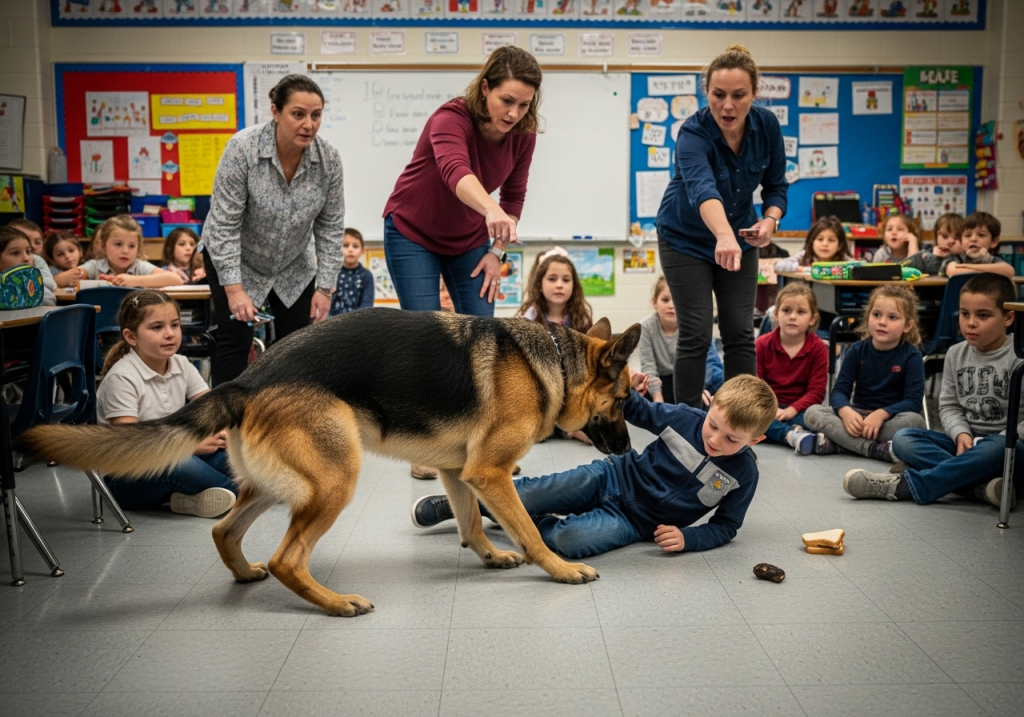
With a final, desperate leap, the 120-pound German Shepherd slammed violently into my little boy’s chest.
The impact was sickening. I heard the air get driven from Leo’s lungs. I saw his tiny feet lift off the ground as he was thrown backward. He crashed into the hard-packed dirt, his head bouncing against the ground, instantly disappearing beneath the massive, thrashing weight of the dog.
Twenty-three children began screaming simultaneously. It was a chaotic, high-pitched choir of absolute terror.
“Get him off!” Mrs. Gable shrieked, sprinting toward the pile, tears already streaming down her panicked face. “Get him off my student!”
“LEO!” I roared, throwing my entire body weight against the locked chain-link gate, rattling it with maniacal, desperate strength. “MY BABY! GET OFF HIM!”
Through the gaps in the fence, through the flurry of kicked-up dust and dry leaves, I saw Bear’s massive jaws open wide. I saw the flash of two-inch, ivory-white canine teeth. I saw the dog lunge his head downward, burying his snout directly into my son’s throat.
The world went entirely, terrifyingly black.
Chapter 2: The Anatomy of Panic
There is a distinct difference between fear and panic. Fear is a cold shiver down your spine; it is the logical part of your brain warning you of danger. Panic, however, is a violent, chemical explosion. It strips away every ounce of your humanity, every shred of rational thought, and reduces you to a primal, desperate animal.
When the 120-pound German Shepherd clamped his massive jaws down toward my six-year-old son’s throat, fear died. Panic took the wheel.
I didn’t think about the chain-link fence being eight feet tall. I didn’t process the fact that the top was lined with twisted, exposed wire meant to keep vandals out of the schoolyard at night. I didn’t care that I was wearing a skirt and a thin silk blouse, or that I had never climbed anything higher than a stepstool in my entire life.
My body simply acted.
My hands, slick with cold sweat and spilled coffee, grabbed the diamond-shaped metal links. I lunged upward, my sensible office heels slipping desperately against the metal. One shoe popped off, tumbling to the concrete below. I didn’t care. I jammed my bare foot into the chain-link, ignoring the sharp bite of the steel against my arch, and I pulled.
“LEO!” The scream that tore out of my throat didn’t even sound human. It sounded like an animal being slaughtered. It sounded exactly like the wail I had let out in the sterile, fluorescent-lit waiting room of Portland General Hospital fourteen months ago, when a doctor with exhausted eyes had told me my husband’s heart had stopped on the operating table.
We did everything we could, Mrs. Miller. The phantom echo of that doctor’s voice overlapped with the deafening, chaotic shrieks of twenty-three first graders. History was repeating itself. The universe was coming back to finish the job, to take the only piece of David I had left.
“Get off him! Get off him!”
Through the blur of tears and the blinding red haze of my own terror, I saw Mrs. Gable.
Chloe Gable was twenty-eight, barely five-foot-three, and weighed maybe a hundred and fifteen pounds soaking wet. She was wearing a yellow cardigan with little embroidered daisies on the collar. She was a woman whose body had betrayed her three separate times in the cold, quiet rooms of fertility clinics. Three times, she had painted a nursery, bought tiny onesies, and dreamed of a child, only to have her hopes hollowed out by silence on an ultrasound monitor. She carried an invisible, crushing weight of maternal grief that most people never saw.
But in that horrific fraction of a second, Chloe Gable became a titan.
She didn’t run away. She didn’t freeze. As the massive, wolf-like dog pinned my son to the autumn dirt, Chloe dropped her clipboard, lowered her shoulders, and charged.
She threw her entire small body at the 120-pound retired K9. She didn’t reach for the collar; she reached for the dog’s massive, muscular neck, wrapping her arms around the thick fur, planting her knees into the dirt, and pulling backward with a hysterical, guttural scream.
“NO! LET HIM GO! LET HIM GO!”
But Bear was immovable. He was a creature bred for war, trained to take down fleeing felons and withstand the chaos of active crime scenes. Chloe’s desperate pulling barely registered as a nuisance to him. The dog planted his front paws on either side of my son’s small chest, his hackles raised so high he looked twice his size. A terrifying, vibrating growl was erupting from deep within his chest, a sound that shook the dead oak leaves on the ground.
I was halfway up the fence now. The metal links dug into my bare toes, tearing the skin. My hands were bleeding, the rough galvanized steel shredding my palms. I reached the top, throwing my leg over the twisted wire. The sharp metal hooked into the fabric of my skirt, tearing it, slicing a deep, burning gash into the side of my thigh. I felt the warm rush of blood trickling down my leg, but the pain was distant, muted by the sheer volume of adrenaline pumping through my veins.
I threw my weight forward and practically fell the eight feet down the other side.
I hit the hard-packed dirt of the recess yard with a sickening crunch. My left ankle rolled violently. A white-hot spike of agony shot up my leg, buckling my knee. I hit the ground hard, tasting dirt and metallic blood in my mouth.
I scrambled to my hands and knees, my breath coming in jagged, agonizing gasps. “Leo… Mommy’s coming. Mommy’s coming!”
Across the yard, Mr. Henderson was running.
Arthur Henderson, the weathered, sixty-eight-year-old Marine, was moving faster than a man with two bad knees and a shrapnel scar should ever be able to move. His face, usually a stoic mask of quiet isolation, was twisted into a portrait of absolute, disbelieving horror.
To Arthur, Bear was not just a dog. After his wife, Martha, died, Bear was the only reason Arthur bothered to wake up in the morning. Bear was the one who sat by his armchair at night, resting his heavy head on Arthur’s knee while the old man wept into his whiskey. Bear was a decorated officer of the law, a hero who had found lost hikers in the freezing rain and apprehended violent criminals without hesitation. Bear was disciplined, brilliant, and deeply loyal.
Seeing his dog—his only family—suddenly break command and violently attack a six-year-old child was breaking Arthur’s reality into a million jagged pieces.
“BEAR! OFF! COMMAND OFF!” Arthur roared, his deep voice booming over the screams of the children.
Arthur reached the pile just seconds after I managed to drag myself off the dirt and start limping, half-running toward them.
“Arthur, help me! Help me get him off!” Chloe shrieked, tears streaming down her pale face. Her yellow cardigan was covered in dirt. She had her hands shoved into the thick ruff of Bear’s neck, her feet planted in the grass, pulling with all her might. Her knuckles were white. “He’s going to kill him! He’s killing him!”
Arthur threw himself to the ground beside Chloe. He didn’t hesitate. He grabbed Bear’s heavy, leather tactical collar, twisting his thick, calloused hands into the material to choke the dog off.
“Bear! Out! Out!” Arthur commanded, his voice cracking with a mixture of authority and sheer panic. He drove his knee into the dog’s ribcage, trying to physically dislodge the beast from my son.
I finally reached them.
I threw myself onto the ground, my bleeding hands reaching for Leo.
“Leo! Baby!” I sobbed, frantically trying to find my son’s face beneath the mountain of black and tan fur.
The scene was pure, unadulterated chaos. Three adults, completely unhinged by terror, wrestling a 120-pound apex predator in the middle of an elementary school playground.
And yet… something was wrong.
Through the screaming, the crying, the frantic pulling, and the cloud of dust kicked up by our struggle, a strange, terrifying detail began to pierce through the fog of my panic.
Bear was not tearing flesh.
When a dog of that size attacks to kill, it is a violent, thrashing, bloody event. They bite, they shake, they rip. But Bear was not doing that.
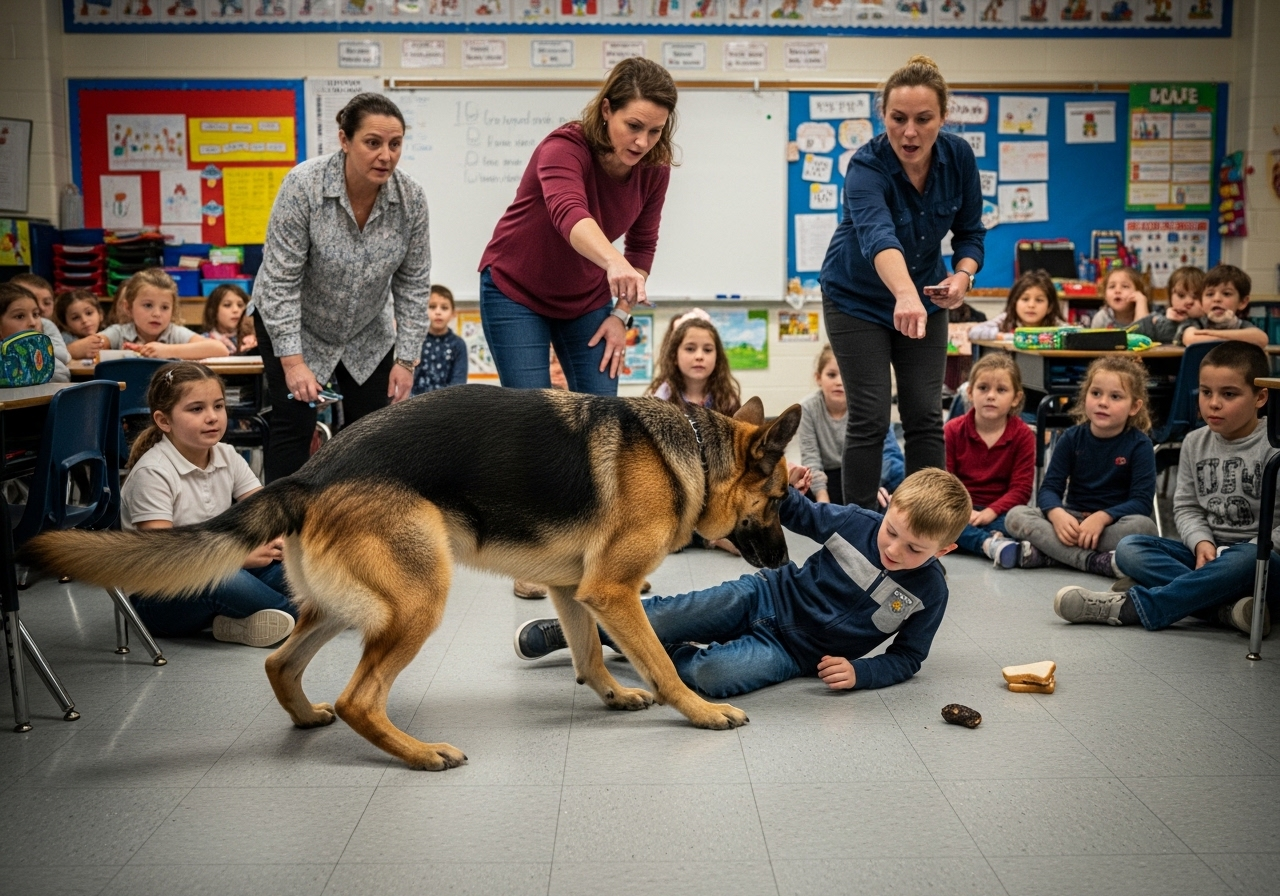
His massive front paws were planted on either side of Leo’s shoulders. His heavy, muscular chest was pressed firmly down against my son’s chest, completely pinning the six-year-old to the earth. Bear’s head was lowered, his jaws open, his teeth bared, right next to Leo’s neck.
But he wasn’t biting down.
Instead, Bear was rigidly frozen in place, a living shield of muscle and bone. And the deep, rumbling growl that was shaking his entire body? He wasn’t growling at Leo.
He was growling at the woods.
“Get away from him!” I screamed, entirely blind to anything but the fact that this monster was crushing my child. I drove my fists into the side of the dog’s head. I hit him as hard as I could, my wedding rings tearing the skin on my own knuckles. I punched his ribs, his shoulders, his neck. “Get off my son! Get off!”
Bear didn’t even flinch. He absorbed my frantic blows as if they were nothing more than a light rain. He kept his massive body draped over Leo, his eyes locked dead ahead, staring into the thick, dark tree line that bordered the edge of the playground just ten feet away.
“He won’t move! He won’t move!” Arthur yelled, his face turning purple with exertion as he hauled back on the leather collar. The old man was sobbing now, tears tracking down the deep lines of his weathered face. “I’m sorry, Sarah! I don’t know what’s wrong with him! Bear, please! God, please, let him go!”
Beneath the dog, I saw Leo’s hand.
It was tiny. Pale. Trembling. His little fingers were curled into fists, clutching the strap of his blue dinosaur backpack.
“Leo!” I cried, grabbing his small hand, my tears falling onto the dry earth. “Mommy’s here. I’m right here. Squeeze my hand, baby. Please, God, squeeze my hand.”
His fingers weakly squeezed mine back.
He was alive. He wasn’t unconscious. He was just trapped, crushed beneath the sheer weight of the animal.
“Mrs. Gable! Get the other children inside! NOW!”
The sharp, authoritative voice cut through the chaos like a knife. I looked up to see Mrs. Higgins, the senior teacher from the adjacent classroom, sprinting toward us. She had realized what was happening and was already corralling the screaming, traumatized first-graders. “Everyone inside! Lockdown! Move, move, move!”
Chloe Gable let go of the dog for a split second, looking back at her fleeing students. She was torn. The agony on her face was clear. Her maternal instinct was split down the middle—protect the child under the dog, or protect the twenty-two children running blindly toward the brick building.
“Go!” Arthur yelled at her, his voice gravelly and desperate. He was straddling Bear now, using his entire body weight to try and pry the dog’s jaws away from Leo’s face. “Get the kids inside, Chloe! Call 911! Tell them to bring animal control! Tell them to bring guns!”
The word guns hit me like a physical blow.
Arthur Henderson, a man who loved this dog more than his own life, was asking the police to come and shoot him. That was how desperate the situation had become.
Chloe nodded, a choked sob escaping her throat. She scrambled to her feet, her yellow cardigan ruined, her knees scraped and bleeding. She turned and ran after the herd of terrified six-year-olds, her voice shrieking above the wind, “Inside! Everyone inside, do not look back!”
It was just me, Arthur, the dog, and my little boy.
“Hold on, Sarah,” Arthur grunted, his muscles trembling violently. “I’m going to try to choke him out. I’m going to cut off his air.”
The old Marine twisted the leather collar, pulling it as tight as he physically could against Bear’s windpipe. It was a brutal, heartbreaking maneuver. Arthur was intentionally trying to asphyxiate his best friend to save my son.
Bear choked. A dry, rasping sound escaped his throat. But the dog did not yield.
Instead of backing away, Bear seemed to press himself even harder against Leo, spreading his front legs wider to create a firmer base. He lowered his head further, tucking his snout under his own paws, essentially hiding Leo’s face beneath his thick chest.
“He’s crushing him!” I screamed, feeling Leo’s small hand go limp in mine. “Arthur, he can’t breathe! You have to get him off!”
“I’m trying! I’m trying, God damn it!” Arthur cried, pulling with the last of his fading strength.
Minute three passed. Then minute four.
The sirens began in the distance. A faint, rising wail echoing through the crisp autumn air of the suburban neighborhood. The cavalry was coming. But it felt like they were a million miles away.
I pressed my face against the dirt, trying to look under the dog’s chest. “Leo? Leo, honey, can you hear me?”
I saw his hazel eyes. They were wide, dilated with absolute terror, staring blankly ahead. He was breathing in shallow, rapid gasps. The sheer weight of the 120-pound animal was compressing his small lungs. If the dog didn’t bite him, the compression asphyxia would kill him.
“David,” I whispered to the dirt, praying to a husband who wasn’t there. “David, please. Don’t let him take him. Please, God, not him too.”
Suddenly, Bear’s ears twitched.
The dog stopped growling for a fraction of a second. His entire massive body went completely rigid, like a statue carved out of stone. His dark eyes, which had been locked on the tree line, narrowed.
A low, vibrating snarl began to rumble in his chest again, but this time, it was different. It wasn’t a warning. It was a promise of violence.
I followed the dog’s gaze.
I looked past Arthur’s struggling arms. I looked past the chain-link fence. I looked into the shadows of the dense oak trees that bordered the school playground.
The autumn leaves were thick on the ground, piled high in brown and gold drifts. The wind was blowing, rustling the branches, creating shifting patterns of light and shadow.
For a moment, I saw nothing. Just the woods. Just the quiet, indifferent nature reserve.
But then, the wind died down. The leaves settled.
And something in the shadows moved.
It wasn’t a squirrel. It wasn’t a deer.
It was low to the ground, hidden behind a thick cluster of blackberry brambles just ten feet from where my son lay pinned beneath the dog.
My breath caught in my throat. My heart, which had been hammering a frantic rhythm against my ribs, seemed to stop entirely.
Arthur stopped pulling on the collar. He froze, his weathered hands still gripping the leather, his eyes suddenly tracking to the exact same spot in the brush.
“Dear God in heaven,” Arthur whispered, the color draining completely from his weathered face.
The sirens were getting louder. The police were seconds away. But as I stared into the dark, tangled brush of the tree line, I realized the horrifying truth.
Bear hadn’t attacked my son.
Bear had tackled him.
And as the long, thick, heavily muscled body began to slowly slide out from beneath the dead autumn leaves, its diamond-shaped head rising from the brush with a chilling, cold-blooded hiss that silenced the entire playground, the 11-minute countdown suddenly made terrifying sense.
We weren’t fighting the monster.
We were fighting the shield.
Chapter 3: The Eleven Minutes of Hell
There is a sound in nature that you don’t have to be taught to fear. It bypasses the logical centers of your brain and speaks directly to the ancient, primitive DNA buried deep inside your bones. It is a dry, electric, buzzing hum. It sounds like a high-voltage wire snapping, or a handful of dried gravel shaking inside a paper bag.
As the massive, diamond-shaped head rose from the thick cluster of autumn blackberry brambles, that sound began to vibrate through the cold morning air.
Ch-ch-ch-ch-ch-ch.
It was a rattlesnake. But it wasn’t just a snake; it was a monster. Native to the remote, rocky outcrops of the Oregon wilderness, Northern Pacific rattlesnakes occasionally wandered down into the suburbs, displaced by the heavy construction on the new highway a mile away. But this one was an anomaly. It was easily five feet long, its body as thick as a grown man’s forearm, wrapped in a jagged, terrifying pattern of dark brown and olive scales.
It had been sleeping under the warm, decomposing pile of oak leaves at the edge of the playground. And my six-year-old son had just walked directly into its nest.
The realization hit me with the physical force of a sledgehammer to the chest.
All the breath left my lungs. The frantic, blinding panic that had fueled me over the eight-foot chain-link fence instantly evaporated, replaced by a cold, paralyzing horror.
I looked at the dog.
Bear was not attacking my son. He never was.
From across the schoolyard, the retired police K9 had seen the threat before any human could even comprehend it. With his razor-sharp instincts and years of tactical training, Bear had recognized the deadly danger lurking in the leaves. He had broken command, sprinted across the blacktop, and intentionally tackled Leo to the ground. He hadn’t pinned him to hurt him. He had used his massive, 120-pound body as a living, breathing shield, pressing the boy into the dirt to keep him completely immobile, putting his own flesh between my son and the lethal strike of a disturbed predator.
I looked down at my hands. My knuckles were split, raw, and bleeding. My wedding rings were twisted. I had been punching this animal in the head. I had been screaming at him, beating him with everything I had, while he stoically absorbed my blows, refusing to abandon his post.
I looked at Arthur.
The old Marine was frozen. His thick, calloused hands slowly released Bear’s heavy leather collar. He had just spent the last four minutes trying to strangle his best friend to death. The realization of what he had almost done crashed over the 68-year-old man, and I watched his broad shoulders completely collapse.
“Oh, God,” Arthur whispered. The sound was barely a breath, carrying a lifetime of regret. “Oh, dear God. Bear… I’m sorry. I’m so sorry, buddy.”
Bear didn’t look at Arthur. He didn’t look at me. The dog’s entire universe was narrowed down to the five-foot reptile currently coiled like a spring in the brush, just three feet away from his snout.
The snake was furiously agitated. Its rattle was a deafening, continuous blur of motion. It raised the front third of its heavy body off the ground, its neck forming a tight ‘S’ shape. Its tongue flicked rapidly, tasting the air, locking its cold, dead eyes onto the massive black-and-tan dog blocking its path.
“Arthur,” I choked out, my voice trembling so violently I could barely form the words. “Arthur, what do we do?”
Arthur didn’t answer immediately. He slowly, agonizingly, shifted his weight backward, his knees popping in the dirt. The military training that had kept him alive in the jungles of Vietnam decades ago suddenly took over, overriding the panic of a grieving widower. His face hardened into a mask of pure concentration.
“Do not move, Sarah,” Arthur commanded, his voice dropping to a low, authoritative rasp. “Do not breathe loudly. Do not make a single sudden movement. If we startle it, it strikes. And if it strikes, Bear will react, and the boy could get hit.”
Beneath the dog’s chest, Leo began to whimper.
It was a small, high-pitched, terrifying sound. The sheer weight of the 120-pound animal was making it incredibly hard for my six-year-old to draw a full breath. He didn’t know about the snake. He couldn’t see the brush. All Leo knew was that a giant, terrifying dog had knocked him down, and he couldn’t move his arms or legs, and his mother was sitting right next to him, bleeding and covered in dirt, looking utterly terrified.
“Mommy,” Leo gasped, his voice muffled by Bear’s thick fur. “Mommy, it hurts. Get him off.”
Every maternal instinct I possessed screamed at me to grab my child and run. To rip him out from under the dog and sprint toward the safety of the brick school building. But the logical, rational part of my brain—the part that was currently watching a venomous apex predator sway back and forth in the dead leaves—knew that movement meant death. If I pulled Leo out, I would expose him. A child that small wouldn’t survive a full-venom bite to the face or neck from a snake that size. He wouldn’t even make it to the hospital.
I had to do the hardest thing a mother could ever do. I had to force my child to stay under the monster.
I slowly slid my body across the dirt, ignoring the searing pain from my torn ankle, until my face was inches from Leo’s ear. I kept my eyes locked on the snake over Bear’s back.
“Leo, look at me,” I whispered, fighting to keep the absolute terror out of my voice. “Look right at Mommy’s eyes.”
Leo’s hazel eyes—David’s eyes—flicked toward mine. They were filled with hot, panicked tears.
“You have to be a statue, buddy,” I breathed, stroking his hair with my bleeding, trembling fingers. “We are playing a game. You have to be completely frozen. You cannot move a muscle. Do you understand?”
“He’s crushing me,” Leo cried softly, a tear spilling over his pale cheek, leaving a clean track in the dust on his face.
“I know, baby. I know it’s heavy,” I lied, my heart breaking into a thousand pieces. “But Bear is protecting you. Bear is a good boy. He’s keeping you safe from a bad bug in the woods. You just have to be still. For Daddy. Be brave for Daddy.”
At the mention of his father, Leo’s breathing hitched. He squeezed his eyes shut and gave a tiny, almost imperceptible nod. He stopped struggling. He went entirely limp beneath the dog’s weight.
It was minute eight.
The standoff felt like an eternity. Time stretched and warped, every second agonizingly long. The playground was eerily silent. The twenty-three screaming children were gone, locked safely inside the brick walls of the school by Mrs. Gable. The only sound in the world was the violent, electric hum of the rattle and the heavy, measured panting of the dog.
Bear was magnificent.
I had been terrified of this animal for two years, viewing him as a dangerous liability. But now, looking at him, I saw the absolute pinnacle of canine loyalty. His muscles were corded tightly beneath his black coat. He was holding a half-crouch, keeping his chest firmly pressed against Leo while keeping his head raised just enough to track the snake’s every twitch. He was intentionally offering his own face, his own throat, to the snake, ensuring that if a strike came, it would hit him, not the boy beneath him.
“Hold, Bear,” Arthur whispered from his knees, his eyes brimming with tears he refused to let fall. “Hold the line, soldier. You’re a good boy. You hold that line.”
Bear’s ears flicked back toward Arthur’s voice for a fraction of a second, acknowledging the command, before locking forward again.
Then, the sirens arrived.
At first, it was a distant wail, but within seconds, the piercing shriek of police cruisers tore through the quiet suburban neighborhood. The cavalry was here. But the relief I expected to feel was instantly swallowed by a brand new, suffocating wave of panic.
They didn’t know about the snake.
Chloe Gable, the terrified teacher who had called 911, had reported a massive police dog mauling a six-year-old child. She had told them to bring animal control. She had told them to bring guns.
Two Oak Creek Police Department SUVs came skidding into the school parking lot, their tires squealing against the asphalt. The heavy doors flew open. I heard the sharp, terrifying metallic clack of sidearms being unholstered.
“Over here! By the fence!” a voice roared.
I turned my head slightly, my cheek pressing into the dirt.
Two officers were sprinting across the blacktop, closing the distance to the playground with terrifying speed. The lead officer was a young man, maybe twenty-five, his face pale and tight with adrenaline. His name badge read Ramirez. He had his service weapon drawn, gripped tightly in both hands, the barrel pointed directly at the ground as he ran. The second officer, an older man with graying temples, was right behind him, carrying a heavy black pole with a metal snare loop at the end—animal control equipment.
They reached the eight-foot chain-link fence. The gate was locked.
“Police! Ma’am, get back!” Officer Ramirez shouted through the wire mesh, his eyes locked onto the horrific scene. From his perspective, it was exactly what dispatch had reported: a massive, snarling German Shepherd pinning a small child to the ground, surrounded by two bloody, desperate adults.
“No!” I screamed, my voice cracking, throwing my hand up in the air. “Stop! Don’t come near us!”
Ramirez didn’t listen. He wasn’t trained to listen to hysterical civilians; he was trained to eliminate active threats. He shoved his boot into the chain-link, preparing to climb exactly as I had done.
“Arthur, they’re going to shoot him!” I shrieked, sheer panic clawing at my throat. “They’re going to shoot Bear!”
If they shot the dog, the 120-pound weight would instantly go limp, crushing Leo further. Worse, the gunshot would terrify the rattlesnake, practically guaranteeing a blind, lethal strike into the pile of bodies. And if Bear flinched, if Bear moved out of the way, my son would be exposed.
Arthur snapped his head toward the fence.
“STOP!” Arthur roared. It wasn’t the voice of a grieving old man; it was the booming, terrifying voice of a Marine Corps drill instructor. The sheer volume and authority of the command actually made Officer Ramirez freeze halfway up the fence.
“Sir, step away from the animal!” Ramirez yelled back, aiming his gun through the chain-link, the barrel pointed dead at Bear’s ribcage. His hands were shaking. He was a rookie. He had a two-year-old daughter at home. The thought of a child being mauled was overriding his trigger discipline. “I have a clear shot! Step back!”
“If you fire that weapon, you will kill this boy!” Arthur bellowed, his face red with fury. He didn’t move an inch from Bear’s side. He pointed a thick, calloused finger past the dog, directly into the brush. “SNAKE! WE HAVE A SNAKE! DO NOT MOVE!”
Minute nine.
Ramirez squinted through the metal mesh. It took a second for his brain to process the information, to look past the terrifying dog and peer into the shifting shadows of the autumn leaves.
When he finally saw it—the thick, coiled body, the vibrating blur of the tail, the raised, diamond-shaped head—all the color drained from the young officer’s face.
“Holy mother of God,” Ramirez breathed, slowly lowering his weapon, his finger slipping off the trigger. He dropped back down to the concrete on the other side of the fence. “Dispatch, we have a Code 4 on the dog. Repeat, Code 4 on the dog. We have a massive rattlesnake, active and aggressive, in close proximity to a trapped juvenile.”
The older officer with the snare pole rushed up to the fence. “How close?”
“Three feet,” Arthur grunted, his eyes never leaving the snake. “The dog is shielding the boy. If we spook it, it hits the dog or the kid. We need a clear angle to neutralize the reptile without causing a ricochet, and we need it right now.”
“I can’t shoot through this mesh,” Ramirez said, his voice tight with frustration. “The bullet could fragment. It could hit the child.”
“Go around to the maintenance gate!” Arthur ordered. “Fifty yards down the fence line! Enter slow, flank it from the woods side. Do not make a sound.”
Ramirez nodded sharply. He holstered his weapon, tapped his partner, and the two officers took off in a dead sprint down the perimeter of the fence, heading for the service entrance that bordered the dense nature reserve.
It was minute ten.
The snake was tired of waiting.
It had been holding its defensive posture for too long. The vibrations of the police cars, the shouting, the heavy footsteps—it had elevated the reptile’s threat response to maximum capacity. It felt cornered. It felt the immense heat signature of the dog directly in front of it.
The continuous, electric buzz of the rattle suddenly stopped.
The silence that followed was the most terrifying sound I have ever heard in my life. It was a vacuum, sucking all the air out of the playground.
“Arthur,” I whimpered, a cold sweat breaking out across my spine. “The noise stopped.”
“I know,” Arthur whispered, his entire body tensing. “Bear. Brace.”
The dog understood. Bear didn’t back away. Instead, he lowered his heavy head another inch, fully covering the gap where Leo’s small face was buried against the dirt. Bear closed his eyes, his muscles locking into solid granite. He was preparing to take the hit.
The strike happened faster than the human eye could track.
It wasn’t a lunge; it was a violent, spring-loaded explosion of muscle and venom. The massive rattlesnake launched itself forward over the pile of dry oak leaves, its jaws unhinging, two curved, hollow fangs gleaming in the pale morning sunlight.
It aimed straight for the largest heat signature. It aimed straight for Bear’s face.
I screamed, a raw, primal sound tearing from my throat.
Bear didn’t flinch. He didn’t turn his head to avoid the pain. The dog took the full, brutal impact of the strike directly on his thick, muscular left shoulder, just inches above where his chest pressed against my son.
The snake hit the dog with such force that I actually heard the dull thud of the impact. The reptile’s jaws clamped down, driving the two-inch fangs deep through the black-and-tan fur, sinking straight into the muscle. The snake injected a massive, lethal dose of hemotoxic venom directly into the dog’s bloodstream.
Bear let out a sharp, agonizing yelp—a sound of pure pain that shattered my heart.
But what the dog did next defied every law of nature.
Any normal animal, upon being struck by a venomous predator, would violently recoil, thrash, and run away to nurse its wound. It is the basic instinct of self-preservation.
Bear did not move.
Despite the agonizing, burning fire of the venom entering his veins, the 120-pound German Shepherd held his ground. He kept his front paws planted firmly in the dirt on either side of Leo. He kept his chest pinned over my child. He absorbed the lethal strike, gave one sharp cry of pain, and then instantly snapped his massive jaws forward.
Bear caught the snake mid-air as it tried to recoil from the bite.
The dog’s teeth clamped down violently around the thickest part of the reptile’s body. With a terrifying, guttural roar, Bear whipped his heavy head to the side, ripping the snake away from the strike zone. He threw the five-foot rattlesnake through the air like a ragdoll. The massive reptile hit the chain-link fence ten feet away with a heavy metallic crash, tumbling into the dirt, stunned and thrashing violently.
“NOW!” Arthur roared.
BANG.
The gunshot echoed across the schoolyard like a cannon blast.
Officer Ramirez had cleared the maintenance gate and entered the tree line. Standing twenty feet away, his service weapon drawn, he had a clear line of sight. He didn’t hesitate. He fired a single shot.
The bullet struck the thrashing rattlesnake cleanly, severing its head and instantly neutralizing the threat. The heavy, scaled body writhed wildly in the dust for a few seconds before finally going completely still.
The silence that rushed back into the playground was deafening, broken only by the ringing in my ears and the harsh, ragged sound of my own breathing.
It was over. Minute eleven.
“Bear, break,” Arthur said. His voice broke on the command. He was sobbing openly now. “Break, buddy. Good boy.”
The massive German Shepherd let out a long, shuddering breath. He slowly, painfully, lifted his heavy chest off the ground. He stepped backward, his front left leg—the one that had taken the strike—trembling violently, refusing to hold his weight.
The moment the crushing weight was lifted, Leo gasped.
It was a huge, desperate pull of air into his small lungs. He rolled over onto his back, his face smeared with dirt, his hazel eyes wide with shock. He still had his small hands tightly gripped around the straps of his blue dinosaur backpack.
I didn’t think. I scrambled forward on my hands and knees, ignoring the sharp agony in my twisted ankle, and threw myself over my son. I grabbed him, pulling his small, fragile body tightly against my chest. I buried my face in his neck, inhaling the smell of his maple syrup breakfast mixed with dust and sweat.
“I got you,” I sobbed hysterically, rocking him back and forth on the hard earth. “Mommy’s got you. You’re safe. You’re safe.”
“Mommy,” Leo cried, wrapping his small arms tightly around my neck, burying his face in my shoulder. “The doggy squished me.”
“I know, baby, I know,” I wept, kissing the top of his head over and over again. “The doggy saved you. The doggy is a hero.”
I looked up through my blurred, tear-filled vision.
Arthur Henderson was sitting in the dirt, completely ignoring the approaching police officers. The tough, weathered Marine had pulled the massive, 120-pound German Shepherd into his lap.
Bear was deteriorating rapidly.
The venom of a Western Diamondback or a massive Northern Pacific is highly destructive. It destroys tissue, breaks down blood vessels, and causes massive internal hemorrhaging. For a dog, even one as large as Bear, a full envenomation bite close to the chest cavity is a death sentence if not treated immediately.
Bear lay heavily across Arthur’s legs, his breathing coming in shallow, ragged rasps. The thick fur on his left shoulder was already wet and slick with blood, the area swelling visibly by the second. His dark, intelligent eyes were open, but they were clouding over, losing their sharp focus.
“Look at me, Bear,” Arthur pleaded, taking the dog’s heavy head in his hands, resting his forehead against the animal’s snout. The old man’s tears dripped steadily onto the dog’s fur. “Look at me, soldier. You stay with me. Do you hear me? You stay with me.”
Bear gave a weak, tired whine. He slowly raised his tongue and gave Arthur’s rough, calloused hand a single, gentle lick. Then, his heavy head went entirely limp against the old man’s chest.
“Medic!” Officer Ramirez screamed, sprinting across the yard toward us, abandoning all protocol as he realized the magnitude of what had just happened. He keyed the radio on his shoulder, his voice cracking with pure adrenaline. “Dispatch, I need an emergency veterinary transport to the Oak Creek playground right now! We have an officer down! I repeat, we have a K9 officer down!”
I sat in the dirt, clutching my terrified six-year-old son to my chest, my hands stained with the blood of the animal I had just tried to beat to death.
I watched the old Marine rocking the lifeless body of his best friend back and forth in the autumn leaves, sobbing into the black and tan fur.
The eleven minutes of hell were over. The physical threat was dead in the grass. But as the wail of new sirens began to rise in the distance—the sound of ambulances and fire trucks rushing to the scene—I realized the true cost of survival.
The universe hadn’t come back to take my son. It had sent a 120-pound angel wrapped in fur to stand in the gap. And as I watched Bear’s chest struggle for a single, shuddering breath, I prayed with every fiber of my being that the universe wouldn’t take him, either.
Chapter 4: The Price of Grace
There is a specific kind of cold that seeps into your bones when the adrenaline finally leaves your bloodstream. It isn’t a temperature drop; it is the absolute, shivering exhaustion of a body that has just burned through its emergency reserves of survival instinct.
As the wail of the approaching sirens grew deafening, echoing off the brick walls of Oak Creek Elementary, that cold washed over me.
I was sitting in the dirt, my skirt torn, my blouse stained with a terrifying mixture of my own blood and the dog’s. My left ankle throbbed with a dull, sickening heat, swelling rapidly over the top of my missing shoe. But my arms were locked entirely around my six-year-old son.
Leo was miraculously, impossibly whole.
He was crying softly into my neck, his small fingers still curled into the fabric of my shirt. The paramedics arrived within ninety seconds of Officer Ramirez’s frantic radio call. A wave of fluorescent yellow jackets and heavy black boots flooded the playground.
“Ma’am! Ma’am, let us see the boy,” a paramedic with kind, crinkled eyes said, dropping to his knees beside us. He gently but firmly pried my arms away from Leo.
I couldn’t speak. I just nodded, my teeth chattering violently.
The paramedic checked Leo with practiced efficiency. He checked his pupils, palpated his chest, and looked for puncture wounds. “He’s okay,” the man finally said, letting out a long breath. “He’s just bruised from the compression. No bite marks. He’s safe, Mom. You did good.”
I didn’t do good.
I turned my head. Ten feet away, the scene was playing out like a silent, heartbreaking movie.
Officer Ramirez and his partner had physically lifted the 120-pound German Shepherd into the back of their police cruiser. Arthur Henderson was in the back seat with him. The old Marine had Bear’s heavy, bleeding head rested on his lap. Arthur’s face was a mask of sheer, unadulterated devastation.
“Go!” Arthur roared at the young officer.
Ramirez didn’t wait for animal control. He didn’t wait for permission. He slammed the cruiser door, jumped into the driver’s seat, threw the SUV into drive, and tore out of the school parking lot with the sirens screaming and the lights flashing. They were turning the police cruiser into a makeshift ambulance, rushing an injured officer to the only emergency veterinary hospital in the county equipped with anti-venom.
“Ma’am, we need to look at your ankle and those hands,” another EMT said, snapping my attention back. He reached for my bleeding, scraped palms.
“No,” I rasped, my voice sounding like crushed glass. I pulled my hands back. “I need to follow them. I have to go to the vet.”
“You have a sprained ankle and multiple lacerations. You need a hospital,” the EMT countered gently.
“My son is alive because of that dog,” I said, the tears finally breaking through my shock, spilling hot and fast down my dirty cheeks. “I was punching him. I tried to beat him to death while he was taking a bullet for my child. I am not going to a hospital. Take me to the vet.”
Seeing the absolute, unyielding desperation in my eyes, the paramedic sighed. He hastily bandaged my shredded hands, wrapped my ankle tightly in an ACE bandage, and helped me limp toward my rusted Subaru.
Chloe Gable, still shaking and covered in dust, ran out from the school building. The principal had taken over her classroom. She had tears streaming down her face as she wrapped her arms around Leo.
“I’ve got him, Sarah,” Chloe wept, kissing Leo’s forehead. “My husband is on his way. We will take him to our house. We will watch cartoons and eat ice cream until you get back. Go. Go be with Arthur.”
I kissed Leo a hundred times, promising him I would be home soon, and then I got into my car.
The drive to the Willamette Valley Emergency Animal Hospital took twenty minutes, but it felt like three lifetimes. My hands burned against the steering wheel. My mind replayed the horrifying tape loop over and over. The dog’s massive jaws right near Leo’s face. The terrifying buzz of the rattle. The sickening thud of the snake striking Bear’s shoulder.
I realized, with a wave of nausea, how completely trauma had blinded me.
Since David died on that operating table fourteen months ago, I had viewed the entire world as a hostile, murderous place. I saw danger in every shadow, in every tree, in every car. When Bear ran toward Leo, my broken, grieving brain didn’t see a protector; it saw the universe coming back to finish the job. I had assumed the absolute worst.
I walked through the sliding glass doors of the veterinary clinic, leaning heavily on the reception desk.
The waiting room was silent, smelling sharply of bleach and fear. Sitting in the far corner, on a cheap plastic chair, was Arthur Henderson.
The mountain of a man looked small. He was staring blankly at the linoleum floor. His hands, resting on his knees, were stained dark red with Bear’s blood. His weathered face was gray.
I limped across the room and sat down in the chair next to him.
We didn’t speak for a long time. The only sound was the hum of the fluorescent lights overhead and the distant, muffled voices of the veterinary surgeons working behind the double doors.
“They gave him two vials of CroFab,” Arthur finally whispered. His voice was hollow, stripped of all its usual gruff authority. “It’s the human anti-venom. It’s the only thing that works for a bite that bad. But the snake… it hit him right over the brachial artery. The venom is circulating too fast. They said his blood pressure is crashing.”
I swallowed the heavy knot in my throat. I looked at my bandaged hands, resting in my lap.
“Arthur,” I started, my voice trembling. “Arthur, I need to tell you…”
“You don’t need to tell me anything, Sarah,” he interrupted softly, turning his tired eyes toward me.
“I hit him,” I sobbed, the guilt crushing my chest like a physical weight. “I punched him in the head. Over and over again. He was saving my baby, he was taking a venomous strike for a child he barely knows, and I tried to hurt him. I’m so sorry. God, Arthur, I’m so sorry.”
Arthur reached out. His large, blood-stained hand gently covered my trembling, bandaged fingers.
“Sarah, look at me,” he said.
I looked up through my tears.
“You were being a mother,” Arthur said quietly, his voice thick with a profound, aching empathy. “You saw a threat to your pup, and you fought. That is exactly what you are supposed to do. Bear didn’t hold it against you. He knew what he was doing. He was being a soldier.”
A fresh wave of tears hit me. “Why did he do it? Leo isn’t his family. Why did he break command?”
Arthur looked back down at the floor, a sad, proud smile touching the corners of his mouth. “Because a good dog doesn’t care who you belong to when you’re in danger. Bear spent seven years looking for lost kids in the woods. He spent his whole life putting his body between the innocent and the monsters. When he saw that snake in the leaves… he didn’t see your son. He just saw a kid who needed a shield. And Bear was the biggest shield on the yard.”
Arthur paused, his jaw tightening. “When Martha died… I wanted to die, too. I sat in my armchair for three months, just waiting for my heart to stop. Bear wouldn’t let me. He would bring his leash and drop it on my lap. He would force his head under my hand. He saved my life in that empty house. If he dies on that table in there…”
Arthur didn’t finish the sentence. He didn’t have to. I knew exactly what that silence meant. It was the exact same silence that had consumed my house when David never came home from work. It was the terrifying, echoing void of total abandonment.
“He’s not going to die,” I said fiercely, squeezing his hand. “Do you hear me? We are not letting him die.”
Suddenly, the double doors swung open.
A veterinary surgeon in green scrubs walked out. Her mask was pulled down around her neck. She looked exhausted.
Arthur stood up so fast his plastic chair tipped over backward. I scrambled to my feet, ignoring the shooting pain in my ankle.
“Dr. Evans,” Arthur breathed, his chest heaving. “Tell me.”
“He’s alive,” the doctor said immediately, raising her hands to stop Arthur’s panic. “He’s alive, Arthur. But it was incredibly close.”
Arthur let out a sound that was half-sob, half-laugh, covering his face with his hands. I sagged against the wall, the relief washing over me so intensely my knees buckled.
“The venom caused massive tissue necrosis in his left shoulder, and he lost a dangerous amount of blood,” Dr. Evans explained, her tone serious. “We had to administer four vials of CroFab, and he is currently receiving a whole blood transfusion from one of our donor greyhounds. His vitals are stabilizing, but the road ahead is rough. He will have permanent muscle damage in that leg. He’ll likely have a severe limp for the rest of his life.”
“I don’t care,” Arthur wept, wiping his face with the back of his sleeve. “I don’t care if I have to carry him outside every day for the rest of his life. Can I see him?”
“He’s deeply sedated, but yes. You can sit with him,” Dr. Evans smiled gently.
“Wait,” I interrupted, stepping forward. I looked at the doctor. “You said four vials of anti-venom. And a transfusion. Plus the surgery.”
Dr. Evans nodded slowly, a sympathetic look crossing her face. “Yes. Anti-venom is extraordinarily expensive, Mrs. Miller. It’s thousands of dollars per vial. Arthur and I were going to discuss payment plans—”
“No,” I said firmly, my voice suddenly very clear and steady. “Put it on my card.”
Arthur turned to me, his eyes wide with shock. “Sarah, absolutely not. That bill is going to be over fifteen thousand dollars. You are a single mother. You cannot—”
“Arthur, stop,” I said, looking the old Marine directly in the eyes. “Fourteen months ago, my husband bought a life insurance policy. He told me it was to make sure that if anything ever happened to him, Leo and I would be protected from the monsters in the world.”
I reached into my purse, pulled out my wallet, and handed my credit card to the front desk receptionist.
“Today, the monster was a rattlesnake,” I said, smiling through my tears. “And the protection was a 120-pound German Shepherd. David is paying this bill. It is the absolute least we can do.”
Arthur stared at me, his jaw trembling. He didn’t argue. He just stepped forward and wrapped his massive, heavy arms around me, pulling me into a hug that smelled of sweat, fear, and absolute gratitude.
Two weeks later, the autumn air had turned brutally cold, signaling the imminent arrival of winter.
I stood on my front porch, holding two mugs of hot apple cider. The sun was setting, casting long, golden shadows across my lawn.
A beat-up pickup truck pulled into my driveway. Arthur Henderson stepped out. He walked slower now, the events of the playground having aged him in subtle ways. He walked around to the passenger side and opened the door.
Slowly, carefully, Bear climbed down.
The massive dog looked different. A large patch of fur on his left shoulder had been completely shaved bare, revealing an angry, jagged pink scar. He didn’t move with the lightning-fast, coiled energy of a tactical police dog anymore. He walked with a pronounced, heavy limp, dragging his front left paw slightly with every step.
He was broken. But he was alive.
The front door behind me banged open.
“BEAR!”
Leo came sprinting out of the house. He was wearing his blue dinosaur backpack. He ignored the porch stairs, jumping straight into the grass, and ran as fast as his little legs could carry him toward the driveway.
I held my breath. For two weeks, I had worried about the psychological trauma. I had worried that Leo would be terrified of dogs, terrified of the woods, terrified of the world.
But as Leo reached the driveway, he didn’t hesitate. He threw his arms entirely around Bear’s thick, muscular neck.
Bear let out a soft, rumbling grumble of happiness. The massive apex predator gently lowered his heavy head, resting his snout on Leo’s small shoulder, perfectly still, letting the six-year-old bury his face in the black and tan fur.
“He brought you something,” I called out, walking down the steps to hand Arthur his mug of cider.
Leo pulled back, unzipped his dinosaur backpack, and pulled out a massive, ridiculous, bright orange squeaky toy shaped like a hot dog. He held it out to the retired police K9.
Bear looked at the toy. He looked at Arthur. Arthur gave a small nod.
Bear gently took the toy in his mouth, his tail giving a slow, methodical thump-thump-thump against the side of the pickup truck.
“He’s doing good, Sarah,” Arthur said quietly, taking a sip of the warm cider, watching the boy and the dog play in the fading light. “He’s retiring. The school board approved it. He’s officially just a civilian now.”
“He earned it,” I smiled, leaning against the side of the truck next to the old Marine.
I looked at my son. I looked at the way he laughed when Bear nudged him with his cold nose. And for the first time in fourteen months, the heavy, suffocating band of anxiety around my chest actually loosened.
I had spent over a year treating my son like fragile glass, terrified that if I let him step out of my sight, the world would break him. I had locked my doors, checked my windows, and lived in a perpetual state of anticipated grief.
But watching a broken, limping dog play with my fatherless son, I finally understood the truth about survival.
You cannot bubble-wrap the people you love. The world is wild, chaotic, and inherently dangerous. There will always be drunk drivers on rainy highways. There will always be rattlesnakes hidden beneath the beautiful autumn leaves. You cannot control the monsters.
But if you spend your entire life staring into the dark woods, waiting for the snake to strike, you will miss the grace of the angels standing right beside you.
David was gone. But he had left me Leo.
The snake had struck. But Bear had taken the bite.
We were bruised, we were scarred, and some of us walked with a limp. But we were still here. And as long as we were here, we had an obligation to actually live, not just to survive.
“Arthur,” I said quietly, the cold wind blowing my hair across my face. “Do you guys want to stay for dinner? I made pot roast. I think I bought enough to feed a K9 unit, too.”
Arthur looked at me, his weathered eyes crinkling at the corners. The deep, agonizing loneliness that used to define his posture was gone.
“We’d like that very much, Sarah,” Arthur smiled.
I watched Leo throw the bright orange toy across the lawn. Bear limped after it, his tail wagging, a retired soldier who had finally found his peace. I took a deep breath of the freezing autumn air, and for the first time since my husband died, my lungs felt entirely full.
Life is an agonizingly fragile, terrifyingly beautiful thing; but when the fangs of the world finally bare themselves, you might just find that the very monsters you feared were the ones sent to save your life.
A Note on the Story: Trauma has a devastating way of hijacking our perception. When we lose someone we love, our brain attempts to protect us by painting the entire world as a threat. We become hyper-vigilant, suffocating the people we have left out of a desperate, paralyzing fear of losing them too. We judge situations entirely through the lens of our own unhealed wounds.
But this story reminds us that we must be careful not to mistake our protectors for our predators. Grace rarely looks like a soft, glowing light; sometimes, grace looks like a 120-pound beast willing to take the fatal blow on your behalf. Healing begins the moment we accept that while we cannot control the tragedies that strike us from the shadows, we can choose to recognize, and deeply love, the unexpected heroes who step into the gap to shield us. Don’t let the fear of what’s hiding in the leaves stop you from seeing the loyalty standing right in front of you.
Sometimes, the universe doesn’t send an angel with wings; it sends a soldier with a limp, black-and-tan fur, and a heart big enough to absorb the poison meant for you.