On a brisk December evening, nearly two years after the brutal death of 30-year-old Jamilla Smith, justice for her tragic demise moved one important step closer to closure.
In a courtroom in Aiken County, 34-year-old Daniel Gabriel Harmon, the man responsible for taking Jamilla’s life, pleaded guilty to charges of murder and kidnapping.
It was a quiet yet momentous act that brought relief to some and painful memories to many.
Circuit Court Judge Walton McLeod IV sentenced Harmon to 45 years for murder and 30 years for kidnapping, both sentences to be served concurrently.
Given that Harmon had already spent 748 days in jail awaiting trial, he would serve the remainder of his sentence behind bars.
In exchange for Harmon’s guilty plea, prosecutors dropped a series of drug-related charges that had also been filed against him.
While the courtroom drama played out in the historic walls of the Aiken County Courthouse, the real story of Smith’s tragic death began not in legal filings, but on the cold night of December 2, 2023.
That night, Jamilla made a chilling 911 call that would set in motion one of Aiken’s most harrowing murder investigations.
Shortly after midnight, Jamilla dialed 911 from her home in Aiken, South Carolina.
At just 30 years old, she was a daughter, friend, sister, and neighbor—someone with a life full of hopes, relationships, routines, and future plans.
But on that fateful night, something was terribly wrong.
The 911 call, later released by court officials, painted a chilling picture.
Smith’s voice, filled with fear and urgency, captured the moment she reported that a man had broken into her home.
According to the dispatcher’s transcript, she said the man had already hit her with his vehicle before pursuing her down the street.
Then, in the background, a low male voice can be heard commanding her into a car, saying he would take her to the emergency room.
Over and over, Smith pleaded—not just for help, but for her life.
“I’ve been hit,” she said. “Please don’t let him take me…”
Then the call abruptly ended.
When she didn’t return home by morning, Smith’s mother reported her missing.
Immediately, law enforcement launched a full-scale search.
But at first, there were very few answers.
No sign of Smith.
No confirmed sightings.
Just fragments of panic, worry, and unanswered questions.
Investigators soon identified the man on the 911 call as Daniel Gabriel Harmon.
A 34-year-old man with prior run-ins with law enforcement, Harmon was quickly named a person of interest in Smith’s disappearance.
Officers soon located Harmon in North Augusta, just across the Georgia state line.
They also discovered troubling evidence—Smith’s blood in the trunk of a rental car that Harmon had been driving.
Despite this discovery, Harmon initially refused to disclose Smith’s location.
For nearly five agonizing months, Smith’s family and friends were left in limbo—clinging to the faint hope that she might still be alive somewhere.
But as each day passed, that hope dwindled.
Then, in the late spring of 2024, the truth began to emerge.
After continued pressure from investigators, Harmon finally led authorities to a patch of land off Silver Bluff Road.
There, buried in a shallow grave under brush and pine needles, lay the remains of Jamilla Smith.
The discovery sent shockwaves through the community.
For Smith’s family, there was no welcoming reunion.
Instead, there was the unbearable clarity of knowing that their daughter, sister, niece, and friend had been murdered.
The life they had hoped would return to them was gone forever.
For law enforcement and prosecutors, the discovery strengthened their case.
What had originally been an investigation into a possible abduction and assault now became an undeniable murder inquiry.
On December 19, 2025, Harmon stood before Judge McLeod IV for a hearing that marked a significant turning point in this long-running case.
In a plea agreement with prosecutors, Harmon entered guilty pleas to charges of murder and kidnapping.
The technical drug charges, which had initially been filed against him, were dismissed as part of the deal.
The legal compromise led to a clear sentence: Harmon would spend decades in prison.
He was sentenced to 45 years for murder and 30 years for kidnapping, both terms running concurrently.
He also received credit for the time he had already spent in custody.
The plea spared Smith’s family from enduring a lengthy, emotional trial that might have retraumatized them by forcing them to relive painful testimony in public.
For the defense, the plea deal avoided the possibility of even harsher sentencing.
To many, the plea was a legal compromise, but for Smith’s loved ones, it was something more: justice.
Speculation and scrutiny surrounded the details of the case, but at the heart of it all was Jamilla Smith, a woman with a life story—hopes, dreams, relationships, and connections.
Colleagues and friends described her as warm, compassionate, and full of light.
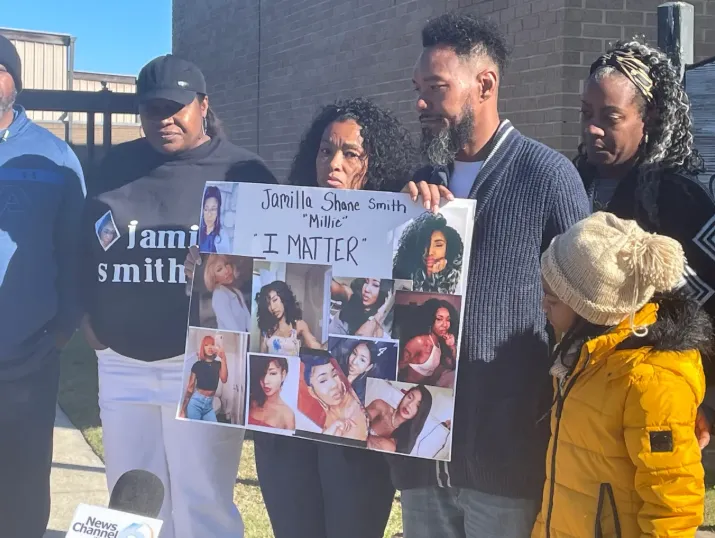
Her mother, who had made the heart-wrenching missing person report, was vocal in the aftermath, speaking out about her daughter’s vibrancy and bright future.
In community vigils and social media tributes, words like “love,” “light,” “unforgettable,” and “tragic loss” consistently appeared, trying to encapsulate the life of a person whose potential had been stolen.
Daniel Gabriel Harmon, the accused and now convicted murderer, had a troubled history, which only added complexity to the case.
His prior contacts with law enforcement and his past criminal behavior were part of the story, but they offered little comfort to those mourning Smith’s death.
In sentencing Harmon, the focus was clear: accountability for a heinous crime.
However, two other men remain charged in connection with Smith’s death.
Clyde Hendley is accused of assisting in the disposal of Smith’s body and evidence.
Bryan Hampton, Harmon’s cousin, is also charged in relation to the murder.
Their cases are still pending, separate but undeniably linked to the same nightmare that began in December 2023.
If convicted, these men too could face significant prison time.
Aiken County is no stranger to difficult news and tragic crime.
But the disappearance and murder of Jamilla Smith resonated deeply across neighborhoods, workplaces, and social circles.
Local leaders emphasized community safety and awareness after Smith’s disappearance.
Vigils were held, search parties organized, and pleas for information flooded regional media.
Smith’s case served as a reminder of the fragility of life, the importance of support networks, community outreach, and vigilant policing.
Churches and advocacy organizations echoed the same message: while the criminal justice system pursues the perpetrators, the community must play a role in healing.
Grief counselors offered services to those affected by the case, and public safety forums discussed domestic intrusion and conflict prevention.
Residents began talking about what it truly means to look out for one another.
Since Smith’s body was found, her case has fueled conversations beyond Aiken County about domestic violence, personal safety, and the vulnerability many feel when alone or threatened.
Experts in trauma and victim advocacy have noted the importance of early 911 recordings in such cases, not just for law enforcement but also for understanding the psychological dynamics of victims in danger.
Smith’s last moments on the 911 call—unheard cries and a voice not her own—highlighted how quickly ordinary life can turn into a struggle for survival.

Her story has become a teaching moment for law enforcement trainers, 911 dispatch educators, and community safety advocates who stress the need for both immediate responsiveness and better public education on recognizing and reporting dangerous behavior before it escalates.
For Smith’s family, the journey does not end with a conviction.
No sentence, no matter how long, will return Jamilla Smith to them.
That truth was palpable in the courtroom when Harmon’s sentence was read aloud.
There were tears in the air, and a heavy silence filled the room, the weight of the moment pressing down on everyone present.

Smith’s loved ones expressed mixed emotions after the sentencing: relief that a conviction had been secured, anger that their daughter’s life was stolen so abruptly, and sadness that they would never again celebrate holidays, birthdays, or milestones with her.
They spoke about wanting Jamilla’s memory to fuel positive change—improvements in community safety education and stronger support systems for those in distress or danger.

“People need to know she wasn’t just a number,” one family member said. “She was our heart. And we want something good to come from all of this pain.”
With Harmon’s guilty plea and sentencing, many chapters of the case have reached critical points.
But the narrative is not yet complete.

Hendley’s and Hampton’s cases are still pending, and Smith’s family continues their journey of healing—one that will never truly end.
The Aiken County community continues to grapple with questions of safety, trust, and collective responsibility.
For them, Jamilla’s legacy is more than just a newspaper headline or a court docket entry.
It’s a reminder of the fragility and preciousness of every life and the collective duty to protect one another.
In the end, justice was served—but the loss remains.