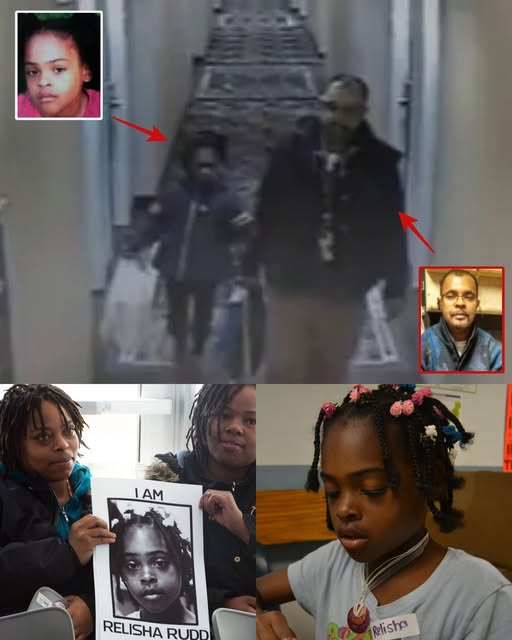
Relisha was only eight years old when she vanished one fateful day, her innocence stolen in an instant.
Her disappearance sparked an overwhelming search, lasting for weeks, as the entire community rallied together, desperately calling her name, holding on to hope, and praying for her safe return.
She had walked into that hotel room holding his hand, innocent and unaware of the danger she was stepping into.
He walked out alone, leaving behind an empty room, and the silence between those two moments has haunted a city ever since.
Before she disappeared, Relisha lived with her mother and younger brothers in a shelter that was supposed to be temporary.
What was intended to be a brief stay turned into weeks, which then turned into months, slowly becoming a new, unfamiliar version of “normal.”
The shelter was filled with broken promises, exhaustion, and the feeling that the world was slowly crumbling around them.

Despite everything, Relisha tried to live her life as any child should—laughing, playing, and enjoying her childhood as best as she could.
Her mother did her best to care for her, though every day felt like a struggle to survive in a system that failed to meet their basic needs.
But Relisha’s life, which should have been full of joy and safety, was being lived in a constant state of uncertainty, a feeling that started to seep into her childhood.

In this unstable environment, there was a man who worked at the shelter.
He wasn’t part of her family, but he was familiar—someone who knew the names of all the residents and who had built trust through small, thoughtful gestures.
He seemed like a trustworthy figure, someone who genuinely cared and wanted to help, or so it seemed.
He brought gifts for the children.
He offered rides, claiming to be a friendly neighbor.
He spoke with a calm, reassuring tone that convinced many, including Relisha’s mother, that he was simply another kind soul trying to help.
For a family living in such uncertain conditions, his acts of kindness, no matter how small, felt like a lifeline.
Relisha, like any child, welcomed the attention because it made her feel seen and safe, even in a world that seemed to be collapsing around her.
She had no reason not to trust him.
She didn’t know any better.
For her, being noticed, receiving affection, and feeling valued was a rare gift in the midst of everything else going wrong.
However, the truth was that this man had no intention of being the protector he appeared to be.
His kindness was nothing more than a carefully constructed mask.

Relisha’s mother trusted him, as did others in the shelter, but Relisha’s grandmother couldn’t shake the feeling that something was off.
She didn’t want to believe the worst, but something about him made her uncomfortable.
The man’s charm, his willingness to help, should have raised red flags, but no one noticed.
The day Relisha vanished, no one expected what was about to happen.
Her absence from school started off as an excuse like any other—she was sick, or there were issues with transportation.
But then her teacher noticed that something wasn’t right.
Relisha didn’t miss school.
She was always there, smiling, laughing, and attending class.

Her absence wasn’t normal, and the teacher’s gut told her that something was terribly wrong.
The school reached out, and the answer they received came in the form of a note from the “doctor” who was taking care of Relisha.
The note claimed that Relisha was sick and was under the care of a doctor, and it seemed official enough to quiet any doubts that arose.
They called the number provided on the note.
A man answered, his voice calm and professional, as if he were a figure of authority.
He promised paperwork, promised updates, and assured everyone that everything was fine.
But the promised paperwork never arrived.
Days turned into weeks, and still, no documentation, no updates.
Relisha’s absence began to feel less like illness and more like a deliberate act.
The days dragged on.
Thirty days without Relisha in her classroom seat.
Thirty days of growing concern that was met with constant delay.
Delay, as every parent and investigator knows, is the enemy of truth and accountability.
One missed phone call, one assumed excuse, one “we’ll follow up tomorrow,” and Relisha’s disappearance slowly drifted out of focus.

But when someone finally took the time to meet the so-called “doctor” in person, the facade began to crack.
There was no doctor.
There was only the man from the shelter, hiding behind a fake name, deceiving everyone around him.
And suddenly, the truth that had been buried under layers of lies was beginning to surface.
He had been taking Relisha places.
Places that no child should ever visit with a stranger, no matter how friendly they seem.
Relisha’s movements were tracked through security footage.
There, in the video, was Relisha, holding his hand.

Her small, innocent hand wrapped in his, trusting him as they entered a hotel room together.
But hours later, only he walked out.
The haunting image of the man leaving the hotel room alone, with Relisha never to return, left a gaping hole in the investigation.
The questions began pouring in: What had happened in that room?
What was the man’s true intention?
Why had Relisha been allowed to be taken away without anyone stopping it?
The details began to pile up, and the truth became impossible to ignore.
Relisha had been taken to a hotel room, and no one knew what had happened to her after that.
But what investigators did know was that this man was not who he appeared to be.
His story had been a carefully constructed lie.

He had manipulated a vulnerable family, using their trust to carry out his plans.
The investigation uncovered chilling evidence of deliberate actions and a twisted agenda.
Forensic analysis, phone records, and security footage painted a disturbing picture of the man’s movements and the lies he told.
And the more they uncovered, the more terrifying it became.
This was not a case of panic.
This was not a case of an accident.
This was a crime carefully planned, with each step premeditated long before Relisha disappeared.
The pieces of the puzzle began to fit together.
The man had been involved in the entire scheme, and it was clear that the community had been misled.
Her father’s desperate pleas for answers fell on deaf ears for far too long.
Each time he asked for the truth, he was met with more deflection and more lies.
Relisha’s case exposed a failure in the system.
A system that failed to see the warning signs, failed to act quickly enough, and failed to protect her.
Her story highlights the importance of paying attention to every absence, to every missed sign, and to every moment when something doesn’t seem quite right.
The system should have acted sooner.

Relisha should not have been allowed to slip through the cracks.
But the sad truth is that in this case, the system failed.
Relisha’s case is not just about the disappearance of one child.
It’s about a pattern.
It’s about the way vulnerable children are often ignored, overlooked, and allowed to fall through the cracks.
Her case forced painful questions into the open:
Why were these warning signs ignored?

Why was the man allowed to be around children, despite his troubling past?
How did the system allow this to happen?
Why did it take so long for someone to listen to the concerns and ask the right questions?

Relisha’s disappearance exposed the failure of the system, the negligence of those who should have been protecting her, and the unthinkable reality that a predator can hide in plain sight.
This story is a painful reminder of how easily someone can deceive us, of how predators take advantage of vulnerability, and of how the failure to act can lead to devastating consequences.
As years passed, Relisha’s face remained on posters, on flyers, and in the minds of those who never stopped looking for her.

Her story is not just a tragedy.
It is a reminder that we must never stop asking questions.
We must always be vigilant, always notice the small signs that something is wrong.
Relisha’s story is a call to action for all of us.
It’s a reminder to be the adults who notice when something is off.
To be the ones who speak up when others stay silent.
To protect children from harm, even when it’s uncomfortable.
Because if we don’t, we risk losing more children.
Relisha Rudd, eight years old, still missing.

Her name should never be forgotten.
Her story must always be told.
And her case must never be allowed to slip through the cracks again.