The warning did not come with sirens or breaking news banners.
It arrived quietly, buried in policy remarks and corporate decisions that, on their own, seemed manageable.
But taken together, they reveal something far more serious: California’s energy system is entering a phase of structural strain that could redefine how the state functions.
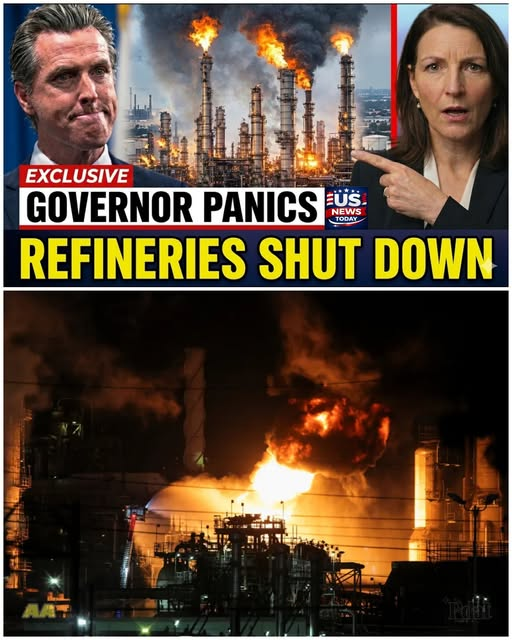
At the center of this unfolding situation is a simple but critical reality—refining capacity is shrinking.
Not temporarily, not due to maintenance cycles, but permanently.
Facilities that once processed crude oil into gasoline and diesel are shutting down, and with each closure, the system loses a piece of its foundation.
Refineries are not interchangeable parts that can be swapped in and out.
They are massive, complex industrial systems that take years—sometimes decades—to design, approve, and build.
When one disappears, the capacity it provided does not return quickly.
It leaves a gap, and that gap immediately tightens supply.
At the same time, demand remains constant.

Millions of Californians still commute daily.
Trucks still transport goods across cities and states.
Emergency services still depend on uninterrupted fuel access.
The system continues to consume energy at the same pace, even as its ability to produce that energy declines.
This imbalance—steady demand against shrinking supply—is where the pressure begins to build.
And when pressure builds inside a constrained system, the release is rarely smooth.
It manifests as volatility, as sudden price spikes, as instability that feels unpredictable but is actually rooted in structural limitations.
California’s situation is further complicated by its unique position within the national energy network.
Unlike other regions, the state operates with relative isolation.
Pipeline connections to other fuel-producing areas are limited, and transportation logistics make rapid resupply difficult.
More importantly, California requires a specialized gasoline blend designed to meet strict environmental standards.
Under normal conditions, this system functions.

Under stress, it becomes fragile.
Because when local supply drops, California cannot simply draw from a vast national reserve of identical fuel.
Other states do not produce the same blend at scale.
Even when fuel is available elsewhere, adapting it, transporting it, and integrating it into California’s system takes time—time that a tightening market does not have.
This is what creates the “perfect storm” dynamic.
Reduced refining capacity, limited import flexibility, and consistent demand converge to produce sharp price increases.
Not gradual adjustments, but sudden jumps that ripple through the economy.
The effects extend far beyond the gas pump.
Fuel is not just a consumer expense—it is a foundational input for nearly every sector.
When fuel costs rise, transportation becomes more expensive.
When transportation costs increase, the price of goods follows.

Food distribution, retail logistics, construction materials—all are affected.
What begins as an energy issue quickly evolves into a broader economic challenge.
For individuals, the impact is immediate and personal.
Commuters feel it first, watching their weekly fuel expenses climb.
For lower-income households, the burden is even heavier.
Energy costs are not discretionary.
They cannot be postponed or avoided.
As prices rise, other areas of spending must adjust, creating a cascade of financial pressure.
Behind these outcomes lies a deeper question: why are refineries shutting down?
The answer is not singular.
It is the result of multiple forces converging over time.
Regulatory frameworks in California are among the most stringent in the world, reflecting ambitious environmental goals.
While these policies aim to reduce emissions and transition toward cleaner energy, they also increase operational complexity and cost for traditional refining.

Maintaining compliance requires continuous investment.
Upgrading facilities to meet evolving standards can cost billions.
For companies evaluating long-term strategies, these costs must be weighed against future demand.
And that is where uncertainty enters the equation.
Energy companies operate on long timelines.
They invest with decades in mind.
When policy signals indicate a gradual move away from fossil fuels, companies begin to question whether continued investment in refining infrastructure is viable.
If the future demand for gasoline is expected to decline, the incentive to maintain or expand capacity weakens.
The result is not always immediate closure.
Often, it is hesitation.
Projects are delayed.
Upgrades are reconsidered.
Over time, that hesitation becomes withdrawal.
At the same moment, other states are offering a different environment.
Texas, in particular, has emerged as a focal point for energy investment.
Lower taxes, streamlined regulatory processes, and a policy framework supportive of production create conditions that attract companies seeking stability and predictability.
This divergence is not just about business decisions—it represents a redistribution of infrastructure.
As capacity shifts geographically, so does economic influence.
Jobs follow investment.
Communities that host new facilities experience growth, while those losing them face decline.
For California, the challenge is not simply replacing what has been lost.
It is navigating a transition while maintaining stability.
Moving toward cleaner energy is a long-term objective, but the current system still relies heavily on traditional fuels.
Bridging that gap requires careful management, because removing capacity faster than alternatives can scale creates imbalance.
And imbalance, in systems as complex as energy networks, rarely resolves itself quickly.
The broader implication is that California is entering a period where energy policy, economic strategy, and daily life are increasingly interconnected.
Decisions made at the regulatory level ripple outward, affecting corporate behavior, infrastructure investment, and ultimately the cost of living.
This is not a collapse.
It is a transformation—but one that carries risk.
The question now is whether that transformation can be managed in a way that preserves stability while pursuing long-term goals.
Can alternative energy sources scale quickly enough to offset declining refining capacity? Can infrastructure adapt to maintain supply without excessive volatility? Can policy strike a balance between ambition and practicality?
These are not abstract questions.
They will determine how Californians experience the coming years—whether through manageable adjustment or disruptive change.
For now, the signs are clear.
Capacity is shrinking.
Pressure is building.
And the system, once taken for granted, is being tested in real time.