The moment did not begin with chaos.
It began with a question—quiet, procedural, almost routine.
But within minutes, the tone inside Washington shifted, revealing a deeper conflict that had been building beneath the surface for weeks.
At the center of the storm stood a single issue: the fate of election-related legislation widely debated across the country.
What unfolded was not simply a policy disagreement, but a clash over how power is exercised inside the United States Senate, and who ultimately controls the pace and direction of that power.
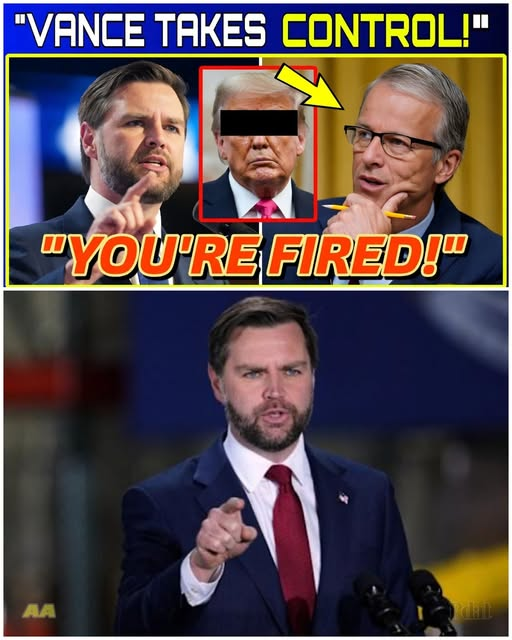
The discussion first turned toward an unusual idea—whether Vice President JD Vance could step into a more assertive procedural role in the Senate.
Constitutionally, the vice president serves as the presiding officer, a position that carries authority over floor proceedings.
While often ceremonial in modern practice, the role does include the power to make rulings and influence the flow of debate.
That possibility alone was enough to ignite controversy.

Some voices argued that the presiding officer could, in theory, exercise greater independence from the Senate parliamentarian, reshaping how procedural decisions are made in real time.
Others pushed back, noting that while the authority exists on paper, its use is constrained by precedent, political norms, and the risk of institutional backlash.
This tension—between what is technically possible and what is politically acceptable—became a defining feature of the debate.
Meanwhile, attention shifted to Senate Majority Leader John Thune, who found himself navigating competing pressures.
On one side stood members of his own party demanding a more aggressive strategy to advance the legislation.
On the other stood the institutional realities of the Senate, where most major bills require 60 votes to overcome a filibuster.
That 60-vote threshold is not just a number.
It is the central pillar of how the modern Senate operates.
Without it, legislation can stall indefinitely.
With it, bipartisan cooperation becomes necessary—even when political divisions run deep.

Critics argued that proceeding under standard rules, knowing the votes were not there, amounted to little more than a symbolic exercise.
Supporters countered that the debate itself held value, forcing lawmakers to publicly take positions on issues they might otherwise avoid.
Beneath this procedural argument lay a more strategic disagreement: whether to pursue confrontation or compromise.
One faction pushed for the use of a “talking filibuster,” a rarely used tactic that would require opponents to physically hold the Senate floor to block legislation.
In theory, this approach could shift public pressure onto those resisting the bill.
In practice, it introduces risks—opening the door to unlimited amendments and unpredictable outcomes that could alter or derail the legislation entirely.
Another option under discussion was budget reconciliation, a process that allows certain fiscal measures to pass with a simple majority.
But this path comes with strict limitations.
Not all policy provisions qualify, and attempts to stretch those boundaries often run into resistance from the Senate’s procedural gatekeepers.
The result was a legislative stalemate shaped as much by rules as by ideology.
As the debate unfolded, rhetoric intensified.

Supporters of the legislation framed it as a matter of fundamental fairness and election integrity, arguing that clear standards are essential to maintaining public trust.
Opponents raised concerns about implementation, access, and the broader implications for how elections are administered across states.
These competing narratives reflect a larger national conversation—one that extends far beyond the walls of the Senate chamber.
At the same time, political pressure outside Washington continued to build.
Activists, commentators, and voters from across the spectrum weighed in, amplifying the stakes and shaping the narrative in real time.
In today’s media environment, legislative battles are no longer confined to committee rooms; they play out simultaneously on television, online platforms, and in public discourse.
This dynamic adds another layer of complexity.
Lawmakers are not only negotiating with each other—they are also responding to audiences far beyond Capitol Hill.
Inside the Senate, however, the constraints remain the same.
Numbers matter.
Procedures matter.

And even the most passionate arguments must ultimately navigate a system designed to slow things down.
That design is intentional.
The Senate was built to be deliberative, to require consensus, and to prevent rapid swings in policy.
But in moments like this, that same structure can become a source of frustration, especially when urgency collides with institutional inertia.
The question now is not simply whether this particular piece of legislation will pass.
It is how far leaders are willing to go to change the rules—or reinterpret them—in pursuit of their goals.
Because once those boundaries shift, the effects rarely remain contained.
What emerges from this episode is a portrait of a political system under strain.
Not broken, but stretched—testing the limits of its own procedures, traditions, and balance of power.
For observers, the significance lies less in any single vote and more in the precedent being set.
How authority is exercised.
How rules are applied.
And how far each side is willing to push to achieve its objectives.
In the end, the outcome may not be decided by speeches or even by votes alone.
It will be shaped by something more enduring: the structure of the system itself, and the choices leaders make within it.
And those choices, once made, have a way of echoing far beyond the moment in which they occur.