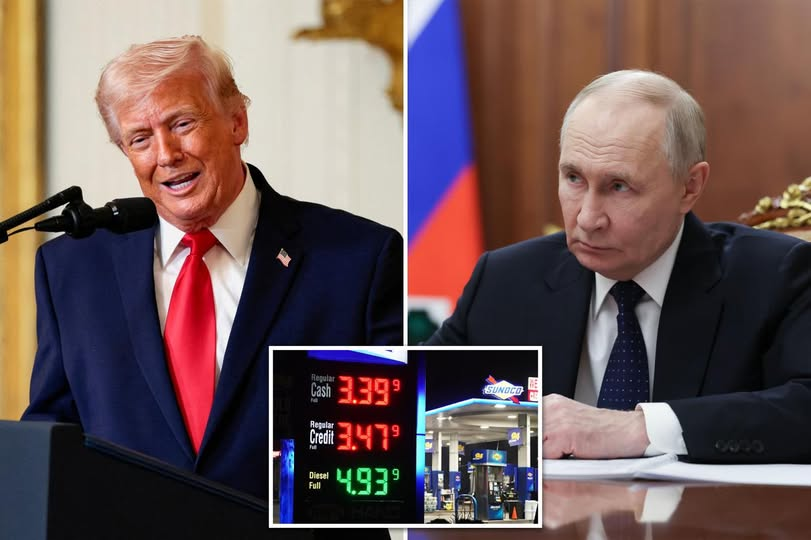
Trump temporarily lifts sanctions on Russian oil ‘stranded at sea’

The Trump administration temporarily lifted sanctions on Russian oil “stranded at sea” Thursday in an effort to contain skyrocketing energy prices due to Iranian threats against tanker ships.

Treasury Secretary Scott Bessent described the move as one of President Trump’s “decisive steps to promote stability in global energy markets” and keep oil prices low amid the “threat and instability posed by the terrorist Iranian regime.”

U.S. President Donald Trump speaking at a Women's History Month event in the East Room of the White House.
The Trump administration has temporarily lifted sanctions on Russian oil in an effort to contain skyrocketing energy prices.REUTERS
A general view of $3 gas prices as seen at a Sunoco gas station in Englewood, NJ on March 12, 2026. Gasoline prices jumped almost 30 cents in the last week to a national average of $3.59 per gallon since the United States and Israel have been attacking Iran with bombs and missiles resulting in the unexpected death of Iran's Supreme Leader Ali Khamenei. (Photo/Christopher Sadowski)
Gas prices jumped almost 30 cents in the last week to a national average of $3.59 per gallon since the US and Israel’s war with Iran began.Christopher Sadowski for New York Post

“To increase the global reach of existing supply, [Treasury] is providing a temporary authorization to permit countries to purchase Russian oil currently stranded at sea,” Bessent wrote on X.

The treasury secretary noted that the “narrowly tailored, short-term measure” will only apply to oil “already in transit.”

There are an estimated 124 million barrels of oil originating from Moscow at sea, which is enough for about five to six days of supply, according to CNBC.

Bessent also asserted that it “will not provide significant financial benefit to the Russian government,” adding that the Kremlin “derives the majority of its energy revenue from taxes assessed at the point of extraction.”

“President Trump’s pro-energy policies have driven U.S. oil and gas production to record levels, contributing to lower fuel prices for hardworking Americans,” the treasury secretary continued.

“The temporary increase in oil prices is a short-term and temporary disruption that will result in a massive benefit to our nation and economy in the long-term.”

United States Secretary of the Treasury Scott Bessent, arrives for a television interview outside the West Wing of the White House in Washington, DC, USA, on Friday, March 6, 2026. US President Donald J Trump is set to host executives from top Pentagon contractors, amid worries around depleting stockpiles as the war on Iran approaches the one-week mark with no clear end in sight.
“To increase the global reach of existing supply, [Treasury] is providing a temporary authorization to permit countries to purchase Russian oil currently stranded at sea,” Treasury Secretary Scott Bessent wrote on X.Aaron Schwartz/POOL via CNP/INSTARimages.com
MANDATORY CREDIT

Mandatory Credit: Photo by GAVRIIL GRIGOROV/SPUTNIK/KREMLIN POOL/EPA/Shutterstock (16759252a)

Russian President Vladimir Putin meets with Orenburg Region Governor Yevgeny Solntsev at the Kremlin in Moscow, Russia, 12 March 2026.

Russian President Vladimir Putin meets with Orenburg Region Governor Yevgeny Solntsev, Moscow, Russian Federation - 12 Mar 2026
Bessent also asserted that it “will not provide significant financial benefit to the Russian government,” adding that the Kremlin “derives the majority of its energy revenue from taxes assessed at the point of extraction.”GAVRIIL GRIGOROV/SPUTNIK/KREMLIN POOL/EPA/Shutterstock

The exemptions will be in place until April 11.

As the war against Iran continues, oil prices surged to $100 per barrel on Thursday.

The price of a barrel of Brent crude, the international standard, climbed 9.2% to settle at $100.46.

Iranian Supreme Leader Mojtaba Khamenei, meanwhile, vowed Thursday to keep the Strait of Hormuz closed as a “tool to pressure the enemy.”