There is a specific kind of silence that hits before a tragedy.
It’s not empty. It’s heavy.
It feels exactly like the dead, suffocating air right before a tornado touches down and rips your world apart.
That was the exact silence that fell over the Oak Creek Elementary playground on a sunny Tuesday morning.
I can still smell the damp woodchips.
I can still feel the cold metal of the chain-link fence pressing into my palms.
And I can still see the exact moment my heart stopped beating in my chest.
My name is Sarah. I’m thirty-two years old, and for the last fourteen months, I have been surviving on coffee, sheer willpower, and the desperate need to keep my six-year-old son, Leo, safe.
Ever since my husband, Chris, passed away in a sudden accident, Leo had retreated into his own little world.
He used to be the loudest kid in the room. He used to run around the house wearing a makeshift cape, pretending to be a superhero.
Now, he barely spoke above a whisper.
He wore Chris’s old, faded flannel shirt over his school clothes every single day, like a suit of armor against a world that had already proven it could hurt him.
He was fragile. He was my whole world.
And on that Tuesday, I almost lost him right in front of my eyes.
Oak Creek Elementary was hosting its annual “Community Helpers Day.”
It was a big event. Firetrucks were parked in the bus loop. Paramedics were handing out plastic badges.
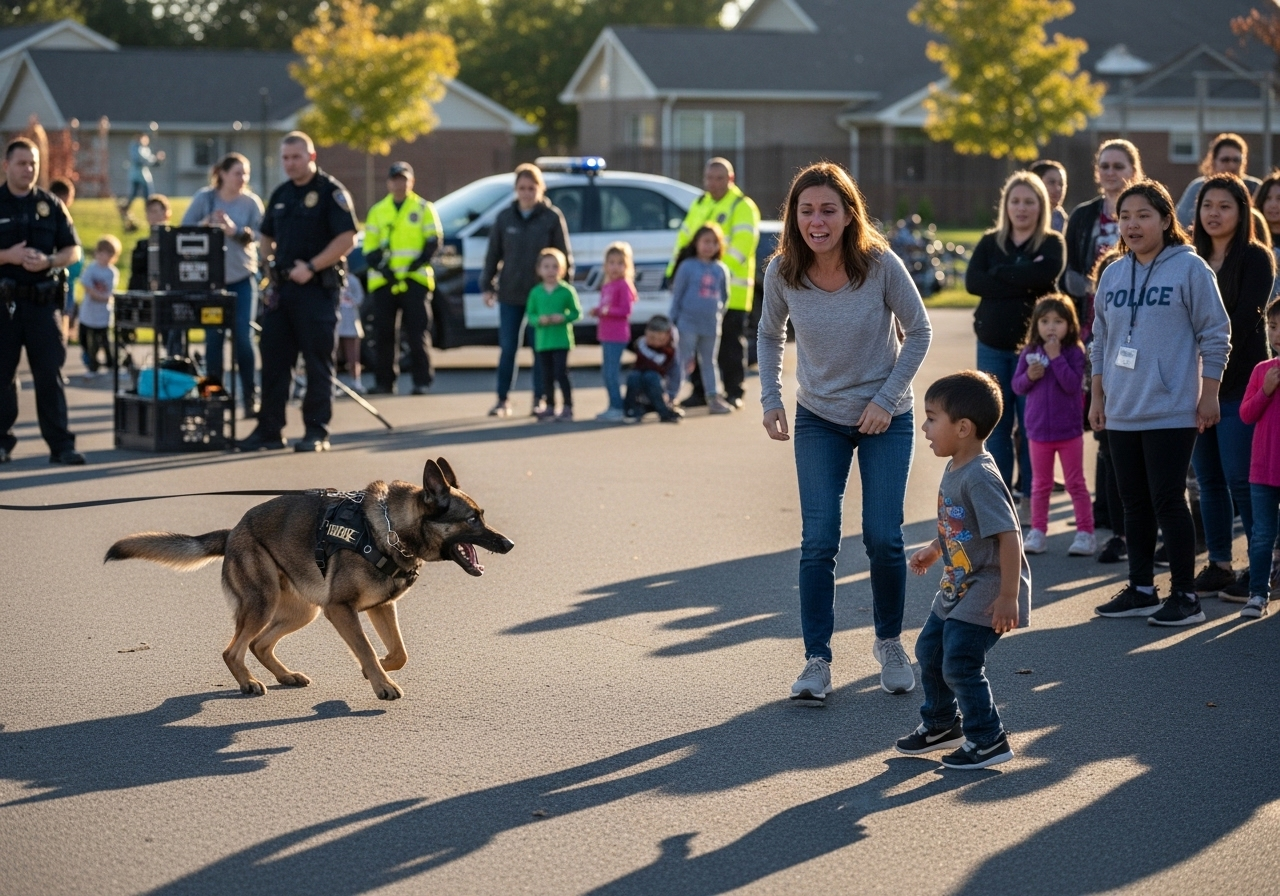
And the local police department had brought their K9 unit for a demonstration on the main soccer field.
I had taken my lunch break from the accounting firm just to be there.
I knew loud noises and crowds overwhelmed Leo, and I wanted to stand by the playground fence so he could see me. So he would know he wasn’t alone.
I stood with a group of other mothers.
There was Mrs. Gable, the school principal, standing perfectly straight in her tailored suit, arms crossed, overseeing the event with a stern, judgmental eye.
She had already warned me twice this semester that Leo’s “lack of participation” was becoming a problem.
As if grief had an expiration date.
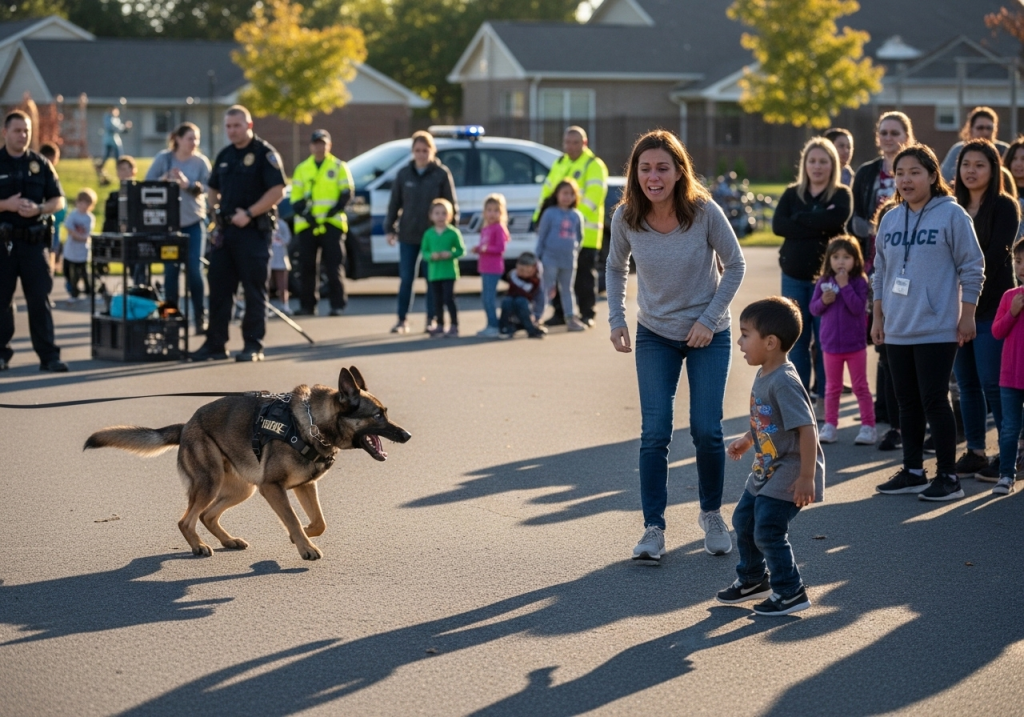
Out on the field, Officer Mark Davies was leading a massive, muscular German Shepherd named Titan.
Titan was beautiful but terrifying. He looked like pure muscle and instinct, a dog trained to take down criminals, find contraband, and protect his handler at all costs.
The kids were seated on the grass, a safe distance away.
Except for Leo.
Leo had wandered off to the far edge of the playground, near the old oak tree.
He was crouching down in the dirt, entirely focused on a line of ants or a shiny rock. He was totally isolated. Alone.
I smiled softly, watching him. I gripped the chain-link fence, wishing I could just reach through and smooth down his messy blonde hair.
Then, everything went wrong.
It happened so fast that my brain couldn’t process the mechanics of it.
One second, Officer Davies was commanding Titan to sit.
The next second, a loud siren blared from one of the firetrucks being demonstrated in the parking lot.
It was a sharp, ear-piercing wail.
Titan startled.
Officer Davies, who looked exhausted, his shoulders heavy with a fatigue I recognized all too well, somehow lost his grip on the thick leather leash.
The leash snapped out of his hand.
Titan whipped his head around. His ears pinned back.
And then, he locked eyes on the far corner of the playground.
He locked eyes on Leo.
“Titan, NO!” Officer Davies roared. The sound tore from his throat, raw and panicked.
But it was too late.
The German Shepherd dug his paws into the grass and launched himself forward.
He wasn’t jogging. He was sprinting.
A hundred pounds of trained muscle, teeth, and raw power, tearing across the open field, kicking up dirt behind him.
And he was heading in a straight, unswerving line directly toward my tiny, fragile six-year-old boy.
“LEO!” I screamed.
The sound ripped out of me so violently it burned my throat. I slammed my hands against the top of the fence, desperately trying to find a foothold to climb over.
The playground erupted into pure chaos.
Mothers started shrieking. Teachers blew their whistles frantically, a useless, sharp sound cutting through the panic.
Principal Gable froze completely. I saw her face drain of color, her mouth hanging open, entirely paralyzed by the unfolding horror. She didn’t move an inch to help.
“Somebody grab the dog!” a father yelled, but no one moved.
Everyone was terrified. Everyone was stepping back.
Officer Davies was sprinting as fast as he could, his heavy boots pounding the grass, his face twisted in absolute terror.
But he was too far away. He was never going to make it.
Time didn’t just slow down. It stopped.
Every millisecond burned itself into my retinas.
I saw the heavy metal clasp of the leash bouncing wildly against the grass.
I saw the foam at the edges of Titan’s mouth as he breathed heavily, closing the distance. Fifty yards. Thirty yards. Ten yards.
And then, I saw Leo look up.
My sweet, quiet boy.
He didn’t run. He didn’t scream.
He just slowly stood up, dropping his little plastic dinosaur into the woodchips.
He looked incredibly small in his dad’s oversized flannel.
He pulled his arms in tightly against his chest, a pathetic, heartbreaking attempt to shield himself from the massive beast hurtling toward him.
His blue eyes were wide, filled with a silent, helpless terror that shattered my soul into a million pieces.
“Please,” I sobbed, my fingernails bleeding as I tore at the chain-link wire. “Please, God, no. Take me. Don’t touch him!”
The whole school seemed to inhale at the exact same moment.
Thirty seconds. That’s all it took.
Thirty seconds from the moment the leash slipped to the moment Titan reached my son.
I closed my eyes. I couldn’t watch my child be torn apart. I couldn’t survive losing him, too.
I heard the heavy thud of the dog’s paws hitting the mulch right in front of Leo.
I heard a sharp gasp from the crowd.
And then, I heard something that made my blood run ice cold.
Chapter 2
The sound that ripped through the air wasn’t a scream of pain. It wasn’t the sound of fabric tearing or bone snapping. It was a sound so heavy with grief and recognition that it felt like it had been pulled from the very bottom of a dark, cold ocean.
It was a whimper.
A long, low, soul-shattering cry that came from the throat of the hundred-pound killing machine.
I forced my eyes open, my breath hitching in a throat that felt like it had been scraped with glass. My hands were still white-knuckled on the fence, my knees buckled, ready to hit the dirt. I expected to see blood. I expected to see my son—my beautiful, broken little boy—under the weight of the beast.
But what I saw stopped my heart for an entirely different reason.
Titan, the dog who had just been a blur of lethal intent, had skidded to a stop inches from Leo’s feet. He hadn’t lunged. He hadn’t bared his teeth. Instead, the massive German Shepherd had collapsed onto his belly in the woodchips, his tail thumping once, twice, weakly against the ground. He was crawling forward, inch by painful inch, his nose twitching frantically, his ears flattened against his skull in a posture of complete and total submission.
And then, he did it again. That low, mourning whimper.
Leo hadn’t moved. He was still frozen, his small hands clutching the hem of his father’s oversized flannel shirt. His chest was heaving, his eyes wide and glassy with a terror so deep it looked like he’d left his own body.
“Titan! Heel! Down!” Officer Davies screamed as he finally reached them, his face a mask of sweat and pure, unadulterated panic. He reached for the dragging leash, his hand shaking so hard he almost missed it. He was ready to tackle the dog, ready to put his own body between the animal and the child, surely expecting a lawsuit, a firing, or worse.
But the moment Davies touched the leash, Titan didn’t growl. He didn’t even acknowledge the officer. The dog lunged forward—not to bite, but to bury his massive head directly into the crook of Leo’s neck.
The crowd gasped again. A woman behind me sobbed into her hand.
“Get that dog away from him!” Principal Gable’s voice finally returned, shrill and sharp, cutting through the heavy atmosphere. She was marching toward them now, her high heels sinking into the mulch, her face red with a mix of fear and the need to regain control. “Officer! This is a school! That animal is a menace! Secure him immediately!”
Davies didn’t answer her. He couldn’t. He was staring at his dog—a dog he’d worked with for eight months, a dog known for being “all business,” a dog that had never shown this kind of raw, desperate emotion to anyone, including him.
“Leo…” Davies whispered, his voice cracking. He looked from the dog to my son, and then his eyes traveled upward, landing on the faded, blue-and-grey flannel shirt Leo was wearing.
I saw the moment the realization hit Mark Davies. It was like watching a man see a ghost.
“Oh, God,” Davies breathed, his hand falling away from the leash. He sat back on his heels, oblivious to the principal’s shouting, oblivious to the cameras being held up by parents, oblivious to everything but the two souls in front of him. “Christopher…”
I couldn’t stay behind the fence anymore. I didn’t care about the rules. I didn’t care about Principal Gable’s “safety protocols.” I found the gate and threw it open with such force it rattled the entire fence line. I ran. My shoes kicked up woodchips, my lungs burned, and I didn’t stop until I reached them.
I didn’t grab Leo. I didn’t pull him away. Because for the first time in fourteen months—fourteen long, silent, agonizing months—I saw something in my son’s eyes that I thought had died the night the police chaplain knocked on our door.
I saw life.
Leo’s small, trembling hand slowly released the fabric of the flannel. Very carefully, as if he were touching something made of spun glass, he reached out. He buried his fingers into the thick, coarse fur of Titan’s neck.
“Buddy?” Leo whispered.
The word was so quiet, so fragile, but in the sudden silence of the playground, it sounded like a shout.
Titan erupted. He didn’t jump, but he began to nuzzle Leo with a ferocity that was almost overwhelming. He licked Leo’s face, his ears, his hands, his tail wagging so hard his entire back half was swaying. He was making tiny, frantic “woofing” sounds, the kind of noises a dog makes when its person finally comes home after a long deployment.
“Sarah,” Mark Davies looked up at me as I knelt beside them. His eyes were swimming with tears. “Sarah, I didn’t know. I didn’t put it together. I’m so sorry.”
“You couldn’t have known, Mark,” I whispered, my own voice breaking. I reached out and put my hand on Titan’s head, right next to Leo’s.
Titan was a hero. He was a decorated member of the K9 unit. But before he was Officer Mark Davies’ partner, he had belonged to someone else.
He had belonged to my husband, Christopher Miller.
Chris hadn’t just been a cop. He had been the lead K9 trainer for the county. Titan hadn’t just been his partner; he had lived in our house. He had slept at the foot of Leo’s bed for three years. He had been the one who “protected” Leo from the monsters in the closet. He had been the one who waited by the door every evening until he heard the jingle of Chris’s keys.
When Chris died in that high-speed pursuit—when his cruiser was clipped and sent rolling into the ravine—Titan had been in the back. The dog had survived with only minor injuries, but his spirit had been shattered. The department had almost retired him early, thinking he was too traumatized to work. But Mark Davies, Chris’s best friend and protégé, had stepped up. He had spent months earning Titan’s trust, bringing him back from the brink of depression.
But because of the pain, because every time I looked at Titan I saw Chris’s smile, I couldn’t keep him. The memories were too sharp, too jagged. I had asked Mark to take him. I had told Leo that Titan had a “special job” to do for Daddy.
I had thought it was the right thing to do. I had thought it would help us move on.
I was wrong.
Watching them now, I realized I had stripped my son of the only living connection he had left to his father. I had taken away his protector, his best friend, his “Buddy.”
“This is unacceptable!” Principal Gable was standing over us now, her shadow falling across the three of us and the dog. “The dog is off-leash! It’s a liability! Officer Davies, if you don’t remove this animal right now, I will be calling the Superintendent. This child is clearly traumatized!”
Leo flinched at her voice, his shoulders hiking up toward his ears. Titan felt it instantly.
The dog didn’t growl—not exactly. But he shifted. He moved his massive body so that he was a physical wall between Leo and the principal. He let out a low, vibrating hum from deep in his chest. It wasn’t an attack posture; it was a shield.
“He’s not traumatized, Margaret,” I said, standing up slowly. I wiped the tears from my face, feeling a surge of protective fire I hadn’t felt in over a year. I stood my ground, my feet planted in the mulch, looking the most powerful woman in the school district right in the eye. “He’s finally breathing.”
“He’s a police dog, Mrs. Miller! Not a pet!” Gable snapped. “He belongs in a kennel or a squad car, not huddled with a student who is already struggling with… behavioral issues.”
The word “behavioral” hit me like a physical blow. I looked at the crowd. Parents were whispering. Some were filming. I saw the judgmental stares of the “perfect” moms—the ones whose husbands came home every night, the ones whose children didn’t wear grief like a heavy cloak.
“He’s not ‘struggling,’ Margaret,” I said, my voice rising, carrying across the playground. “He’s grieving. And that dog? That dog is the only thing in this world that understands exactly what he’s going through. Because they both lost the same man.”
A hush fell over the crowd. The whispers stopped. Even the wind seemed to die down.
Mark Davies stood up, his hand firmly back on Titan’s leash, but he didn’t pull the dog away. He looked at the principal, his jaw set in a hard, professional line. “Ma’am, with all due respect, Titan isn’t just a police dog. He’s a veteran. He’s a public servant. And right now? He’s doing his job. He’s protecting a citizen in distress.”
“This is a circus!” Gable hissed, though she stepped back, unnerved by the intensity in Mark’s eyes. “I want everyone back in their classrooms! Now! Demonstration over!”
But nobody moved.
Leo finally looked up from Titan’s fur. His face was tear-streaked, but for the first time in fourteen months, his eyes were clear. He looked at me, then at Mark, and then he did something he hadn’t done since the funeral.
He smiled. A small, shaky, hesitant thing, but it was there.
“Mom?” he asked, his voice stronger than before. “Can Buddy come home now? I think he’s finished with his job.”
The question hung in the air, heavy and hopeful. I looked at Mark. I saw the conflict in his eyes. He loved Titan. They were a team. But he also knew the truth. He knew that Titan hadn’t been working for the badge for the last few minutes. He had been working for the boy.
“I don’t know, Leo,” I whispered, my heart breaking all over again. “It’s not that simple.”
But as I looked at the massive dog, who was now resting his chin on my son’s knee, and then at the principal who was already on her cell phone, likely calling the board of education, I knew one thing for certain.
This wasn’t over. This thirty-second encounter had opened a door that couldn’t be shut. And the secret that Titan had just uncovered—the depth of a bond that even death couldn’t break—was about to trigger a chain of events that would rock this town to its core.
Because there was a reason Chris had been on that road that night. There was a reason the “accident” happened. And Titan?
Titan was the only witness who knew exactly what had happened in that ravine.
As Mark Davies led a reluctant Titan back toward the police cruiser, the dog kept turning his head, looking back at Leo. And Leo stood there, clutching his father’s flannel, watching until the black-and-white SUV disappeared from sight.
“He’ll be back, Leo,” I promised, pulling him into my arms.
“I know,” Leo said, and there was a strange, haunting certainty in his voice. “He told me.”
I shivered. “What did he tell you, honey?”
Leo looked at the spot where the dog had been, his expression turning solemn. “He told me he found it, Mom. He found the thing Daddy was hiding.”
My blood turned to ice. I looked at the principal, who was watching us from the school steps, her eyes narrowed and cold. I looked at the police cruiser in the distance.
What had Chris been hiding? And why was a six-year-old boy the only one who seemed to know the truth?
Chapter 3
The silence of my house used to be a comfort. After Chris died, it felt like a thick, soft blanket that muffled the world’s jagged edges. But that night, after the incident on the playground, the silence felt different. It felt like a held breath. It felt like a predator crouching in the corner of the room, waiting for the lights to go out.
I sat at the kitchen table, a mug of tea gone cold between my hands. Across from me, Leo was drawing. This in itself was a miracle—he hadn’t touched his crayons in months. But he wasn’t drawing the usual six-year-old things. No dinosaurs, no stick-figure families, no suns in the corner of the page.
He was drawing a tree.
It was a gnarled, twisted oak, its branches reaching out like skeletal fingers. And at the base of the tree, he was meticulously coloring a small, dark square.
“Leo, honey?” I whispered, my voice sounding loud in the quiet kitchen. “What are you drawing?”
He didn’t look up. His tongue was poked out of the corner of his mouth in deep concentration. “The place where Buddy hides his toys,” he said.
My heart skipped. “Buddy… you mean Titan? But Titan doesn’t live here anymore, sweetie. He lives with Officer Mark.”
“He told me,” Leo said simply, his blue eyes finally lifting to meet mine. There was an unnerving clarity in them. “He said Daddy put the ‘bad secret’ under the tree so the monsters wouldn’t find it. But Buddy says the monsters are looking for it now. He says we have to go get it before they do.”
A chill that had nothing to do with the evening breeze crawled up my spine. “Who are the monsters, Leo?”
He went back to his drawing, his hand moving faster now. “The people who made Daddy’s car go fast.”
I stood up so abruptly my chair scraped harshly against the linoleum. My head was spinning. The official report said Chris’s accident was caused by a mechanical failure during a high-speed pursuit. A tie-rod had snapped, causing the cruiser to lose steering at eighty miles per hour. It was a tragedy. An act of God. A failure of equipment.
That was the story I had been told. That was the story I had forced myself to believe so I could wake up every morning without screaming.
But looking at my son—a child who had barely spoken a word since the funeral—now talking about ‘bad secrets’ and ‘monsters,’ I felt the foundation of my reality beginning to crumble.
The next morning, the “monsters” took a much more bureaucratic form.
I was called into an emergency meeting at Oak Creek Elementary. I expected a lecture. I expected a slap on the wrist for my “outburst” on the playground. I did not expect to find three men in suits sitting alongside Principal Margaret Gable in her cramped, overly-perfumed office.
“Sarah, thank you for coming,” Gable said, her voice dripping with a fake, sugary sympathy that made my skin crawl. “These gentlemen are from the District Legal Office and the City Council’s Public Safety Committee.”
I sat down, clutching my purse like a shield. “I don’t understand. Why is the City Council here?”
The man in the center, a silver-haired shark named Harrison Reed, leaned forward. “Mrs. Miller, yesterday’s event was… traumatic. Not just for your son, but for the entire student body. A lethal weapon—and make no mistake, a K9 is a weapon—was loose on school grounds. It targeted your son.”
“It didn’t target him,” I snapped. “It recognized him. Titan was our dog. He was Chris’s partner.”
“That is exactly the problem,” Reed said, his voice smooth and cold. “The emotional instability of the animal, coupled with your son’s… fragile state, has created a significant liability. The school board has decided that for the safety of the children, Leo needs to be placed on a mandatory leave of absence until a full psychological evaluation can be completed.”
I felt the air leave my lungs. “A leave of absence? You’re kicking a six-year-old out of school because a dog was happy to see him?”
“We are protecting him, Sarah,” Gable chimed in. “And we are protecting the school. There is also the matter of the… rumors. Leo has been saying some very disturbing things to his teachers. Things about his father’s death. Things that suggest he is suffering from severe delusions.”
“He’s a grieving child!” I shouted, standing up. “What do you expect?”
“We expect a safe environment,” Reed said, rising with me. “Furthermore, the Police Department has been notified. Due to the ‘glitch’ in Titan’s training yesterday, the Chief has ordered the animal to be decommissioned. He’s being sent to a facility in upstate New York for behavioral reassessment. He leaves tonight.”
“No,” I whispered. “You can’t do that. That dog is fine. He just loved my son.”
“The decision is final, Mrs. Miller,” Reed said, his eyes narrowing. “And I would strongly suggest you stop digging into things that don’t concern you. For Leo’s sake. It would be a shame if Child Protective Services felt this environment was too… unstable for a young boy.”
It wasn’t a suggestion. It was a threat. Clear, cold, and unmistakable.
I walked out of that office with my ears ringing. I didn’t go to my car. I walked straight to the soccer field where the incident had happened the day before. I stood by the old oak tree—the one Leo had drawn.
I looked at the base of the tree. The mulch was disturbed, but there was nothing there. Just dirt and woodchips.
“Sarah?”
I jumped, spinning around. Mark Davies was standing there, his police uniform looking crumpled, his eyes bloodshot. He didn’t have Titan with him.
“Mark, they’re taking him,” I said, my voice shaking. “They’re taking Titan. They said he’s decommissioned.”
Mark looked around frantically, then grabbed my arm and pulled me toward the shadow of the school’s equipment shed. “I know,” he hissed. “I just got the orders. But Sarah, it’s worse than that. I went into the evidence locker this morning. I wanted to look at the maintenance logs for Chris’s cruiser. I wanted to see who signed off on that tie-rod inspection.”
“And?”
“The logs are gone, Sarah. Not just missing—deleted. From the digital server and the physical files. And the dashcam footage from Chris’s car? The tech sergeant told me it was ‘corrupted’ by the crash. But I saw that footage the night of the accident. It wasn’t corrupted then.”
I felt a wave of nausea. “Leo said… he said Daddy put a secret under the tree. He said the monsters are looking for it.”
Mark’s face went pale. “Which tree?”
I pointed to the gnarled oak. “But I looked, Mark. There’s nothing there.”
Mark shook his head, his eyes darting to the school windows. “Chris was a K9 trainer, Sarah. He didn’t hide things in the dirt where any kid could dig them up. He hid things where only a nose could find them.”
“What do you mean?”
“Titan,” Mark whispered. “I have to get Titan. I’m supposed to hand him over to the transport team at 6:00 PM. That gives us four hours.”
“Mark, if you get caught…”
“I’m already losing my partner,” Mark said, his voice thick with emotion. “And I already lost my best friend. I’m not losing my soul, too.”
The sun was beginning to dip below the horizon, casting long, bloody shadows across my backyard. I had picked Leo up from his “leave of absence” and brought him home, my mind racing with a thousand terrifying scenarios.
At 5:15 PM, a nondescript black SUV pulled into my driveway. Mark got out, looking over his shoulder. He opened the back door, and Titan bounded out.
The dog didn’t bark. He didn’t even run to Leo. He stood on the grass, his body tense, his nose in the air. He looked like a soldier reporting for duty.
“We don’t have much time,” Mark said, his voice tight. “The transport team showed up early at the precinct. I had to slip out the back. They’ll be looking for me.”
Leo ran out of the house, his father’s flannel flapping around his knees. He didn’t hug the dog this time. He walked straight up to Titan and pointed toward the dense woods that bordered our property.
“Not the school tree, Buddy,” Leo said, his voice eerily calm. “The training tree. The one with the lightning mark.”
Mark and I exchanged a look of pure confusion. “The training tree?” I asked.
“Chris had a spot,” Mark whispered, a memory clicking into place. “Deep in the creek beds. He used to take Titan there for ‘off-the-books’ scent work. He said it was the only place the dog could really focus.”
“Show us, Leo,” I said.
We ran. We plunged into the woods, the branches scratching at my arms, the mud sucking at my shoes. Leo led the way, moving with a certainty that was impossible for a six-year-old in the fading light. Titan ran beside him, his tail low, his breathing heavy and rhythmic.
We reached the creek after ten minutes of frantic trekking. In the center of a small clearing stood a massive, dead pine tree. Its trunk had been split down the middle by lightning years ago, leaving a blackened, hollowed-out core.
Titan didn’t wait for a command. He lunged at the tree, his front paws hitting the charred bark. He didn’t bark. He began to dig—not in the dirt, but into the hollow of the trunk itself, tearing away chunks of rotten wood with his teeth.
“Titan, easy!” Mark called out, but the dog was possessed.
Seconds later, Titan backed away. In his mouth was a heavy, waterproof Pelican case, covered in dirt and sap. He dropped it at Leo’s feet and let out a single, sharp bark.
Mark knelt down, his hands trembling as he popped the latches.
Inside wasn’t money or drugs.
It was a stack of handwritten notebooks in Chris’s neat, architectural print. And tucked into the back was a small, high-capacity digital recorder and a thumb drive labeled: “THE WAREHOUSE – AUGUST 12.”
Mark opened the first notebook. I leaned over his shoulder, my heart hammering against my ribs.
“July 15th,” the entry began. “Noticed a discrepancy in the impound lot logs. Three vehicles seized in the Harrison Reed drug bust are missing. When I asked Chief Miller about it, he told me to ‘focus on the dogs.’ I think I’m being followed.”
I gasped, covering my mouth. “The Chief? Chris was investigating his own Chief?”
“And Harrison Reed,” Mark whispered, flipping through the pages. “The guy from the school board meeting today. Sarah… this isn’t just a corruption case. This is a map. Chris found out they were using the K9 transport vans to move high-end narcotics through the state. No one ever stops a K9 van.”
“Mark,” I said, my voice failing me. “August 12th. That was the night Chris died.”
Mark turned to the last page. The handwriting was frantic, the ink smeared.
“They know. I have the footage from the warehouse. I’m heading to the D.A. tonight. If I don’t make it, Titan knows where I put the truth. I hope he’s enough. God, I hope Leo forgets everything I told him tonight.”
The silence of the woods was suddenly shattered by the sound of a twig snapping.
Titan spun around, a low, guttural growl vibrating through his entire chest. His hackles rose, and his lips curled back, revealing rows of white, lethal teeth.
Out of the shadows of the trees, three sets of headlights cut through the darkness.
They weren’t police cruisers. They were black SUVs. The same ones I had seen in my driveway. The same ones Harrison Reed used.
“Mark Davies,” a voice boomed through a megaphone, echoing off the trees. “Step away from the animal and the evidence. You are under arrest for the theft of government property.”
“It’s over,” Mark whispered, looking at the case, then at me, then at Leo.
But it wasn’t over.
Leo stepped forward, his small hand resting on Titan’s head. The boy didn’t look scared anymore. He looked like his father. He looked like a Miller.
“Buddy,” Leo whispered. “The monsters are here.”
Titan didn’t wait for Mark’s command this time. He didn’t wait for a whistle or a hand signal. He looked at Leo, then he looked at the approaching headlights.
And then, the most decorated dog in the history of the county did something he had never been trained to do.
He turned toward me, grabbed the strap of the Pelican case in his teeth, and shoved it into my hands. Then, he turned back to the woods and let out a roar—a sound so primal, so full of protective fury, that it made the men in the SUVs hesitate.
“Run, Sarah!” Mark yelled, drawing his service weapon. “Take Leo and the case! Get to the highway! Go!”
“I’m not leaving you!” I cried.
“GO!”
I grabbed Leo’s hand and the case, and we bolted into the darkness, guided only by the sound of the creek and the terrifying, beautiful sound of Titan holding the line.
Behind us, I heard the sound of car doors slamming. I heard shouted orders. And then, I heard a sound that would haunt my dreams forever—the sound of Titan launching himself into the fray, a hundred pounds of justice fueled by a love that not even a “broken” tie-rod could kill.
As we broke through the brush toward the road, I realized the truth. Chris hadn’t just left us a secret. He had left us a guardian.
And the monsters had no idea what was coming for them.
Chapter 4
The rain began as a whisper and turned into a roar, a cold October deluge that turned the forest floor into a graveyard of slick leaves and clutching mud. I ran until my lungs felt like they were filled with hot lead. My hand was clamped around Leo’s small wrist, and the heavy Pelican case banged against my thigh with every stumbling step.
Behind us, the woods were alive with the wrong kind of light. The sweeping white beams of high-powered flashlights cut through the hemlocks, and the distant, muffled shouts of men echoed over the rushing sound of the creek.
“Mom,” Leo gasped, his voice small and ragged. He tripped over a protruding root, his knees hitting the mud with a sickening thud. “Mom, I can’t… I can’t hear Buddy anymore.”
I stopped, spinning around to pull him up. I listened. The woods were devoid of the frantic barking and the sounds of struggle we had left behind. A terrifying, hollow silence had replaced the chaos.
“He’s okay, Leo. He’s just… he’s busy,” I lied, my voice trembling. My mind flashed to Titan—that beautiful, loyal animal—facing three armed men and two tons of steel. I thought of Mark, standing alone against the very people he had sworn to serve with.
I looked at the case in my hand. This wasn’t just plastic and metal. It was Chris’s voice. It was his last will and testament. It was the reason he wasn’t tucking his son into bed tonight.
“We have to go, baby. We have to get to the road,” I whispered, wiping the mud from his forehead.
We broke through the final line of brush ten minutes later, emerging onto the shoulder of Route 42. The asphalt was black and glistening under the moon. My car was miles away. My phone was dead. We were two ghosts standing in the rain, carrying a secret that had already killed one man.
Suddenly, headlights crested the hill. Two sets. Moving fast.
I didn’t think. I pushed Leo behind a massive highway sign for the school district—the irony was a bitter pill—and crouched low. The vehicles slowed. They were black SUVs.
They weren’t looking for us. They were cordoning off the area.
“They’re blocking the way to the city,” I realized, my heart sinking. “They know we’ll try to go to the FBI or the news.”
“Mom?” Leo whispered. He was looking in the opposite direction, back toward the town of Oak Creek. “Look.”
In the distance, the sky was glowing. It was the lights of the Oak Creek High School football stadium. It was Friday night. The “Community Heroes Gala” was being held there—a massive, televised fundraiser for the police department and the school board. Harrison Reed would be there. Chief Miller would be there. The cameras would be there.
“They think I’m going to run away,” I whispered, a cold, hard clarity settling over me. “But Chris never ran. He always went toward the fire.”
I looked at Leo. “Can you run one more time, honey? To the lights?”
Leo straightened his father’s flannel shirt. He looked at the stadium, then back at the woods where his best friend was lost. He didn’t look like a scared six-year-old anymore. He looked like the son of a hero.
“Let’s go find Daddy’s voice,” he said.
The gala was a sea of black ties, blue uniforms, and fake smiles. A massive stage had been erected on the fifty-yard line, draped in bunting. Harrison Reed stood at the podium, his silver hair perfect even in the humidity, projecting the image of the concerned statesman.
“And tonight,” Reed’s voice boomed through the stadium speakers, “as we honor the men and women who keep Oak Creek safe, we remember those we’ve lost. Like Officer Christopher Miller…”
A photo of Chris appeared on the jumbotron. He was smiling, his arm around a younger, leaner Titan.
I stood at the edge of the tunnel leading onto the field, my clothes torn, my hair plastered to my face, clutching Leo’s hand. The security guards at the gate were distracted, laughing with some of the gala attendees. They weren’t expecting a mud-covered widow to walk through the front door.
“Wait here,” I told Leo, tucking him behind a stack of equipment trunks. “Stay low. If anything happens, you run to the first person you see with a camera. Do you understand?”
“I’m not leaving you, Mom,” he whispered.
“You’re not leaving me. You’re guarding the flank. Just like Buddy.”
He nodded, his jaw set.
I took a deep breath, gripped the Pelican case, and stepped out onto the turf.
I didn’t run. I walked. I walked straight down the center of the field, toward the stage. The crowd didn’t notice me at first. I was just a shadow moving against the bright lights. But then, a woman in the front row gasped. A man pointed.
Harrison Reed stopped mid-sentence. His eyes found me. I saw the moment his soul left his body. His hand gripped the edges of the podium so hard the wood groaned.
“Mrs. Miller?” Reed said, his voice cracking, amplified by the microphone for three thousand people to hear. “Sarah? What… what are you doing here? You’ve clearly been through an ordeal.”
Chief Miller, standing to the side of the stage, reached for his radio, his face turning a dark, dangerous purple. He gestured for two officers to move toward me.
“Stop!” I screamed. The word echoed through the stadium, silencing the murmurs.
I reached the foot of the stage. I held the Pelican case up high.
“You told me Chris died because of a mechanical failure!” I shouted, my voice raw with fourteen months of suppressed rage. “You told me he was a hero who died in an accident! But you lied! You killed him because he found out what you were doing in those K9 vans!”
The crowd erupted. The local news cameras, already live-streaming the event, swung away from Reed and focused on me.
“She’s hysterical,” Reed stammered, looking at the cameras. “The grief… it’s been too much for her. Officers, please, escort her to a hospital. She needs help.”
The two officers closed in. They were young men, boys Chris had trained. They looked at me with hesitation, with a flicker of doubt.
“Don’t touch me!” I barked. “I have the notebooks! I have the warehouse footage! I have Chris’s voice!”
I fumbled with the latches of the case, my hands shaking so hard I could barely move them. The officers were three feet away. Chief Miller was stepping off the stage, his hand on his holster.
“Give me the case, Sarah,” the Chief said, his voice a low, lethal growl. “For Leo’s sake. Don’t make this worse.”
I looked at him, and for a second, I felt the old fear. I felt the weight of the “blue wall.” I felt the crushing power of the men who ran this town.
And then, a sound cut through the stadium.
It wasn’t a human sound. It was a high, melodic howl that started low and rose until it pierced the very air.
At the top of the stadium stairs, silhouetted against the dark sky, stood a dog.
He was limping. His fur was matted with blood and mud. One ear was torn, and his side was heaving with exhaustion. But Titan stood there like a king.
Beside him, Mark Davies appeared, his uniform shredded, his face bruised, but his service weapon was holstered and his hands were raised. He wasn’t there to fight. He was there to witness.
“Titan!” Leo’s voice rang out from the sidelines.
The dog didn’t wait. He didn’t care about his injuries. He launched himself down the stairs, a blur of fur and fury. The crowd parted like the Red Sea. He tore across the turf, his eyes locked on one person.
He didn’t go to Leo. He didn’t go to me.
Titan skidded to a stop directly in front of Chief Miller. He didn’t bite. He didn’t attack. He sat down, looked the Chief in the eye, and let out a single, deafening bark—the “alert” signal. The signal for contraband. The signal for a criminal.
The jumbotron was still showing the photo of Chris and Titan. The contrast was devastating. The hero dog, broken and bleeding, pointing his finger at the man in charge.
“He knows,” I whispered into the silence. “The dog knows who did it.”
The Chief looked at the dog, then at the three thousand people watching him, then at the news cameras. He saw his career, his life, and his freedom vanishing in the reflection of Titan’s golden eyes.
“Get that animal away from me!” Miller screamed, his composure finally shattering. He drew his weapon—not at me, but at Titan.
“NO!” Mark Davies shouted, leaping from the stage.
But he didn’t need to.
The two young officers who had been moving toward me didn’t grab my arms. Instead, they stepped in front of the dog. They stepped in front of me. They turned their backs to us and faced their Chief, their hands resting on their own duty belts.
The wall had broken.
“Drop the weapon, Chief,” one of the young officers said, his voice steady. “It’s over.”
I didn’t wait. I turned toward the tech booth at the side of the field. I saw the young technician, a kid who had grown up in Oak Creek, staring at me with wide eyes.
“Play it,” I said, shoving the thumb drive into his hand. “Play the audio file labeled ‘August 12’.”
The kid hesitated, looked at the chaos on the field, then looked at the Pelican case. He plugged it in.
A second later, Chris’s voice filled the stadium.
It was distorted by the wind and the sound of a car engine, but it was him. It was my Chris.
“…I’m on the Route 9 bypass. Titan alerted on the van again. I checked the VIN. It’s a department vehicle, registered to the Mayor’s office. If I stop, I’m dead. If I don’t, the drugs hit the street. I’m sorry, Sarah. I’m sorry, Leo. But a cop has to be a cop. Titan, stay ready, buddy. We’re going in.”
Then, the sound of a heavy impact. The screech of tires. And a final, whispered word that broke every heart in that stadium:
“…Protect them, Titan. Protect my boys.”
The audio cut to static.
The stadium was so quiet you could hear the rain hitting the turf. Harrison Reed had slumped into a chair, his face buried in his hands. Chief Miller had dropped his gun; it lay in the grass like a piece of trash.
I felt a small, warm hand slip into mine. Leo was standing beside me. He wasn’t crying. He was looking at the jumbotron, at the face of the father he had missed for so long.
Titan walked over to us. He moved slowly, his body aching, and leaned his weight against Leo’s legs.
Leo reached down and buried his face in the dog’s neck. “He did it, Dad,” he whispered. “He protected us.”
The aftermath was a whirlwind.
The “Oak Creek Corruption Scandal” became national news. Harrison Reed, the Chief, and four other officials were indicted on charges ranging from drug trafficking to first-degree murder. The “mechanical failure” was proven to be a lie—a technician confessed to tampering with the cruiser under the Chief’s orders.
Mark Davies was promoted to Sergeant, tasked with cleaning up the department Chris had loved so much.
And Titan?
The department tried to retire him to a kennel facility for “heroic service.” I didn’t let them. I spent three weeks in court, fighting every bureaucrat in the state, until the judge finally signed the papers.
Titan was officially “decommissioned” and released into my custody.
A month later, the sun was shining over our backyard. The woods were no longer a place of shadows and secrets, but a place of peace.
I sat on the porch, watching Leo. He was wearing a new shirt—a bright red one, his favorite color. He was running across the grass, a tennis ball in his hand.
“Ready, Buddy?” Leo shouted. His voice was loud. It was clear. It was full of the joy that had been stolen from him.
Titan, his wounds healed into honorable scars, let out a joyful bark. He didn’t limp anymore. He didn’t look back. He was no longer a weapon, a servant, or a witness.
He was just a dog who had come home.
I looked at the oak tree at the edge of the yard. I could almost see Chris leaning against it, his arms crossed, a proud smile on his face.
The silence in our house was gone. It had been replaced by the sound of laughter, the thumping of a happy tail, and the breathing of a boy who finally knew he was safe.
Justice isn’t always a gavel hitting a block or a man in a cell. Sometimes, justice is just a six-year-old boy and a German Shepherd, sitting together in the sun, watching the world finally turn right again.
I leaned back, closing my eyes, and felt the warmth on my face.
We had lost a hero, but we had found our way back to the light, guided by the one heart that never learned how to lie.
A dog might not understand the law, but he knows the truth—and a hero doesn’t always wear a badge; sometimes, he just carries a leash.
Chapter 5: The Weight of Silence and the Sound of Justice
The courthouse in Oak Creek was a building made of cold marble and echoes, a place where the truth was supposed to live but had been buried under layers of bureaucracy and bribes for decades. For six months following the “Gala Incident,” as the news cycle called it, that building became my second home.
I sat in the front row of Courtroom 4B, my hand resting on the smooth, worn wood of the bench. Beside me sat Mark Davies, now Sergeant Davies, looking uncomfortable in a suit that was a bit too tight in the shoulders. He had traded his tactical gear for legal briefs, but the look in his eyes—that sharp, watchful intensity—hadn’t changed.
Across the aisle, in the defendant’s box, sat Harrison Reed and Chief Miller. They didn’t look like monsters anymore. Without their expensive suits and polished badges, they looked like what they were: old, tired men who had traded their souls for a few extra zeros in a bank account.
The trial had been grueling. The defense had tried everything. They called Leo’s mental stability into question. They tried to claim the audio recording was a deepfake. They even tried to argue that Titan was “vicious” and had “attacked” the Chief on the field.
But they didn’t count on the weight of a city that had finally woken up.
They didn’t count on the hundreds of people who stood outside the courthouse every morning, holding signs that read “WE HEARD CHRIS” and “TITAN KNOWS.”
“The prosecution calls Leo Miller to the stand,” the District Attorney announced.
My heart stopped. We had discussed this for weeks. The therapists said it might be therapeutic; I feared it would break him. But Leo had insisted. He had walked into my room the night before the trial started and said, “Dad did the hard part. I just have to tell the truth.”
Leo walked up the aisle. He looked so small in the cavernous room, his blonde hair neatly combed, wearing a tie that Mark had spent twenty minutes showing him how to knot. He didn’t look at the defendants. He didn’t look at the cameras.
He looked at the back of the courtroom.
Sitting there, held by a specialized handler (since technically, Titan was still “on trial” as evidence), was the dog. Titan sat perfectly still, his eyes locked onto Leo. He didn’t make a sound, but the connection between them was a physical thing, an invisible silver cord stretching across the room.
Leo took the oath, his voice high but steady.
“Leo,” the D.A. asked gently, “can you tell the jury what happened on the day of the Community Helpers demonstration?”
Leo took a breath. “The dog came to me because he smelled my dad,” he said. “My dad used to wear that flannel shirt when he played with Buddy in the backyard. Buddy knew that Daddy was gone, but he knew the shirt was left. He was checking on me.”
“And what did you mean when you said the dog told you about a ‘bad secret’?”
Leo glanced at Chief Miller. The Chief looked away.
“Buddy didn’t use words,” Leo explained, as if it were the most obvious thing in the world. “But when he put his head on my shoulder, I remembered what Daddy told me the night he didn’t come home. He told me that if anything ever happened, I should tell Buddy to ‘find the light.’ He said Buddy was the only one who wouldn’t lie to me.”
The courtroom was silent. Not a cough, not a rustle of paper.
“I told Buddy to find the light,” Leo whispered. “And he took us to the tree.”
The verdict came three days later. Guilty on all counts.
As the bailiffs led Harrison Reed and the Chief away in handcuffs, Reed paused by our bench. He looked at me, his face a mask of bitter resentment. “You think you won, Sarah? You ruined a town’s reputation over a dead man and a stray dog.”
I stood up. I didn’t feel anger. I felt a strange, cold pity. “I didn’t ruin anything, Harrison. You did that when you decided a few kilos of powder were worth more than a father’s life. And Titan isn’t a stray. He’s the only one in this room who actually knows what ‘honor’ means.”
He was led away, and for the first time in fourteen months, the air in the room felt clean.
The true ending, however, didn’t happen in a courtroom. It happened at the ravine.
A week after the sentencing, Mark drove us out to the Route 9 bypass. It was a beautiful spring afternoon, the kind of day where the world feels like it’s starting over. We hiked down the steep embankment, the same path Chris’s car had taken that final night.
The wreckage was long gone, but the earth was still scarred. A small, simple wooden cross stood near the creek, placed there by Mark months ago.
Titan hopped out of the truck and immediately went to the water’s edge. He didn’t bark. He just stood there, the wind ruffling his fur, looking down into the hollow where his partner had breathed his last.
Leo walked over and stood beside him. He took off the faded flannel shirt—the “armor” he had worn for over a year—and folded it neatly.
“It’s okay now, Buddy,” Leo said, his voice catching. “We don’t have to be afraid anymore.”
Leo laid the shirt at the base of the cross. It was a symbolic gesture, a release. He was letting go of the grief that had kept him frozen, and he was letting Titan know that his watch was over.
Titan let out a long, low whine, then turned and licked Leo’s hand.
I stood back with Mark, watching them. “What happens now?” I asked.
Mark looked at the horizon. “Now? We live, Sarah. We make sure the department stays clean. We make sure Leo grows up knowing his dad wasn’t just a hero because of how he died, but because of how he lived.”
He paused, then looked at me. “And we make sure that dog gets as many tennis balls as he can handle.”
We walked back up the hill, the three of us and the dog. As I reached the top, I turned back one last time.
The sun was hitting the water of the creek, turning it into a ribbon of pure, blinding light. And for a split second, I could have sworn I saw a shadow standing by the cross—a tall man in a blue uniform, his hand resting on the head of a ghost dog, waving goodbye.
I blinked, and the shadow was gone. Only the light remained.
I climbed into the truck, and Leo climbed in next to me, Titan squeezing in between us, his heavy head resting on Leo’s lap.
“Mom?” Leo said as we started the engine.
“Yeah, baby?”
“I think I want to be a K9 trainer when I grow up.”
I smiled, my heart finally, truly at peace. “I think you’d be the best one in the world, Leo. Just like your dad.”
We drove away from the ravine, leaving the secrets and the pain behind us. We weren’t just survivors anymore. We were a family. And as Titan let out a contented sigh, closing his eyes as he drifted off to sleep, I realized that the greatest “community helper” wasn’t a man in a suit or a person with a badge.
It was the one who loved without condition, who fought without fear, and who never, ever forgot the scent of a friend.
EPILOGUE: VIRAL POST-SCRIPT
Six months later, a photo went viral on the Oak Creek Community Page.
It wasn’t a photo of a crime or a tragedy. It was a photo of a small boy and a large German Shepherd sitting in the front row of a graduation ceremony. The boy was holding a diploma from a grief counseling program, and the dog was wearing a custom-made vest that didn’t say POLICE.
It said: RETIRED HERO. CURRENT BEST FRIEND.
The caption read: “They said he was a liability. They said he was broken. But sometimes, the only way to fix a broken heart is with four paws and a love that refuses to give up. Welcome home, Titan.”
It was shared over two million times.
Because in a world that can often feel dark and corrupt, everyone wants to believe in a hero who doesn’t need a weapon to save the day—just a heart that remembers.
THE END