My phone rang just before midnight. I almost ignored it—I had an early shift the next morning—but when I saw my daughter’s name, Rachel, my chest tightened.
I answered, and at first there was only crying. Then her voice broke through.
“Dad, please come get me. Please.”
I asked where she was. She whispered, “At Ethan’s parents’ house.” Before I could ask anything else, the call dropped.
Rachel had been married to Ethan Parker for a little over a year. They lived out of state, but that weekend she’d gone with him to visit his parents, Marilyn and Thomas, for what Ethan called a “family bonding visit.” Rachel hadn’t sounded enthusiastic when she mentioned it, but she brushed off my concern. “It’s fine, Dad. I’ll be back Sunday.”
I drove through the night.
When I reached the quiet suburban street, the house looked peaceful—too peaceful. Lights glowed behind closed curtains. I knocked hard. The door opened slightly, and Marilyn stood there with her arms crossed, her expression cold.
“She’s not going anywhere,” she said flatly.
I told her to move. She blocked the doorway. “This is a private family issue. Rachel is emotional. You’ll only make things worse.”
That’s when I pushed past her.
The living room smelled like old coffee and something sour. Ethan stood near the staircase, pale and silent. And then I saw Rachel.
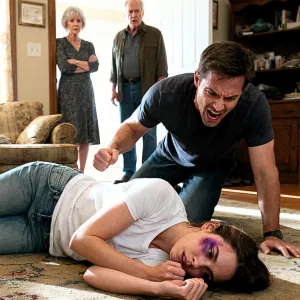
She was sitting on the floor by the couch, her back against the wall, knees pulled in. Her face was swollen. One eye was dark with bruising. Her hands trembled as if she’d been cold for hours.
For a moment, everything tilted. This wasn’t a disagreement. This wasn’t stress or family tension.
This was fear.
“Rachel,” I said, dropping beside her. She looked up at me, and I saw something I’d never seen in her eyes before—relief tangled with shame.
Marilyn began speaking rapidly. “She fell. She’s been hysterical all day. We’re just trying to calm her down.”
As I helped Rachel stand, my hand brushed her arm. Beneath her sleeve, I felt raised welts.
That was when I knew.
Whatever had been happening in that house wasn’t an accident. It was something they were hiding—on purpose.
I wrapped my jacket around Rachel’s shoulders and pulled her close. She flinched, then collapsed into me, sobbing so hard her legs nearly buckled. Ethan still hadn’t moved. He stared at the floor as if pretending none of this existed.
“We’re leaving,” I said.
Thomas spoke from the hallway. “You don’t understand. She’s unstable. Ethan’s been dealing with this for months.”
I looked straight at him. “If you ever describe my daughter that way again without explaining the bruises on her body, we’re going to have a much bigger problem.”
Marilyn stepped forward. “You’re overreacting. Families handle things internally.”
That sentence chilled me more than anything else that night.
As we walked out, Rachel whispered, “Dad… they took my phone. They said I wasn’t allowed to talk to you. Or anyone.”
In the car, she finally told me everything. How Ethan’s temper shifted after the wedding. How his parents excused it. How arguments turned into shouting, then grabbing, then shoving. How Marilyn would say, “If you were a better wife, he wouldn’t get so angry.” How Thomas told her to stop exaggerating.
That night, Rachel had tried to leave after Ethan shoved her into the coffee table. Marilyn blocked the door. Thomas stood behind her. Ethan said nothing.
I drove straight to the hospital. One look at Rachel, and the nurse called a social worker. X-rays showed bruised ribs—close to broken.
The next morning, Rachel filed a police report. She kept asking me, “What if I ruin his life?” I told her what my own father once told me: the truth doesn’t ruin lives. Abuse does.
Ethan’s parents called nonstop. They left messages accusing me of kidnapping, of turning Rachel against them. One voicemail said, “Families don’t involve outsiders.”
I saved every message.
By the end of the week, Rachel moved back home with me. She barely slept. Loud noises made her jump. But slowly, she began to breathe again.
Six months later, the divorce was finalized. Ethan accepted a plea deal that included mandatory counseling and a restraining order. His parents never apologized. In their final message, Marilyn wrote, “You destroyed this family.”
I didn’t respond.
Rachel goes to therapy twice a week now. Some days are harder than others, but she’s rebuilding her life on her own terms. She laughs more. She cooks again. She talks about going back to school. And sometimes, sitting quietly together, she looks at me and says, “Thank you for coming, Dad.”
I always answer the same way. “There was never a world where I wouldn’t.”
I’ve replayed that night many times—the signs I missed, the moments I assumed she was just adjusting. I’ve learned that abuse doesn’t always look loud. Sometimes it hides behind polite smiles and the word family used as a weapon.
If any of this feels familiar, please hear this: love does not demand fear. Family does not trap you. And asking for help is not betrayal.