Chapter 1: The Deafening Silence of Home
They tell you that the hardest part of a deployment is the leaving. They talk about the tearful goodbyes at the terminal, the way your gut twists when you watch your family disappear behind the security glass, the smell of jet fuel mixing with the scent of your wife’s perfume that lingers on your collar for the first few hours of the flight. They tell you that once you’re “in country,” you switch off. You become a machine. You focus on the mission, your squad, the sector, the heat, the dust. You suppress the memories of home because distraction gets you killed.
But they are lying. The hardest part isn’t leaving. It isn’t the firefights in the sandbox or the sleepless nights listening for the whistle of incoming mortars.
The hardest part is coming home.
It’s the transition. It’s the jarring shift from a world where everyone wants to kill you to a world where people are worried about the price of milk or the traffic on the I-35. It’s the silence. In the desert, silence is a threat. Silence means the enemy is maneuvering. Silence means an ambush. When you come home, you crave the noise of life, but your body is still wired for the noise of war.
I am Staff Sergeant Jack Sullivan, 1st Cavalry Division. I’ve spent the last twelve months eating dust, sweating through my body armor, and counting the days until I could step back onto Texas soil. Three hundred and sixty-five days. That’s eight thousand, seven hundred and sixty hours of missing my life.
The flight into Killeen was bumpy. The C-130 touched down with a screech of tires that sent a jolt up my spine, a familiar greeting from the military transport. But this time, when the ramp lowered, the heat that hit me wasn’t the dry, suffocating furnace of the Middle East. It was the humid, thick blanket of a Texas afternoon. It smelled of asphalt, ozone, and wet grass. It smelled like freedom.
I didn’t tell them the exact time I was landing. I wanted to surprise them. It’s a cliché, I know—the soldier walking through the door, the dog barking, the wife dropping a plate, the kids screaming and tackling him. I had played that scene in my head a thousand times while lying on a cot in a tent that smelled like unwashed socks and despair. That scene was the fuel that kept me going.
My twin daughters, Maya and Chloe. Fifteen years old now. Sophomores. The last time I saw them, they were still awkward freshmen, braces on their teeth, nervous about high school. I missed their fifteenth birthday. I missed Christmas. I missed the day Maya got her braces off. I missed Chloe making the varsity debate team. I missed a year of their lives, a year I could never buy back, not with all the combat pay in the world.
I caught a ride with a buddy from the base. He dropped me off at the end of my driveway. The house looked the same. The siding was a little faded—I’d need to pressure wash that next weekend. The lawn was a little overgrown—Sarah had probably been too busy or too tired to mow it. But it was standing. It was mine.
I adjusted the strap of my duffel bag on my shoulder. My boots crunched on the gravel. Every step felt heavier than the last, the anticipation building in my chest like a physical weight. I expected to see movement in the windows. I expected to hear the television blaring, or music. Maya was always playing that pop music too loud, and Chloe was usually shouting over it to be heard.
But as I reached the front porch, I stopped.
Silence.
Not the peaceful silence of a lazy Sunday afternoon. This was a heavy, thick silence. The kind of silence that hangs over a house where something has gone wrong. The blinds were drawn. All of them. It was 4:00 PM on a Tuesday. The girls should be home from school. Sarah should be starting dinner. The house should be alive.
Instead, it felt like a tomb.
I reached for my keys, my hand shaking slightly. It wasn’t the shake of fear—I don’t get afraid, not in the traditional sense. It was the adrenaline spike of the unknown. My combat instincts, dormant for the last twenty-four hours of travel, suddenly flared to life. The hair on the back of my neck stood up.
Check your corners.
I unlocked the door and pushed it open.
“Sarah? Girls?”
My voice echoed in the entryway. It sounded too loud, too rough. It was a voice used to shouting orders over the roar of Humvees, not a voice for a suburban living room.
The air inside was stale. Stuffy. Like the windows hadn’t been opened in weeks.
“Jack?”
The voice came from the kitchen. It was weak. Trembling.
I dropped my bag right there in the hall. It hit the floor with a heavy thud. I walked into the kitchen, my boots heavy on the hardwood.
Sarah was sitting at the small round table by the window. The table where we used to drink coffee on Saturday mornings. The table where the girls did their homework.
She wasn’t making dinner. She wasn’t smiling. She was sitting with her hands wrapped around a mug that looked empty. She was wearing her bathrobe, even though it was late afternoon.
When she looked up, my heart stopped.
Sarah, my rock, the woman who had held our family together through three deployments, looked broken. Her eyes were red, swollen almost shut. Dark circles bruised the skin beneath them. She looked like she hadn’t slept in a week. She looked like she had aged ten years in the twelve months I had been gone.
“Sarah,” I breathed, rushing to her. I fell to my knees beside her chair, wrapping my arms around her. “Baby, what is it? What happened? Is it… is it my mom?”
She shook her head against my chest. She was sobbing now, deep, gut-wrenching sobs that shook her entire frame. She gripped my uniform shirt so hard her knuckles turned white.
“I’m so sorry, Jack,” she gasped. “I tried. I tried so hard to handle it. I didn’t want to worry you while you were over there. I didn’t want you to be distracted.”
I pulled back, gripping her shoulders. The soldier in me was taking over. Assess the situation. Identify the threat. Neutralize it.
“Handle what? Sarah, look at me. Breathe. Tell me.”
She took a ragged breath, wiping her nose with the back of her hand. She looked toward the ceiling. Toward the second floor.
“The girls,” she whispered.
My blood ran cold. “Are they sick? Are they hurt?”
“They’re upstairs,” she said, her voice barely audible. “They haven’t been to school in three days. They won’t leave their room. They… they didn’t want you to see them like this.”
I didn’t wait for another word. I stood up. The chair scraped loudly against the floor.
“Jack, wait—” Sarah called out, but I was already moving.
I took the stairs two at a time. The familiar creak of the third step didn’t register. My mind was racing through scenarios. Car accident? Drugs? Some kind of illness?
The hallway was dark. The door to their shared bedroom—the one with the sign that said “Keep Out – Genius at Work” which Chloe had made, and “No Boys Allowed” which Maya had added—was closed.
I stood in front of that door for a second. I took a breath. I had kicked down doors in Fallujah. I had breached compounds in the dead of night. But opening this white, wooden door with the peeling paint felt more terrifying than any of that.
I turned the knob. It was unlocked.
I pushed it open slowly.
“Girls?”
The room was pitch black. The blackout curtains were drawn tight. The air smelled of stale food and tears. It was the smell of depression.
“Dad?”
It was Maya’s voice. But it sounded wrong. Thick. Muffled.
“Turn on a light,” I said. My hand found the switch on the wall.
“No!” Chloe screamed. “Dad, don’t! Please!”
Her scream was primal. Filled with panic.
I froze. My hand hovered over the switch.
“I can’t help you in the dark,” I said, my voice dropping to that low, commanding register I used when things went sideways in the field. “I am turning on the light. Now.”
I flipped the switch.
The overhead fan light flickered on, casting a harsh yellow glow over the room.
I blinked, my eyes adjusting.
And then I saw them.
And then I died.
The Jack Sullivan who had walked up the driveway five minutes ago died right there in the doorway. The man who replaced him was something else entirely. Something colder. Something darker.
Maya was sitting on the edge of her bed. She was hugging a pillow to her chest. She looked up at me, flinching as the light hit her.
My beautiful, vibrant Maya. The girl with the infectious laugh.
Her face was a ruin.
Her left eye was swollen shut, the skin around it a grotesque shade of purple, black, and sickly yellow. There was a cut above her eyebrow that had been butterfly-bandaged, probably by Sarah. Her lip was split, swollen to twice its size. But it wasn’t just the bruises. It was the way she held herself. Hunched over. Broken.
I looked at Chloe. She was on the other bed, curled into a ball under her duvet. She pulled the blanket down slowly, her hands trembling.
“Hi, Daddy,” she whispered.
Chloe didn’t have bruises on her face. Not like Maya. But when she sat up, I saw it.
She turned her head.
A patch of her long, honey-blonde hair—the hair she had been growing out for two years because she wanted to look like her favorite singer—was gone. Ripped out. Not cut. Ripped. The scalp was angry, red, and scabbing. Other parts of her hair had been hacked off unevenly, leaving jagged, short clumps.
I walked into the room. I felt like I was walking underwater. The pressure in my chest was crushing me.
I sat on the edge of Maya’s bed. The mattress dipped under my weight. I looked at my hands. They were big, rough, scarred hands. Hands that knew how to field strip a rifle in thirty seconds. Hands that had dug trenches.
I reached out and gently touched Maya’s cheek, below the bruise. She winced.
“Who?” I asked.
The word hung in the air.
“It doesn’t matter,” Maya said, tears leaking from her swollen eye. “Just… can we move? Can we please just move, Dad? I can’t go back there. I won’t go back.”
“We aren’t moving,” I said. My voice was steady, but inside, a dam was breaking. “We are staying right here. But you need to tell me who did this. And you need to tell me why.”
They looked at each other. The twin communication. They were deciding how much to tell me. They were trying to protect me. Me. Their father. The soldier.
“Talk,” I ordered. “Report. From the beginning.”
Chloe sat up. She wiped her eyes. “It started when you left,” she said softly.
Three months. It had been escalating for three months.
“It was the ‘Kings’,” Chloe said. The name tasted like poison in her mouth.
“The Kings?”
“Brad, Tyler, and Josh,” Maya explained. “The seniors. The football stars. The ones everyone worships.”
It started small. Comments in the hallway. “Trash.” “Army brats.” “Baby killers.”
My jaw tightened. They used my service against my daughters.
Then it moved online. They created fake profiles. They took photos of the girls in the cafeteria and captioned them with filth. Rumors that no fifteen-year-old should ever have to hear about themselves. They isolated them. Friends stopped sitting with them because they were afraid of becoming targets too.
“We tried to ignore it,” Maya said, her voice cracking. “Mom told us to just ignore it. To be the bigger person.”
“Mom went to the school,” Chloe added. “Three times. She talked to the counselor. She talked to the Vice Principal.”
“And?”
“And they said it was ‘he-said-she-said’,” Chloe spat. “They said we needed to learn resilience.”
“Resilience,” I repeated. The word tasted like ash.
“But yesterday…” Maya touched her eye. “Yesterday was different.”
“Tell me.”
“We were in the locker room,” Maya said. “After gym. The girls’ locker room. We thought we were safe.”
“They came in?” I asked, my voice dangerously low.
“No,” Chloe said. “They waited outside the back exit. Where the buses don’t go. We were walking to the car.”
They cornered them. Three senior boys. Each one over six feet tall. Football players. Against two fifteen-year-old girls.
“Brad had scissors,” Chloe whispered. She touched her head. “He said… he said I was too ugly to have long hair. He said he was doing me a favor.”
She started to cry again. “Tyler held me down. I screamed, Dad. I screamed for help. There were people around. Other students. They just… they just watched. Some of them filmed it.”
I closed my eyes. I saw the scene. My little girl, pinned to the concrete, screaming while a boy hacked at her hair.
“Maya tried to pull him off,” Chloe continued.
“I bit him,” Maya said, a flash of defiance in her good eye. “I bit Tyler’s arm.”
“And that’s when Josh hit you?” I asked.
Maya nodded. “He punched me. Closed fist. Like I was a man. He said… he said, ‘Equal rights, equal fights, bitch.’”
I stood up. I couldn’t sit anymore. The energy in my body was too volatile. I paced the small length of the room. Four steps one way. Four steps back.
“Did you go to the police?” I asked.
“Mom took us to the ER,” Maya said. “The police came. They took a report. But then… then the Principal called.”
“Principal Miller?” I knew the name. He had been the principal when I left. A slick politician of a man who cared more about the district’s football ranking than education.
“He called Mom,” Chloe said. “He said that if we pressed charges, the boys would counter-sue. He said they claimed we attacked them first. That Maya biting Tyler was assault.”
“He said,” Maya’s voice trembled, “that since there was no video of them starting it, but there were witnesses—their friends—who said we started it, we would be the ones getting expelled. He said Brad has a scholarship to UT waiting. He said we shouldn’t ruin a young man’s future over a ‘misunderstanding’.”
I stopped pacing.
I looked at my daughters. I looked at the wreckage of their self-esteem. I looked at the physical proof of their torture.
A misunderstanding.
A young man’s future.
The rage that had been building in my gut didn’t explode. It didn’t make me scream or punch the wall.
It crystalized. It turned into something cold, hard, and sharp. It turned into a mission objective.
In the Army, we have Rules of Engagement. ROE. You don’t fire unless fired upon. You don’t engage civilians. You minimize collateral damage.
But this? This wasn’t a peacekeeping mission. This was an invasion. They had invaded my home. They had attacked my unit.
“Where is your mom?” I asked.
“Downstairs,” Chloe said.
“Get dressed,” I said.
“Dad, no,” Maya pleaded, standing up. “Please don’t go over there. Brad’s dad is crazy. He has lawyers. He practically owns the town. You’ll just get in trouble.”
“I’m not going to their house,” I said. I walked over to Maya. I kissed her forehead, right above the bandage. “And I’m not going to get in trouble.”
“Then what are you going to do?”
I looked at myself in the mirror on their closet door. I saw the uniform. The American flag patch on my shoulder. The Combat Infantryman Badge on my chest.
“I’m going to teach them a lesson,” I said. “Not the lesson they expect. I’m going to teach them about consequences. And I’m going to start with the man who let this happen.”
“Principal Miller?”
“Get dressed,” I repeated. “Put on your uniforms.”
“We can’t go to school like this!” Chloe cried. “Everyone will stare.”
“Let them stare,” I said. “Let them see. You have nothing to be ashamed of. You are survivors. You are Sullivans. And Sullivans do not hide.”
I walked to the door. I paused and looked back at them.
“I promised to keep this country safe,” I said. “That includes you. Especially you. I failed you for the last three months. I won’t fail you today.”
I walked out of the room and down the stairs. The silence of the house was gone. It was replaced by the sound of my boots on the wood, a rhythmic, heavy drumbeat of impending justice.
Sarah was still in the kitchen. She looked up as I entered. She saw the look on my face. She had seen it before, years ago, when a drunk driver had sideswiped her car.
“Jack,” she warned. “Don’t do anything stupid. You have a pension to think about. You have a career.”
“I’m not going to do anything illegal, Sarah,” I said, grabbing my car keys from the counter. “I’m just going to have a conversation.”
“With who?”
“With the chain of command,” I said.
I didn’t tell her that in my book, the chain of command at Northwood High was about to be broken.
I waited by the front door. Five minutes later, the girls came down. They were wearing their jeans and hoodies. Maya had her hood up to hide her face. Chloe was wearing a beanie hat.
“Hoods down,” I said gently. “Hats off.”
They hesitated.
“Trust me,” I said. “If you hide, they win. If you show them what they did, they have to face it.”
Slowly, painfully, Maya lowered her hood. Chloe took off the hat.
They looked vulnerable. They looked battered. But standing there, next to their father in his fatigues, they looked like something else too.
They looked like evidence.
“Let’s go,” I said.
We walked out into the Texas heat. The sun was blinding.
I opened the door to my truck. I helped them in.
As I walked around to the driver’s side, I looked down the street. It was a nice neighborhood. Manicured lawns. American flags hanging from porches. It looked like the perfect slice of the American Dream.
But rot was hiding underneath. And I was the exterminator.
I started the engine. The truck roared to life.
“Dad,” Chloe said from the backseat. “Are you scared?”
I looked at her in the rearview mirror.
“No, sweetie,” I said. “I’m not scared.”
I shifted into gear.
“But they should be.”
Chapter 2: Zero Tolerance
The drive to Northwood High took fifteen minutes. In a Humvee, fifteen minutes can be a lifetime. In my Ford F-150, with the air conditioning blasting and the radio off, it felt like a funeral procession.
I drove with one hand on the wheel, my eyes scanning the road. Force of habit. Scanning for IEDs in the trash on the side of the road. Scanning for snipers on the overpasses. But here, the threats were different. They were invisible. They were whispered insults and digital taunts that had slowly eroded my daughters’ souls while I was 7,000 miles away.
Maya sat in the passenger seat. She had stopped crying, but her silence was worse. She was staring out the window, watching the familiar suburban landscape pass by—the strip malls, the gas stations, the manicured parks. She looked like a prisoner being transported back to her cell.
In the rearview mirror, I watched Chloe. She was picking at her fingernails, a nervous tic she’d had since she was a toddler. She had pulled the beanie cap back on, unable to bear the exposure of her ruined hair.
“We’re almost there,” I said. My voice was calm. Controlled.
“Dad,” Maya whispered. “Please don’t yell at him. Principal Miller… he’s friends with the Mayor. He’s untouchable.”
“Nobody is untouchable, Maya,” I said. “That’s a lie people tell you so you won’t fight back.”
We pulled into the school parking lot. It was massive. Northwood High was one of those Texas football factories—a sprawling brick fortress that looked more like a university than a high school. The stadium lights loomed over the building like guard towers.
School had just let out. The buses were lining up, yellow whales swallowing streams of teenagers. Cars were clogging the exit lanes.
I parked in a spot reserved for “Faculty Only.” I didn’t care.
“Stay close to me,” I ordered.
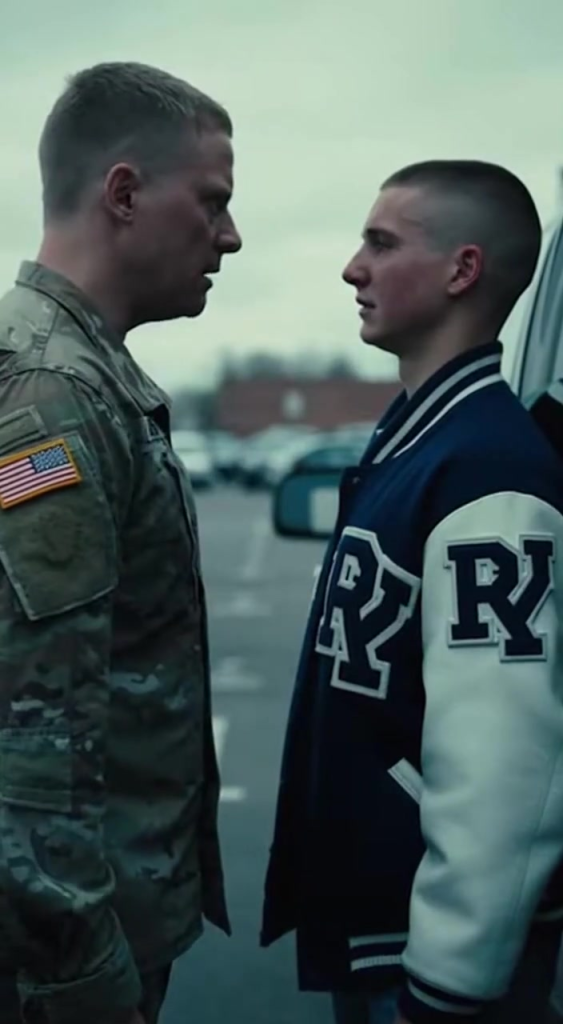
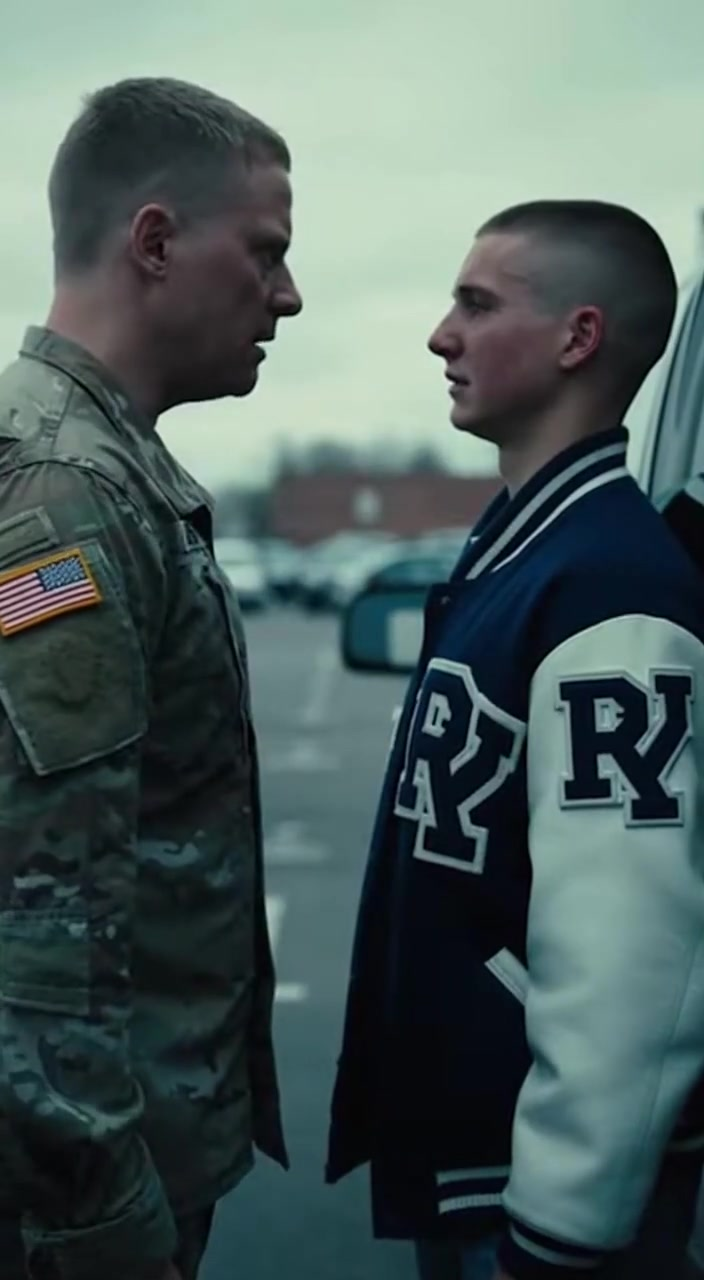
I climbed out of the truck. I was still in my fatigues—my MultiCam OCPs (Operational Camouflage Pattern). I hadn’t changed. I wanted the visual impact. I wanted them to see the flag on my shoulder. I wanted them to see the boots that had kicked in doors in places they only saw on the news.
I walked around the truck and opened the door for Maya. She stepped out, shielding her face with her hand. Chloe followed, keeping her head down.
“Head up,” I murmured. “You are Sullivan women. You do not bow.”
We walked toward the main entrance. The sea of students parted.
At first, it was just confusion. Who is the soldier? But then, they saw the girls.
The whispers started immediately. Like the buzzing of flies.
“Is that Maya?” “Look at her face.” “Oh my god, look at Chloe’s hair.” “Is that their dad?” “He looks pissed.”
I ignored them. I kept my eyes locked on the double glass doors of the administration building. I walked with a long, purposeful stride. The girls had to jog slightly to keep up with me.
We burst through the doors into the air-conditioned coolness of the front office.
The receptionist was an older woman with glasses on a chain and a perm that hadn’t moved since 1995. She was typing on a computer. She didn’t look up immediately.
“Sign in at the sheet, please. If you’re picking up a student, I need ID.”
I didn’t sign in. I walked up to the high counter and placed my hands on the Formica.
“Principal Miller,” I said.
She looked up, startled by the tone. Her eyes widened when she saw the uniform. Then they flicked to the girls standing behind me. She gasped when she saw Maya’s eye.
“Oh my,” she breathed. “Sir, I… do you have an appointment?”
“My appointment was three months ago when this started,” I said. “I want to see him. Now.”
“He’s in a meeting with the booster club,” she stammered, reaching for her phone. “I can’t just interrupt—”
“You can,” I said, leaning in. “Or I can go back there and interrupt him myself. And I promise you, my version of an interruption is much louder than a phone call.”
She held my gaze for a second. She saw something there that made her swallow hard. She picked up the phone.
“Mr. Miller? There’s a… a parent here. Mr. Sullivan. Yes. No, sir, I don’t think he’s going to wait. Yes, sir.”
She hung up. “Go right in. Second door on the left.”
I didn’t thank her. I signaled the girls. “Move.”
We walked down the carpeted hallway. It was lined with photos of past football teams. Trophies in glass cases lined the walls. It was a shrine to teenage athleticism. Nowhere did I see a shrine to academic excellence or kindness.
I didn’t knock. I opened the heavy oak door and walked in.
Principal Miller was standing behind a desk that looked like it cost more than my first car. He was a big man, soft around the middle, wearing a suit that was too tight. He had a gold ring on his finger and a fake smile plastered on his face.
There were two other men in the room—boosters, probably—wearing Northwood Football polo shirts. They looked surprised.
“Gentlemen, could you give us a moment?” Miller said smoothly.
The men grabbed their coffees and shuffled out, eyeing me warily as they passed.
Miller waited until the door clicked shut. Then he sighed, taking off his glasses and cleaning them with a microfiber cloth. A power move. Making me wait.
“Staff Sergeant Sullivan,” he said, finally looking at me. “I heard you were deployed. Thank you for your service.”
He didn’t offer me a seat.
“Cut the pleasantries,” I said. I pulled Maya forward gently. I turned her face so the light from the window hit the gruesome bruise in full detail.
“Look at this,” I commanded.
Miller glanced at it, then looked away. He grimaced slightly. “Yes. Your wife sent me photos this morning. It’s… unfortunate.”
“Unfortunate?” I repeated. “Unfortunate is a flat tire, Miller. Unfortunate is rain on a picnic. This? This is assault. This is battery.”
I pulled Chloe forward. “Take off the hat, Chloe.”
“Dad…”
“Take it off.”
She pulled the beanie off.
Miller stared at the bald patch, the angry red scabs where the hair had been ripped from the root.
“And this?” I asked, my voice rising. “Is this unfortunate? Or is this torture?”
Miller put his glasses back on. He sat down in his leather chair, creating a barrier between us. He clasped his hands on the desk.
“Look, Mr. Sullivan. I understand you’re upset. Any father would be. But I’ve already explained the situation to your wife.”
“Explain it to me,” I said. “Explain to me why the three boys who did this—Brad, Tyler, and Josh—are currently walking around your school laughing, while my daughters are afraid to leave their bedroom.”
Miller sighed again. “We have a Zero Tolerance policy here at Northwood.”
“Good. Then why aren’t they expelled?”
“Zero Tolerance applies to all parties involved in a physical altercation,” Miller said, his voice taking on a condescending, lecture-like tone. “The student handbook clearly states that any student engaged in fighting faces suspension. We have witness statements—multiple statements—indicating that your daughters provoked the incident.”
“Provoked it?” I laughed. It was a cold, sharp sound. “You think my hundred-pound daughters provoked three linebackers? How? Did they aggressively exist in their vicinity?”
“We were told that Maya used racial slurs,” Miller said.
Maya gasped. “I never! That’s a lie! They’re the ones who—”
“And,” Miller interrupted, raising a hand, “we have confirmation that Maya bit one of the boys. That is assault, Sergeant. Human bites are dangerous.”
“She bit him because he was holding her sister down and scalping her with office scissors!” I roared. I slammed my hand onto his desk. The impact made his nameplate jump.
Miller flinched. He pushed his chair back.
“Control yourself, sir,” he warned. “Or I will have security remove you.”
I leaned over the desk. I was inches from his face. I could smell his cologne—expensive, musky, trying too hard.
“You listen to me,” I hissed. “I know what this is. Brad’s father owns the dealership that sponsors your scoreboard. Tyler’s dad is on the city council. You aren’t protecting students. You’re protecting your donors.”
Miller’s face turned red. “That is a baseless accusation.”
“Is it? Then show me the security footage.”
“There are no cameras in that hallway,” Miller said quickly. Too quickly.
“Convenient,” I said. “So it’s their word against my daughters’. And since they have more friends willing to lie for them, they win. Is that the lesson you’re teaching here?”
Miller stood up. He was trying to regain authority. “The lesson is that violence is never the answer, Sergeant. I’m willing to let this go—no suspension for your girls for the biting—if we drop this matter now. The boys have been given a verbal warning to stay away. That is the end of it.”
“A verbal warning,” I said, incredulous. “For assault causing bodily harm.”
“Without video evidence, my hands are tied,” Miller said, shrugging. “I suggest you take your daughters home. Let them cool off. Maybe… maybe look into counseling for them. It’s hard having a father away for so long. They might be acting out for attention.”
That was it.
The moment he said that, the rage in my chest settled. It stopped being hot and chaotic. It froze. It became absolute zero.
He was blaming them. He was using my service, my sacrifice, as a weapon to gaslight my children.
I looked at him. I really looked at him. I saw the fear behind his eyes. He wasn’t afraid of me hurting him physically; he was afraid of the scandal. He was afraid of the boat being rocked.
He was an enemy combatant. He just wore a suit instead of a vest.
“You’re right,” I said softly.
Maya looked at me, her eyes wide with betrayal. “Dad?”
“You’re absolutely right, Principal Miller,” I said, straightening up. I brushed an imaginary speck of dust off my uniform. “I’ve been away too long. I’ve forgotten how the world works. Without evidence, you can’t act. I respect the chain of command.”
Miller looked relieved. He smiled, a greasy, triumphant smile. “I knew you’d understand. We all want what’s best for the kids.”
“We sure do,” I said. I extended my hand.
He hesitated, then shook it. His palm was sweaty. My grip was iron. I squeezed, just enough to make him wince, just enough to let him know that this wasn’t a truce. It was a warning.
“I’m going to handle this my way,” I said. “And since you can’t control your soldiers, I’m going to have to police the area myself.”
“I… excuse me?” Miller pulled his hand back, rubbing his knuckles.
“Have a good afternoon, Principal,” I said.
I turned to the girls. “Let’s go.”
We walked out of the office. The receptionist watched us go, her mouth slightly open.
“Dad, why did you do that?” Chloe whispered as we walked down the hall. “You let him win.”
“I didn’t let him win,” I said, pushing the exit doors open. “I just changed the battlefield.”
We stepped out into the blinding afternoon sun.
And there they were.
It was like a scene from a bad movie, but it was real life.
Three boys were leaning against a lifted, black Ford F-250 in the student lot. They were wearing their varsity letterman jackets, despite the heat. They were laughing, drinking sodas, looking like they owned the world.
Brad. Tyler. Josh.
I knew their faces from the descriptions.
Brad saw us first. He saw Maya.
He nudged Tyler. He pointed.
They didn’t look ashamed. They didn’t look scared. They looked… entertained.
Brad made a crying face, rubbing his eyes with his fists in a mocking gesture. Tyler laughed and made a snipping motion with his fingers, imitating scissors.
My blood boiled. Every instinct in my body screamed at me to drop my bag, walk over there, and show them what a man who has fought in Ramadi can do to three spoiled brats. I could break them. Physically, it would take seconds.
I took a step toward them.
“Dad, no!” Maya grabbed my arm. Her grip was tight. “Please. They’ll film it. You’ll go to jail. That’s what they want.”
I stopped. I looked down at my daughter. She was right.
If I hit them, I was the aggressor. I was the crazy PTSD veteran who attacked kids. I would lose everything. My career. My pension. My freedom. And I would leave my girls alone again.
I looked back at the boys. I memorized them.
I memorized the arrogance in Brad’s posture. I memorized the way Tyler’s hair fell over his eyes. I memorized the license plate of the truck: KING-1.
I took a deep breath, inhaling the hot Texas air. I forced my heart rate down. In for four, hold for four, out for four.
“Get in the truck,” I said to the girls.
“You’re not going to do anything?” Chloe asked, her voice disappointed.
I opened the back door for her.
“I’m not going to touch them, Chloe,” I said, looking her in the eye. “Touching them is illegal. Breaking them? Dismantling their lives piece by piece? That’s just strategy.”
I climbed into the driver’s seat. I started the engine.
As I pulled out, I drove slowly past them. I rolled down my window.
The boys stopped laughing. They stared at me.
I didn’t say a word. I just looked at Brad. I gave him the look. The “thousand-yard stare.” The look that says, I have seen death, and you are nothing to me.
Brad’s smile faltered. He looked down at his shoes.
I drove away.
The drive home was silent again, but the energy had changed. It wasn’t fearful anymore. It was focused.
“What are you going to do?” Maya asked as we pulled into our driveway.
“Tonight,” I said, turning off the truck, “we gather intel. Tomorrow, we execute.”
I wasn’t just a father anymore. I was a Staff Sergeant on a mission. And the mission objective was simple: Total destruction of the enemy’s will to fight.
Chapter 3: Intelligence Preparation of the Battlefield
The first rule of warfare: You do not engage the enemy until you know their terrain better than they do.
By 8:00 PM, my dining room table had been transformed. The placemats were gone. In their place were two laptops, a legal pad, three burner phones, and a pot of black coffee strong enough to wake the dead.
Sarah had taken the girls upstairs to watch a movie. She knew the look in my eye. She knew that when I got like this, I needed space to work. She was worried, I could tell, but she trusted me. She knew I wouldn’t cross the line into illegality—at least, not in a way that could be traced.
I sat in the dark, the glow of the monitors illuminating my face.
I needed an asset. Someone who could dig deeper than a Google search.
I picked up my phone and dialed a number I hadn’t called in two years.
“It’s late, Jack,” a voice answered on the second ring. Gravelly. Tired.
“Snake,” I said. “I need a favor.”
Snake—real name Marcus—was a former Intelligence Officer from my old unit. He got out on a medical discharge three years ago after an IED took two of his fingers and a chunk of his thigh. Now, he ran a private security and digital forensics firm in Austin. He was the best hacker I knew, though he preferred the term “information retrieval specialist.”
“I heard you were back,” Snake said. “I also heard the local grapevine says you marched into Northwood High today looking like the Terminator.”
“News travels fast.”
“Small town, Jack. What’s the op?”
“Three targets,” I said. “High school seniors. Brad Jenkins, Tyler Ross, Josh Miller.”
“Miller? Related to the Principal?”
“Nephew, I think. Or cousin. I need a full workup. Digital footprint. Social media, hidden accounts, deleted posts, text logs if you can get them. I want to know where they go, who they talk to, and what they’re hiding.”
Snake sighed. “Jack, these are kids. You sure about this?”
“They assaulted Maya and Chloe,” I said. My voice didn’t waver. “They beat Maya. They cut Chloe’s hair off. And the school is covering it up.”
There was a silence on the line. Then, the sound of a keyboard clacking furiously.
“Send me the names again,” Snake said. His tone had changed. It was cold now. Professional. “And the spellings.”
I gave him the info.
“Give me two hours,” Snake said. “If it’s on the internet, I’ll find it. If they deleted it, I’ll undelete it.”
“Thanks, brother.”
“Don’t thank me. Just make sure when you nail them, you use a big hammer.”
I hung up.
I spent the next two hours building my own file. I researched the parents.
Brad’s dad, the car dealership owner. Jenkins Ford. I looked up his reviews. I looked up his business filings. I found a forum post from three years ago complaining about predatory lending practices. Interesting.
Tyler’s dad, the City Councilman. I pulled up the public records of his voting history. He ran on a “Family Values” platform. The irony was palpable.
At 10:15 PM, my email chimed.
Subject: Package Delivered.
I opened the attachment from Snake. It was massive.
“Holy hell,” I whispered as I started scrolling.
Snake was a magician. He hadn’t just found their public profiles. He had found the shadow accounts. The ones they used to bully kids without getting caught.
I saw the messages. The racial slurs. The misogyny. It was a sewer of hate.
But then, I found the gold mine.
Snake had cracked a Telegram group chat named “The Crown.”
I opened the log.
It was a diary of crimes.
Video file: Brad throwing a rock through the window of a teacher’s car who gave him a C. Photo: Tyler posing with a street sign they had stolen. Chat log: Detailed discussions about cheating on the SATs using a stolen answer key.
And then, the smoking gun.
A video from two weeks ago. It was shaky, filmed on a phone.
It showed Brad and Tyler standing at the counter of a liquor store. The clerk was laughing, handing them a case of vodka and a carton of cigarettes.
“Thanks, Uncle Steve!” Brad said in the video.
The clerk waved. “Just don’t tell your dad, alright? And keep this on the down-low. Principal Miller would have my ass if he knew I was serving you guys before the big game.”
“Miller won’t do shit,” Brad laughed. “He knows who pays for the stadium lights.”
I paused the video. I zoomed in on the clerk.
I opened a new tab. searched “Principal Miller family.”
There it was. A Facebook photo from a family reunion. Principal Miller standing with his arm around the clerk. The caption: Me and my brother-in-law, Steve, at the BBQ.
Steve owned the liquor store.
Principal Miller knew.
This wasn’t just bullying. This was a criminal conspiracy involving a minor, alcohol, and a school administrator turning a blind eye to protect his family and his funding.
I sat back in my chair. A grim smile spread across my face.
They thought they were the Kings of the school. They thought they were predators.
They didn’t realize they had just become prey.
I printed the photos. I printed the chat logs. I downloaded the videos to three separate encrypted drives.
I walked upstairs. The house was quiet.
I peeked into the girls’ room. They were asleep. Chloe was restless, tossing and turning. Maya was still, but her breathing was shallow.
I stood in the doorway, watching them. The anger was gone, replaced by a cold, tactical resolve.
I went to my bedroom. I opened my closet.
I pushed aside my civilian clothes. I reached into the back and pulled out my Dress Blues. The formal uniform. The one you wear to weddings and funerals. The one that commands respect not because of camouflage, but because of history.
I brushed the lint off the shoulders. I checked the ribbons.
Tomorrow, I wasn’t going to be a guerrilla fighter. I was going to be an army of one.
I checked my watch. 11:00 PM.
The enemy was sleeping. They were probably dreaming of football games and cheerleaders. They thought they had won.
I turned off the light.
Sleep well, boys, I thought. Because tomorrow, we’re having lunch.
Chapter 4: The Ambush at High Noon
The psychological component of warfare is often more effective than the kinetic one. If you can break the enemy’s mind, you never have to touch his body.
The next morning, the house was quiet. I woke up at 0500, purely out of habit. I went for a run—five miles in the humidity, pushing my body until my lungs burned and the anger in my chest had settled into a focused, rhythmic thrum.
When I got back, Sarah was in the kitchen making coffee. She looked at me, assessing my mood.
“You’re in a mood,” she said. It wasn’t a question.
“I’m in a mindset,” I corrected.
“What’s the plan, Jack?”
“Take the girls out today,” I said, pouring a glass of water. “Go to the mall in the next town over. Maybe a movie. Somewhere they won’t run into anyone from Northwood.”
“And you?”
“I have a lunch date.”
I went upstairs to shower. I shaved close, going against the grain until my skin was smooth. Then, I began the ritual of dressing.
I didn’t put on the fatigues today. Fatigues are for work. Today was for a ceremony. The ceremony of judgment.
I put on my Army Service Uniform—the Dress Blues. I adjusted the tie. I pinned my rack of ribbons to my chest: the Bronze Star, the Purple Heart, the Campaign medals. I polished the brass until it gleamed. I put on the service cap.
When I walked downstairs, Sarah gasped. She hadn’t seen me in full dress since my cousin’s wedding three years ago.
“You look…” she trailed off. “Intimidating.”
“Good.”
I kissed her. “Take the girls. Don’t check your phones. I’ll call you when it’s done.”
Northwood High had an “Open Campus” policy for seniors with a GPA over 3.0. It was a privilege. And like clockwork, the “Kings”—Brad, Tyler, and Josh—exercised that privilege every day at 11:30 AM.
Their spot was The Burger Barn, a retro-style diner about a mile from the school. It was the place to be seen. If you sat in the center booth at Burger Barn, you ruled the school.
I pulled into the parking lot at 11:15 AM. I didn’t park in the back. I parked right in front of the large glass window.
I sat in my truck and waited.
At 11:35 AM, a lifted black Ford F-250 roared into the lot. It took up two spaces.
Brad jumped out. Then Tyler. Then Josh. They were loud. They were high-fiving. They were wearing their letterman jackets, walking with that swagger that only seventeen-year-old boys who have never been punched in the mouth possess.
They walked into the diner.
I gave them five minutes to order. I wanted them settled. I wanted them comfortable.
At 11:40 AM, I opened my truck door.
I put on my sunglasses. I adjusted my cover.
I walked toward the diner door.
As I entered, the bell above the door chimed. Ding-ling.
The diner was packed with students, teachers, and locals. It was a cacophony of chatter, sizzling grease, and clinking silverware.
But as I stepped fully into the room, the noise began to die down.
It started at the front tables. People looked up. They saw a six-foot-two man in a pristine military uniform, standing in the doorway like a monolith.
The silence spread like a contagion. It moved from table to table until the only sound left was the sizzle of burgers on the grill.
I scanned the room. Target acquired.
Center booth.
They were laughing, looking at something on Brad’s phone. Probably a video of someone they had tormented. They hadn’t noticed the silence yet. They were too wrapped up in their own world.
I began to walk.
My dress shoes had hard heels. They made a distinct, sharp sound on the checkerboard linoleum.
Click. Click. Click.
The rhythm was slow. Deliberate. The sound of a clock counting down.
I walked past tables of wide-eyed freshmen. I walked past a table of teachers who stopped chewing their salads to stare.
I stopped exactly three feet from the center booth.
Brad was mid-laugh. “…so she starts crying, right? And I was like—”
He sensed the shadow looming over him.
He looked up.
The laugh died in his throat. It turned into a strangled cough.
He recognized me. But this wasn’t the guy in the t-shirt from yesterday. This was the institution of the United States Army standing over his lunch.
“Can I… can I help you?” Brad asked. His voice cracked.
Tyler and Josh looked up, their eyes widening. Josh actually dropped his fork.
I didn’t answer immediately. I took off my sunglasses slowly, folding them and sliding them into my pocket. I locked eyes with Brad. I didn’t blink.
“Stand up,” I said.
My voice wasn’t loud. I didn’t shout. I used what NCOs call the “Command Voice.” It resonates in the chest. It bypasses the ears and hits the nervous system directly.
“Excuse me?” Brad tried to summon his bravado. He looked around for support, but the entire diner was watching. “I’m eating my lunch.”
I took one step closer. I placed my hands flat on the table, leaning in.
“I said, stand up. Unless your legs don’t work. Is that it? Do you require medical assistance?”
“I ain’t disabled,” Brad snapped, his face flushing red.
“Then stand at attention when a Staff Sergeant is speaking to you, boy.”
The word “boy” hung in the air like a slap.
Brad looked at his friends. They were shrinking into the vinyl seats, desperate to be invisible. He realized he was alone.
Slowly, reluctantly, Brad slid out of the booth. He stood up. He was tall, maybe six-one, but he slumped.
“Straighten your back,” I barked. “Chin up. Eyes front.”
Brad instinctively straightened up.
“You think you’re a man,” I said, my voice rising just enough to carry to the corners of the room. “You drive a big truck. You wear a jacket with a patch on it. You think that makes you a warrior.”
“I don’t know what your problem is,” Brad muttered.
“My problem?” I laughed dryly. “My problem is that I spent the last year in a desert protecting the freedom of this country. And I come home to find that you are using that freedom to terrorize women.”
“I didn’t do anything!” Brad protested. “It was just a joke! The girls started it!”
“Don’t you lie to me!” The volume snapped up, sharp as a whip crack. Tyler flinched so hard he knocked over his soda. The dark liquid spilled across the table, dripping onto their laps. None of them moved to wipe it up.
“I have seen the enemy, son. And they look a lot like you. They pick on the weak because they are too cowardly to face the strong.”
I reached into my jacket pocket.
Brad flinched. He thought I was pulling a weapon.
I pulled out a manila envelope.
I tossed it onto the table. It landed in a puddle of spilled Coke.
“Open it,” I ordered.
Brad’s hands were shaking so bad he could barely undo the clasp. He pulled out the stack of papers.
The color drained from his face instantly. It was like pulling a plug.
He was looking at the chat logs. The racial slurs. The plans to cheat.
Then he saw the photos. The liquor store. The vandalism.
“Where… where did you get these?” he whispered.
“That is none of your concern,” I said. “Here is the Situation Report. I have three copies of that file. One is in my truck. One has already been emailed to the admissions office at the University of Texas. And one…”
I leaned in close, right into his personal space.
“…one is currently on its way to the local Police Chief. Along with a formal statement regarding the distribution of alcohol to minors by your Principal’s brother-in-law.”
Brad’s knees actually gave out. He grabbed the edge of the table to stop from falling.
“No,” he gasped. “My dad… the scholarship… you can’t.”
“I can,” I said. “And I did. You took my daughters’ peace of mind. I took your future. That seems like a fair exchange.”
“Please,” Josh squeaked from the booth. “We… we’ll stop. We promise.”
I turned my head slowly to look at Josh. “You’ll stop because you have no choice. But that is not enough.”
I turned back to the room. Every student was recording on their phones. Good.
“Ladies and gentlemen,” I announced. “These three ‘kings’ have a confession to make. They seem to think that assaulting girls is a sport. They think cutting a girl’s hair is funny.”
I looked back at Brad.
“You have a choice, Brad. Right now. A tactical decision.”
“What?” he breathed. Tears were welling in his eyes.
“Option A: I walk out of here, and I release everything. The video of the liquor store goes to the news. The chat logs go to your parents. You get arrested. You lose the scholarship. Your life is over.”
Brad was crying now. Silent, terrified tears.
“Option B,” I continued. “You finish your lunch. You get in that big truck. You drive back to school. You walk into Principal Miller’s office. And you confess. Everything. You tell him you are resigning from the football team immediately. And you issue a public apology to Maya and Chloe Sullivan.”
“I can’t quit the team,” Brad sobbed. “My dad will kill me.”
I smiled. It was the smile of a wolf.
“Son, if you pick Option A, your dad won’t just kill you. He’ll go bankrupt when the lawsuits hit. Option B is your survival strategy. Which is it?”
Brad looked at the photos. He looked at me. He looked at the phones pointing at him from every direction.
“Option B,” he whispered.
“I can’t hear you!”
“Option B!” he shouted, his voice breaking.
“Good choice.”
I checked my watch. “You have twenty minutes to get to the school. If I don’t see you walking into that office by 12:10, I press the button.”
I stepped back. I adjusted my jacket.
“Enjoy your lunch, ladies.”
I turned on my heel. Click. Click. Click.
I walked out of the diner. I didn’t look back. I didn’t have to. I could feel the fear radiating off them like heat waves.
I got into my truck. My hands were steady. My pulse was 60 beats per minute.
Phase One complete.
Now for the Head of the Snake.
Chapter 5: The Snake in the Grass
I drove straight to Northwood High. I parked in the same spot as yesterday.
I sat in the truck and waited.
Ten minutes later, the black Ford F-250 screeched into the lot. It parked crookedly.
Brad, Tyler, and Josh practically fell out of the truck. They were running. They looked like they were fleeing a war zone. They ran straight into the administration building.
I gave them five minutes. Let them sweat. Let them start the confession.
Then, I exited my vehicle.
I walked into the school. The hallway was empty; classes were in session.
I walked into the main office. The receptionist looked up. When she saw me in the Dress Blues, she stood up. She looked like she wanted to salute.
“Mr. Sullivan,” she said, her voice trembling. “They… the boys are in there. With Mr. Miller. It sounds… intense.”
“I imagine it is,” I said. “I’m joining the meeting.”
“I don’t think—”
I didn’t wait. I walked to the door and pushed it open.
The scene inside was chaotic.
Brad was sitting in a chair, head in his hands, sobbing loud, ugly cries. Tyler was pacing. Principal Miller was standing behind his desk, his face a mask of purple rage.
“You idiot!” Miller was shouting at Brad. “You admitted to what? Who told you to—”
He saw me.
The room went silent.
“You!” Miller pointed a shaking finger at me. “You harassed my students! I just got a call from a parent at the diner. You threatened them!”
“I didn’t threaten anyone,” I said calmly, closing the door behind me and locking it. “I simply laid out the tactical landscape.”
“I’m calling the police,” Miller said, reaching for his desk phone. “I’m having you arrested for intimidation.”
“Go ahead,” I said. I sat down on the leather couch, crossing my legs. “Officer Daniels is a good friend of mine. In fact, I think he’s already interested in a case involving the distribution of alcohol to minors.”
Miller’s hand froze halfway to the receiver.
“What are you talking about?”
“I’m talking about your brother-in-law, Steve,” I said. “And the Bottoms Up liquor store on 5th Street.”
Miller went pale. It wasn’t a gradual fade; it was instant. All the blood left his face.
“I have video, Miller,” I said softly. “4K video. Of these boys buying vodka from Steve. And audio of them saying you set it up.”
Miller dropped the phone. It clattered into the cradle.
He looked at the boys. “You told him?”
“He knew!” Brad wailed. “He had the texts! He has everything!”
Miller slumped into his chair. The fight went out of him. He looked at his trophies. He looked at his tenure. He saw it all evaporating.
“What do you want?” Miller whispered. “Money? I can… we can work something out.”
I stood up. The disgust I felt was physical. I wanted to vomit.
“I don’t want your money,” I said. “I want your scalp.”
Miller flinched.
“I want a safe environment for my daughters,” I said. “And clearly, as long as you are in this chair, that is impossible. You are compromised. You are corrupt. And you are done.”
“I have a contract…”
“You have a choice,” I interrupted. “Resign. Today. Cite health reasons. Family issues. I don’t care what lie you tell. But you clear out your desk by 3:00 PM.”
“And if I don’t?”
“Then I release the video,” I said. “And the texts. And the photos. You won’t just lose your job, Miller. You’ll go to prison. Contributing to the delinquency of a minor. Conspiracy. It’s a long list.”
I walked over to the desk. I picked up a pen and a piece of paper. I slid them toward him.
“Start writing.”
Miller looked at the pen. He looked at me. He saw the ribbons on my chest. He saw the unyielding line of my jaw.
He picked up the pen. His hand was shaking.
I watched him write. I, Robert Miller, hereby resign…
When he was done, I took the paper.
“Good,” I said. “Now, I suggest you call the school board.”
I turned to the boys. They were terrified. They were waiting for their turn.
“You three,” I said. “You’re lucky. Because you confessed, you might avoid jail. But you are going to serve your time.”
“We quit the team,” Brad whispered.
“That’s a start,” I said. “But you’re also going to do something else. Every Saturday for the rest of the year, you are going to volunteer at the Veterans Hall. You’re going to sweep floors. You’re going to clean toilets. You’re going to listen to stories from real men. Maybe, just maybe, you’ll learn what it actually means to be tough.”
They nodded furiously.
“Get out of my sight,” I dismissed them.
They scrambled for the door, tripping over each other to get away.
I looked back at Miller one last time. He was staring at the wall, a broken man.
“Dismissed,” I said.
I walked out of the office.
The receptionist was pretending to type.
“He’s resigning,” I told her as I passed. “You might want to update the website.”
I walked out into the sunshine.
I took a deep breath. The air smelled sweeter. The weight on my chest was gone.
I pulled out my phone. I dialed Sarah.
“Mission accomplished,” I said. “Coming home.”
Chapter 6: Walking Through Fire
The ride home from the school was different than the ride there. The tension that had filled the cab of the truck—thick enough to choke on—had evaporated. In its place was a strange, vibrating exhaustion.
I drove with both hands on the wheel, the adrenaline crash starting to hit me. My hands weren’t shaking, but they felt heavy.
“Did you do it?” Maya asked from the passenger seat. She was looking at me, her good eye wide, searching for a signal.
“It’s done,” I said. “Principal Miller resigned. The boys confessed. They aren’t going to bother you again.”
“Ever?” Chloe asked from the back.
“Not if they want to stay out of jail,” I replied.
We pulled into the driveway. Sarah was waiting on the porch. She must have been tracking my phone or watching out the window for the last hour. She ran to the truck before I even put it in park.
I stepped out and she buried her face in my chest, right against my ribbons.
“I heard,” she muffled against my uniform. “Jenny from the PTA called me. She said Miller walked out with a box of his things. She said he looked like a ghost.”
“He saw a ghost,” I said, holding her tight. “The ghost of his career.”
But the real test wasn’t the resignation. It was the digital fallout.
That night, the house was buzzing. Not with silence, but with notifications.
“Dad,” Chloe called out from the living room. She was holding her phone, scrolling frantically. “You’re… you’re viral.”
“What?” I walked in, drying my hands on a dish towel.
“TikTok,” she said. “Someone at the diner filmed you. Look.”
She held up the screen. The video had 2.4 million views. It was titled: US Army Dad DESTROYS Bullies without throwing a punch.
I watched myself on the small screen. I looked taller than I felt. I looked terrifying. I saw the way I leaned over Brad. I heard my voice, calm and deadly. “I have seen the enemy, son. And they look a lot like you.”
The comments were scrolling so fast I couldn’t read them. “W Dad.” “Give this man a medal.” “Those kids are cooked.”
“Is this bad?” I asked. “Did I embarrass you?”
Maya looked at the phone, then at me. A small, tentative smile touched her lips—the first real smile I’d seen since I landed.
“No, Dad,” she said softy. “You look like a superhero.”
But viral videos don’t fix bruises. And they don’t grow hair back.
The weekend passed in a blur of quiet family time. We went to the movies. We grilled steaks. We didn’t talk about the “Kings.” We just existed, trying to find our rhythm again.
Then came Tuesday. The return to school.
Monday had been a teacher in-service day, which bought us time. But Tuesday was unavoidable.
At 0700, I was in the kitchen making pancakes. Comfort food.
The girls came down.
Maya was dressed in jeans and a vintage band tee. She wasn’t wearing a hoodie. Her eye had faded from purple to a sickly green-yellow, but she wasn’t hiding it with makeup. She wore it like a badge.
Chloe walked in behind her. She had done something bold. She had gone to a salon on Saturday and had them even out the chop job Brad had done. It was a pixie cut now—short, spiky, fierce. She looked like a rock star.
“Ready?” I asked, flipping a pancake.
“No,” Chloe admitted. “But we’re going.”
“That’s bravery,” I said. “Being ready is easy. Going when you aren’t ready? That’s courage.”
I drove them to school. I offered to walk them in, but they refused.
“We have to do this ourselves,” Maya said as we pulled up to the curb.
I watched them get out.
The student body was milling around the front steps. The usual cliques. The jocks, the skaters, the band kids.
As Maya and Chloe stepped onto the sidewalk, a hush fell over the crowd. It was eerie.
I gripped the steering wheel, my knuckles white. If anyone says a word… if anyone laughs…
But nobody laughed.
The football team was standing near the entrance. Usually, Brad and his crew held court there.
Brad wasn’t there. Neither was Tyler. Neither was Josh.
The remaining players looked at Maya and Chloe.
One of them—a linebacker named Davis, a kid I didn’t know—stepped forward. He looked at Maya’s eye. He looked at Chloe’s hair.
He didn’t sneer. He didn’t mock.
He nodded. A sharp, respectful nod. Then he stepped aside, clearing the path to the door.
“Morning, ladies,” Davis said.
The rest of the team moved aside. It was like the Red Sea parting.
My daughters walked through the gap. They walked with their heads high. They walked with the knowledge that the monsters had been slain, and the village knew who had slain them.
I watched them disappear into the safety of the building.
I let out a breath that rattled in my chest. I wiped a tear from my cheek before anyone could see.
“Give ’em hell, girls,” I whispered.
Chapter 7: The New Normal
Time is the only true medic. It stitches wounds that surgeons can’t touch.
The weeks turned into a month. The “Diner Incident” became local folklore. I couldn’t go to the hardware store or the gas station without someone stopping me.
“Good job, Sergeant,” a man at the pump told me, nodding at my truck. “We needed someone to clean up the trash.”
I didn’t relish the fame. I just wanted peace.
And slowly, peace returned to the Sullivan household.
Maya started painting again. Before the bullying, she painted landscapes. During the darkness, she had stopped. Now, she was back at the easel in the garage.
I watched her one evening. She was painting a storm. Dark, violent clouds. But in the center, there was a single, bright shaft of golden light breaking through, hitting a field of flowers.
“It’s beautiful,” I said.
“It’s angry,” she corrected. “But it’s getting better.”
Chloe took a different path.
One night, she came into the living room while I was watching the news.
“Dad,” she said. “Teach me.”
“Teach you what?”
“To fight.”
I looked at her. She looked older than fifteen. The pixie cut gave her a hardness, an edge.
“You don’t need to fight, Chloe. I’m here.”
“You won’t always be here,” she said. “And I never want to feel like that again. Helpless. Like a doll they could just break.”
I turned off the TV.
“Garage. Five minutes.”
We bought pads. We bought gloves. And we went to work.
Every evening at 6 PM, we trained. I taught her how to throw a punch from the hip, not the shoulder. I taught her how to use an attacker’s weight against him. I taught her the sensitive points: throat, eyes, groin.
She was ferocious. She hit the pads with a rage that was terrifying and beautiful. She was exorcising the demons with every strike. Thwack. Thwack. Thwack.
“Again!” I’d bark.
“Hoorah!” she’d yell back, sweating, panting, alive.
We never saw Brad, Tyler, or Josh again.
Rumors floated around. Brad’s dad had shipped him off to a military academy in Alabama. I chuckled when I heard that. God help those Drill Sergeants, and God help Brad. He was about to learn that money doesn’t buy pushups.
Tyler and Josh had transferred to a private Christian school three towns over. They were gone. Erased.
The new Principal, Mrs. Gable, was a stern woman with a background in administration, not athletics. She implemented a new anti-bullying program. Anonymous reporting. Zero tolerance that actually meant zero tolerance.
The culture changed. Not overnight, but it changed.
One Friday night, about two months later, the girls came downstairs. They were dressed up. Makeup, nice clothes.
“Where are you two going?” I asked from the recliner.
“Football game,” Maya said casually.
I stiffened. “Northwood game?”
“Yeah,” Chloe said. “Davis asked us to sit in the student section. He said the team wanted to make sure we knew we were welcome.”
I looked at Sarah. She smiled and nodded.
“Have fun,” I said. “Be home by ten.”
“Thanks, Dad.”
They walked out the door. Laughing. Chatting.
I realized then that my job wasn’t to fight their wars forever. It was to win the big one, so they could fight the small ones themselves.
Chapter 8: The Call to Arms
Three months passed.
Life had settled into a comfortable routine. Coffee. Work (I was doing some consulting for a security firm). Dinner. Training with Chloe. Art with Maya.
But the Army has a way of calling you back just when you get comfortable.
The envelope came on a Tuesday. The same day of the week I had come home.
I knew what it was before I opened it. Thick packet. Official seal.
I stood by the mailbox, the Texas wind blowing dust across my boots. I felt the familiar pull. The duty.
I walked inside. Sarah was in the kitchen. She saw the envelope. She stopped chopping vegetables.
“Where?” she asked.
“Germany,” I said. “Stuttgart. Training rotation with NATO. Six months.”
“Safe?”
“Safer than the sandbox,” I said. “No IEDs. Just beer and bratwurst.”
She hugged me. We stood there for a long time.
“You have to tell them,” she said.
“I know.”
That night at dinner, I laid it out.
“I have orders,” I said.
The clinking of forks stopped.
Maya looked up. Her eye was perfect now. No trace of the bruise. Her spirit was healed.
Chloe put down her glass. Her hair had grown out a bit, a stylish bob now. She looked strong.
“When do you leave?” Chloe asked.
“Two weeks.”
I waited for the tears. I waited for the begging. I waited for the “Don’t go, Dad, what if they come back?”
But it didn’t come.
Maya took a bite of her potatoes. “Germany. That’s cool. Can you bring us chocolate?”
I blinked. “You… you’re okay with this?”
Chloe leaned forward. She flexed her bicep. It was rock hard.
“Dad,” she said. “Look at us.”
I looked.
“We aren’t the same girls you came home to,” she said. “We know who we are now. And everyone in this town knows who we are. We have the ‘Sullivan Reputation’.”
Maya laughed. “Yeah. Nobody messes with us. Even the seniors get out of our way in the hallway.”
“We’ll be fine, Dad,” Maya said, her voice serious. “Go do your job. We’ve got the home front secured.”
I felt a lump in my throat the size of a grenade.
They were right. They weren’t victims anymore. They were survivors. They were warriors.
Two weeks later, I was at the airport.
The goodbyes were different this time. No frantic clinging. No desperate sobbing.
Sarah kissed me long and deep. “Come home safe.”
“Always.”
I turned to the girls.
I hugged Maya. “Keep painting the light,” I whispered.
“I will.”
I hugged Chloe. I squared up to her. “Guard the perimeter.”
She saluted. A crisp, perfect salute. “Yes, Sergeant.”
I picked up my duffel bag. I turned and walked toward the security checkpoint.
I looked back one last time.
They were standing there, arm in arm. Three strong American women. My wife. My daughters.
I remembered the darkness of the room when I first came home. I remembered the silence.
Now, I saw strength.
I realized then that the greatest victory I ever achieved wasn’t on a battlefield in the Middle East. It wasn’t scaring three bullies in a diner.
It was raising two girls who could look fear in the eye and not blink.
I smiled, turned around, and walked through the gate.
The war was over. And we had won.