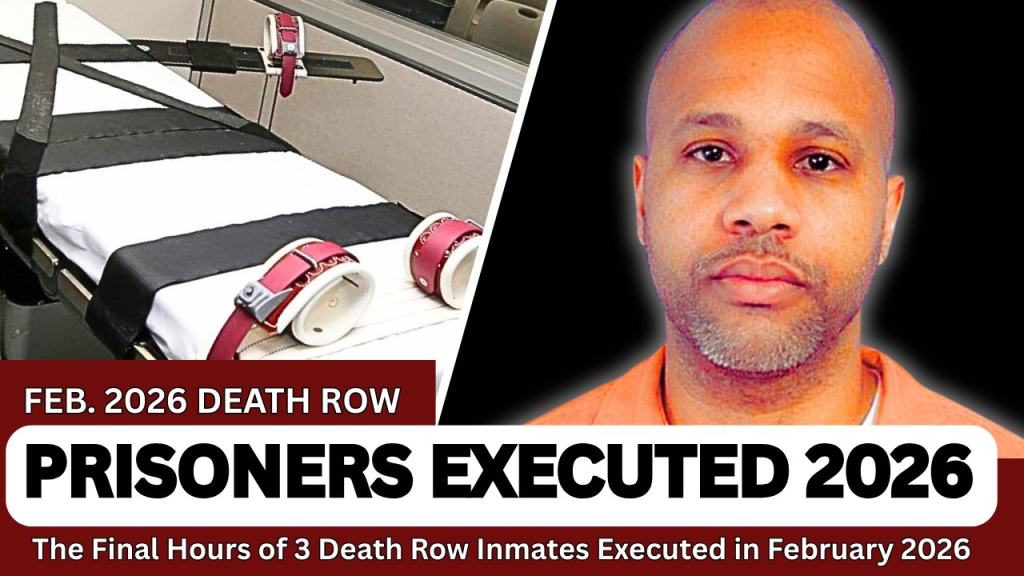
Three men have been executed in the United States during February 2026 for brutal and tragic crimes that shook communities. Ronald Palmer Heath, Kendrick Antonio Simpson, and Melvin Troder met their deaths by lethal injection following decades on death row, each with harrowing backstories and chilling final moments. This is a stark moment in the nation’s history of capital punishment.
The first execution struck Florida on February 10th at Florida State Prison. Ronald Palmer Heath, a 64-year-old man whose violent path began at age 16, was put to death. His crime was cold-blooded: a savage robbery and double murder rooted in a pattern of violence spanning decades. Heath’s chilling final words were a brief, sorrowful apology.
Heath’s first victim was Michael Lee Green, stabbed 23 times by the then 16-year-old Heath, followed by the crushing of Green’s skull and an attempt to destroy evidence. After only serving 10 years for that brutal act, Heath was released and within six months committed a second, even more devastating murder.
On a May night in 1989, Michael Sheridan, a traveling salesman, entered a Gainesville bar where Heath and his brother Kenneth were drinking. Sheridan’s kindness shattered with betrayal when Heath orchestrated a robbery and murder, forcing Sheridan into the night’s darkest corners with an ultimate, fatal ending.
Sheridan endured gunshots and stab wounds, dying without a chance to reconcile the betrayal of the men he had just bought drinks for. His lifeless body was hidden deep in the woods by the Heath brothers, who then brazenly used his credit cards to live for days before their arrest.
Kenneth Heath, who pulled the trigger, turned state’s witness for a reduced sentence, while Ronald was sentenced to death after an overwhelming case sealed by evidence and testimony. After 35 grueling years on death row, Heath’s execution was swift, his final words, “I’m sorry,” carrying a brutal weight.
Just two days later, in Oklahoma, 45-year-old Kendrick Antonio Simpson faced lethal injection for a horrifying act sparked by a trivial insult over a baseball cap. His shooting spree from an AK-47 ended the lives of Glenn Palmer and Anthony Jones, young men with futures cut short by senseless violence.
Simpson’s violent past traced back to a near-fatal ambush at age 16, leaving him with PTSD and a fractured mind. Displaced by Hurricane Katrina, Simpson’s trauma exploded into deadly aggression in 2006, when a confrontation at a hip-hop club escalated into a highway shooting that stunned Oklahoma City.
The night spiraled from a confrontation into cold-blooded murder as Simpson fired about 20 rounds at the car carrying Palmer and Jones. Both men died on the spot; the sole survivor bore witness to their final moments. Simpson’s prior crimes and patterns of violence made his death sentence inevitable.
Simpson’s last moments offered scant remorse, his final words directed to his supporters rather than the devastated families. His nearly two decades on death row were marked by studied transformation, yet the justice system deemed his violence beyond redemption, executing him with tightly controlled procedures.
The closing execution of February 2026 took place on the 24th in Florida, with 65-year-old Melvin Troder. His crime was a vicious robbery and murder of 70-year-old Vie Langford, a beloved grocery store owner stabbed seven times for a mere $100 and food stamps. Her life and legacy were brutally stolen.

Troder’s troubled childhood—marred by 𝓪𝓫𝓾𝓼𝓮, foster care instability, and tragedy—did not spare him the harshest penalty. His attack on Langford was a desperate, merciless act rooted in addiction and despair. The crime shocked the community and triggered decades-long legal battles over his death sentence.
Despite sentences and appeals centered on Troder’s diminished mental capacity and troubled background, the state pressed forward. Legal maneuvers even redefined community control to sustain his execution. His nearly 40 years on death row marked by quiet compliance finally ended in lethal injection, a stark closure.
The final act of Troder’s life was marked by silence—no words, no apology for Langford’s family. The state d elivered the penalty for a horrific crime that extinguished a life dedicated to community service. Outside, protests echoed the ongoing debate over capital punishment and its place in justice.
These three executions—each with unique stories of violence, tragedy, and complicated justice—highlight the complex realities of the death penalty. Victims, perpetrators, families, and society face painful questions about justice, redemption, and closure that defy simple answers even as the gurnies rise and fall.

The nation watched as February 2026 closed with these executions, each man’s life story unfolding in stark evidence of failure, violence, and consequence. The painful legacy of these deeds remains alive through surviving family members, advocates, and all who wrestle with what justice truly demands and offers.
As controversy continues over capital punishment’s role, these cases fuel the fiery dialogue about law, mercy, and the limits of punishment. The executions remind the country of its persistent struggle with crime, punishment, and the human cost embedded in every decision to end a life by state decree.