the bodycam footage opens on a crowded street lined with shops and late-evening foot traffic. the kind of place where arguments break out easily and spread quickly through the noise. officers were responding to a call about a disturbance outside a convenience store. witnesses had reported a man yelling profanities, knocking items over, and refusing to leave the storefront. by the time officers arrived, the man was already pacing in circles, visibly agitated, his hands flailing as he argued with anyone who looked at him.
the officers approach cautiously. they issue commands for the man to calm down and keep his distance. at first he complies halfway, stepping back but continuing to shout. the bodycam captures his uneven breathing, his frantic gestures, and the frustration in the officer’s voice as they try to bring the situation under control. several pedestrians watch from the sidewalk, phones raised, sensing that something unpredictable is about to unfold.
after several warnings, the officers move in to detain him for disorderly conduct. they grab his wrists, apply handcuffs, and secure him with minimal struggle. the man protests loudly but does not physically resist. the tension drops noticeably once the cuffs click. the officers begin guiding him toward the patrol car. the bodycam shows him talking rapidly, twisting his shoulders slightly, but nothing in his movements appears violent or threatening.
then everything changes in a second.
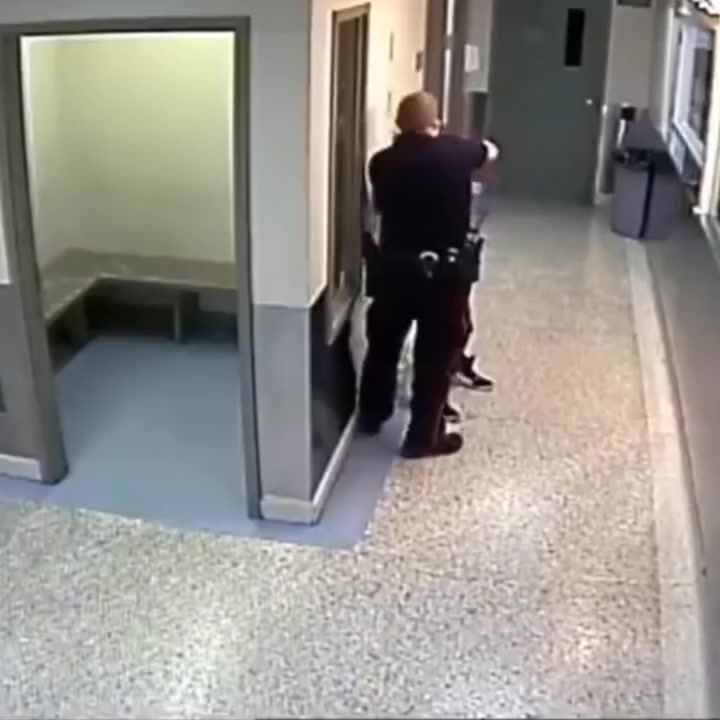
as the officers reach the curb, the man turns his head and says something the audio cannot fully capture. he shifts his weight, steps sideways, and leans back. the motion looks awkward but not aggressive. one officer suddenly reacts with force. he grabs the handcuffed man by the upper arm, pivots his body sharply, and slams him down onto the pavement. the bodycam jolts violently as the officer pushes him chest-first onto the ground.
the impact is loud and unmistakable. the man cries out in pain, his face pressed into the concrete, his arms pinned behind him by the cuffs. nearby pedestrians gasp. someone yells that the takedown was unnecessary. another person begins recording from a different angle. the scene shifts instantly from routine arrest to public confrontation about force and accountability.
the officer presses a knee into the man’s back, telling him to stop resisting. the bodycam shows the man’s legs kicking slightly—more from the shock of hitting the ground than any attempt to escape. he tries to explain himself, insisting he wasn’t trying to run, that he just lost balance. the officer repeats the command again, louder, sounding increasingly frustrated. the man’s voice cracks as he says he cannot breathe comfortably in that position.
backup units arrive and help secure the area. the second officer kneels beside the suspect to assess injuries. the man’s forehead is scraped, and his left cheek is already reddening from the impact. witnesses begin shouting conflicting accounts. some insist the suspect was provoking officers. others claim he did nothing at all. the officers attempt to disperse the crowd while maintaining control of the scene, but the tension refuses to settle.
investigators later review the footage closely. they pause at the moment before the takedown, analyzing every shift in posture and every word spoken. there is debate about whether the man’s movement constituted a threat or simply a clumsy step backward. one frame shows the suspect leaning off-balance. another appears to show him twisting slightly toward the officer. the footage becomes a puzzle of interpretation—each angle suggesting a different narrative.
the man, once helped to his feet, confronts the officers verbally. he demands to know why he was thrown to the ground while already handcuffed. his voice trembles with anger, confusion, and pain. the officer responds that the suspect “attempted to pull away,” a claim the bodycam neither confirms nor clearly disproves. the ambiguity becomes the center of the unfolding controversy.
paramedics examine the suspect before transport. he suffers abrasions, minor bruising, and swelling near his jaw. he tells them repeatedly that he did not resist and that he felt singled out simply for being loud in public. paramedics record his statements while the officer stands silently nearby, offering no additional explanation.
back at the station, the officers file paperwork describing the use of force as “necessary to maintain control of a disorderly subject.” they emphasize the suspect’s erratic behavior, his history of noncompliance earlier in the encounter, and the brief but visible shift in posture before the takedown. critics argue the report downplays the severity of the slam and exaggerates the threat level. supporters insist that officers are forced to make split-second decisions.
when the footage is released to the public, it triggers immediate debate. some viewers defend the officer, saying the suspect’s movement appeared suspicious and unpredictable. others call the takedown excessive, pointing out that the suspect was handcuffed and surrounded by officers. news outlets pick up the story, framing it as yet another instance in an ongoing national conversation about law enforcement and force.
use-of-force experts weigh in. some argue that slamming a cuffed individual is only justified when there is clear evidence of imminent violence—a threshold this footage may not meet. others claim officers are trained to respond decisively to sudden movements, even from restrained subjects, because unexpected shifts can escalate into serious harm.
the suspect’s attorney releases a statement calling the takedown “absolutely unjustified,” demanding disciplinary action against the officer and a full investigation into the encounter. the police department confirms that the incident is under review, and the officer is placed on temporary desk duty pending outcome.
in the final frames of the footage, the officer stands near the patrol car breathing heavily, the weight of the moment visible even through the camera’s lens. the street returns slowly to normal—pedestrians walking by, cars passing, the noise of the city rising again. but beneath that normalcy lies a deeper question, one the footage refuses to answer clearly.
the man was cuffed. he was controlled. he was surrounded. and he was slammed.
whether that use of force was justified now depends on who watches the video, who interprets the movements, and who decides how much force is too much when a split second becomes the defining moment.