Chapter 1: The Long Way Home
The flight from Ramstein had been long, but the drive from the base to my house felt longer. Eighteen months. That’s how long I’d been gone. Eighteen months of FaceTime calls that froze every few seconds, of missed holidays, of watching my little girl, Lily, grow up in pixels rather than person.
I’m Sergeant First Class Jack Harrison. I deal with high-stress situations for a living. I dismantle explosives. I manage chaos. But sitting in the driveway of my suburban rental in North Carolina, gripping the steering wheel of my truck, I was terrified.
Would she recognize me? Not the face on the screen, but me? The smell of my cologne, the scratch of my beard, the way I used to toss her in the air?
I walked inside quietly. My wife, Sarah, knew I was coming, but we had kept it a secret from Lily. Sarah was at work, and Lily was at school. The house was quiet, too quiet. It smelled like lemon pledge and missed memories.
I saw her backpack by the door—a new one, pink with unicorns. I didn’t recognize it. That hurt more than I expected.
I checked the time. 9:30 AM.
I couldn’t wait until school let out at 3:00 PM. I just couldn’t. I needed to see her. I decided I’d go to the school, maybe just peek through the window, or sign her out early for a “doctor’s appointment” that was really just a daddy-daughter ice cream run.
I didn’t bother changing out of my uniform. I just splashed some water on my face, grabbed my keys, and headed to Oak Creek Elementary.
It’s a good school, or so we thought. “Top rated,” the real estate agent had said. “Strict academics. Discipline.”
At the time, “discipline” sounded good to a military family. We thrive on structure. But I had noticed something in Lily’s letters lately. They were shorter. The drawings were darker—lots of black crayons, less sun. She mentioned “Mrs. Halloway” a lot. Not in a “my favorite teacher” way, but in the way soldiers talk about a drill sergeant who enjoys the power a little too much.
“Mrs. Halloway says I wiggle too much.” “Mrs. Halloway says I look out the window.” “Mrs. Halloway took my recess.”
I pushed those thoughts down as I pulled into the school parking lot. The American flag was flapping lazily on the pole. It looked peaceful.
I walked into the front office. The air conditioning was blasting.
“Can I help you?” the receptionist asked, not looking up from her computer.
“I’m here to see Lily Harrison. I’m her father.”
She looked up, her eyes widening when she saw the rank on my chest and the unit patch on my shoulder. Her demeanor shifted instantly.
“Oh! Sergeant Harrison! We didn’t know you were… back.”
“Just got in,” I said, trying to smile. “I wanted to surprise her.”
“That’s so sweet,” she beamed. “She’s in Room 1B. Down the hall, first door on the right. You can just head down. I’m sure she’ll be thrilled.”
She printed a visitor badge. I stuck it on my chest.
As I walked down the hallway, the walls were lined with artwork. Hand turkeys. Finger paintings. It was the epitome of innocence.
But the closer I got to Room 1B, the heavier the air felt. My training kicked in. You know when something is wrong before you see it? The hairs on the back of your neck stand up. The silence isn’t peaceful; it’s predatory.
I was twenty feet away when I heard the first scream.
It wasn’t a child. It was an adult. And it was full of venom.
Chapter 2: The Collapse
“I AM SICK OF THIS BEHAVIOR!”
The voice cut through the heavy door like a knife. I froze.
“YOU DO NOT MOVE! YOU STAND THERE UNTIL I SAY YOU ARE FIT TO LEARN!”
I stepped closer, my boots making no sound—a habit from the field. I reached the door of Room 1B. It had a narrow vertical window. I leaned in to look.
The classroom was arranged in neat rows. Twenty kids, heads bowed, staring at their desks. They looked terrified. Not bored. Terrified.
And then I saw the target of the aggression.
My stomach dropped to my boots.
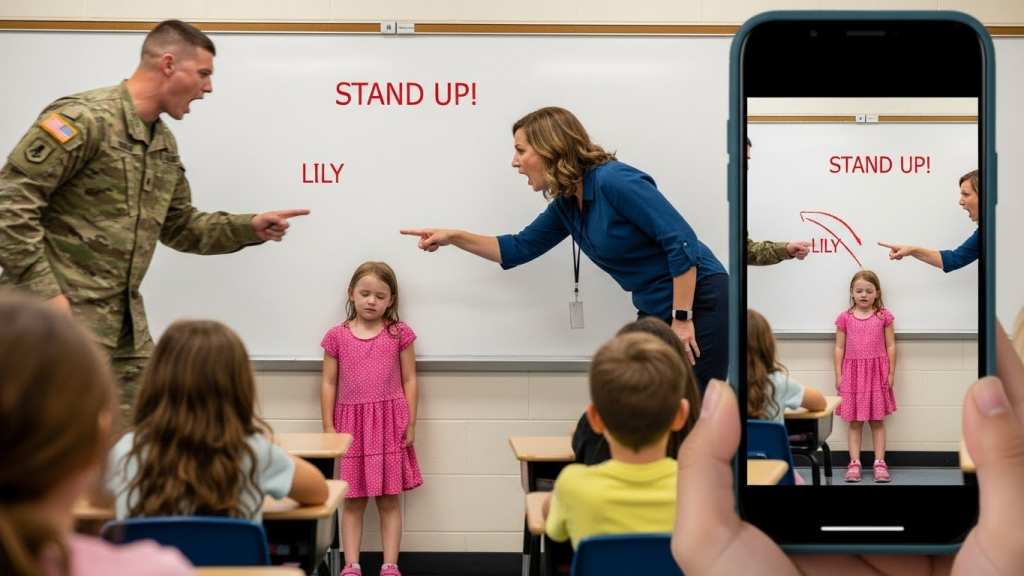
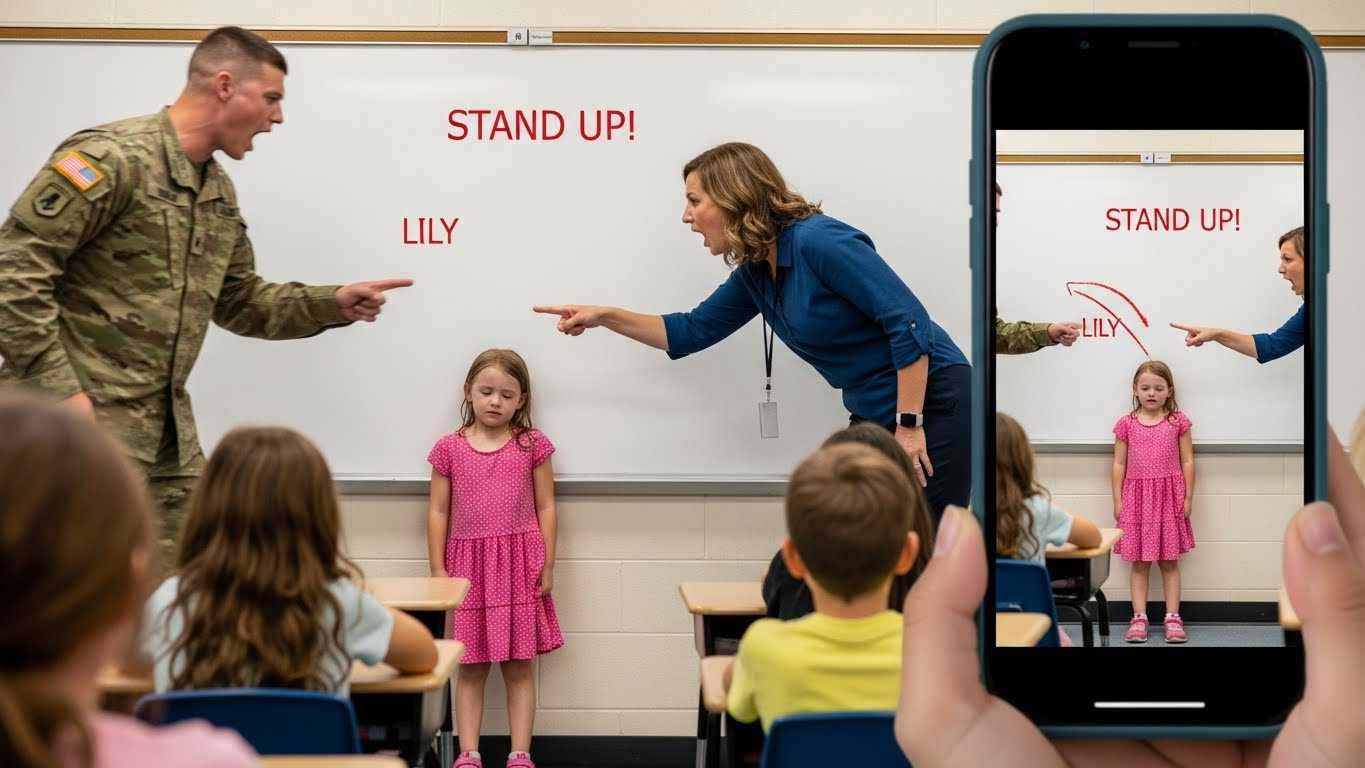
Lily was standing against the back wall, directly under the American flag and the clock.
She looked… sick. Her skin, usually a rosy peach, was a translucent gray. Her blonde hair was plastered to her forehead with sweat. She was wearing her favorite blue dress, the one I’d sent her for her birthday, but it hung loosely on her frame.
She wasn’t just standing. She was swaying.
Her little chest was heaving, like she couldn’t get enough air. Her eyes were glazed over, staring at nothing.
Mrs. Halloway, a woman with tight gray curls and a face etched in permanent disapproval, was pacing in front of her. She held a wooden ruler, slapping it rhythmically against her own palm. Smack. Smack. Smack.
“I said stand up straight, Lily!” Mrs. Halloway shrieked. “You lack discipline! You think because your father is off playing soldier you don’t have to follow rules here? You lack focus! If you can’t sit still, you will stand until you learn how to be a student! Do you hear me?”
My blood turned to magma. Playing soldier?
I watched Lily’s lips move. She was trying to say something. Maybe “water.” Maybe “Daddy.” But no sound came out.
“Don’t you mumble at me!” the teacher roared, stepping into Lily’s personal space.
That was it.
I didn’t turn the handle. I hit the door with my shoulder.
The door flew open, slamming against the wall with a deafening crash. The entire class jumped. Mrs. Halloway spun around, her eyes wide.
“LILY!” I shouted.
My voice seemed to be the final straw for Lily’s body.
Her eyes rolled back into her head. Her knees, which had been locking and unlocking in a desperate attempt to stay upright, simply vanished beneath her.
She fell forward, dead weight.
Time slowed down. It’s a phenomenon called tachypsychia. I saw the dust motes in the air. I saw the horror on the other kids’ faces. I saw the edge of the teacher’s desk, sharp and metal, right in Lily’s path.
I moved faster than I ever had in combat.
I dove, sliding on my knees across the hard tile, disregarding the friction burn tearing through my pants.
My arms shot out.
I caught her.
My hands cupped her shoulders and head inches—literally inches—before she smashed into the floor.
She was limp. So terrifyingly limp. And she was burning up. I could feel the heat radiating off her through her dress.
“Lily? Baby? Lily, it’s Daddy. Open your eyes.”
Nothing. Her head lolled back against my bicep.
The room was deathly silent.
I looked up.
Mrs. Halloway was pressed against the whiteboard, clutching her ruler like a shield. She was staring at me. She saw the uniform. She saw the name. She saw the sheer violence in my eyes.
“She… she was refusing to focus,” Mrs. Halloway stammered, her voice dropping an octave, trembling. “She wouldn’t sit still. I told her to stand for a time-out.”
I stood up, lifting Lily effortlessly. She felt lighter than my rucksack. Too light.
“How long?” I growled. My voice wasn’t loud. It was a low rumble, like a tank engine idling.
“W-what?”
“HOW LONG HAS SHE BEEN STANDING THERE?” I roared, and the windows rattled.
“Two… two periods,” she whispered. “Since morning recess.”
Two hours. She had made a six-year-old stand at attention for two hours.
“She is six years old,” I said, stepping toward her. The other kids scrambled away from their desks, sensing the danger. “You made her stand for two hours until she passed out.”
“I… it’s school policy for discipline…”
“Discipline?” I spat the word out. “I know discipline. This isn’t discipline. This is torture.”
I looked down at Lily. Her eyelids fluttered. She let out a small, weak whimper.
“Daddy?” she breathed, barely audible.
“I’ve got you, baby. I’m here.”
I looked back at the teacher. “You better pray she’s okay. Because if she isn’t, I’m coming back. And I won’t be alone.”
I turned on my heel and marched out of the classroom, carrying my daughter toward the exit, leaving a stunned, silent room in my wake. But I knew this wasn’t over. This was just the beginning.
Chapter 3: Casualties of War
The run from the classroom to the parking lot felt longer than any patrol I had ever led in the sandbox. My boots, usually a source of stability, felt heavy and clunky on the polished school floors. Every impact sent a jar through my body, but my arms remained rock steady, cradling Lily as if she were a live explosive device that would detonate if I jostled her too much.
She was so hot. That was the only thought screaming through my mind. She is too hot.
The heat radiating from her tiny body was soaking through the thick fabric of my Operational Camouflage Pattern (OCP) uniform. It wasn’t just a fever; it was the kind of metabolic heat I’d seen in soldiers suffering from heat stroke after rucking for twenty miles in the desert sun. But Lily hadn’t been rucking. She had been standing in an air-conditioned classroom.
“Stay with me, Lily. Stay with me, bug,” I whispered, my voice cracking.
I burst through the front double doors of the school. The bright North Carolina sun hit us, blindingly indifferent to the panic clawing at my throat.
“Sir! Sir!”
I heard the receptionist running after me, her heels clicking frantically on the pavement. “You can’t just take her! You have to sign her out! It’s protocol!”
I didn’t stop. I didn’t even turn around. I reached my truck—a black Silverado parked haphazardly across two spaces—and wrenched the back door open.
“Protocol?” I yelled back, careful not to scream into Lily’s ear. “My daughter is unconscious! If you want a signature, call the police. Otherwise, get out of my way!”
I strapped Lily into her booster seat. Her head lolled to the side, her blonde hair matted against her pale, clammy forehead. Her chest was rising and falling in shallow, rapid bursts.
I jumped into the driver’s seat, the engine roaring to life before my door was even closed. I peeled out of the parking lot, tires screeching, leaving the bewildered school staff staring in my wake.
The drive to the nearest Emergency Room was a blur of red lights that I treated as yield signs and a speedometer that refused to drop below sixty.
My hand kept reaching back, touching her leg, checking for movement. “Lily? Can you hear Daddy?”
A small groan. It was the best sound I had ever heard.
“Thirsty…” she murmured, her eyes still closed.
“I know, baby. We’re going to get you water. Just hang on.”
I pulled up to the emergency bay of Mercy General Hospital, abandoning the truck in the ambulance lane. I scooped her up again and sprinted through the automatic doors.
“I need a doctor!” I bellowed. The command voice I used to direct fire teams cut through the din of the waiting room.
Heads turned. People gasped. It must have been a sight—a hulking soldier in full combat gear, covered in travel dust, holding a limp child in a pink dress.
A triage nurse, a heavyset woman with kind eyes, was around her desk in a second. She didn’t ask for insurance. She didn’t ask for a name. She saw the child. She saw the uniform. She saw the emergency.
“Trauma One!” she shouted to an orderly. “Follow me, Sergeant!”
They laid Lily on a gurney. The white paper crinkled under her. Immediately, nurses swarmed. Blood pressure cuffs, pulse oximeters, thermometers.
I stood back, pressed against the wall, feeling utterly useless. I could dismantle an IED with a pair of pliers and a steady hand, but I couldn’t fix this.
“Temp is 103.5,” a nurse called out. “BP is low. 80 over 50. Pulse is thready, 120.” “She’s severely dehydrated. Look at the skin turgor.”
A doctor stepped in. Dr. Evans, according to his badge. He was young, efficient. He shone a light in Lily’s eyes.
“Dad?” Dr. Evans looked at me. “I need to know exactly what happened. Did she fall? Did she eat something?”
“I… I just got back,” I stammered, the adrenaline beginning to crash, leaving me shaking. “I went to her school to surprise her. I found her standing against a wall. The teacher… Mrs. Halloway… she said Lily had been standing there for two periods. Two hours. She wasn’t allowed to move.”
The doctor stopped working for a split second. He looked up, his expression hardening. “She was forced to stand still? locked knees?”
“Yes. She was shaking. Then she just… collapsed.”
“Orthostatic hypotension coupled with severe dehydration and heat exhaustion,” Dr. Evans muttered, turning back to the nurse. “Start a bolus of normal saline. Check her blood sugar. And get a cooling blanket. Now.”
He turned back to me. “Sergeant, when kids lock their knees and stand under stress for that long, blood pools in the legs. The brain doesn’t get enough oxygen. Add in the anxiety and the heat… she went into shock. If you hadn’t caught her…”
He didn’t finish the sentence. He didn’t have to.
I sank into a plastic chair in the corner of the room, burying my face in my hands. The smell of antiseptic was overwhelming. It smelled like the field hospitals. It smelled like trauma.
Then, my phone buzzed.
Sarah.
I stared at the screen. How was I going to tell her? Hi honey, I’m home, and our daughter is in the ER because a teacher decided to torture her.
I swiped answer.
“Jack?” Her voice was breathless. “The school just called. They said you… they said you stormed in and kidnapped Lily? They’re threatening to call the MPs! Jack, what is going on? Are you even in the country?”
“I’m at Mercy General,” I said, my voice hollow. “Emergency Room.”
“What? Jack! Is she okay? Is it you?”
“It’s Lily. Just… just get here, Sarah. Please.”
The next twenty minutes were agony. I watched the IV drip into Lily’s arm. I watched the color slowly return to her cheeks. She was sleeping now, a real sleep, not a faint.
When Sarah burst into the room, she looked like a hurricane. She saw me, and for a second, relief washed over her face—her husband was home, alive, in one piece. But then she saw the bed.
“Lily!”
She rushed to the bedside, her hands hovering over our daughter, afraid to touch the wires.
“She’s okay,” I said softly, stepping up behind Sarah and wrapping my arms around her. “She’s stable. Fluids. Exhaustion.”
Sarah turned into me, burying her face in my chest, sobbing. I held her tight, smelling her shampoo, feeling the reality of my family finally being in my arms. But it was tainted. It was tainted by the image of Mrs. Halloway and that ruler.
“The school said you were aggressive,” Sarah cried into my uniform. “They said you scared the children.”
“I scared the teacher,” I corrected, my jaw tightening. “Sarah, she made Lily stand against a wall for two hours. Two hours. Because she couldn’t focus.”
Sarah pulled back, her eyes red and confused. “What? Mrs. Halloway? She’s… she’s strict, but…”
“She’s a monster,” I said. “I saw it, Sarah. Lily was grey. She passed out in my arms.”
Just then, Lily stirred.
“Mommy?”
Sarah spun around. “Baby! I’m here.”
Lily blinked her eyes open. She looked groggy. She looked at Sarah, then her eyes found me. A slow, tired smile spread across her face.
“Daddy?” she whispered. “You came back.”
“I came back, baby,” I choked out, stroking her hair. “I’ll always come back.”
“I’m sorry,” she said, a tear rolling down her cheek.
“Sorry? Why are you sorry, Lil?” Sarah asked, brushing the tear away.
“I moved,” Lily said, her voice trembling. “Mrs. Halloway said I couldn’t move. But my legs hurt so bad, Daddy. I tried to be a good soldier like you. I tried to stand at attention. But the room got spinny.”
My heart shattered into a million pieces. She was trying to be a soldier. For me.
“You are the bravest soldier I know,” I said, my voice thick with emotion. “But soldiers need rest, too. You did nothing wrong. Do you hear me? Nothing.”
“She was mad because I was looking at the bird,” Lily confessed, her voice barely a whisper. “There was a blue jay outside the window. It was so pretty. I just wanted to see where it was going. And she yelled. She said I was… defective.”
Defective.
The word hung in the air like toxic smoke.
Sarah gasped, her hand flying to her mouth.
I felt a cold, calculated rage settle over me. It wasn’t the hot, reactive anger from the classroom. This was different. This was strategic. This was the mindset of a man preparing for a siege.
“She called you defective?” I asked calmly.
Lily nodded. “She told the class that if they didn’t focus, they would end up like me. Broken.”
I stood up. I checked the IV bag. I checked the monitors.
“Sarah,” I said. “Stay with her.”
“Where are you going?” Sarah asked, seeing the look in my eyes. It was a look she hadn’t seen since my first deployment.
“I have a mission,” I said. “I need to go have a conversation with the Principal. And I need to get Lily’s things.”
“Jack, don’t do anything stupid. You’re still active duty. If you get arrested…”
“I won’t get arrested,” I said, putting my beret on my head and adjusting it. “But someone is going to lose their job. Today.”
I kissed Lily on the forehead. “Rest, soldier. Daddy will handle the perimeter.”
I walked out of the ER, my boots striking the floor with renewed purpose. The war wasn’t in the Middle East anymore. It was at 123 Oak Creek Lane. And I was bringing the fight to them.
Chapter 4: Chain of Command
I didn’t speed on the way back to the school. I drove the speed limit. I needed time to think, to plan. In the military, you don’t rush into a kill zone without intel.
I replayed the scene in my head. The fear in the other kids’ eyes. The way Mrs. Halloway held that ruler—not as a pointer, but as a weapon. The specific wording she used. “Defective.” “Fit to learn.”
This wasn’t just a bad teacher having a bad day. This was a pattern of abuse masquerading as education.
I pulled into the school lot. It was lunch time now. Kids were playing on the playground. I watched them run, scream, and laugh. It looked idyllic. But I knew what was happening inside Room 1B.
I walked into the office again. The receptionist, the same one who had smiled at me earlier and then yelled at me later, turned pale when I walked in. She reached for the phone.
“Put the phone down,” I said. I didn’t yell. I used the voice I used when instructing trainees on live-fire ranges. Calm. Authoritative. Non-negotiable.
She froze. “Sergeant Harrison, the Principal is… he’s calling the Superintendent. You caused quite a disturbance.”
“I’m here to see Principal Vance,” I said. “Is he in?”
“He’s in a meeting.”
“Good. I’ll wait.”
I didn’t wait. I walked past the desk, through the swinging gate.
“Sir! You can’t go back there!”
I ignored her. I walked down the administrative hallway until I saw the door marked “PRINCIPAL VANCE.” I didn’t knock. I opened it.
Principal Vance was a small man in a cheap suit, sitting behind a large mahogany desk that seemed designed to compensate for his stature. He was on the phone, laughing.
“…yeah, just some PTSD parent, you know how they are. We’ll smooth it over.”
He saw me and the phone slipped from his hand, clattering onto the desk.
“Sergeant Harrison,” he said, standing up quickly, adjusting his tie. “I… I was just discussing your case.”
“My ‘case’?” I repeated, closing the door behind me and locking it.
Vance’s eyes darted to the lock. “Now, see here. You can’t just barge in here. Mrs. Halloway is very shaken. You threatened a staff member.”
“Mrs. Halloway is shaken?” I laughed, a dry, humorless sound. “My six-year-old daughter is in the Emergency Room, hooked up to an IV, being treated for shock and rhabdomyolysis because your staff member forced her to stand in a stress position for two hours.”
Vance waved his hand dismissively. “Stress position? Come on, Sergeant. She was in time-out. Standing. It’s a standard disciplinary procedure for children who lack focus. We pride ourselves on rigor here at Oak Creek.”
“Rigor is math drills,” I said, stepping closer to the desk. “Rigor is spelling bees. Making a child stand until they pass out is abuse. She called my daughter ‘defective’ in front of her peers.”
Vance sighed, sitting back down and steepling his fingers. “Look, Mr. Harrison. I appreciate your service. Truly. But you’ve been… away. You don’t know Lily’s behavior lately. She’s been disruptive. Daydreaming. Refusing to follow instructions. Mrs. Halloway is a tenured teacher. She’s been here for thirty years. She knows how to handle difficult children.”
“Difficult?” I leaned my knuckles on his desk. “She was looking at a bird. She’s six.”
“She needs to learn to conform,” Vance said, his voice hardening. “If she can’t handle the structure of a classroom, maybe this school isn’t the right fit for her. Maybe she needs… special accommodations.”
He was gaslighting me. He was trying to make me believe my bright, happy daughter was the problem. He was protecting the institution over the child.
“You’re right,” I said softly. “This school isn’t the right fit. But not because of her.”
I pulled out my phone.
“What are you doing?” Vance asked nervously.
“I’m recording this,” I lied. “And I’m going to send the medical report from Mercy General to the State Board of Education. And the local news. I think ‘War Hero Returns to Find Daughter abused by Teacher’ makes for a pretty compelling headline, don’t you?”
Vance’s face went white. The confidence evaporated. He knew the optics. He knew how the community loved their military.
“Now, hold on,” he stammered. “Let’s not be hasty. We can discuss this. Maybe Mrs. Halloway was a bit… zealous.”
“Zealous,” I repeated. “I want her gone. Not suspended. Not transferred. Gone. She doesn’t come near children again.”
“I can’t just fire a tenured teacher! The union…”
“Then I’ll destroy the school’s reputation,” I said simply. “I’ll stand outside on the sidewalk in my uniform with a picture of my daughter in her hospital bed every single morning until every parent knows what happens in Room 1B.”
Vance stared at me. He was calculating the risk.
“I’ll… I’ll launch an investigation,” he conceded. “She’ll be placed on administrative leave pending the outcome. Effective immediately.”
“Good start,” I said. “I want that in writing. Emailed to me by the end of the day.”
I turned to leave, but stopped at the door.
“Oh, and Principal? I’m going to Room 1B to get her backpack. If Mrs. Halloway is still there, I can’t promise I’ll be as polite as I was this morning.”
I walked out, leaving Vance sweating in his cheap suit.
I headed back to the classroom. The hallway was empty now. I reached the door of Room 1B. It was closed.
I pushed it open.
The room was different. The tension was gone, replaced by a nervous murmur. A substitute teacher was at the desk—a young woman who looked terrified. Mrs. Halloway was gone.
The kids looked up. When they saw me, they didn’t look scared anymore. They looked… hopeful.
I walked to Lily’s desk. It was small. Her name tag was taped to it: Lily H. Next to it was a drawing. It was unfinished. A picture of a blue bird.
I picked up her pink unicorn backpack. As I did, a little boy in the front row, a kid with glasses and a missing front tooth, raised his hand.
“Sir?” he squeaked.
I looked at him. “Yeah, buddy?”
“Is Lily okay?”
The whole class leaned in, waiting for the answer.
“She’s going to be fine,” I said, forcing a smile. “She’s tough.”
The boy nodded. Then he looked around to make sure the substitute wasn’t listening. He whispered, “Mrs. Halloway is mean. She made me hold books up with my arms straight yesterday until I cried.”
Another girl chimed in. “She taped my mouth shut because I was talking.”
“She threw my eraser in the trash because I made a mistake.”
I stood there, clutching the tiny backpack, listening to a litany of horrors from six-year-olds. It wasn’t just Lily. It was all of them. This woman had been terrorizing this class for months, maybe years, and they were too small, too scared to speak up.
I looked at the young substitute. She looked horrified. She was hearing this for the first time too.
“You hearing this?” I asked her.
She nodded mutely.
“Write it down,” I told her. “Write it all down.”
I looked back at the kids. “You guys are brave,” I told them. “You’re really brave. And I promise you, Mrs. Halloway isn’t coming back.”
“Promise?” the boy with glasses asked.
“Soldier’s promise,” I said.
I walked out of the school with Lily’s backpack over my shoulder. I felt lighter, but the fire in my gut was burning hotter.
I had neutralized the immediate threat. But now I had ammunition. I wasn’t just fighting for Lily anymore. I was fighting for the boy with the books, the girl with the tape, and every kid who had ever been made to feel small by a tyrant with a teaching certificate.
As I walked to my truck, my phone buzzed again. It was a text from an unknown number.
“Is this Mr. Harrison? My son is in Lily’s class. He just told me what happened. Can we talk? We’ve been trying to get rid of her for years.”
I smiled grimly. The reinforcements were arriving.
I got into the truck. I had a war to plan.
Chapter 5: The War Room
I returned to the hospital with a backpack full of unicorns and a heart full of cold, tactical fury.
When I walked back into Lily’s room, the atmosphere had shifted. The monitors were still beeping, but the frantic energy had settled into a weary peace. Lily was awake, propped up on white pillows that made her look even smaller than she was. She was sipping apple juice through a straw, her tiny fingers gripped around the plastic cup.
Sarah was sitting on the edge of the bed, her hand resting on Lily’s leg. She looked up at me as I entered, her eyes searching mine for what had happened at the school.
“I got her bag,” I said, setting the pink backpack on the chair. “And I talked to Vance.”
“And?” Sarah asked, her voice hushed.
“Mrs. Halloway is on administrative leave. For now.”
I sat down on the other side of the bed. Lily looked at me, her eyes bright but tired. “Daddy, is the blue bird still there?”
I reached into my pocket and pulled out the unfinished drawing I’d taken from her desk. “He’s right here, Lil. I brought him to you so you can finish him when you feel better.”
She reached for the paper, a small smile touching her lips. That smile was worth more than every medal I had pinned to my chest, but it also served as a reminder of how close I’d come to never seeing it again.
“Sarah, can we talk outside for a second?” I asked.
Sarah nodded and followed me into the quiet, sterile hallway. The overhead lights hummed.
“It’s worse than we thought,” I said, leaning against the wall. “I talked to the other kids. She’s been doing this to everyone. Stress positions, taping mouths shut, humiliation. It wasn’t a one-time thing, Sarah. This is how she runs her classroom.”
Sarah’s face went through a rapid succession of emotions: shock, disbelief, and finally, a white-hot anger that mirrored my own. “Why didn’t they say anything? Why didn’t Lily tell us?”
“Because they’re six,” I said. “Because she told them it was their fault. Because she told them they were ‘defective.’ When a person in authority tells a child they’re broken, the child doesn’t question the adult—they question themselves.”
Sarah leaned her head against my shoulder. “I feel like I failed her, Jack. I was here. I was the one taking her to school every morning while you were gone. How did I not see it?”
“Don’t,” I said, pulling her close. “She’s a master manipulator. She’s been doing this for thirty years. But she picked the wrong family to mess with this time.”
I told Sarah about the text message I’d received from the other parent. Within an hour, my phone was blowing up. Word travels fast in a suburban town, and “Soldier saves daughter from abusive teacher” was the kind of story that caught fire.
By 4:00 PM, I wasn’t just a dad. I was a coordinator.
I spent the afternoon in the hospital cafeteria with my laptop and phone. I wasn’t just looking for sympathy; I was building a case. I reached out to the parent who had texted me—a woman named Elena whose son, Leo, had been the one forced to hold books.
“She’s a tyrant, Sergeant Harrison,” Elena told me over the phone, her voice shaking with repressed rage. “We’ve complained to Vance for two years. He always says the same thing: she has ‘seniority’ and ‘high test scores.’ He treats the kids like data points, not human beings.”
“The data is about to change,” I told her.
I spent the next four hours organizing a meeting. I didn’t want a riot; I wanted a coordinated strike. I invited every parent from Room 1B to meet at the local VFW hall that evening.
Before I left the hospital, I went back to Lily’s room. She was asleep again, her breathing deep and even. The doctor had said she could come home tomorrow morning if her vitals stayed stable.
“Go,” Sarah whispered, seeing the fire in my eyes. “Fix this. I’ve got her.”
I kissed them both and walked out. As I stepped into the cool evening air, I felt the familiar weight of responsibility. In the Army, you protect your own. You don’t leave a man behind, and you sure as hell don’t let a civilian-in-disguise hurt the people you swore to protect.
Chapter 6: The Gathering Storm
The VFW hall smelled of stale beer and old wood. Usually, it was a place for veterans to swap stories and find a bit of peace. Tonight, it was a command center.
When I walked in, there were already thirty people there. Not just parents from Lily’s class, but parents of former students who had heard the news.
I walked up to the small podium at the front of the room. I was still in my uniform. I hadn’t changed because I wanted them to see exactly who they were dealing with. I wasn’t just “Jack the Dad.” I was a representative of a standard they had failed to meet.
The room went quiet.
“My name is Jack Harrison,” I began, my voice projecting to the back of the hall. “Most of you know what happened today. My daughter Lily is in the hospital because her teacher decided that a six-year-old’s lack of focus was a crime punishable by physical torture.”
A murmur of “shame” and “horrible” rippled through the crowd.
“But I’m not here just to talk about Lily,” I continued. “I’m here because I’ve spent the last few hours hearing about your children. I’ve heard about the tape. I’ve heard about the books. I’ve heard about the names she calls them.”
I looked at a man in the front row, a burly guy in a construction vest who looked like he was about to cry. “Your son, Leo? He told me he was scared to come to school every day. That’s not education. That’s a hostage situation.”
“What can we do?” a woman cried out from the back. “Vance won’t listen! The school board protects their own!”
“The school board protects what it can control,” I said, leaning over the podium. “They can’t control the truth. And they can’t control a community that stands together.”
I laid out the plan. We weren’t going to just complain. We were going to document. I had brought a stack of “Incident Report” forms I’d drafted, modeled after military witness statements.
“I need every one of you to sit down and write exactly what your child has told you. Dates, times, specific words. If there are physical marks, I want photos. If there are psychological changes—nightmares, bedwetting, fear of school—I want it documented.”
For the next two hours, the only sound in the hall was the scratching of pens on paper. It was a beautiful, haunting sound. It was the sound of a silent trauma being given a voice.
As I walked around, helping parents phrase their statements, I realized the scale of the damage. Mrs. Halloway hadn’t just been “strict.” She had been systematically breaking the spirits of children for decades. She used her tenure as a shield and her “high test scores” as a justification for her cruelty.
“She told my daughter she was too stupid to ever learn to read,” one mother whispered to me, handing me her paper. Her eyes were wet. “My girl used to love books. Now she hides them under her bed.”
“That ends tonight,” I promised her.
Around 9:00 PM, I had a thick folder of evidence. Over forty statements. Each one a nail in the coffin of Mrs. Halloway’s career.
But I knew Vance would still try to bury it. I knew the “administrative leave” was just a way to let the heat die down before sliding her back into a classroom or transferring her to another unsuspecting school.
“Tomorrow morning at 8:00 AM, the school board is holding an emergency budget meeting,” I announced. “It’s a public forum. I’m going to be there. And I’m not going alone.”
“We’ll be there,” Leo’s dad said, standing up. “I’ll bring my whole crew.”
“Me too,” said another.
As the meeting broke up, I felt a sense of grim satisfaction. We had the intel. We had the numbers. Now, it was time for the engagement.
I drove back to the hospital, the folder sitting on the passenger seat like a loaded weapon. I went straight to Lily’s room. Sarah was asleep in the recliner, and Lily was curled up, clutching the blue bird drawing.
I sat by her bed and watched her breathe. I thought about the thousands of miles I’d traveled, the dangers I’d faced, thinking I was making the world safer for her. The irony wasn’t lost on me. The most dangerous person she had ever met wasn’t a bearded insurgent in a mountain pass—it was a woman in a cardigan in a room filled with alphabet posters.
I reached out and touched her hand. Her skin was cool now. The fever was gone.
“I’ve got the perimeter, Lil,” I whispered. “Sleep tight.”
I spent the rest of the night in that hospital chair, not sleeping, just planning. I refined my speech. I organized the documents. I prepared for the counter-attack.
In the morning, the doctor cleared Lily to go home. Sarah took her back to our house, promising to keep her wrapped in blankets and love.
“Are you sure you want to do this today?” Sarah asked as I walked them to the car. “You just got home, Jack. You should be resting.”
“I’ll rest when the objective is secured,” I said, kissing her. “This is part of the homecoming, Sarah. I’m taking back our life.”
I watched them drive away, then I straightened my uniform, polished my jump boots until they shone like glass, and headed toward the District Office.
It was time to see if Principal Vance and the School Board were as “strict” about their own rules as they were about a six-year-old’s focus.
Chapter 7: The Confrontation
The District Office was a sterile, glass-and-steel building that felt more like a corporate headquarters than a place dedicated to children. As I pulled into the parking lot, I saw them. Not just a few parents, but a sea of people.
Leo’s father was there with ten of his construction workers, all wearing their high-visibility vests. There were mothers with strollers, fathers in suits, and veterans from the VFW hall wearing their old unit caps. They had made signs. Simple ones. “Protect Our Children.” “Justice for Lily.” “No More Torture.”
When I stepped out of my truck, the crowd went quiet. I could feel the weight of their expectations. In the military, leadership isn’t about the rank on your shoulder; it’s about the trust of the people behind you.
“Sergeant Harrison!” Elena called out. “They tried to lock the doors. Said the meeting was full.”
I looked at the glass doors where two private security guards stood, looking nervous. “They can’t lock a public forum,” I said. “Follow me.”
I marched toward the entrance. The security guards stepped forward, but I didn’t slow down. I used my “command presence”—that invisible aura of authority that tells people it’s a very bad idea to stand in your way.
“Gentlemen,” I said, my voice low and steady. “We are here for the public comment section of the board meeting. You can open the doors, or we can discuss the legal ramifications of barring taxpayers from a public building.”
They looked at each other, then at the fifty angry parents behind me. They stepped aside.
We filed into the boardroom. The school board members—five men and women in expensive clothes—were sitting behind a raised dais. Principal Vance was there too, sitting off to the side, looking like he wanted to crawl under his chair.
The Chairman of the Board, a man named Dr. Aris, banged his gavel. “This meeting is for budget appropriations only. We are not taking comments on personnel matters.”
“Then you’re going to have a very long morning, Doctor,” I said, walking right up to the microphone in the center of the room.
“Sir, you are out of order,” Aris snapped.
“No,” I replied, leaning into the mic. “Your school is out of order. My name is Sergeant First Class Jack Harrison. I just returned from a combat deployment to find my daughter in the ER because of a teacher you’ve protected for thirty years.”
“We cannot discuss Mrs. Halloway,” Aris said, his face reddening. “It is a confidential personnel issue.”
“It stopped being confidential when she put her hands on my child,” I countered. I held up the thick folder from the VFW meeting. “I have forty-two signed statements from parents in this district. Statements detailing physical abuse, psychological trauma, and gross negligence. I have medical records from Mercy General. And I have a choice for you.”
The room was so quiet you could hear the hum of the air conditioner.
“You can take this folder, read it, and terminate Mrs. Halloway’s employment for cause, effective immediately,” I said. “Or, I can hand this folder to the three news crews waiting in the parking lot. I can hand it to the District Attorney. And I can make sure that every parent in this state knows that Oak Creek Elementary is a place where children are tortured while the board looks the other way.”
Vance stood up. “Now, Jack, let’s be reasonable…”
“I’m past being reasonable, Vance,” I barked. “You told me she was ‘strict.’ You told me my daughter was ‘defective.’ You looked me in the eye while my child was hooked up to an IV and you defended a monster.”
I turned back to the board. “You have five minutes to go into executive session and make a decision. Five minutes. Then I start making phone calls.”
Dr. Aris looked at the other board members. They saw the crowd. They saw the cameras. They saw the uniform. They realized that the “PTSD parent” wasn’t a problem they could “smooth over.” He was a strategist who had them pinned.
“The board will take a five-minute recess,” Aris muttered.
They scurried into a back room. The parents in the hall erupted in a low, buzzing cheer. I stood by the microphone, my back straight, my eyes fixed on the door. I was back in the “wait and see” phase of an operation. The tension was familiar.
Four minutes and fifty seconds later, the board returned. They looked pale.
Dr. Aris cleared his throat. “After a preliminary review of the… uh… gravity of the allegations presented by Sergeant Harrison, the board has voted unanimously to bypass administrative leave. Mrs. Linda Halloway is terminated, effective immediately. Furthermore, Principal Vance is placed on unpaid leave pending an investigation into his handling of parental complaints.”
The room exploded. People were crying, hugging, and shouting. I felt a massive weight lift off my chest.
Objective secured.
Chapter 8: The Blue Bird
The aftermath was a whirlwind. The story broke, of course. It was too big to keep quiet. But I didn’t care about the news cycles or the “viral” fame. I cared about the quiet house at the end of the cul-de-sac.
A week later, I was sitting on the back porch of our house. The North Carolina air was crisp and smelled of pine. I was wearing a t-shirt and jeans—my “Dad uniform.”
Lily came out, holding a tray with two glasses of lemonade. She walked carefully, her tongue poked out in concentration. She wasn’t shaking. Her color was back. She looked like a little girl again, not a broken soldier.
“Here, Daddy,” she said, handing me a glass.
“Thanks, Lil. How’s the masterpiece coming?”
She sat down next to me and opened her sketchbook. The blue bird drawing was finished. It was vibrant, surrounded by bright yellow suns and green trees. But there was something new. Next to the bird, she had drawn a tall man in a green uniform. He was holding the bird’s wing.
“Is that me?” I asked, pointing to the figure.
“Yeah,” she said. “You’re the one who caught the bird when it fell.”
I pulled her into my lap, burying my face in her hair. “I’ll always catch you, Lily. No matter what.”
“I don’t have to go back to that room, right?” she asked softly.
“Never,” I said. “You’re going to a new school. A school where they like birds and drawings. A school where you can wiggle as much as you want.”
The phone rang inside. It was Sarah, calling from the grocery store to see if we needed more apples. Life was returning to the mundane, beautiful routine of peace.
I looked out into the yard. A real blue jay landed on the fence, chirping loudly. Lily giggled and pointed.
I had spent my career fighting for people I didn’t know in lands I couldn’t pronounce. I thought that was where the glory was. But as I watched my daughter laugh at a bird, I realized the most important battle I ever won didn’t involve a single shot fired. It was won with a folder, a microphone, and the refusal to let a child’s spirit be dimmed.
I was home. Truly home. And for the first time in eighteen months, the war was finally over.