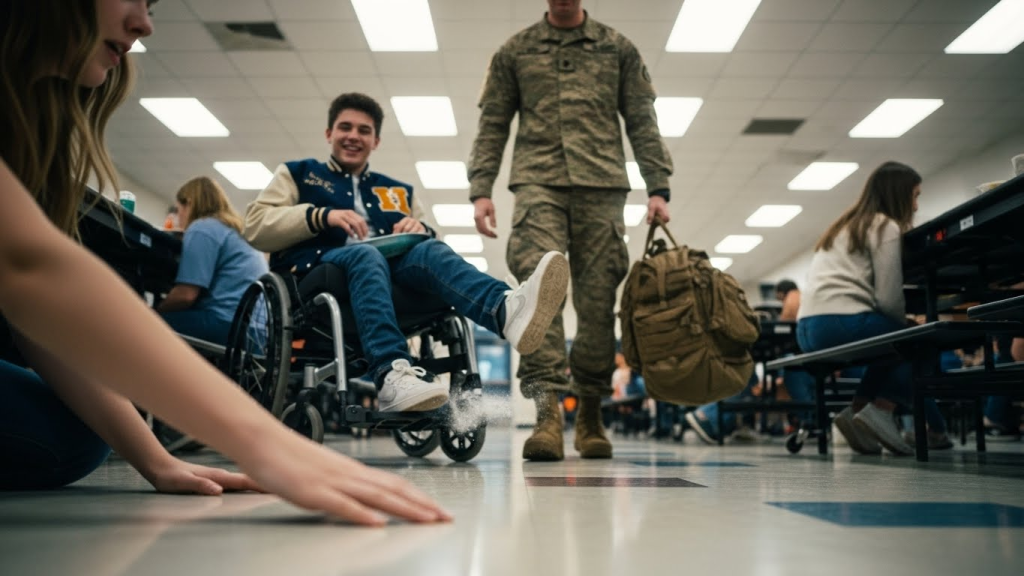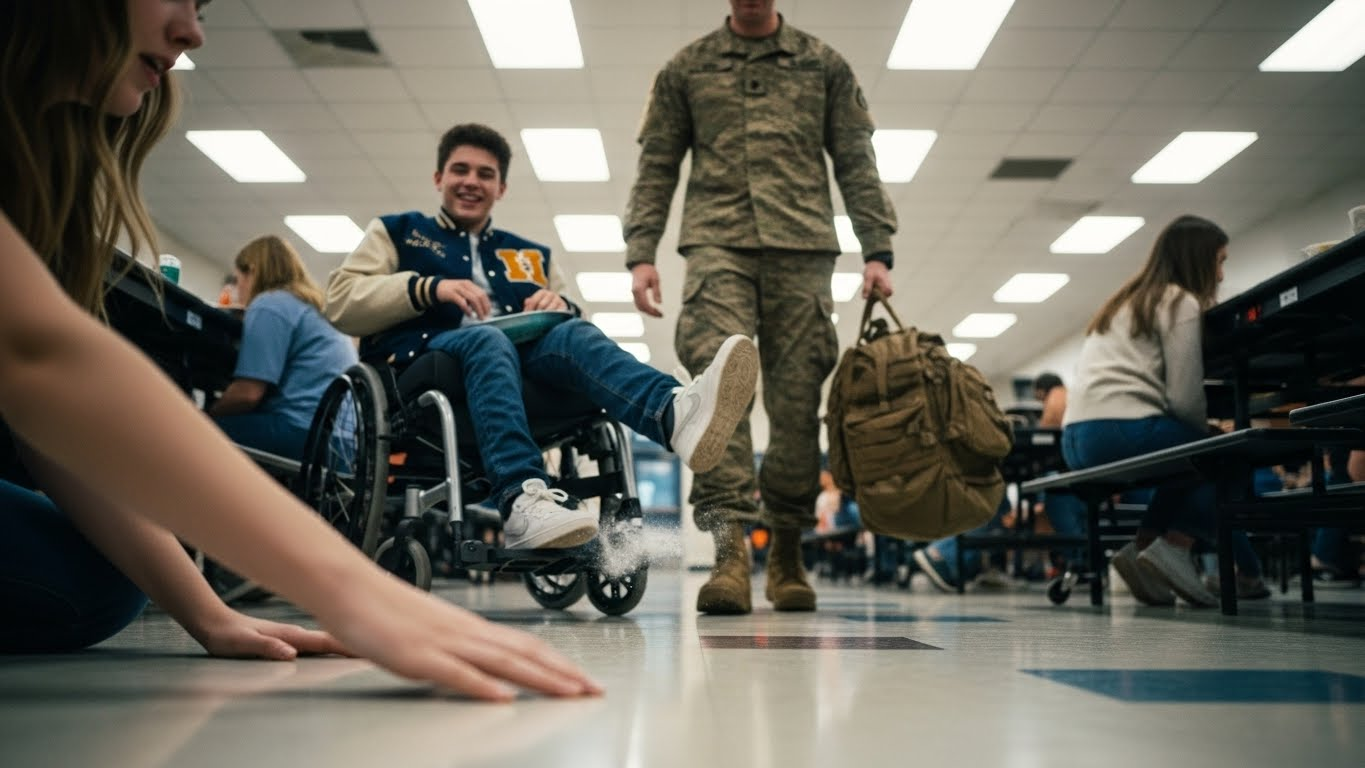
The floor of a high school cafeteria smells like spilled milk and desperation. I learned that the hard way.
From down here, the world is a forest of sneaker treads and table legs. My knees were already burning, the denim of my jeans offering zero protection against the industrial-grade linoleum.
“Come on, Maya. Fetch.”
Above me, Liam sat on my throne. My custom-fitted, titanium-frame wheelchair. The one my dad had worked extra security shifts for six months to afford before he deployed.
Liam was spinning in it, popping a wheelie, his varsity jacket bunching up around his shoulders. He looked like a king.
I looked like a bug.
“I said give it back, Liam,” I gritted out. My voice didn’t shake. I promised myself I wouldn’t let it shake.
The cafeteria had gone dead silent. That heavy, suffocating silence where three hundred teenagers hold their breath at once.
“I don’t hear a ‘please’,” Liam sneered, stopping the chair. He leaned forward, resting his elbows on his knees—my knees, technically. “And honestly? You haven’t earned it. If you want to walk away, you gotta walk to me. Oh, wait… you can’t.”
His friends, the court jesters, erupted in laughter. It was a sharp, jagged sound that cut right through my chest.
I looked at the distance between us. Ten feet. It might as well have been ten miles. My legs, useless dead weights since the car crash when I was twelve, dragged behind me like anchors.
I put one hand forward. Palm flat on the sticky floor. Then the other.
“Look at her go!” someone shouted from the back.
I dragged my body forward. Scrape. Drag. Scrape. My hip bone ground against the floor. A hot tear of pain shot up my spine, but I bit the inside of my cheek until I tasted copper. I wasn’t going to cry. Not here. Not in front of him.
Liam took out his phone. The red light of the recording indicator blinked like a demonic eye. “Smile for the camera, Maya. This is going on the story.”
I was five feet away. I could see the scuff marks on his expensive Nikes. I could see the cruelty etched into the corners of his mouth. He wasn’t just bullying me; he was enjoying the anatomy of my humiliation.
I reached out, my fingers trembling, brushing the footrest of my chair.
“Almost there,” Liam cooed.
Then, he kicked my hand away. Hard.
Chapter 2
The boot connected with my knuckles, and I gasped, recoiling.
“Oops,” Liam laughed, rolling the chair back another three feet. “You gotta be quicker than that.”
The rage that filled me wasn’t hot. It was ice cold. It started in my stomach and froze my lungs.
“Liam, stop it!” Sarah, a bystander, tried to intervene, but Liam snapped at her to sit down.
I pushed myself up on my forearms again. My shoulders were screaming.
Suddenly, the heavy double doors of the cafeteria flew open. But it wasn’t the bang that stopped the room. It was the silhouette.
“What the hell is going on here?”
The voice cut through the air like a sniper shot. Low. Controlled. Lethal.
It was my dad.
He wasn’t wearing his mechanic jumpsuit anymore. He was wearing full OCPs—Army fatigues. Dust on his combat boots. A heavy green duffel bag in his left hand. He had been gone for eighteen months.
He dropped the duffel bag. The heavy thud of military gear hitting the floor was the loudest thing in the room.
Dad didn’t run. He stalked. He moved with the terrifying speed of a soldier in a combat zone. He crossed the cafeteria in seconds. He reached me first, kneeling down, his rough hands gripping my shoulders.
“Are you hurt?” he whispered, his eyes wild, scanning my face for injuries.
“I’m okay, Dad,” I lied.
He nodded once. Then he stood up. He seemed to grow three inches as he turned to Liam.
“Get. Out,” my father said.
“Sir, I was just—” Liam started.
“Get out of her chair,” Dad said, stepping closer. “Before I drag you out of it.”
Liam scrambled up, practically falling out of the chair to escape the wall of anger that was Sergeant Russo. Dad cleaned the seat of my chair with a napkin, then gently lifted me off the floor and placed me back where I belonged.
“We’re leaving,” Dad said.
“Sir, you can’t just take a student out—” a teacher finally intervened.
Dad spun around. “You watched. You let a boy kick a disabled girl while she crawled on the floor.”
He grabbed the handles of my chair and wheeled me out. But as we passed the principal’s office, he stopped.
“Actually,” Dad said. “We aren’t leaving. Not yet.” He pulled out his phone. “Because while Liam was recording for his friends… I was recording for the School Board. And the JAG office.”
Part 2: The War at Home
Chapter 3
The fluorescent lights of Principal Skinner’s office hummed, but the tension in the room was deafening. Dad sat in the cheap plastic chair next to me, still in his fatigues. He looked out of place among the motivational posters—a weapon of war sitting in a bureaucracy.
Principal Skinner was sweating. “Now, Sergeant Russo,” he began, his voice oily. “First, thank you for your service. But I think we’re blowing this incident out of proportion.”
Dad didn’t blink. “Out of proportion?”
“It was horseplay,” Skinner said, waving a hand. “Liam is a good kid. Quarterback. Spirited. We’ll have him write an apology letter.”
“He kicked her,” Dad said. His voice was level, which made it scarier. “I saw him kick her hand while she was crawling on the floor.”
“I’m sure it was accidental contact,” Skinner smiled tight. “Look, let’s be realistic. You just got back. You’re… high strung. Maybe seeing things through a combat lens?”
That was the wrong thing to say.
Dad stood up. The air left the room.
“A combat lens?” Dad repeated softly, leaning over the desk. “You’re right. I do see things differently. I see a chain of command that failed. I see a leader who let his troops get hurt.”
He tapped his phone on the desk. “I recorded your ‘horseplay’ explanation too, Mr. Skinner.”
Skinner’s face dropped. “You can’t record in here.”
“Two-party consent doesn’t apply in a public official’s office regarding a crime,” Dad bluffed—or maybe he knew the law. “And assault is a crime. I want Liam expelled. And I want the teacher who watched fired. Or this video goes to the local news.”
Chapter 4
We didn’t go home immediately. Dad took me to our old diner. He ordered me a milkshake, trying to be normal, but his hands had tremors. The adrenaline dump was hitting him.
“I’m sorry, Maya,” he whispered. “I wasn’t there. I should have been here.”
“Dad, you saved me.”
By the time we got home, my phone was blowing up. But not with hate. With support.
Someone else had recorded the incident—a kid from the AV club. He posted it on TikTok. The caption: “Bully makes girl crawl. Soldier dad makes him pay.” It had 500,000 views in two hours.
“Dad,” I said, showing him the screen. “Look.”
He watched the video. “Good.”
But Liam wasn’t going down without a fight. An hour later, a black SUV pulled into our driveway. It was Mr. Miller, Liam’s father. He owned half the car dealerships in the county.
He banged on our front door.
“Russo!” Miller screamed. “You threatened my son! I’ll have your badge! I’ll sue you into the ground!”
Dad stepped out onto the porch. He didn’t yell. He invaded Miller’s personal space with precise military aggression.
“Mr. Miller,” Dad said quietly. “I just spent a year and a half clearing villages in a place you can’t find on a map. Do you really think a lawsuit scares me?”
Miller faltered.
“Your son assaulted a disabled person. That’s a felony. So go ahead. Sue me. I’d love to read the discovery documents where we discuss how you raised a predator.”
Miller realized his money had no power here. He retreated to his SUV and peeled out of the driveway.
Chapter 5
The next morning, the school wasn’t the same. When Dad dropped me off—walking me all the way to class in his civilian clothes—people stared with respect.
But the real shock came at lunch.
I rolled into the cafeteria, terrified. But Liam’s table was empty. Instead, a group of seniors—JROTC cadets—walked over.
“Maya?” the tallest one said. “Is your dad Sergeant Russo?”
“Yeah.”
“My brother served with him in the 101st,” the boy said. “We saw the video. If anyone messes with you again… you let us know. We got your six.”
I felt tears prick my eyes.
Principal Skinner called Dad at noon. “Mr. Russo! Great news. We’ve suspended Liam indefinitely pending a hearing.”
It felt like a victory. But that night, a brick flew through our living room window.
It shattered the glass, sending shards flying onto the rug. Wrapped around the brick was a note: Watch your back, GI Joe.
Dad didn’t flinch. He walked to the window, crunching over the glass, and looked out into the dark street.
“Okay,” Dad said calmly. “If they want a war, I’ll give them a war.”
Chapter 6
Dad didn’t buy a gun. He did something smarter. He called his squad.
Saturday morning, our front lawn looked like a Forward Operating Base. Five men and two women showed up. They were Dad’s unit, all recently returned.
“So this is the little punk bothering our girl?” a massive guy named ‘Tiny’ asked, cracking his knuckles.
“We’re not touching the kid,” Dad warned them. “We’re just… establishing a presence.”
They set up lawn chairs and a grill in the front yard. They openly carried holstered pistols (legal in our state). They didn’t yell. They just existed.
But when Mr. Miller’s car drove by slowly, seven combat veterans stopped talking and just watched him. They hit him with the collective intensity of a thousand-yard stare. Mr. Miller’s car sped up and disappeared.
We were safe. But the final battle was the School Board meeting on Tuesday.
Chapter 7
The meeting room was packed. The video had hit 5 million views. National news vans were parked outside.
Mr. Miller was there with a lawyer, trying to argue that the video was “doctored” and that I had “provoked” Liam.
Then, the doors opened.
Dad walked in. Behind him walked Tiny, Doc, and the rest of the squad. And behind them?
Fifty local veterans. The VFW. The American Legion. Men in biker vests. Old men in Vietnam caps.
They filed into the room silently, lining the back wall, crossing their arms.
Mr. Miller’s lawyer stopped talking.
“Mr. Chairman,” Dad said, walking to the microphone. “I’d like to say a few words about honor.”
Dad spoke for ten minutes. He didn’t yell. He talked about the oath he took to defend the weak. He asked the Board if they were upholding their oath to protect students.
“You have a choice,” Dad concluded. “You can protect the rich kid who thinks people are furniture. Or you can protect the girl who just wants to learn. The whole country is watching.”
Chapter 8
The vote was unanimous.
Liam was expelled. The district adopted a zero-tolerance policy for bullying students with disabilities.
When we left the meeting, the parking lot was full of people cheering. Dad pushed my wheelchair to the car, looking tired but content. The soldier was fading, and my dad was coming back.
“You okay, Dad?”
“I am now,” he said. “I missed you, Maya.”
As we drove away, I saw Liam standing by his father’s car, crying. His dad was screaming at him, blaming him for the embarrassment. Liam looked small. Alone.
I almost felt sorry for him. Almost.
Dad put the car in gear and turned on the radio—classic rock. He started humming.
He had fought for his country, but his biggest victory was right here. He taught me that sometimes, you have to crawl. But only so you can stand up taller than ever before.
And if you can’t stand?
Well, that’s what dads are for.
Chapter 5: The Turn of the Tide
The morning sun hit the windshield of Dad’s truck, but it didn’t feel warm. It felt like a spotlight.
We were parked in the drop-off lane at Northwood High. Usually, this was the part of the day where my stomach would twist into a cold, hard knot. I would scan the sidewalk, looking for Liam’s varsity jacket, looking for the sneers of his entourage, calculating the safest route to the handicap ramp.
Today, the knot was still there, but it was different. It wasn’t fear of them. It was the fear of the unknown.
“You ready?” Dad asked. He was wearing civilian clothes—jeans and a plain black t-shirt that stretched tight across his chest—but he was scanning the perimeter like he was back on patrol in Kandahar. His eyes flicked from the entrance doors to the parking lot, then to the groups of students loitering by the flagpole.
“Dad, you don’t have to walk me in,” I said, though part of me desperately wanted him to. “It’ll just make people stare more.”
“Let them stare,” Dad said, killing the engine. “They’ve been staring at you for the wrong reasons for too long. Today, they stare at us.”
He got out, retrieved my chair from the bed of the truck, and set it up with practiced efficiency. When he lifted me out of the cab, I felt the tension in his arms. He wasn’t just holding me; he was shielding me.
We moved toward the entrance. The change in the atmosphere was instantaneous.
Usually, the morning crowd was a cacophony of shouting, laughing, and chaos. But as we rolled up the concrete ramp, a hush rippled through the crowd. It started at the curb and spread outward like a wave.
Heads turned. Phones were lowered.
They weren’t looking at the girl in the wheelchair. They were looking at the man pushing her. They had seen the video. They had seen him part the Red Sea of the cafeteria and dismantle the school’s golden boy without throwing a single punch.
I saw Sarah, the girl who had tried to help me yesterday, standing near the lockers. She gave me a small, tentative wave. Dad nodded at her—a sharp, respectful dip of his chin. Sarah beamed like she’d just been knighted.
We reached my first-period class, AP History. Mr. Henderson was at the door. He was one of the teachers who had been in the cafeteria yesterday. The one who had looked down at his grading papers while I dragged myself across the floor.
He looked up as we approached. His face went pale. He couldn’t meet my father’s eyes.
“She’s all yours, sir,” Dad said. The word ‘sir’ was dripping with irony. It sounded more like an insult than a title.
“Mr. Russo,” Henderson stammered. “I… I just want to say…”
“Don’t,” Dad cut him off. “Just teach. That’s your job. Do it.”
Dad squeezed my shoulder. “I’ll be here at 3:00. Call me if even the wind blows the wrong way.”
“I will,” I whispered.
The day passed in a surreal blur. Liam wasn’t there. His desk in third period was empty, a gaping void that sucked the air out of the room. Rumors were flying. He was arrested. He fled the country. His dad fired the principal.
But the real shift happened at lunch.
I rolled into the cafeteria, the scene of the crime. My heart hammered against my ribs. I went to a corner table, far away from the center where the popular kids held court. I just wanted to eat my sandwich and disappear.
I opened my book, trying to build a wall between me and the room.
“Excuse me, Ma’am?”
I looked up.
Standing there were four boys. They were seniors. They wore the crisp, blue uniforms of the JROTC—Junior Reserve Officers’ Training Corps. I knew who they were, but I didn’t know them. They were the “military kids,” the ones who did color guard at football games and spent their weekends doing drill practice.
The leader was a tall boy with a buzz cut and the rank of Cadet Lieutenant Colonel on his collar. His name was Marcus.
“Can we sit here?” Marcus asked.
I blinked. “Uh, sure.”
They sat down. They didn’t sprawl out or throw food. They sat with a kind of rigid discipline, placing their trays down in unison.
“My dad was 101st Airborne,” Marcus said, opening his milk carton. “Saw the video. He recognized your dad’s unit patch. Said your dad is the real deal.”
“Yeah,” I said, feeling a strange warmth in my chest. “He is.”
“We just wanted to say,” Marcus continued, looking around the room, making eye contact with a group of football players who were whispering nearby, “that what happened yesterday… that’s a disgrace to the uniform we wear. And to this school.”
The football players quickly looked away.
“We ran a new standing order this morning,” Marcus said, taking a bite of his apple. “From now on, wherever you go on campus, you’ve got a detail. You won’t see us always, but we’ll be there. 12 o’clock to 6 o’clock.”
“You don’t have to do that,” I said, stunned.
“We know,” another cadet said. “But we leave no man behind. Or woman.”
For the first time in two years, I ate lunch without looking over my shoulder. I had a perimeter.
By the time I got home, the atmosphere had shifted from protective to ominous.
Dad was in the living room, pacing. The TV was on, muted, showing a local news channel. The banner at the bottom read: VIRAL VIDEO SPARKS OUTRAGE AT NORTHWOOD HIGH.
“Principal Skinner called,” Dad said without turning around.
“And?”
“Liam is suspended indefinitely. Pending a formal hearing with the School Board next Tuesday.”
“That’s good, right?” I asked.
“It’s a start,” Dad said. “But Skinner sounded scared. Not of me. Of someone else.”
“Miller,” I guessed.
“Miller,” Dad confirmed. “He’s putting pressure on the district. Threatening to pull funding for the stadium. Threatening to sue the individual board members.”
Dad stopped pacing and looked at me. “This isn’t over, Maya. Men like Miller… they don’t lose. They destroy the board so no one can win.”
The sun went down, and the house felt too big. Dad went around checking the locks on the windows. He closed the blinds. It felt like we were bunkering down for a hurricane.
We ordered pizza, but neither of us ate much. We sat on the rug in the living room, watching a movie to try and decompress.
It was 9:42 PM. I remember the time because I had just checked my phone.
CRASH.
The sound was explosive. It wasn’t just a tinkling of glass; it was a violent, shattering impact that sent shards flying across the room like shrapnel.
I screamed, throwing my hands over my head.
Dad didn’t scream. He moved.
In less than a second, he was on top of me, covering my body with his own, shielding me from the glass.
“Stay down!” he hissed.
Silence followed the crash. The cold night air rushed in through the jagged hole in the bay window.
“Are you hit?” Dad asked, checking my arms, my face.
“No, I’m okay,” I was shaking. “Dad, what was that?”
He stood up, crouching low, moving toward the window but staying out of the line of sight. He scanned the street.
“Car,” he whispered. “Sedan. Headlights off. Moving fast down the block.”
He looked at the floor. Amidst the glittering shards of glass lay a red brick. It was wrapped in a piece of notebook paper, held together by a rubber band.
Dad picked it up. He unwrapped the paper.
He read it, and his face… it went blank. The anger was gone. The fear was gone. It was replaced by something much colder. Calculation.
“What does it say?” I asked, trembling.
He handed it to me.
Watch your back, GI Joe. Accidents happen.
Dad took the note back. He walked to the kitchen and grabbed a trash bag. He started taping it over the broken window to keep the cold out. His movements were precise, mechanical.
“Dad?” I asked. “Are you going to call the police?”
“I already did,” he said. “They’ll file a report. They’ll say it’s vandalism. They’ll say without a witness or a license plate, there’s nothing they can do.”
He finished taping the window. He turned to me. The look in his eyes was terrifying. It wasn’t the look of a father anymore. It was the look of a Sergeant who had just taken contact from the enemy.
“Go pack a bag, Maya,” he said softly.
“Are we leaving?”
“No,” he said. “We’re moving to the basement for tonight. It’s safer.”
“Dad, you’re scaring me. What are you going to do?”
He walked over and kissed my forehead.
“I tried to do this the civilian way,” he whispered. “I tried to follow their rules. But they threw a brick at my daughter.”
He walked to the hallway closet and pulled out his old rucksack.
“If they want a war,” he said, dialing a number on his phone, “I’ll give them a war.”
Chapter 6: Rules of Engagement
The police came and went, just as Dad predicted. Two bored officers took a report, looked at the brick, shrugged, and said they’d “increase patrols.” They left after fifteen minutes.
Dad waited until their taillights faded. Then he made the call.
I heard him from the top of the basement stairs. He wasn’t shouting. He was speaking in code, a language of acronyms and shorthand I didn’t understand.
“SitRep is red… hostile action at my POV… I need a heavy QRF… yeah, bring the smoker. We’re digging in.”
I slept fitfully in the basement guest room. When I woke up, the smell of coffee and… charcoal?… was wafting downstairs.
I wheeled myself to the elevator lift Dad had installed years ago and went up to the ground floor.
I looked out the front window and gasped.
Our front lawn had been transformed.
There were four pickup trucks parked in a tactical formation—two on the street, two in the driveway—creating a semi-circle barricade.
And there were people.
A giant of a man, easily six-foot-five with a beard that reached his chest, was standing by a massive smoker grill, flipping burgers. He wore a cutoff t-shirt that showed arms the size of tree trunks, covered in tattoos.
A woman with short, spiked hair and sunglasses was sitting in a lawn chair near the sidewalk, reading a magazine. But she wasn’t reading. Her head was on a swivel, checking every car that drove by.
Two other men were sitting on the tailgate of a truck, cleaning what looked like fishing gear, but their eyes were sharp, scanning the perimeter.
I opened the front door.
“Morning, Sunshine!” the giant at the grill boomed.
Dad walked over. He looked rested, energized. He handed me a mug of hot chocolate.
“Maya,” Dad said, gesturing to the crew. “Meet the squad.”
“This is Tiny,” Dad pointed to the giant. “Heavy weapons specialist. Or, in this case, Grill Master.”
“Nice to meet you, little lady,” Tiny grinned. “Your dad says you got guts.”
“This is Doc,” Dad pointed to the woman. “Best medic in the battalion. She can patch a bullet hole with duct tape and a prayer.”
Doc lowered her sunglasses and winked. “Don’t listen to him. I use superglue.”
“And that’s Miller and Johnson,” Dad pointed to the guys on the tailgate. “We call them the Twins because they argue like an old married couple.”
“What are they doing here, Dad?” I whispered. “Is this… a militia?”
“No,” Dad smiled. “This is a barbecue. It is perfectly legal to have a barbecue on your private property with your friends. It is perfectly legal to park our trucks on the street.”
He looked at the broken window, now covered with plywood.
“But if anyone wants to get to this house,” Dad said, his voice dropping, “they have to get through the 1st Platoon.”
The neighborhood didn’t know what to make of it. The HOA president drove by slowly, looked at Tiny, saw the grim professionalism in his eyes, and decided to keep driving.
Around noon, the test came.
The black Escalade. DEALER1.
It turned onto our street. I saw it from the porch. My breath hitched.
“He’s back,” I said.
Dad didn’t move. “Tiny. Eyes up.”
The atmosphere on the lawn shifted instantly. The laughing stopped. The burger flipping stopped.
Tiny stepped away from the grill. He walked to the edge of the curb. He didn’t have a weapon in his hand. He held a spatula. But the way he stood—legs apart, chest out, an immovable object—was more threatening than a rifle.
Doc stood up and crossed her arms. The Twins hopped off the tailgate.
They formed a line. The “Wall of Veterans.”
Mr. Miller’s car slowed down as it approached the house. He rolled down the window, probably intending to shout something, to issue another threat.
But then he saw them.
He saw five combat veterans staring at him. They weren’t angry. They weren’t screaming. They were looking at him with the detached, clinical observation of a predator analyzing prey.
It was the “Thousand Yard Stare.” It was the look that said, We have hunted men in the mountains of Afghanistan. You are a car salesman in the suburbs. Do the math.
Miller’s face went white. He slowed to a crawl, his eyes locking with Dad’s.
Dad simply raised his coffee mug in a mock toast.
Miller rolled up his window. The Escalade accelerated, swerving slightly, and sped away down the block.
“That’s what I thought,” Tiny grunted, going back to the grill. “Hostile retreated. Burgers are done.”
Dad sat down on the porch steps next to me.
“See?” he said. “Bullies only understand one language, Maya. Force. And looking at them, I’d say we have the superior firepower.”
“Are they going to stay all night?” I asked.
“We’re running shifts,” Dad said. “Doc has the 0200 to 0600 watch. Nobody is throwing a brick through that window again.”
I felt a tear slide down my cheek. For the first time since the cafeteria, I didn’t feel like a victim. I felt protected.
“Thank you,” I whispered.
Dad wrapped his arm around me. “We’re not done yet. The School Board meeting is Tuesday. Miller is going to bring his lawyers. He’s going to try to bury us in paperwork and lies.”
“What are we going to do?”
Dad looked at the squad—his brothers and sisters in arms, laughing, eating, but always watching.
“We’re going to escalate,” Dad said. “Miller thinks he owns this town because he has money. He forgot that this town is full of people who remember what honor looks like.”
He pulled out his phone again.
“I’m calling the VFW. I’m calling the American Legion. I’m calling every man and woman who ever wore a uniform in this county.”
He looked at me, his eyes burning with a fierce light.
“He wants a public hearing? Fine. Let’s give him an audience.”
The weekend passed under the watchful eye of the squad. I learned that Tiny was actually a kindergarten teacher in his civilian life, which explained why he was so gentle. I learned that Doc was an ER nurse who had saved three lives the previous week.
They treated me like the unit mascot. They fixed the loose wheel on my chair. They told me stories about Dad—not the war stories, but the funny ones. The time he fell into a mud pit. The time he tried to adopt a stray goat.
They humanized the hero, but they also lionized the dad.
“He talked about you every day,” Doc told me Sunday night, while we were sitting on the porch watching the stars. “Every single day. He’d show us your picture. ‘That’s my Maya,’ he’d say. ‘She’s the toughest fighter I know.’”
“He said that?”
“Yeah,” Doc smiled. “He was terrified of coming home. scared he wouldn’t know how to be a dad anymore. Scared he’d be too… broken.”
She looked at Dad, who was checking the perimeter with a flashlight.
“But seeing him now? He’s not broken. He’s exactly where he’s supposed to be.”
Tuesday came. The day of the hearing.
The squad packed up the “barbecue.” They changed out of their t-shirts and jeans.
When they came out of the house, I gasped.
They were wearing their Class A uniforms. Or suits with their miniature medals pinned to the lapels. They looked sharp. Dignified.
“Ready to roll out?” Dad asked. He was wearing his Dress Blues. The gold stripes on his sleeves caught the light. He looked like a knight.
“Ready,” I said.
We drove to the district administration building. The parking lot was full. News vans with satellite dishes were set up on the lawn. Reporters were interviewing people.
“Look at that,” Tiny said from the back seat.
I looked.
Lined up along the walkway to the entrance were motorcycles. Dozens of them. The Patriot Guard Riders. Men in leather vests holding large American flags, creating a corridor of honor.
We got out of the car. The riders snapped to attention.
“Mr. Russo,” one of the bikers said. “We heard you needed some backup.”
Dad nodded. “Let’s go inside.”
We entered the building. The meeting room was packed to capacity. Mr. Miller was sitting in the front row, flanked by three men in expensive gray suits. Liam was sitting next to him, looking at the floor, picking at his nails.
They looked confident. They had briefcases full of loopholes.
Dad pushed me down the center aisle. The room went quiet.
He parked me in the designated spot. Then he turned to face the Board members, who were sitting on a raised dais, looking uncomfortable.
“The meeting will come to order,” the Board President said, banging a gavel. “We are here to discuss the disciplinary hearing of student Liam Miller.”
Miller’s lawyer stood up immediately.
“Mr. President,” the lawyer slicked back his hair. “Before we begin, we move to dismiss these proceedings. The evidence—the so-called video—was obtained illegally. Furthermore, my client has been subjected to harassment and emotional distress by Mr. Russo and his… associates.”
The lawyer gestured vaguely at Dad.
“We have a character witness statement here,” the lawyer waved a paper, “stating that Liam is a model student and this was an isolated incident of horseplay that was provoked.”
“Provoked?” I whispered. I felt the anger rising again.
“Mr. Russo,” the Board President said. “Do you have a response?”
Dad stood up. He walked to the microphone. He didn’t have a briefcase. He didn’t have notes.
“I don’t have a law degree,” Dad said. His voice filled the room without shouting. “I don’t have a character witness statement.”
He turned and looked at the back doors of the auditorium.
“But I do have witnesses.”
Dad nodded to Tiny, who was standing by the doors.
Tiny opened them.
And the army walked in.
Chapter 7: The Court of Public Opinion
The double doors at the back of the auditorium didn’t just open; they were held open by two uniformed Marines in dress blues.
And then, they marched in.
It wasn’t just Tiny, Doc, and the squad. It was a legion.
First came the Veterans of Foreign Wars, older men in caps adorned with pins from Vietnam and Korea. They moved slowly, some with canes, some with walkers, but their formation was tight. They filed into the back of the room, lining the walls like a silent, gray brigade.
Then came the bikers. The Patriot Guard. Big men in leather vests, holding their helmets under their arms, their faces stern and unyielding. They filled the side aisles, crossing their huge arms over their chests.
But the biggest shock wasn’t the soldiers. It was the students.
Marcus, the Cadet Lieutenant Colonel, walked in leading fifty students. Not just JROTC cadets. There were kids from the AV club. Kids from the band. Kids I recognized as the “outcasts”—the ones Liam and his friends usually targeted.
They were all wearing t-shirts. White t-shirts with black marker written on them.
I STAND WITH MAYA.
Mr. Miller’s lawyer stopped midway through his objection. He looked around the room. The sea of faces wasn’t angry. It was resolute. It was a wall of humanity that money couldn’t buy and intimidation couldn’t break.
The Board President cleared his throat. He looked nervous. The cameras from the news stations were zooming in on the crowd.
“Mr. Russo,” the President said, his voice shaking slightly. “This is… highly irregular. This is a closed hearing.”
“Actually,” Dad said, leaning into the microphone. “It’s a public school board meeting. And these are members of the public. They are taxpayers. And they are voters.”
Miller stood up, his face red. “This is a circus! You brought a mob to intimidate the Board!”
“I didn’t bring a mob,” Dad said calmly. “I brought a community. You see, Mr. Miller, you think power comes from writing a check. These people know that power comes from showing up.”
Dad turned back to the Board.
“You asked for witnesses. You said my daughter ‘provoked’ the attack. You said it was ‘horseplay’.”
Dad pointed to the crowd of students.
“Sarah? Can you come down here?”
Sarah, the girl who had tried to speak up in the cafeteria, stepped out of the group of students. She looked terrified, clutching her backpack straps. But when she looked at me, she straightened up. She walked down the aisle.
“State your name for the record,” Dad said gently.
“Sarah Jenkins,” she whispered into the mic.
“Sarah, were you in the cafeteria on Monday?”
“Yes, sir.”
“Did Maya provoke Liam? Did she insult him? Did she start it?”
“No,” Sarah said, her voice gaining strength. “She just asked for her chair back. She asked three times.”
“And what did Liam do?”
Sarah looked at Liam, who was sinking lower in his seat.
“He laughed,” Sarah said. “He told her to crawl. He said she hadn’t earned it. And when she almost reached it… he kicked her.”
The room was so quiet you could hear the hum of the ventilation system.
“Thank you, Sarah,” Dad said.
He turned back to the Board. He looked at each member in the eye.
“I served 18 months in a combat zone,” Dad said. “I saw terrible things. But I also saw bravery. I saw men and women put their bodies between danger and the innocent. That is the code we live by.”
Dad gripped the podium.
“When I walked into that cafeteria, I didn’t see a school. I saw a failure of leadership. I saw a teacher watching a crime and doing nothing. I saw a principal trying to sweep trauma under the rug to protect a football record.”
He gestured to me.
“My daughter can’t walk. But on Monday, she showed more strength crawling on that floor than any man in this room has shown in his entire life.”
Dad’s voice cracked, just for a second.
“She crawled because she had to. She crawled because you failed to protect her. And I am here to tell you… she will never crawl again. Not while I have breath in my body. And not while these men and women stand behind her.”
Dad leaned in close to the mic.
“You have a choice tonight. You can vote to protect the bully because his father buys you a new scoreboard. Or you can vote to expel him and show every child in this district that decency still matters.”
Dad stepped back.
“The world is watching. Make your choice.”
Chapter 8: The Long Road Home
The silence that followed Dad’s speech was heavy. It hung in the air for ten seconds, fifteen seconds.
Then, slowly, a slow clap started.
It was Tiny. He was standing by the door, his massive hands clapping together like thunder.
Then Doc joined in. Then the veterans. Then the students.
Within moments, the room was a deafening roar of applause. It wasn’t polite applause. It was a demand. A mandate.
The Board President banged his gavel, but no one stopped. He looked at his colleagues. They were whispering frantically. They looked at the cameras. They looked at the voters. They looked at Mr. Miller, who was now screaming at his lawyer, his face a mask of impotent rage.
Finally, order was restored.
“We will… we will take a vote,” the President stammered. “On the motion to expel student Liam Miller for assault and violation of the district’s zero-tolerance bullying policy.”
“All in favor?”
Five hands shot up. Instantly.
“All opposed?”
Silence.
“The motion carries,” the President said quickly, eager to end the nightmare. “Liam Miller is hereby expelled from the Northwood School District, effective immediately. The administration is also ordered to conduct a full review of the faculty present during the incident.”
The room erupted again.
I slumped in my chair. It wasn’t joy I felt. It was relief. Pure, exhausting relief. It was over. The fear was over.
Dad walked over to me. He knelt down, ignoring the cheering crowd.
“We did it, baby,” he whispered.
“We did it,” I cried, hugging him around the neck.
We stayed until the room cleared out. The veterans all came by to shake Dad’s hand. The students high-fived me. Marcus and the JROTC cadets gave me a crisp salute.
Finally, we pushed out into the cool evening air.
The parking lot was clearing out. But one car remained.
The black Escalade.
Mr. Miller was standing by the driver’s door. He had his jacket off. He looked deflated. The arrogance was gone, replaced by the crushing reality of public humiliation.
Liam was standing on the curb. He wasn’t the king of the school anymore. He was just a kid in a varsity jacket that he would never wear again. He was crying. Not the fake tears of a manipulator, but the ugly, snotty tears of a boy who realized his life had just changed forever.
Mr. Miller saw us coming. He stiffened.
Dad stopped the wheelchair. He told me to wait.
He walked over to them.
I held my breath. Was this it? Was there going to be a fight?
Dad stopped three feet from Miller.
“It didn’t have to be this way,” Dad said quietly.
“You ruined his life,” Miller spat, but there was no venom in it. Only defeat.
“No,” Dad said. “He ruined it when he decided that being strong meant hurting people who couldn’t fight back. And you ruined it by teaching him that money fixes everything.”
Dad looked at Liam.
“You’re young,” Dad said to the boy. “You made a mistake. A big one. But you’re breathing. You have a chance to fix it. Don’t be like your father. Be a man. Learn from this.”
Liam looked up. He looked at my dad, then he looked at me.
“I’m sorry,” Liam whispered.
It was faint, but I heard it.
Dad nodded. He turned around and walked back to me. He didn’t look back at the millionaire or his son. They were in the rearview mirror now.
We got into the truck. Dad folded my chair and put it in the back—handling it with care, like a precious object.
As we drove away, the lights of the school faded behind us.
“Dad?”
“Yeah, Maya?”
“What happens tomorrow?”
He smiled. “Tomorrow? I go back to the auto shop. You go back to school. We eat breakfast. We live our lives.”
He reached over and turned on the radio. It was Fortunate Son by CCR. He cranked it up.
“But we live them a little differently now,” he shouted over the music. “No more looking down. Head up. Eyes forward.”
I looked out the window at the passing streetlights.
I thought about the floor. I thought about the smell of the linoleum and the pain in my knees. I thought about the feeling of dragging my dead weight while people laughed.
And then I looked at my dad. The man who had crossed an ocean to fight a war, and then crossed a cafeteria to fight for me.
He was right.
They made me crawl. They thought it would break me. They thought it would be a funny video for their friends.
But all they did was remind me that I come from a bloodline of fighters.
I looked at my reflection in the glass. I wasn’t just the girl in the chair anymore. I was the girl who survived the crawl.
“Dad?”
“Yeah?”
“I love you.”
He reached over and squeezed my hand. “I love you too, Maya. Mission accomplished.”
We turned the corner onto our street. The broken window was still boarded up with plywood, a scar from the battle. But inside, the lights were warm.
And on the front lawn, Tiny had left the American flag he brought, planted firmly in the grass. It waved in the night wind.
We were home. And we were standing tall.