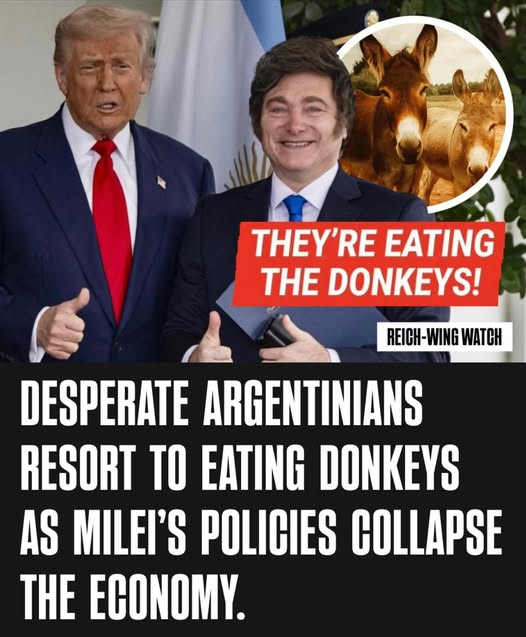

247 – The rapidly increasing prices of beef in Argentina, amidst the economic crisis under the government of Javier Milei, have led consumers to replace the product with cheaper alternatives, such as donkey meat, which is beginning to gain market share. According to a report by Página/12 , the price increase has turned beef into a luxury item in the country, frustrating campaign promises to reduce prices and profoundly altering the population’s eating habits.https://landing.mailerlite.com/webforms/landing/r9f0h9
In recent months, prices have risen sharply, with increases exceeding 10% in just one month, and common cuts of meat reaching over 25,000 pesos per kilo. Faced with this scenario, families have reduced their consumption, initially switching to chicken and pork—options that have also become more expensive—and later to even cheaper foods, such as eggs.
The economic crisis is part of a broader context of persistent inflation. According to the National Institute of Statistics and Censuses (Indec), the Consumer Price Index (IPC) rose 3.4% in March, up from 2.9% in February, marking the highest level in a year. Over the past 12 months, inflation has reached 32.6%.
Since assuming the presidency in December 2023, Javier Milei has implemented a broad program of economic reforms. Among the measures are the halting of federal projects and the suspension of transfers to the provinces, as well as the removal of subsidies in areas such as energy, transportation, and essential services, which has contributed to higher consumer prices.
Amidst soaring prices, a proposal emerged to sell donkey meat, priced at around 7,500 pesos per kilo. Butcher Gonzalo Moreira, from Buenos Aires, described the effects of the crisis on the sector. “We are facing a significant recession. I don’t know any merchant who isn’t experiencing difficulties. The sector is under a lot of pressure, even without major price fluctuations. Everything is paid for by card, pushed forward,” he told Radio 750.
He also highlighted changes in consumer behavior: “And food is also starting to be paid for in installments. We are reorganizing sales. People have stopped buying beef, which has fallen by about 20% in purchases, and switched to pork or chicken. A kilo of beef costs between 15,000 and 18,000 pesos. Pork, on the other hand, costs between 8,000 and 9,000 pesos.”
Regarding donkey meat, Moreira acknowledged the alternative’s role in addressing necessity. “If it’s about meeting daily needs, I’m not saying it’s the best… But there are people who at least have access to this type of food,” he said.
He also expressed cultural resistance to the consumption: “I don’t agree. I don’t think I want to eat a donkey. We’re used to eating beef. But, if you have to take it to another level… Nobody likes to eat rabbit, but people have been eating it all their lives.”
The initiative came from rural producer Julio Cittadini, creator of the “Burros Patagones” project. According to him, the demand exceeded expectations. “What we put up for sale was gone in a day. In a day and a half, nothing was left,” he reported.
The enterprise has authorization from the Chubut Ministry of Production and follows sanitary regulations, being a formal activity within the agricultural sector.