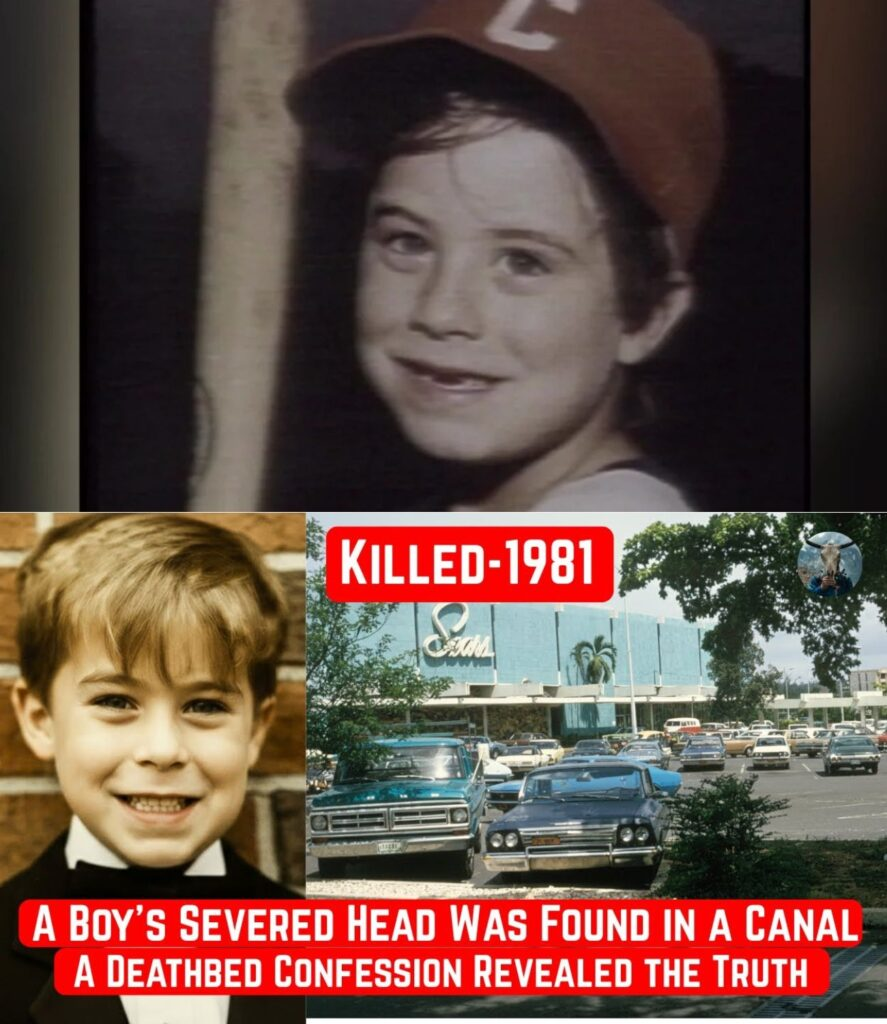
“Adam Walsh, your mother is waiting for you. Please report to the toy department.”
The announcement echoes through the Hollywood Mall in Florida. Once, twice, every 15 minutes, but no little boy comes running. No freckled face appears from behind a clothing rack. The toy department remains empty. And with each passing minute, the temperature in that store drops because everyone is starting to realize something terrifying.
6-year-old Adam Walsh is gone. This is July 27th, 1981. The day that changed America forever. Let me take you back to that morning. Adam woke up in his home in Hollywood, Florida, and watched Sesame Street like any other six-year-old. His father, John Walsh, kissed him goodbye before heading to work.
John was riding high, vice president and director of marketing at the Paradise Grand Hotel, working on a $26 million project. His wife Revé was a part-time student studying interior design. They had everything. The American dream, a beautiful home, a thriving career, and their son, their precious only son, Adam. If you could order the son out of a catalog, John would later say, that would be Adam, 3’6″ tall.
Sandy blonde hair, hazel eyes, dimpled cheeks covered in freckles. His nickname was “Cutter.” He loved baseball. He loved drawing. He loved his parents more than anything. Around 11:00 a.m., Revé loaded Adam into their gray Checker car. They had errands to run. First stop, St. Mark’s Lutheran School. Revé dropped off a $90 check to register Adam for second grade.
Then a 5-minute drive to the Hollywood Mall. Revé had been waiting months for a specific lamp to go on sale at Sears. She had the advertisement in her hand. Today was the day. She parked in her usual spot, the north side, near the catalog entrance. It was a habit. She planned to hit the gym after shopping. She’d been competing in bodybuilding tournaments. But first, the lamp.
They entered through the north entrance, passing guest services, and that’s when Adam saw it in the toy department: a brand new Atari 2600 video game system. In 1981, this was revolutionary technology. A TV screen, two controllers. Kids gathered around it like moths to a flame, taking turns playing Star Strike. Adam’s eyes lit up.
He begged his mother to let him stay and watch. Revé looked around. Security guards patrolling. Dozens of shoppers, staff everywhere, and right across Hollywood Boulevard, visible through the windows, the police station. It was noon, broad daylight, one of the safest, most public places you could imagine.
TV & Video
She said, “I’m going over to the lamp department. It’s just a few aisles away.”
Adam replied, “Okay, mommy. I know where that is.”
When she left, Adam was three deep in the line of boys waiting for their turn at the game. She walked to the lamp section, close enough that she could practically see the top of his head. 10 minutes, maybe 15 at most. She looked for the lamp. It wasn’t on the floor. She asked the salesperson. They checked the back. Not in stock. The saleswoman was on lunch break, so Revé left her name and number.
Then she returned to the toy department. The boys were gone. All of them. The Atari sat there abandoned. Revé’s heart started pounding. She called out for Adam. She walked through the aisles. Nothing. She went to customer service. “Page my son. Adam Walsh, please.”
The announcement crackled over the speakers: “Adam Walsh, your mother is waiting for you. Please report to the toy department.”
Silence. By sheer coincidence, Revé’s mother-in-law, Jean Walsh, was shopping in the same store. They ran into each other. Jean joined the search. Both women, along with store employees, combed every corner of Sears. Every 15 minutes, Adam’s name was paged again and again and again.
But here’s what Revé didn’t know. Here’s what Sears refused to tell her. At approximately 12:15, just minutes after she’d left Adam at that video game, a fight broke out. Two black boys and two white boys arguing over whose turn it was to play. A 17-year-old security guard named Kathy Schaefer was called over. She was part-time, plainclothes, untrained. She assumed the boys in each group knew each other. She asked the black boys if their parents were in the store. They said no. She told them to leave through the north entrance.
Then she turned to the two white boys. Same question. The older one said no. The younger one, wearing green shorts and a red and white striped shirt, said nothing. He was shy, scared, probably thought he was in trouble. Kathy Schaefer ordered both white boys out through the east exit—a door Adam never used, leading to a part of the parking lot he didn’t recognize.
And for 27 years, the Walsh family would have no idea this had happened. Sears stayed silent, afraid of a lawsuit. When Revé asked where the boys had gone, employees shrugged. “He’s around somewhere. You’ll find him.”
Family
But Adam wasn’t around. He was outside alone. 6 years old in an unfamiliar section of a massive mall parking lot, confused, frightened, vulnerable. By 1:55 p.m., nearly 2 hours after Adam was last seen, the Hollywood Police Department was finally called. Officers arrived from across the street. They began searching. They interviewed witnesses.
But here’s the part that will make your blood boil: the police didn’t take it seriously. The very next day, a newspaper ran a quote from a police aide: “Kidnapping is not suspected. The kid is probably trying to get home. He’s probably lost. We’re searching the city for him.”
Lost. As if a six-year-old could just wander off and find his way home from 5 miles away. It took 45 minutes for a uniformed officer to even show up at the scene. 45 minutes. The station was right across the street. When John Walsh arrived, having raced 45 minutes from his office in Miami, he couldn’t believe what he was seeing. He demanded answers.
“Where’s the SWAT team? Where’s the cavalry?”
The officer looked at him with disdain. “Hey, cowboy, slow down. I don’t like your attitude. Most kids walk home by themselves.”
John’s voice rose. “This is a six-year-old boy. We live 5 miles from here. He’s never walked anywhere in his life. I want a detective. I want your boss. I support law enforcement. I know the mayor. You should be looking for my son.”
Law Enforcement
But the Hollywood Police Department wasn’t looking. Not really. John and one of his business partners went to the station and stayed there for 2 weeks. They barely went home. They set up their own phone tap in case someone called with a ransom. Through a sleepless night, Revé sat at the police station. All she could think about was Adam’s yellow flip-flops. His feet will be tired, scratched. He’ll be cold in his t-shirt.
When nightfall came, the reality sank in. Things were not going the right way. The Walshes plastered their car with signs: “Adam, we’re still looking for you. Please stay here.” They distributed 500,000 flyers. Adam in his baseball uniform, smiling, innocent.
John appeared on the news, his voice breaking. “We’re not looking for revenge. Just drop him off somewhere. We’ll forget the whole thing.”
A $5,000 reward was offered. Then 10,000. Then $100,000. Eventually $120,000, the equivalent of $365,000 today. The public responded. Helicopters circled. Volunteers walked through fields. Truck drivers searched highways, communicating over CB radios. John gave people gas money to help search. Friends, employees, strangers, all looking for one little boy.
But the police had almost nothing. Witnesses described a dark blue van, mag wheels, tinted windows, a chrome ladder on the back. But the mall had been packed that day. Thousands of people. The list of suspects was impossible to narrow down. And here’s what made it even worse: there were no Amber Alerts in 1981. No National Center for Missing and Exploited Children. The FBI was prohibited by law from helping unless there was proof the child crossed state lines or a ransom note was received.
By day seven, the media moved on. The search continued, but hope was fading. Then John received shocking information from the county coroner. “We don’t exchange information about unidentified bodies. We do it every 6 months by mail.”
John asked, “Is my son in the NCIC?”
The coroner said, “What’s that?”
“The National Crime Information Computer.”
The coroner shook his head. “No missing children. No unidentified dead.”
John was stunned. “We put a man on the moon and you’re telling me I have to call every coroner in Florida to see if my son is dead.”
The coroner nodded. “It’s up to you.”
John tried to get the media’s attention. He called ABC, NBC, CBS. Only three channels existed in 1981. They all said no. “If we do it for you, we have to do it for every missing kid.”
Finally, David Hartman from Good Morning America agreed. John and Revé would appear on national television to plead for Adam’s safe return. The date was set: August 11th, 1981, exactly 2 weeks after Adam’s disappearance.
But on August 10th, the day before their appearance, two fishermen named Vernon Bailey and Robert Hughes were casting lines near a drainage canal off the Florida Turnpike about 120 miles north of Hollywood. Mile marker 130 in Indian River County. It was almost nightfall. Then they saw something floating. At first they thought it was a doll’s head. They rowed closer. It wasn’t a doll. It was the severed head of a child.
They called police immediately. Photos were taken. The fire department arrived. Divers searched the canal for days. They never found the rest of the body. On August 11th, while John and Revé were live on Good Morning America, begging for their son’s return, police were making identifications. When the Walshes landed back in Florida, reporters shoved cameras in their faces. The police had news. Devastating news.
Four separate confirmations proved it was Adam. John Moahan, John Walsh’s close friend and business partner—the same man whose son John had once saved from drowning—drove to Indian River County Hospital. He identified Adam by the gap in his front teeth and the stub of a new tooth growing in. He’d seen Adam just days before. Adam’s dentist, Dr. Burger, brought dental charts and X-rays; an amalgam filling on the lower left molar was a perfect match, the medical examiners confirmed. And years later, mitochondrial DNA from the jawbone would match Revé Walsh, silencing any conspiracy theories.
The head was airlifted to the Broward County Medical Examiner where Dr. Ronald Wright performed the autopsy. Five blows to the back of the neck and skull. A sharp blade approximately 5 1/2 inches. The decapitation was postmortem. Adam had been struck from behind while lying face down. Cause of death: asphyxiation, trauma to the face, a fractured nose.
City & Local Guides
Based on decomposition, Dr. Wright estimated Adam had been dead for at least 10 days, killed within a day or two of his abduction. Not kept alive. There were no drugs in his system. The head had been submerged for 12 days. It only surfaced in the last 24 hours.
Dr. Wright later said, “We were lucky the head was found. If those fishermen hadn’t come along, no one would ever have known what happened to Adam.”
When they cleaned the skull, they found white fragments—ceramic, paint, vitreous material—probably from the weapon. The fracture patterns could have identified the exact tool, but they never found it. The Walshes held a funeral; an empty casket, because the remains were evidence. They couldn’t bury their son. It was eating them alive.
John went to Dr. Wright. He begged for the remains.
Dr. Wright said, “Come to my office. Work late.”
They talked for hours. Dr. Wright explained he couldn’t release the remains yet. But there was something John could do. He could help other missing children. Make sure Adam didn’t die in vain. That conversation changed John Walsh’s life.
But first, they had to find the killer. And what followed was one of the most frustrating investigations in American history. The Hollywood Police Department began investigating everyone in Adam’s life. And they had to. Statistics don’t lie. When a child goes missing, the perpetrator is almost always someone close: a parent, a relative, a family friend.
Law Enforcement