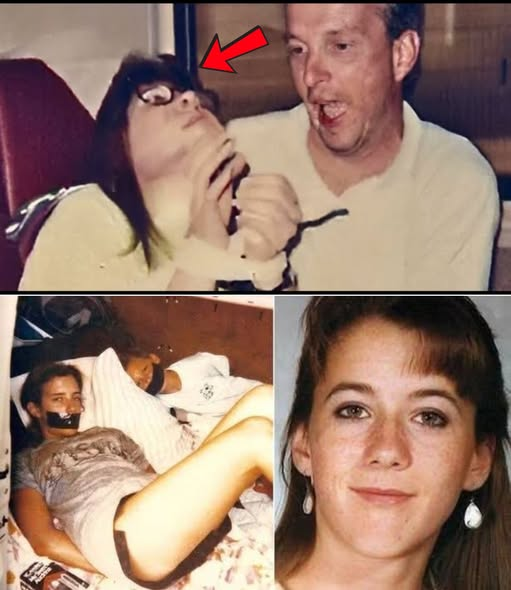
This case occurred in 1988 in the USA. Tara Calico was born on February 28, 1969, in the town of Belen, New Mexico. She grew up in a close-knit family, living with her mother Patty and her stepfather John.
Her parents had separated, but her father David lived nearby. She had two brothers and two sisters. Those who knew Tara described her as a capable, independent young woman who was incredibly organized. She loved making lists to plan her days in detail. She would sit down the night before or first thing in the morning and write down everything she needed to accomplish the next day.
This included her college courses at the Valencia campus of the University of New Mexico, where she was a sophomore, her part-time shifts at the National Bank of Belen, the housework she wanted to get done, and her plans for the weekend. She even noted the time she needed to leave for her daily bike ride. Tara was a very active young woman.
The bike rides she planned were no joke. She rode about 36 miles, several times a week, weather permitting. The route ran south of Belen on New Mexico State Road 47 through terrain described as high desert scrub and farmland. She would then reach a popular railroad crossing near Highway 60 and head back.
Sometimes Tara rode this route with her mother, Patty. But a few weeks before September 1988, Patty remembered a driver who passed them a bit too closely. It frightened her deeply. The car braked hard and even circled back. This encounter intimidated Patty and sent a chill down her spine. After that, she stopped riding with Tara.
She even asked Tara not to ride that route anymore, as she no longer considered it safe. She even told Tara she should take pepper spray with her if she ever rode there again. But Tara just laughed it off. On the morning of Tuesday, September 20, 1988, Tara was 19 years old. She was dressed for her bike ride. She was wearing her work top with “First National Bank of Belen” printed on the front.
She also wore white shorts with green stripes on the side, white ankle socks, and her favorite white and turquoise tennis shoes. And when she rode alone, she always took her Sony Walkman with her. Before she left, Tara spoke briefly with her mother and said something that would later play over and over again in her mother’s mind.
“Come and get me if I’m not home by noon.”
Perhaps this was for practical reasons, in case something like a flat tire happened. Tara had a boyfriend and had organized a tennis match with him, so perhaps it was to ensure she wasn’t late for that. Regardless, after this conversation, Tara left the house and set off on her bike ride.
Several people saw her that morning. Neighbors in the area and truckers driving along the road remembered seeing Tara. After all, her neon pink bicycle was hard to miss. Tara was last seen around 11:45 AM, about 2 miles south of her home, still heading south on Highway 47. Many people later reported seeing nothing unusual.
One witness, however, Baron Freeman, described passing Tara. He said he had a bad feeling in his stomach because a light-colored pick-up truck from the 1950s with a white, homemade camper shell was driving directly behind her, only a few feet away. This vehicle also appeared to be occupied by two men.
He said the hair on the back of his neck stood up. It didn’t look good, but he did nothing at the time—and he was not to be proven wrong. Somewhere on the next empty stretch of road, everything changed. Tara never returned home. It became about 12:00 PM and she was nowhere to be seen. Patty, Tara’s mother, became restless and set out to look for Tara, just as Tara had requested.
She drove the exact same route, calling Tara’s name. She even slowed down to check the roadsides to see if she had been in an accident. At 2:00 PM, her heart sank. Tara’s mother had driven the route several times, and she was still nowhere to be seen. With no other option left, Tara’s mother went straight to the police.
By late afternoon, the Sheriff’s office became active. Deputies, volunteer search teams, and a cadaver dog named Phoenix were deployed, but after several hours, they found nothing. And now it was getting dark. The next morning, Wednesday the 21st, search teams went out again, and that’s when they found something. As I mentioned earlier, when Tara was out alone, she always took her Sony Walkman with her.
While the searchers looked for Tara, they found small fragments of her Sony Walkman scattered across the asphalt. And later that day, Patty personally found Tara’s music cassette by the band Boston, which she listened to on her rides. The plastic case was broken open and the tape was lying loose. It was spread all over the road. Immediately after, the search team discovered bicycle tire tracks that suddenly veered sharply from the paved road into the soft dirt on the shoulder.
Beside them were skid marks in the gravel and churned-up earth that looked like a struggle or a forced stop. With this information, investigators classified the case as an involuntary disappearance. There was now enough evidence to suggest that she had not run away of her own accord. In fact, Tara’s mother Patty was firmly convinced that Tara had deliberately ripped off her headphones and thrown the Walkman and cassette to the ground with force to leave a trail of debris.
The next day, the search was expanded. More volunteers arrived and additional dog teams came to support Phoenix. But despite all efforts, neither Tara nor her neon pink mountain bike could ever be located. The vehicle seen driving behind Tara was also not found, and the drivers never came forward. On September 24, about 20 miles east of Highway 47, near the remote John F. Kennedy Campground, more pieces of Tara’s yellow Sony Walkman were found.
Investigators believed that Tara had thrown them away to leave a second trail marker. This sparked some optimism, as if they were closing in on Tara. But by September 27, the large-scale organized search was officially scaled back. Nevertheless, through door-to-door interviews, police identified seven credible witnesses who had been driving on Highway 47 that morning and remembered seeing Tara on the pink bicycle.
It also turned out that five of these seven people remembered the same suspicious vehicle driving directly behind her. One witness said the truck looked as if it were intentionally escorting her. By September 1988, investigators created a composite sketch of the driver with the help of the five witnesses.
The drawing showed a white or fair-skinned man in his late 30s to mid-40s with reddish or brown hair. The suspect was described as being between 5’9″ and 6’0″ tall, weighing about 190 to 210 lbs. The Albuquerque Journal published the story on September 30 along with the sketch. This led to over 100 phone tips and four formal interviews of possible matches, but unfortunately, none of them led to success. The truck was never found and the driver continued to not come forward.
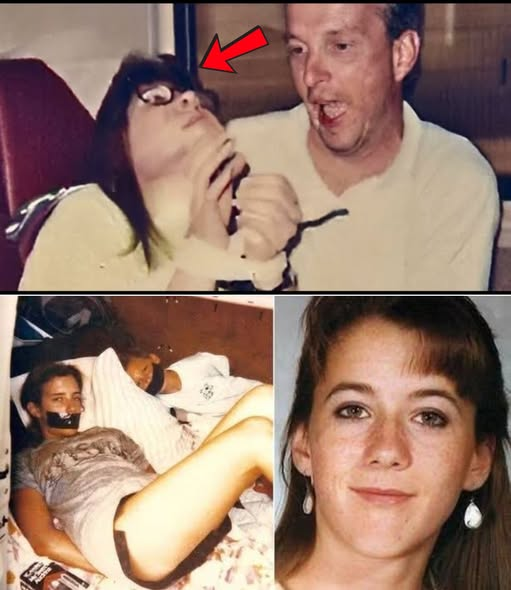
Investigators continued to work on the case, but after a short time, the case went cold. It remained that way until ten months later when something happened. On June 15, 1989, a woman in Port St. Joe, Florida, stopped in the parking lot of a grocery store and discovered a Polaroid lying face down on the asphalt. The photograph was in good condition, so it had to be relatively new.
The photo had been dropped exactly where a white 1980s Toyota cargo van without windows had been parked shortly before. The driver was a white man in his 30s with a mustache, but he was already gone. Now it gets incredibly eerie. The photo showed a young woman and a young boy on what looked like the floor of the same van.
Both had black duct tape over their mouths and their arms were tied behind their backs. The woman in the photo had long brown hair and she appeared to have a scar on her lower right leg. Tara also had a scar in the same place. Next to her lay a tattered paperback book by V.C. Andrews, “My Sweet Audrina.” This was one of Tara’s favorite books.
After seeing the photo, the woman went straight to the police, and they immediately set up roadblocks in the area, but the van was gone. Friends who saw the picture on the news immediately called Patty, and she flew to Florida without delay. She studied the original photo for hours under every light she could find. She took into account the lack of makeup and the time that had passed.
When she finished looking at the photo, she was certain.
“That is my daughter.”
The resemblance was uncanny and unmistakable. The photo spread quickly on national television; first on an episode of “A Current Affair” in July 1989, and then on “Unsolved Mysteries,” “America’s Most Wanted,” and Oprah. It was also all over the newspapers.
For a short time, it felt like the breakthrough the whole country had been praying for. It was proof that Tara might still be alive and breathing somewhere, even if she was going through hell. However, experts began to take it apart. Scotland Yard in the UK said yes, the person in the photo is Tara. They were 85% sure.
But the Los Alamos National Laboratory said no. According to them, the facial proportions and bone structure simply did not match. The FBI’s results were inconclusive. And then some interesting information came to light. The Polaroid Corporation stated that this specific type of film was not commercially available until after May 1989—a full nine months after Tara had already disappeared.
So it was either not her, or she had been abducted, held hostage, and potentially worse. As for the boy in the picture, he was first identified by his own family as 9-year-old Michael Henley. Michael Henley was another missing child from the same part of New Mexico. His mother was almost certain, but in June 1990, Michael’s remains were found in the Zuni Mountains.
He had died of exposure and hypothermia after getting lost months before the Polaroid was taken. At times, people even thought it was Johnny Gosch, the paperboy who disappeared on his route in 1982. But this was never proven. In the following months, two more Polaroid photos surfaced. On July 19, 1989, a blurry close-up of a girl’s face with tape over her mouth was found near a construction site in California.
Patty thought that could also be Tara. Then, in early 1990, a third photo appeared. This time it showed a woman loosely bound in gauze, her eyes covered, wearing large black-framed glasses, sitting next to a man on what looked like a seat on an Amtrak train. Patty began to believe that this was all just a cruel joke.
Years later, the family received several anonymous letters. They contained manipulated copies of the original Polaroid boy, with a mouth guard drawn on with black marker to look like duct tape. There was no return address and no explanation. The Polaroid provided the case with its most disturbing image. It still circulates online over 37 years later. But the investigators who worked on this case the longest say that this whole saga massively hindered the search. It is unlikely that it is Tara.
And investigators say it sucked up the national attention and resources that should have stayed on the roadside of Highway 47, where they believed Tara never left the area. The photo likely belongs to another horror story of kidnapping and human trafficking that we may never know the full truth about, including the names of the woman and the boy.
Ten years after Tara’s disappearance, a judge officially declared Tara dead, and the cause of death was ruled as murder. But no further evidence or a body was discovered. The case became a “cold case.” A sad part of this case, as with many others, is the fact that Patty died in 2006 without ever learning her daughter’s fate. Her husband John and her sister Michelle continue to advocate for Tara.
It wasn’t until 2008 that a shocking development was to occur. On September 20, 2008, the 20th anniversary of Tara’s disappearance, Valencia County Sheriff Rene Rivera went public with some startling information. He stated that he knew the names of two local teenagers who knew Tara and who had allegedly followed her in a truck that morning.
According to him, the two boys had hit her. Tara then said she would report them to the police, whereupon they panicked and killed her. He claims that other people helped dispose of her body and that the families stuck together to help, but the strange thing was that there were no arrests. The Sheriff said that without a body, he could not charge these people.
Tara’s stepfather John publicly disagreed, saying there was enough circumstantial evidence to act. He was angry and wanted to know their names. This bombshell, especially on the anniversary of the disappearance, was more than bizarre. Two people, now in their 50s, are said to have killed Tara, and the Sheriff refused to make their names public and brought no charges.
The FBI announced a $20,000 reward for information leading to Tara’s location or the arrest and conviction of those responsible. And in September 2021, investigators made a discovery. They had focused on a suspect. A search warrant was issued and the house was searched. However, nothing came of it.
But not only that: any findings were kept under lock and key and withheld from the public. And then there was another turn in this case. On June 13, 2023, there was a rare public press conference. The Valencia County Sheriff announced a major breakthrough. He stated that law enforcement now had sufficient evidence to submit their entire case file for review for possible charges.
They said “persons of interest” had been identified. The case is now with the District Attorney for possible prosecution. However, no arrests were made that day or since. In 2025, investigators still working on the case did not want to wait for the outcome from the prosecutor’s office. Instead, they focused on gathering more evidence. Their focus shifted to an abandoned copper shaft about 25 miles from the site of the disappearance.
It is one of four old mines once leased by a family who lived in Belen. It is said they were leased by the family of a convicted kidnapper named David Parker Ray, but this has not been officially confirmed. Investigators set up several fly traps in the shaft to attract insects that feed on human remains in various stages of decomposition.
If these fly traps contained these specific insects, it would be a sign that someone is down there. On September 21, 2025, investigators collected the fly traps. The results have not yet been released. There have been some theories regarding the claims the Sheriff made about the two boys who were said to have killed Tara.
Some claimed that one of the two boys was the son of the original Sheriff from 1988, Lawrence Romero, and the entire department had protected the families from the beginning. They claimed that tips were processed slowly, they refused to search for the suspicious truck, and the case was ultimately allowed to fizzle out for fear of a scandal and a loss of image for the town.
This theory gained even more traction around 2013. It was said that if you went to that place and asked the residents, they would tell you that they all knew who did it. In fact, a man from Belen named Henry Brown was suffering from a terminal illness and was on his deathbed. Before he passed away, he had something to say. Henry Brown gave a detailed statement claiming that shortly after Tara’s disappearance, he was told by his neighbor Lawrence Romero Jr. and several friends that they had hit Tara with their truck.
He said they then took her, assaulted her, murdered her, and buried the body. It is speculated that Tara is buried in the abandoned mine shaft.