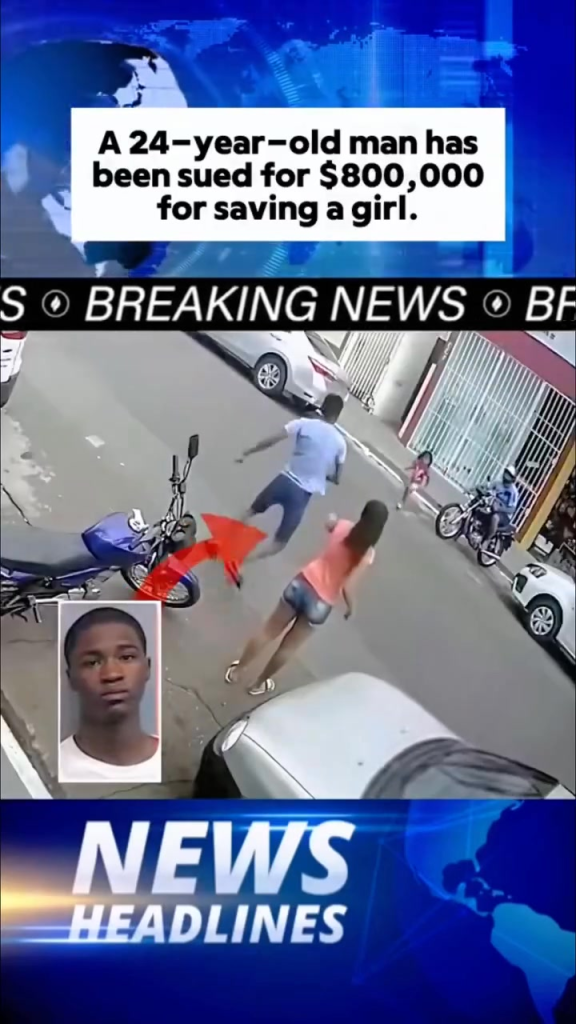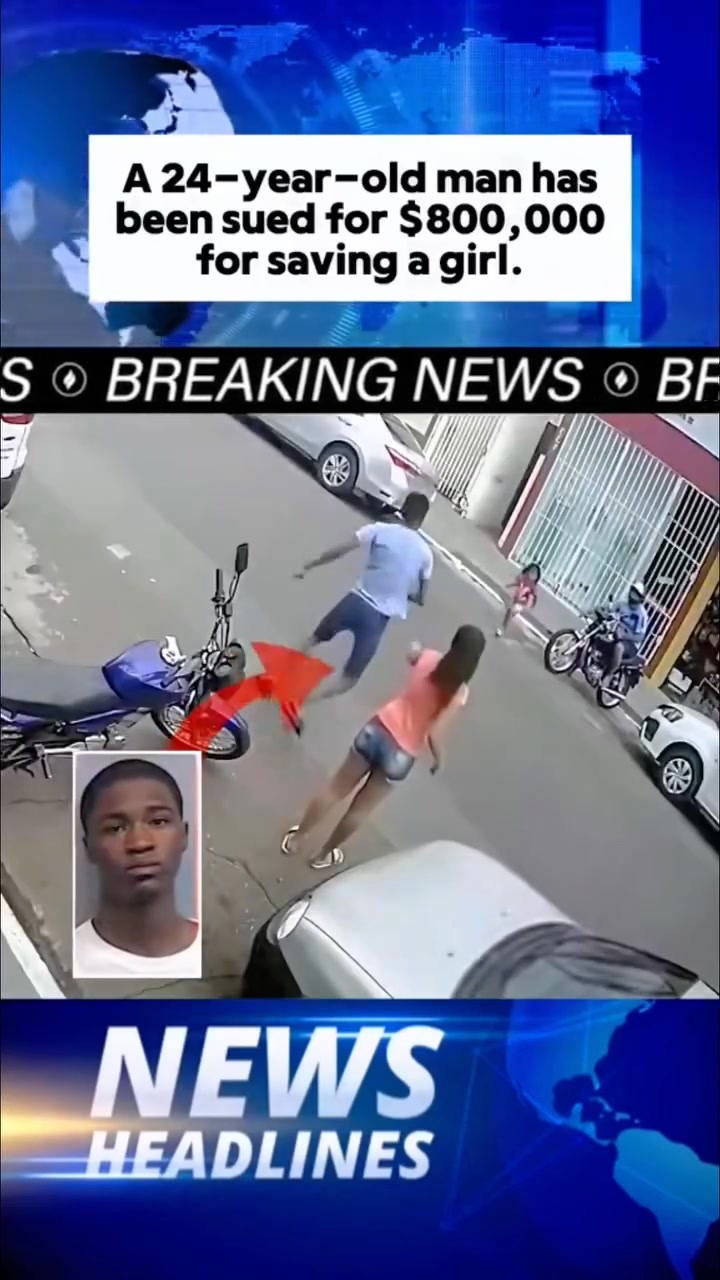
What began as a split second act of courage at a busy intersection has turned into a courtroom dispute that is drawing wide attention. A 24 year old man is being sued for $800,000 after pulling a young girl out of the path of an oncoming vehicle, an action that her mother says prevented one tragedy but caused another injury.
According to the account presented in the widely shared video, the child had crossed the road and was starting to head back when danger approached. Jonathan Anderson and his girlfriend, who were nearby, noticed a pickup truck moving quickly toward the intersection and realized there were only moments to react.
The girlfriend, startled by the scene, instinctively reached toward Jonathan as the vehicle closed in on the crossing. He did not pause, the video narration says, and instead rushed forward to pull the girl away before the truck reached her position.
That intervention appears to have spared the child from being struck, and the video describes the rescue as taking place just seconds before impact. After getting Lucy to safety, Jonathan called emergency services and took her to a hospital so doctors could examine her condition without delay.
At the hospital, physicians determined that Lucy had suffered a fracture in her right arm, an injury linked to the force of being pulled. The finding transformed what had looked like a straightforward story of rescue into a more complicated dispute about responsibility, urgency, and unintended harm.
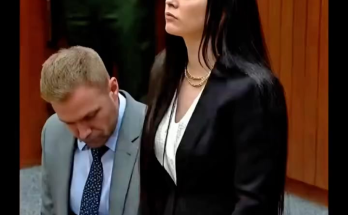
Several days later, according to the video, Jonathan received notice that Lucy’s mother had filed a civil lawsuit against him. Her claim argues that although his actions kept the girl from the speeding truck, the manner of the rescue was reckless and directly caused the broken arm.
The damages sought in the case total $800,000, a figure that has fueled strong public reaction online and renewed debate about legal liability in emergencies. Many viewers have responded emotionally to the idea that a bystander who stepped in during an apparent life threatening moment could face such a severe financial claim.

Jonathan’s defense lawyer says the circumstances left no room for careful planning because the pickup truck was only seconds away. In that version of events, the choice was immediate and stark, either act with imperfect force or risk the child being hit before anyone could intervene.
Legal experts often note that rescue cases can become difficult when courts must weigh good intentions against the outcome of a hurried decision. Questions usually center on whether the responder acted reasonably under pressure, whether alternatives existed, and how the law treats injuries that occur during an attempt to prevent something worse.
The video does not include comments from Lucy’s mother beyond the allegation that the rescue itself produced the fracture. It also does not say whether the driver of the pickup truck was identified, questioned, or accused of any traffic violation in connection with the near collision.
Those missing details leave important gaps in the public understanding of what happened at the intersection that day. Still, the central facts described in the recording remain striking, a child in danger, a rapid rescue, a hospital diagnosis, and a lawsuit that now asks a court to assign blame.
Cases like this can stir conflicting instincts among the public because people want rescuers to help, but they also expect children to be protected from preventable injury. That tension becomes sharper when an emergency unfolds in mere seconds and every option carries some possibility of harm.
For Jonathan, the emotional weight of the lawsuit may be as significant as the financial threat attached to it. The same act that reportedly spared Lucy from a much more serious event is now being examined as the source of the injury that sent her to the hospital.
For Lucy’s family, the issue appears to be whether gratitude for the rescue can exist alongside a claim that the method used was excessive. Civil suits sometimes emerge from exactly that kind of contradiction, where appreciation, fear, and medical costs meet in ways that are difficult to separate.

The court’s eventual ruling could clarify how far the law protects split second decisions made by ordinary people during emergencies. It may also influence how others think about stepping in to help strangers, especially when immediate action seems necessary and waiting for professionals is impossible.
Until then, the case remains under trial, with the competing narratives likely to receive close scrutiny from both lawyers and the public. One side emphasizes a desperate attempt to save a child from a speeding vehicle, while the other points to an injured arm and asks who should pay for it.
Whatever the verdict, the dispute has already become a vivid example of how a heroic moment can evolve into a legal and moral puzzle. It asks a question with no easy answer, when danger arrives without warning, what does society owe the person who chooses to act?
Public reaction to the story has highlighted a familiar concern, that fear of lawsuits may discourage ordinary people from helping during dangerous situations. Supporters of Jonathan argue that hesitation in those circumstances could have led to far graver consequences, while critics say good intentions do not erase the duty to use reasonable care when sudden decisions affect someone else’s safety in lasting ways and health outcomes.
Some jurisdictions have so called Good Samaritan laws that shield rescuers from liability in certain emergencies, but those protections differ widely. Much can depend on where the incident occurred, whether the responder expected payment, and whether a judge believes the conduct was careless beyond what the moment reasonably required to prevent a larger injury or preserve a life in immediate jeopardy nearby that day for everyone.
Because the case is still pending, many of the facts that would matter most in court may not yet be publicly available. Testimony about the truck’s speed, the distance involved, the precise force of the pull, and the child’s movement could shape whether the rescue is judged necessary, negligent, or somewhere between those competing descriptions presented by each side during hearings in the months ahead for jurors.
For now, the story continues to resonate because it touches on instinct, law, parental responsibility, and the uncertain consequences of urgent choices. In a matter of seconds, one man became a rescuer, a patient was diagnosed, and a family dispute moved toward the courts, leaving a community to debate what justice should look like afterward for rescuers, children, parents, drivers, witnesses, and the broader public alike today.