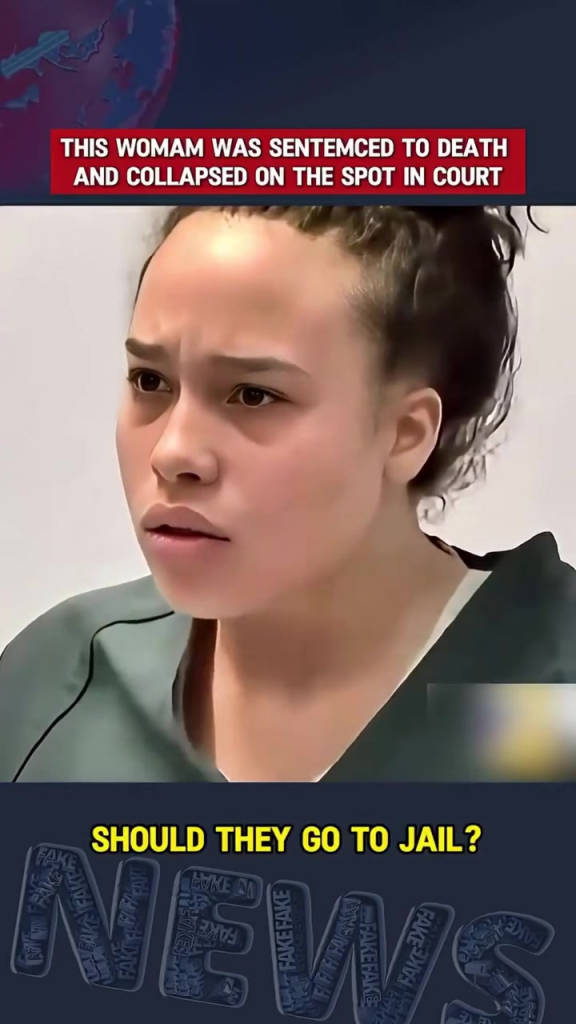
In the world of viral courtroom footage, few moments are as haunting as the sight of a young defendant realizing that their life, as they know it, is over. A video circulating online shows a young woman, identified as Franchette Torres, appearing stoic and almost indifferent during her court proceedings—until the judge delivers a sentence that shatters her composure.
While social media captions often sensationalize these moments with claims of “death sentences,” the reality of the Franchette Torres case is rooted in a brutal, calculated crime that took place in Suwanee, Georgia. It is a story of a young man lured to his death, a group of teenagers who thought they were above the law, and a judicial system that decided that some crimes are too heinous for the leniency typically afforded to minors.
The Luring of William Tonchez
The tragedy began in early 2021. William Tonchez, a 21-year-old resident of Gwinnett County, was like many young men his age—active on social media and looking for connection. Unfortunately, this vulnerability was exploited by 17-year-old Franchette Torres.
According to investigative reports and court testimony, Torres used a communication app to lure Tonchez to a remote location in Suwanee. The “bait” was an agreement for sexual services in exchange for $300. Tonchez, believing he was meeting a young woman for a transactional encounter, arrived at the designated spot on a quiet pedestrian trail.
He had no idea that Torres was not alone. Waiting in the shadows were 17-year-old Nicholas Evans and 18-year-old Khalil Miller. The plan was never about the money Tonchez brought for the “service”; it was a cold-blooded setup for a robbery that quickly spiraled into a fatal assault.
A Brutal and Pointless Crime
When Tonchez arrived at the trail, he was not met with the encounter he expected. Instead, he was ambushed by the trio. The teenagers didn’t just demand his money; they subjected the 21-year-old to a “brutal beating.”
Evidence presented in court detailed the sheer violence of the attack. Tonchez was struck with a blunt object—later identified as a weapon brought by the group—and left for dead. The group fled the scene with Tonchez’s personal belongings, leaving his body to be discovered by a passerby the following morning.
The community of Suwanee was rocked by the discovery. Known for its safety and family-friendly parks, the trail became the site of a gruesome investigation. It didn’t take long for the Suwanee Police Department and Gwinnett County investigators to trace the digital footprint left by the communication between Torres and the victim.
The Arrests and the Defense
Within a short time, Torres, Evans, and Miller were apprehended. Because of the severity of the crime—Malice Murder, Felony Murder, and Armed Robbery—the state of Georgia elected to try the 17-year-olds as adults.
Throughout the trial, the defense attempted to paint a picture of troubled youths who hadn’t intended for the situation to turn fatal. They argued that the brain development of a teenager is not complete and that life without parole was a “cruel and unusual” punishment for someone who had not yet reached the age of 18 at the time of the crime.
However, the prosecution painted a different picture: one of a calculated “predator.” They argued that Torres was the “linchpin” of the operation. She was the one who established the trust, she was the one who set the location, and she was the one who ensured Tonchez would be vulnerable.
The Courtroom Collapse: Fact vs. Fiction
The video often seen online shows a man collapsing in a courtroom, overlaid with text about a woman being sentenced to death. It is important to clarify the context:
- The Man Collapsing: In many versions of this viral clip, the footage of the man collapsing is actually from a different case (often the case of Michael Marin or other unrelated high-profile courtroom dramas) and is edited together with the Torres footage for emotional impact.
- The Sentence: Franchette Torres was not sentenced to death. In the United States, the Supreme Court ruled in Roper v. Simmons (2005) that the death penalty is unconstitutional for anyone who committed a crime under the age of 18.
- The Reality: Torres was sentenced to Life in Prison without the possibility of parole.
For a 17-year-old, “Life without Parole” is essentially a death sentence by increments. It means she will never step foot outside of a prison fence for the rest of her natural life. The moment caught on camera—where Torres’ eyes widen and her face pales—is the exact moment the judge confirmed she would never have a second chance at freedom.
The Victim’s Family Speaks
During the sentencing phase, the emotional weight of the crime was palpable. William Tonchez’s mother provided a heart-wrenching victim impact statement. She spoke of a son who was kind, a brother who was loved, and a life that was discarded for a few hundred dollars and a cell phone.
“You took everything from us,” she told the defendants. Her grief played a significant role in the judge’s decision. While some judges offer the possibility of parole after 30 years for juvenile offenders, the judge in this case cited the “extreme cruelty” and the “premeditated nature” of the luring as reasons to deny any future hope of release for Torres and her accomplices.
The Debate: Juvenile Justice vs. Public Safety
The Franchette Torres case reignites a long-standing debate in the American legal system. Should a 17-year-old ever be sentenced to life without parole?
Advocates for criminal justice reform argue that the “no-parole” sentence ignores the capacity for rehabilitation in young offenders. They point to the fact that the teenage brain is prone to impulsivity and peer pressure.
On the other side, prosecutors and the families of victims argue that certain crimes are so depraved that the age of the offender should not grant them a “get out of jail” card. In the case of William Tonchez, the “impulsivity” argument was hard to maintain because the crime was a planned “honeytrap”—a complex conspiracy involving multiple people, a digital trail, and the procurement of weapons.
Where Are They Now?
As of 2024, Franchette Torres remains incarcerated in a Georgia state women’s prison. Her co-defendants, Nicholas Evans and Khalil Miller, also received life sentences for their roles in the murder.
The pedestrian trail in Suwanee has returned to its quiet state, but for those who knew William Tonchez, the area serves as a somber reminder of a life cut short by a group of peers who chose violence over humanity.
Conclusion
The Franchette Torres video serves as a grim cautionary tale. It highlights the dangers of online “meet-ups” and the devastating consequences of youthful arrogance. Torres believed that her age or her gender might shield her from the ultimate weight of the law. She was wrong.
The justice system sent a clear message: if you lure a human being to their dth with the intent to harm them, the state will ensure you lose your freedom forever. While the viral videos may mix and match footage for views, the cold, hard facts of the Tonchez murder remain a tragedy that no amount of internet fame can undo.