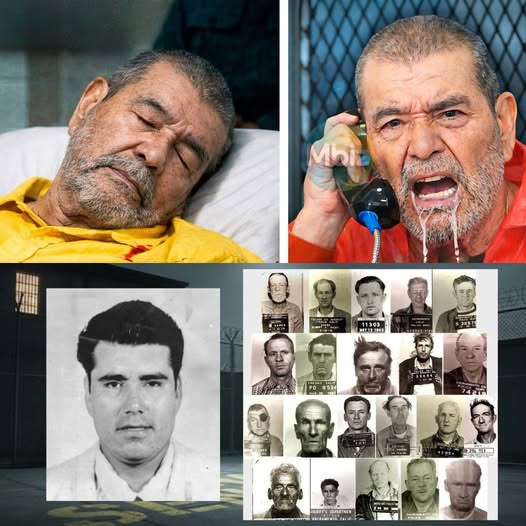
Juan Vallejo Corona, the notorious Mexican-American serial killer responsible for the brutal murders of 25 men in California during the early 1970s, has died at 85 after nearly five decades behind bars. His death marks the end of a dark chapter in U.S. criminal history, closing a case marked by violence, mental illness, and complex justice battles.

Known as a trusted labor contractor, Corona exploited his position to lure vulnerable migrant workers into deadly traps. His dual life—quiet family man by day, cold-blooded killer by night—stunned the nation. Details of his psychological torment surfaced, revealing a man haunted by years of mental illness and trauma dating back to his youth in Mexico.
The investigation into Corona’s killings rapidly became California’s deadliest serial murder case, with evidence pointing conclusively to him: bloody tools, a ledger listing his victims, and matching tire tracks. His arrest in 1971 halted the spree, but sparked a prolonged legal saga fraught with appeals, defense complications, and controversy.

Corona was convicted in 1973 for 25 first-degree murder charges and sentenced to 25 consecutive life terms, escaping the death penalty due to California’s law shift. A decade later, a retrial reaffirmed his guilt amid intense media scrutiny, cementing his place in criminal infamy.
Despite his conviction, Corona’s complex psychological profile—diagnosed with paranoid schizophrenia—challenged notions of criminal responsibility. His defense failed to leverage his mental health records effectively, and the court maintained his full accountability, a decision debated among experts and the public.

During his 46 years in prison, Corona endured violent attacks by inmates, losing an eye and suffering permanent injuries, reflecting the brutal reality of his incarceration. Later years revealed severe Alzheimer’s disease, marking a downward spiral of health and cognition until his death in 2019.
The media barely covered Corona’s passing, underscoring society’s fading attention to victims largely forgotten—many migrant workers whose lives were erased and whose families never came forward. His story raised urgent questions about justice, mental health, and systemic neglect of marginalized victims.

Corona’s legacy is a grim reminder of hidden violence festering in overlooked communities and the challenges law enforcement faces in protecting transient populations. His crimes spurred reforms and widened the lens on serial killers’ psychological and social dimensions in America.
The enduring horror of Juan Vallejo Corona’s murders haunts California’s past, while his death closes the last page on a saga blending tragic human frailty, calculated brutality, and the long pursuit of justice. This grim tale remains a stark warning about vulnerability and evil lurking beneath ordinary facades.