The heat in the stadium was a living thing. It was a humid, suffocating blanket that smelled of stale beer, overpriced nachos, and the nervous sweat of sixty thousand people. For Cooper, it wasn’t just heat—nearing the end of the fourth quarter, it was a trigger. The roar of the crowd didn’t sound like cheering anymore; it sounded like the rhythmic thrum of a rotor blade. The bright stadium lights felt like flares over a dusty valley in Kandahar.
Beside him, Rex sat like a statue carved from salt and shadow. The German Shepherd’s muzzle was turning white, a testament to the eight years of service they’d shared, first in the dust of the Middle East and now in the grueling, thankless world of private security. Rex’s ears flicked back and forth, tracking sounds Cooper’s damaged eardrums couldn’t even register.
“Easy, boy,” Cooper muttered, his voice a low rasp. He adjusted the heavy leather lead wrapped around his calloused hand. His knuckles were white.
Cooper was forty-two, but he felt eighty. He wore a faded tactical polo that struggled to contain shoulders broadened by years of carrying a rucksack. He was a man of hard angles and deep-set eyes that never stayed in one place for more than a second. To the casual observer, he was just another “tough guy” working the gate. They didn’t see the way his pulse thrummed in his neck or the way he counted every exit, every potential weapon, every threat.
The game ended with a sudden, seismic roar. The home team had lost on a fumbled play, and the collective frustration of the crowd turned the atmosphere toxic in an instant.
“Let’s move, Rex,” Cooper said. “Patrol Sector B-4. Keep ’em moving.”
They navigated the concourse, a sea of angry faces and red jerseys. People were pushing. Tensions were high. It was the kind of crowd that felt like a tinderbox waiting for a match.
That’s when Cooper saw him.
A small boy, maybe seven or eight years old, with shocks of blonde hair and a jersey three sizes too big for him. He was standing near a concrete pillar, his face crumpled in that specific, heart-wrenching terror of a child who realizes they’ve lost their mother’s hand.
“Leo! Leo, where are you?”
The voice came from twenty yards away—a woman in a frantic state, being pushed by the tide of people trying to reach the parking lot. She was blonde, pretty in a tired, suburban way, her eyes wide with the kind of primal panic only a parent knows. Sarah. He didn’t know her name then, but he saw the desperation.
But Cooper saw something else first.
At the top of the Section 12 stairwell, a fight had broken out. It was a stupid, drunken scuffle over a spilled drink, but in a packed corridor, it was a catastrophe. A group of men tumbled backward, tripping over a stroller. It created a ripple effect. A literal wave of humanity began to fall.
It was a “crowd crush.” Cooper had seen it happen in overseas markets. Once the momentum starts, there is no stopping it. Hundreds of pounds of pressure, bone-snapping force, moving toward the corner where the little boy stood, paralyzed by fear.
The boy, Leo, was directly in the path of the coming surge. If he stayed there, he wouldn’t just be knocked down. He would be buried under a thousand pounds of panicked adults.
Rex felt it before Cooper did. The dog’s body went rigid. A low, vibrating growl started in his chest—not a threat to the boy, but a reaction to the oncoming danger.
“Rex, wait—” Cooper started, but the leash snapped.
The leather, worn thin by years of salt air and tension, gave way with a sound like a pistol shot.
Rex didn’t hesitate. He wasn’t a pet; he was a precision instrument of survival. He saw the “threat”—the wall of falling bodies—and he saw the “asset”—the child.
To the crowd, it looked like a nightmare.
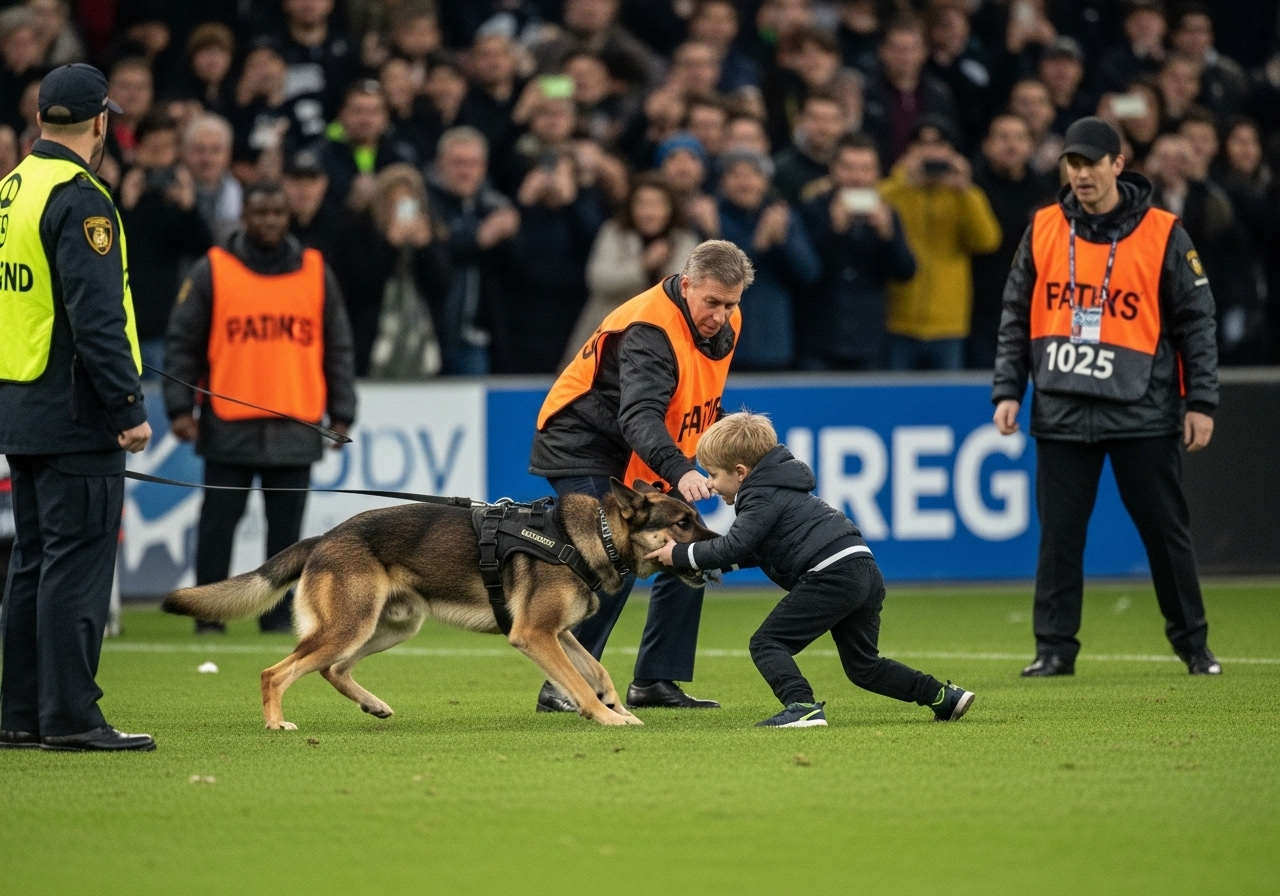
A massive, eighty-pound beast with its teeth bared, launching itself through the air at a crying child.
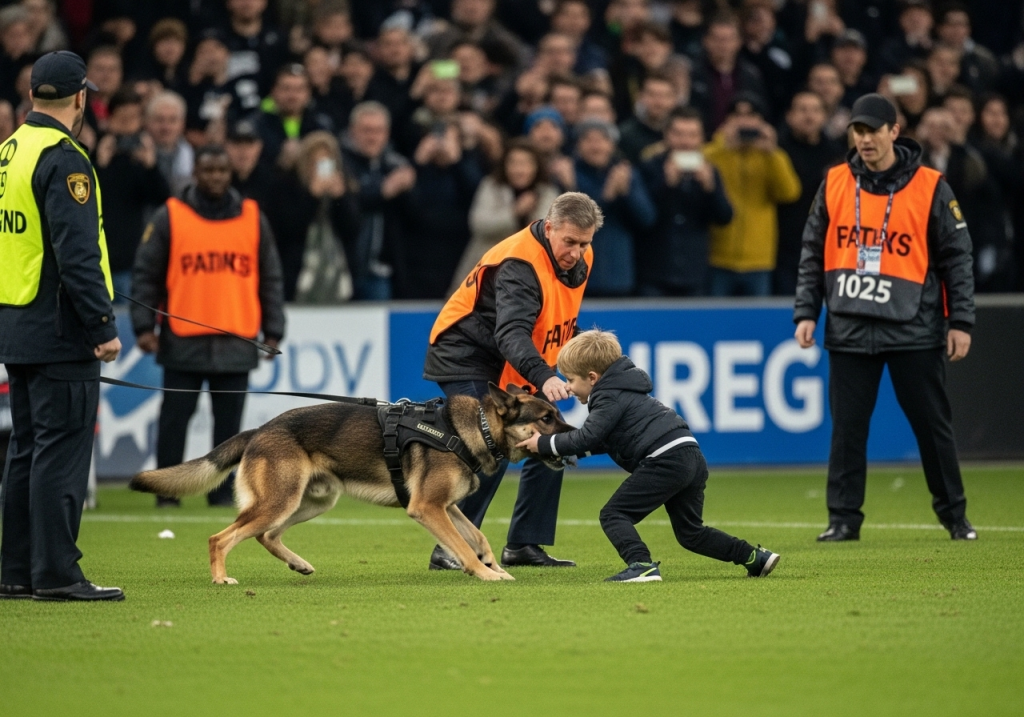
Rex hit the ground running. He didn’t bark. He was silent, a streak of black and tan. He reached Leo just as the first wave of the crowd surge began to tip over the railing.
Rex didn’t bite to hurt. He used a “soft-mouth” grip he’d been trained to use for dragging downed soldiers to cover. He lunged, his jaws snapping shut over the shoulder of Leo’s oversized jersey.
“NO! HELP! THE DOG IS KILLING HIM!” a man screamed, his voice cracking with horror.
Leo let out a piercing shriek as he felt himself being jerked off his feet. To the boy, a monster had emerged from the shadows to eat him.
Rex dug his back paws into the slick concrete, his muscles bulging as he dragged the boy backward, away from the pillar, toward a narrow maintenance alcove.
“REX! DOWN!” a police officer shouted, unholstering his Glock.
Cooper was running, shoving people aside, his heart hammering against his ribs. “DON’T SHOOT! HE’S SAVING HIM! LOOK AT THE CROWD!”
But nobody was looking at the crowd. They were looking at the “vicious” dog.
Sarah, the mother, finally broke through the line. She saw Rex dragging her son by the neck of his shirt. Her scream was something from a horror movie. It was the sound of a soul breaking.
“MY BABY! GET THAT BEAST OFF MY BABY!”
She lunged forward, swinging her heavy leather purse, striking Rex across the head. The metal buckle caught the dog just above the eye.
Rex didn’t let go. He couldn’t. If he let go, the boy would stumble back into the path of the three-hundred-pound man currently falling headlong into the spot where Leo had been standing a split second ago.
The man hit the concrete pillar with a sickening thud. Then another person fell on him. Then another. A pile-up of bodies began to form, a chaotic tangle of limbs and screams.
But all eyes remained on Rex.
A security guard, a young kid named Miller who had always hated Cooper’s “scary” dog, stepped forward and leveled a heavy tactical boot into Rex’s ribs.
Thud.
Rex whimpered, a sharp, pained yelp, but his jaws stayed clamped on the jersey. He pulled Leo those last three feet into the safety of the alcove just as the main surge of the crowd washed over the area.
“GET AWAY FROM HIM!” Miller yelled, drawing his baton and swinging it down on Rex’s back.
Finally, the pressure was off. The boy was safe behind a steel door frame. Rex released the jersey. He collapsed onto his side, his breath coming in ragged, bloody gasps. He looked up at Cooper, his tail giving one weak, confused wag. He had done his job. He had saved the asset.
So why was everyone looking at him like he was the devil?
Sarah scooped Leo up, clutching him so hard the boy could barely breathe. She was sobbing, checking his neck for bite marks, her face contorted in a mask of pure hatred as she looked at Cooper.
“You,” she hissed, her voice trembling. “Your dog attacked my son. He tried to kill him.”
“Ma’am, look behind you,” Cooper pleaded, his hands raised. “Look at the pillar. If he hadn’t pulled him—”
“I saw what I saw!” she screamed. “Everyone saw it! You’re a monster! That thing needs to be put down!”
The crowd closed in. Dozens of phones were out, the little red recording lights glowing like the eyes of predators.
“He’s a dangerous animal!” someone yelled. “I got it all on video! The dog just snapped!” “Shoot it! Just shoot it!”
Officer Miller stood over Rex, his boot hovering near the dog’s bloodied muzzle. “Give me a reason, Cooper. Give me one damn reason why I shouldn’t end this right now.”
Cooper looked down at Rex. The dog was bleeding from the eye where the purse had hit him. His ribs were likely cracked from the kick. But he wasn’t growling. He was just looking at Leo, making sure the “asset” was still breathing.
Cooper felt a cold, familiar weight settle in his gut. It was the feeling of being the hero and being treated like the villain. It was the reason he had left the Army. It was the reason he didn’t trust people.
“Touch him,” Cooper said, his voice dropping to a dangerous, icy whisper that made Miller pause, “and you’ll find out exactly what kind of ‘monster’ I am.”
The standoff lasted only seconds, but it felt like an eternity. The sirens were getting closer. The “viral” moment was already uploading to a thousand servers.
The headline was already written: Heroic Mother Saves Son from Vicious K9 Attack.
Nobody saw the truth. Nobody wanted to.
Chapter 2
The fluorescent lights of the precinct’s intake center didn’t just illuminate the room; they hummed. It was a low-frequency buzz that vibrated in the back of Cooper’s skull, syncopating with the throbbing in his hand where the leather lead had sliced into his palm.
He sat on a hard plastic chair, his wrists zip-tied—a “precautionary measure,” they called it. Across the room, behind a heavy reinforced door, he could hear a sound that tore at his soul more than any shrapnel ever had. It was Rex. It wasn’t a bark. It wasn’t even a growl. It was a long, hollow howl—the sound of a pack animal realizing its Alpha had been taken away.
“Keep him quiet, or we’ll sedate him with a dart,” a voice barked.
Cooper looked up. It was Miller, the young security guard from the stadium. He was preening now, standing with his thumbs tucked into his utility belt, basking in the reflected glow of the police officers who were treating him like a witness to a murder. Miller had a small bruise on his jaw where Cooper had shoved him back at the stadium, and he was wearing it like a Purple Heart.
“He’s not a ‘him,’ Miller. He’s a K9 officer with more commendations than you have years on this earth,” Cooper said, his voice sandpaper-dry. “He’s confused. He’s hurt. You kicked him in the ribs when he was doing his job.”
“His job was to maul a seven-year-old?” Miller sneered, leaning in close. “I saw the video, Coop. It’s already got four million views on Twitter. ‘The Beast of the Ballpark.’ You’re done. That dog is a liability, and you’re a ticking time bomb.”
Cooper closed his eyes. He didn’t need to see the video to know what it looked like. In the age of the smartphone, context was the first casualty. A ten-second clip of a massive dog lunging at a child was all the “truth” the world needed. They didn’t see the physics of the crowd behind the pillar. They didn’t see the structural failure of the walkway that had sent a hundred people tumbling forward like a slow-motion car wreck. They just saw the teeth.
“Detective Vance will be with you in a minute,” a female officer said, walking past and pointedly avoiding Cooper’s gaze. Even here, in a room full of professionals, he was the pariah.
Cooper leaned his head back against the cold cinderblock wall. His mind, unbidden, slipped back. It was 2018. The Helmand Province. The heat was different there—drier, smelling of dust and cordite. He had been pinned down in a dry creek bed, his leg pinned under a piece of a Humvee that had been flipped by an IED. The insurgents were closing in, their voices audible over the ringing in his ears.
Rex, younger then, his fur dark and his muscles like coiled steel, hadn’t waited for a command. He had crawled through the dirt, belly-down, dragging a medical kit to Cooper. When the first insurgent rounded the corner, Rex hadn’t barked. He had launched. He had taken a bullet to the shoulder—the same shoulder Miller had just kicked—and he still didn’t let go until the threat was neutralized.
That dog had carried the weight of a war on his back. And now, he was being treated like a rabid stray.
The door opened, and a man in a rumpled suit stepped in. Detective Elias Vance was a man who looked like he’d seen every shade of human misery and found them all equally boring. He sat down opposite Cooper and placed a tablet on the table.
“You want to tell me your version, Cooper? Or should I just go with what the internet says?” Vance asked.
“The internet wasn’t there,” Cooper said. “The boy was in the path of a surge. A crowd crush. I saw the momentum shifting. If Rex hadn’t pulled him, that kid would have been the base of a human pile-up. He’d be in the morgue right now, not the ER.”
Vance swiped on the tablet. He played the video. It was shot from an elevated angle. It showed Rex’s lunge, the mother’s scream, and the moment Rex dragged the boy into the alcove. From this angle, it looked brutal. It looked like a hunt.
“The mother, Sarah Jenkins, has already filed a formal complaint,” Vance said. “She says her son has a bruise on his shoulder the size of a grapefruit and is too traumatized to speak. The doctors are checking for puncture wounds. If they find even one, Cooper… the city’s Animal Control policy is very specific.”
“He didn’t puncture,” Cooper snapped. “He used a soft-mouth carry. He was trained to drag 200-pound men in body armor. He knows how to scale his force.”
“He’s a dog, not a surgeon,” Vance countered. “And he’s old. Maybe his ‘scaling’ isn’t what it used to be. Maybe you’re seeing the dog you want to see, not the dog that actually exists.”
“I’m seeing a partner who saved a life while everyone else was busy filming it on their iPhones,” Cooper said, his voice trembling with a suppressed rage.
Vance sighed and leaned back. “Look, I’ve got a dozen witnesses saying the dog went rogue. I’ve got a mother who is currently the face of every ‘Mother of the Year’ headline in the country. And I’ve got you—a guy with a discharge record that mentions ‘unstable reactions to stress’ and a dog that’s past his prime. This isn’t a fight you win, Cooper. This is a damage control situation.”
“What happens to Rex?”
Vance didn’t look him in the eye. “He’s being transferred to the County Shelter. He’ll be held in isolation for a 48-hour observation period. After that… if the mother presses charges and the city deems him a ‘dangerous animal,’ he’ll be euthanized.”
The word hit Cooper like a physical blow. Euthanized. Murdered for his loyalty.
“You can’t do that,” Cooper whispered. “He’s a veteran. He has a service record.”
“He’s a private security asset now, Cooper. The laws are different. He’s property. And right now, that property is a public safety hazard.”
Vance stood up and signaled to the officer at the door. “Take the ties off. He’s not under arrest yet, but he’s barred from the stadium and he’s not to go within five hundred feet of the Jenkins family. Cooper… don’t do anything stupid. If you try to break that dog out of the shelter, I can’t help you.”
“I don’t need your help,” Cooper said, standing up, his frame looming over the detective. “I need you to do your job and look at the structural report for Section 12. Check the weight-bearing limits of that walkway. Look at the medical reports of the people who did fall. Then tell me my dog is the monster.”
The night was cold as Cooper walked out of the precinct. He didn’t have his truck—it was still at the stadium lot—so he walked. His house was a small, Spartan apartment on the edge of the suburb, a place that felt more like a barracks than a home. It was filled with things that reminded him of what he’d lost: a folded flag in a glass case, a collection of dog toys that Rex had chewed into unrecognizable shapes, and the silence.
The silence was the worst part. For eight years, that silence had been filled by the sound of Rex’s rhythmic breathing, the click-clack of his nails on the hardwood, the heavy thud of his tail hitting the floor when Cooper walked through the door.
Now, the apartment felt like a tomb.
Cooper sat at his kitchen table and opened his laptop. He didn’t want to look, but he had to. He searched the news. It was everywhere.
“HORROR AT THE STADIUM: VICIOUS ATTACK ON CHILD CAUGHT ON CAMERA” “MOM SPEAKS OUT: ‘I THOUGHT THAT MONSTER WAS GOING TO TEAR HIM APART’”
He watched a clip of an interview Sarah Jenkins had given to a local news station outside the hospital. She looked haggard, her eyes red-rimmed. She was holding Leo, who looked small and pale, his arm in a sling.
“He just… he just came out of nowhere,” Sarah told the reporter, her voice shaking. “We were just trying to get out, and this animal just lunged. If it wasn’t for the people who jumped in to help, I don’t know if Leo would be here.”
Leo, the boy, was staring at the camera. He didn’t look like a victim of a dog bite. He looked like a kid who was drowning in a sea of adults he didn’t understand. He looked confused.
Cooper paused the video on Leo’s face. He remembered the boy’s eyes in that split second before Rex grabbed him. They hadn’t been focused on the dog. They had been looking up.
Cooper grabbed his jacket and his keys. He didn’t care about the 500-foot restraining order. He didn’t care about Vance’s warning.
He drove to the hospital.
He didn’t go inside. He couldn’t. He sat in his truck in the parking lot, watching the entrance. He felt like a stalker, but he was a tracker by trade. He knew how to wait. He knew how to observe.
An hour later, he saw them. Sarah was walking Leo to a silver minivan. She was hovering over him, her body a shield. A man in a suit—likely a lawyer—was walking with them, talking animatedly.
Cooper waited until they pulled out, then followed at a distance. He followed them to a neat, two-story house in a quiet cul-de-sac. It was the kind of neighborhood where people pruned their hedges and kept their secrets behind locked doors.
He parked a block away and watched. The lawyer left. The lights in the house began to click off, one by one.
Cooper reached into his glove box and pulled out a small, high-powered flashlight and a pair of binoculars. He felt the old familiar adrenaline—the “combat high”—settle over him. He wasn’t a security guard anymore. He was a man on a reconnaissance mission.
He moved through the shadows of the neighboring yards, his boots making no sound on the manicured lawns. He reached the edge of the Jenkins’ property and crouched behind a line of hydrangeas.
He could see into the living room window. Sarah was sitting on the couch, her head in her hands. Leo was nowhere to be seen.
Suddenly, a light flickered in a second-story window. It was the boy’s room.
Leo was sitting on his bed, but he wasn’t sleeping. He was holding something. Cooper adjusted the focus on the binoculars.
It was a piece of fabric. A torn, blue-and-white fabric. It was the sleeve of the jersey Rex had grabbed.
The boy wasn’t looking at it with fear. He was running his fingers over the teeth marks—not bite marks, but the indented pressure marks of a dog’s jaw. He was crying, but it wasn’t the loud, attention-seeking cry of a hurt child. It was the quiet, rhythmic sobbing of a kid who felt guilty.
Suddenly, Leo stood up and walked to his closet. He pulled out a pair of sneakers—the ones he had been wearing at the stadium. He set them on the floor and looked at them.
Cooper’s heart stopped. One of the sneakers was missing its sole. It wasn’t torn off; it was crushed. The rubber had been flattened by a force much greater than a child’s weight.
Cooper realized then what had happened. In the surge, someone—a massive adult—had stepped on the boy’s foot. The boy had been pinned. He couldn’t move. He was about to be dragged under by the sheer weight of the crowd.
Rex hadn’t just “pulled” him. He had unpinned him. He had ripped him out of a trap that would have snapped his ankle and then his neck.
“I see you, kid,” Cooper whispered to the night. “I see what you know.”
But before Cooper could move, a heavy hand dropped onto his shoulder.
“I told you not to do anything stupid, Cooper.”
It was Vance. The detective had been following him the whole time.
“Look at the boy, Vance,” Cooper said, not turning around. “Look at the shoes.”
“I don’t care about the shoes,” Vance said, his voice hard. “I care about the fact that you’re trespassing on a victim’s property twenty-four hours before a city council hearing on whether or not to destroy your dog. You’re making it real easy for them to say you’re both dangerous.”
Vance spun Cooper around and shoved him toward the street. “Go home. If I see you here again, I’m not bringing you to the precinct. I’m bringing you to County Jail. And then there will be no one left to speak for Rex.”
Cooper looked back at the window. Leo was gone. The light was out.
“Forty-eight hours, Cooper,” Vance said. “That’s all the time he has left. If you want to save him, you better find something better than a crushed sneaker. You better find a miracle.”
The next morning, the “miracle” didn’t come. Instead, the nightmare grew.
Cooper woke up to a phone call from his boss at the security firm.
“You’re fired, Cooper,” the man said, not even bothering with a greeting. “The stadium canceled our contract. The insurance company is dropping our liability coverage because of your dog. I’ve got protestors at the front gate. People are calling us ‘animal abusers’ and ‘child killers.’ I’m sending your final check by mail. Don’t come back.”
Cooper hung up. He didn’t care about the job. He cared about the resources. He needed the stadium’s internal security footage—the raw files, not the edited clips the media was playing.
He went to the one person he knew who still owed him a favor: Marcus.
Marcus was an old Army tech specialist who now ran a high-end data recovery business in a basement office downtown. He was a man who lived on caffeine and spite, and he was the best hacker Cooper had ever known.
“I saw the news, Coop,” Marcus said as Cooper walked in. “Tough break. That dog is a legend. I remember what he did in the Green Zone.”
“I need the footage, Marcus. The raw feed from Camera 4, Section 12, between 9:45 and 10:00 PM last night. The stadium says the file is ‘corrupted.’ I need you to find the backup.”
Marcus whistled. “The stadium’s servers are encrypted with military-grade protocols, Coop. If I poke that nest, I’m looking at federal charges.”
“Then don’t poke the nest,” Cooper said, leaning over the desk. “Go through the cloud backup. Every major stadium uses a secondary off-site server for insurance purposes. Find the mirror.”
Marcus looked at Cooper’s eyes—the hollow, desperate look of a man who was watching his world burn. He sighed and cracked his knuckles.
“I’m going to need a lot of coffee. And if I get caught, you’re telling the Feds I’m your hostage.”
“Deal.”
While Marcus worked, Cooper went to the County Shelter.
It was a grim, gray building on the outskirts of the city. The air smelled of bleach and despair. Cooper walked to the front desk.
“I’m here to see Rex. K9 Unit 742,” he said.
The woman behind the desk, a tired-looking woman named Martha, looked up. Her expression softened when she saw Cooper’s face. She’d seen this look before—the look of a person whose heart was in a cage.
“I’m sorry, Mr. Cooper. It’s a closed observation. No visitors. Especially not the owner.”
“He’s not just a ‘dog,’ Martha. He’s my partner. He’s going through a high-stress transition. If I don’t see him, he’ll think he’s been abandoned. He’ll stop eating. He’ll become aggressive. You’re setting him up to fail the observation.”
Martha looked around. The lobby was empty. She checked the security monitor.
“Five minutes,” she whispered. “And if anyone asks, you forced your way past me.”
She led him down a long, echoing hallway to the high-security wing. This was where the “dangerous” dogs were kept. The walls were reinforced steel, and the cages were small and dark.
Rex was in the last cage on the right.
He was lying in the corner, his head on his paws. He looked smaller than he had the day before. His fur was matted, and the bandage over his eye was tinged with red.
“Rex,” Cooper whispered.
The dog’s ears twitched. He didn’t jump up. He didn’t bark. He slowly stood, his movements stiff and pained. He walked to the bars and pressed his muzzle against the cold steel.
Cooper reached through and buried his fingers in the thick fur of Rex’s neck. The dog let out a soft, broken whimper, leaning his weight against the bars, seeking the only comfort he had ever known.
“I’m sorry, boy,” Cooper choked out, his eyes stinging. “I’m so sorry. I’m going to get you out of here. I promise. You did good. You saved the boy. You’re a hero, Rex. Don’t let them tell you otherwise.”
Rex licked Cooper’s hand, his tongue warm against the calloused skin. He looked at Cooper with those deep, brown eyes—eyes that had seen the worst of humanity and still chose to love.
“Time’s up,” Martha said, her voice trembling.
Cooper took one last look at his friend. He saw the way Rex’s leg was shaking. He saw the fear in the dog’s posture.
As he walked away, Rex let out a single, sharp bark—a call for his partner to come back.
Cooper didn’t look back. He couldn’t. He walked out into the sunlight, his heart hardened into a cold, sharp stone.
He drove back to Marcus’s office.
“I got it,” Marcus said, his face illuminated by the blue light of three different monitors. “But you’re not going to like it.”
“What is it?”
“The footage from Camera 4? It’s not corrupted. It was manually deleted forty minutes after the incident. Someone at the stadium wanted that video gone.”
“Why?”
“Because of what’s in the background,” Marcus said, hitting the spacebar. “I managed to recover a partial mirror from the HVAC maintenance logs—don’t ask how. Look at the top left corner.”
Cooper leaned in. The video was grainy, but clear enough.
It showed the fight in the stairwell. But it also showed something else. A man in a dark suit—not security, but corporate—was standing near the railing. He was shouting into a radio. As the fight broke out, he didn’t try to stop it. He pushed a group of people away from the exit, funneling them toward the narrow corridor where Leo was standing.
“He’s creating a bottleneck,” Cooper said, his voice a low growl. “Why would he do that?”
“Look at the signage,” Marcus said, zooming in. “That exit was closed for ‘maintenance.’ But there was no maintenance. They were filming a promotional video for the new ‘VIP Fast Pass’ system on the other side. They wanted to show how crowded the normal exits were compared to the VIP lounge. They were intentionally creating a crowd surge for a marketing shot.”
Cooper felt a wave of nausea. “They risked hundreds of lives… for a commercial?”
“And when it went wrong, and the surge turned into a crush, they needed a scapegoat,” Marcus said. “Your dog was a godsend for them. As long as everyone is talking about the ‘vicious K9,’ nobody is looking at why that exit was blocked or why the crowd was funneled into a death trap.”
Cooper looked at the man in the suit. He recognized him. It was the “lawyer” he had seen at Sarah Jenkins’ house.
“He’s not her lawyer,” Cooper realized. “He’s the stadium’s insurance adjuster. He’s ‘handling’ her. He’s making sure she stays angry at the dog so she doesn’t sue the stadium.”
Cooper grabbed the flash drive Marcus handed him.
“What are you going to do?” Marcus asked.
“I’m going to change the narrative,” Cooper said. “I’m going to show the world the real monster.”
But as he walked toward his truck, his phone buzzed. It was a text from Martha at the shelter.
“They’re here, Cooper. The city vet and the Animal Control board. They’ve moved the hearing up. They’re going to put him down in an hour. I can’t stop them.”
Cooper’s world narrowed to a single point of light. The drive to the shelter was twenty minutes. The hearing was in the city hall basement.
He had to choose. The evidence or the dog.
He didn’t hesitate. He jammed the truck into gear and roared toward the shelter.
“Hang on, Rex,” he whispered, the flash drive gripped in his white-knuckled hand. “The cavalry is coming.”
Chapter 3
The engine of Cooper’s Ford F-150 roared, a guttural scream that echoed off the damp asphalt of the suburban backroads. He was pushing eighty in a forty-five zone, his hands gripping the steering wheel so hard the leather groaned. In his pocket, the flash drive felt like it was burning a hole through his jeans.
He didn’t have much. No wife, no kids, no retirement fund. He had a scarred leg, a heart that skipped beats when a car backfired, and he had Rex. To the city, Rex was a “surplus asset.” To the media, he was a “beast.” To Cooper, he was the only thing that kept the ghosts of Kandahar from dragging him into the dark every single night.
“I’m coming, boy,” he whispered, his eyes fixed on the road. “Don’t you dare give up yet.”
The County Shelter was a low-slung, depressing slab of concrete tucked behind a wastewater treatment plant. It was where the city sent the things it no longer wanted to see. As Cooper pulled into the gravel lot, he saw the white van with the city seal on the door. The “Euthanasia Unit.”
He slammed the truck into park and vaulted out before the engine had even stopped vibrating.
At the front entrance, he was met by two uniformed Animal Control officers and a man in a crisp navy suit. It wasn’t Vance. This man was younger, with a face that looked like it had been sculpted out of high-density plastic.
“Mr. Cooper, you’re in violation of a court order,” the man said, stepping forward. “I’m Robert Sterling, Assistant District Attorney. You need to leave the premises immediately.”
“Where is he?” Cooper’s voice was a low, dangerous vibration.
“The decision has been made, Cooper,” Sterling said, checking his Rolex. “The city vet has already begun the preparation. Given the public outcry and the severity of the unprovoked attack on a minor, the board has bypassed the standard waiting period. It’s a matter of public safety.”
“Unprovoked?” Cooper laughed, a dry, jagged sound. “You haven’t even looked at the evidence. You’re killing a war veteran because it’s politically convenient.”
“He’s a dog, Mr. Cooper. Let’s not get dramatic.”
Cooper moved. He didn’t punch Sterling—that would have landed him in a cell before he could reach the back—but he used a tactical shoulder shooing, a move designed to displace an opponent without “striking.” Sterling stumbled back into a row of filing cabinets with a surprised ‘oomph.’
Cooper didn’t wait for the two officers to react. He knew this building. He had been here twice a day for the last forty-eight hours. He bolted down the hallway toward the high-security wing.
“Hey! Stop him!” one of the officers yelled, his heavy boots thudding on the linoleum.
Cooper reached the heavy steel door of the isolation ward. It was locked. He looked through the reinforced glass.
In the center of the room, on a stainless steel table that looked more like an altar than a medical station, lay Rex. He was sedated—not dead yet, but his head was lolling, his tongue draped slightly out of his mouth. A female vet in green scrubs was shaving a small patch of fur on his front leg. A syringe filled with a bright pink liquid sat on a tray beside her.
“Open the door!” Cooper roared, slamming his fist against the glass.
The vet looked up, her eyes wide with fear. She looked at the syringe, then back at Cooper. She was hesitant. She wasn’t a killer; she was a civil servant caught in a storm.
“Don’t do it!” Cooper shouted, his voice cracking. “Look at the flash drive! Look at the boy’s shoes! There was a surge! He saved him!”
The two Animal Control officers caught up to him. One grabbed his arm, trying to twist it into a lock. Cooper reflexively dropped his weight, breaking the hold with a maneuver he’d learned in a dusty camp in Georgia. He didn’t want to hurt them, but he wasn’t going to let them finish this.
“Cooper, stop!”
A new voice cut through the chaos. It was Sarah Jenkins.
She was standing at the end of the hallway, clutching Leo’s hand. The boy was wearing his oversized jersey again, but his arm was no longer in a sling. He looked pale, his small face set in a look of grim determination that no seven-year-old should have to carry.
Behind them stood Detective Vance, looking exhausted and holding a stack of papers.
“Sarah?” Cooper panted, his chest heaving.
Sarah looked at the man in the navy suit, then at the vet behind the glass. She looked like she hadn’t slept in a week.
“Leo told me,” she said, her voice trembling. “He wouldn’t eat. He wouldn’t sleep. He finally told me what happened when the dog grabbed him.”
She turned to Sterling, the ADA. “My son wasn’t attacked. He was trapped. A man—a huge man in a suit—stepped on his foot during the rush. Leo’s foot was caught in a gap in the floorboards. He was going to be crushed. He said the dog didn’t ‘bite’ him. He said the dog ‘picked him up.’”
Leo stepped forward, his voice a tiny whisper that seemed to fill the entire hallway. “He looked at me,” the boy said, his eyes filling with tears. “The doggy… he saw the people falling. He looked at me like my Dad used to when I was scared. He didn’t want to hurt me. He was pulling me to the little room.”
The hallway went silent. The only sound was the distant, mournful baying of a hound in the general population ward.
Sterling cleared his throat, his plastic face twitching. “That… that is a child’s testimony. It doesn’t change the forensic evidence of the bite—”
“What bite?” Vance stepped forward, tossing a folder onto the floor at Sterling’s feet. “I just got the medical examiner’s secondary report. Those aren’t bite marks. There are no skin punctures, no tearing. It’s blunt force bruising consistent with a ‘carry.’ And more importantly, I checked the floor at Section 12. There’s a three-inch gap between the concrete and the steel expansion joint. Exactly where Leo said his foot got stuck.”
Vance looked through the glass at the vet. “Put the needle down, Doc. If you inject that dog, I’m arresting everyone in this room for destruction of evidence in a criminal investigation.”
The vet didn’t need to be told twice. She stepped away from the table, her hands shaking as she dropped the syringe into a biohazard bin.
Cooper felt his knees go weak. He slumped against the wall, the adrenaline leaving his body in a sickening rush. He watched through the glass as Rex’s chest rose and fell in a slow, drug-induced rhythm. He was still alive.
“This isn’t over,” Sterling hissed, trying to regain his dignity. “The stadium is still suing. The city is still liable—”
“The stadium is about to have bigger problems,” Cooper said, standing up and holding out the flash drive. “Marcus found the deleted footage. Your ‘marketing’ stunt. The blocked exits. The intentional bottleneck. I have the video of your guy—the ‘lawyer’ who’s been visiting Sarah—standing there watching the surge happen.”
Sterling’s face went from plastic to parchment-white.
“You want to talk about liability, Sterling?” Cooper asked, his voice returning to that icy, military precision. “Let’s talk about a class-action lawsuit from every person who got trampled in that corridor. Let’s talk about criminal negligence.”
Vance took the flash drive from Cooper. “I’ll take it from here, Coop. Go get your partner.”
The vet unlocked the door. Cooper practically fell into the room. He scrambled to the table and gathered Rex’s heavy, limp head into his arms. The dog smelled of antiseptic and fear, but his heart was beating.
“I got you,” Cooper whispered, burying his face in Rex’s neck. “I got you, buddy. We’re going home.”
The transition wasn’t as simple as a “happily ever after.” The “Beast of the Ballpark” didn’t become a “Hero” overnight. The internet is a slow beast to turn.
For the next two weeks, Cooper lived in a state of siege. While the legal battle erupted between the city, the stadium, and the victims of the crush, Rex had to recover from the sedation and the physical toll of the incident. He had three cracked ribs and a severe corneal abrasion from where Sarah’s purse had struck him.
Cooper spent his days in his small apartment, sleeping on the floor next to Rex’s bed. He didn’t go back to the security firm. He didn’t want to. He was done protecting people who looked at a guardian and saw a monster.
But then, the knocks started.
First, it was Sarah. She came alone, bringing a bag of high-end dog treats and a handwritten note from Leo.
“I don’t know how to apologize,” she said, standing on Cooper’s doorstep, looking at the floor. “I was so scared. I saw what I expected to see, not what was actually happening. I almost let them kill the only thing that saved my son.”
“Fear makes people blind,” Cooper said, his voice softer than it had been in years. “You were a mother protecting her kid. Rex understands that better than anyone.”
She looked past him to where Rex was lying on a rug, his eye covered by a patch, his side bandaged. “Will he be okay?”
“He’s tough,” Cooper said. “But he’s done. He’s retiring.”
“He shouldn’t have to live in a place like this,” Sarah said, gesturing to the cramped, dark apartment. “I have a cousin out in the Valley. He has a ranch. Ten acres, fenced in. He’s looking for a caretaker. Someone who knows how to handle animals and keep an eye on the property.”
Cooper looked at her. “I don’t need charity, Sarah.”
“It’s not charity,” she said, finally meeting his eyes. “It’s a debt. Leo wants to visit him. He calls him ‘The Shadow Dog’ now. He tells everyone that a shadow saved his life.”
A week later, the video Marcus had recovered finally hit the mainstream media. It was a scandal that rocked the city. The stadium’s CEO resigned. The “lawyer,” whose real name was Arthur Grant, was indicted for witness tampering and reckless endangerment.
The narrative shifted. The “Vicious K9” was rebranded as “The Veteran Who Refused to Let Go.”
But the fame brought a new kind of pressure. Reporters were camped outside Cooper’s apartment. Dog food companies wanted Rex for commercials. Activists wanted to use him as a mascot for K9 rights.
“They still don’t get it,” Cooper muttered to Rex as they watched a news segment about themselves on a muted TV. “They still think you’re a story. They don’t know you’re just a guy who wanted to do his job.”
Rex gave a low, appreciative huff and rested his chin on Cooper’s knee.
Cooper knew he couldn’t stay in the city. His PTSD was flaring. The sound of the news helicopters overhead felt like a patrol. The crowds in the grocery store felt like potential surges.
He called Sarah’s cousin.
The move happened on a Tuesday morning, under a sky so blue it looked painted.
Cooper packed his life into the back of his truck—a few boxes of clothes, his military gear, and Rex’s orthopedic bed. They drove two hours out of the city, watching the concrete towers give way to rolling hills and ancient oak trees.
The ranch was beautiful in a rugged, honest way. A small cabin sat on a hill overlooking a creek. There were no sirens here. No roaring stadiums. Just the wind in the grass and the occasional lowing of a distant cow.
As Cooper let Rex out of the truck, the dog hesitated. He sniffed the air—fresh, clean, and full of the scents of a world he hadn’t known since he was a pup. He looked at Cooper, his one good eye questioning.
“Go ahead,” Cooper said, unfastening the leash. “It’s yours. All of it.”
Rex didn’t bolt. He walked slowly, his gait still a bit stiff, into the tall grass. He circled a spot near a large oak tree and then, with a heavy sigh of contentment, he lay down in the sun.
Cooper sat on the porch steps, cracking a bottle of water. For the first time in twenty years, his hands weren’t shaking. His heart wasn’t racing.
He pulled out his phone. He had one last thing to do.
He opened the “Viral Video” that had started it all. The one with twenty million views. The one where everyone saw a monster.
He went to the comments section. It was a wasteland of hate, but he scrolled past it. He posted a single photo.
It was a picture of Rex, lying in the grass at the ranch, his “Shadow Dog” eyes closed in sleep, with Leo sitting next to him, reading a book aloud.
“He wasn’t attacking,” Cooper wrote. “He was waiting for us to see the truth. Don’t wait for a tragedy to start looking.”
He hit ‘post’ and then, with a feeling of profound liberation, he deleted the app. He didn’t need the world’s validation anymore. He had his partner.
But as the sun began to set, casting long, golden shadows across the ranch, a black SUV pulled up the dirt driveway.
Cooper’s instincts flared. He stood up, his hand reflexively reaching for a weapon that wasn’t there. Rex was up, too, his ears forward, a low rumble starting in his chest.
The driver’s side door opened. It was Detective Vance. He looked out of place in his city suit against the backdrop of the wilderness. He was holding a heavy, wooden crate.
“I thought you were done with me, Vance,” Cooper said, staying on the porch.
“I am,” Vance said, walking toward them. “But the Department isn’t. And the Army certainly isn’t.”
He set the crate down on the porch. It was marked with the seal of the Department of Defense.
“What is this?”
“Rex’s official retirement package,” Vance said. “And something else. The stadium’s insurance company settled. They wanted to avoid a trial at all costs. Since you weren’t technically an employee of the stadium, and Rex was a private contractor… well, let’s just say you don’t have to worry about the mortgage on this place. Ever.”
Vance opened the crate. Inside was a new tactical harness, but this one didn’t say Security. It was embroidered with Rex’s name and a series of service medals. Next to it was a check with enough zeros to make Cooper’s head spin.
But at the bottom of the crate was the real prize.
It was a framed photograph. It was taken from the stadium’s internal cameras—the ones Marcus had recovered. It was a freeze-frame of the exact moment Rex had grabbed Leo.
From this angle, you could see everything. You could see the massive man falling toward the boy. You could see the gap in the floorboards where Leo’s shoe was wedged. And you could see Rex’s face.
He didn’t look like a monster. He looked like a father catching a falling child. He looked like a miracle.
“The city is naming a park after him,” Vance said, a small, genuine smile breaking through his weary face. “But I figured you’d prefer the quiet.”
“Thanks, Vance,” Cooper said.
Vance nodded, tipped an imaginary hat to Rex, and got back in his car.
Cooper looked at the photo, then at the real dog standing beside him. Rex nudged Cooper’s hand with his wet nose, his tail wagging slowly.
“You hear that, Rex?” Cooper whispered. “You’re a legend.”
Rex didn’t care about being a legend. He just wanted a rub behind the ears.
As the stars began to poke through the velvet sky, Cooper realized that the “silent shadow” wasn’t a threat. It was a promise. A promise that even in a world of noise and hate, there are things worth protecting. And sometimes, the only way to see the light is to trust the shadow that’s standing in the way of the dark.
Chapter 4
The silence of the Valley was different from the silence of the city. In the city, silence was just a gap between sirens. Out here, on the ten acres of golden grass and gnarled oak, silence was a heavy, sweet thing that smelled of sage and dry earth. It was the kind of silence that let a man finally hear his own thoughts—even the ones he’d been trying to drown in whiskey and adrenaline for two decades.
Cooper sat on the porch, his boots resting on the railing, watching the sun dip behind the coastal range. Beside him, Rex lay flat on his side. The dog was dreaming again. His paws twitched, and a soft, muffled “woof” escaped his throat. In his mind, he was probably still clearing rooms in Fallujah or sprinting across the stadium floor.
“Take it easy, boy,” Cooper whispered, reaching down to scratch the base of Rex’s ears. “The war’s over. You won.”
But Rex was aging. The three cracked ribs from the stadium incident had healed, but the trauma had accelerated the arthritis in his hips. Some mornings, the dog struggled to stand, his back legs trembling until he found his rhythm. Cooper knew the clock was ticking. He’d seen enough death to recognize the shadow it cast when it started circling.
The peace was interrupted by the crunch of gravel. A familiar silver minivan pulled up the long driveway.
Sarah and Leo.
They’d been visiting every other weekend. It was part of the healing—not just for Rex, but for the boy. Leo had stopped having nightmares about “the monster.” Now, he had drawings of “The Shadow Dog” pinned to his bedroom wall.
Leo jumped out of the car before it had even fully stopped. “Rex! Rex, look what I got!”
The dog scrambled to his feet, his tail thumping against the porch boards like a drum. He forgot about his stiff hips the moment he saw the boy.
Leo ran up and presented a tattered, tennis ball-sized knot of rope. “Mom said it’s indestructible. Wanna bet?”
“Hey, Sarah,” Cooper said, standing up.
Sarah smiled, leaning against the van. She looked younger now. The lines of tension around her eyes had smoothed out once the lawsuit against the stadium was settled. She was no longer “The Victim Mom.” She was just Sarah.
“He’s been talking about this all week,” she said. “I think he likes this dog more than he likes his Xbox.”
“Rex has that effect on people,” Cooper said. “Once they realize he isn’t going to eat them.”
They spent the afternoon in the slow, easy way of the country. Cooper and Sarah sat on the porch talking about nothing and everything—the ranch, the court cases, the way the world seemed to have forgotten the “Beast of the Ballpark” as soon as the next viral scandal hit.
In the field below the house, Leo was throwing the rope for Rex. The dog wasn’t as fast as he used to be, but he moved with a joyful clumsiness that made Leo roar with laughter.
“You saved more than just his life that day, Cooper,” Sarah said softly, watching her son. “You saved his spirit. He used to be so afraid of everything. Now… look at him.”
Cooper looked. He saw the boy and the dog silhouetted against the orange sky. It was a picture of perfect safety.
But Cooper’s internal radar, the one that had kept him alive in three combat tours, suddenly spiked.
The wind had shifted.
It wasn’t just the smell of sage anymore. It was something sharper. Acrid.
“Do you smell that?” Cooper asked, his voice instantly losing its relaxed tone.
Sarah sniffed the air. “Barbecue? Maybe the neighbors?”
“The nearest neighbor is three miles upwind,” Cooper said. He stood up, squinting toward the ridge.
A thin, gray finger of smoke was rising from the canyon behind the ranch. In California, in the middle of a dry October, smoke wasn’t a neighborly greeting. It was a death sentence.
“Sarah, get Leo. Now,” Cooper said, his voice snapping into command mode.
“What? What is it?”
“Brush fire. And with this wind, it’s going to move faster than you can imagine.”
Before she could move, a sudden roar echoed through the canyon—the sound of a freight train that wasn’t on tracks. It was the sound of a “fire whirl,” a localized firestorm. The ridge, dry as tinder, ignited in a literal flash of orange.
“LEO! LEO, COME HERE!” Sarah screamed.
The boy was two hundred yards away, near the creek bed. He’d chased the rope into a thicket of scrub oak. He heard his mother, but he also saw the wall of flame appearing over the hill.
Fear is a paralyzing thing for a child. Leo didn’t run toward the house. He did what children do when they are terrified: he hid. He dove into the dry culvert of the creek, thinking the concrete pipe would protect him.
“LEO!”
The fire jumped the fence line. A spark landed in the tall grass near the porch, and within seconds, the yard was a sea of flickering gold and black.
“I can’t see him! Cooper, I can’t see him!” Sarah was hysterical, trying to run into the smoke, but Cooper caught her, pulling her back.
“The van! Get to the van and drive to the road! If the fire hits the gas line, the house is gone!”
“I’m not leaving without my son!”
“Go!” Cooper yelled. “I’ll get him! Rex! FIND LEO!”
Rex didn’t need the command. He had already sensed the change. He saw the boy disappear into the smoke. He knew the “asset” was in danger.
The dog didn’t hesitate. He didn’t look back at the safety of the porch. He sprinted toward the creek, his aging body forced into a gallop that sent jolts of agony through his hips. He didn’t care. The mission was everything.
Cooper grabbed a wet wool blanket from the porch and charged after the dog, but the smoke was thick, a blinding wall of gray and ash. He was coughing, his eyes stinging.
“REX! LEO!”
The fire was crown-lighting now, jumping from tree to tree above them. The heat was so intense it felt like it was peeling the skin off Cooper’s face. He saw Rex’s tail disappear into the thicket.
In the culvert, Leo was curled into a ball, clutching the rope toy. The air was getting hot—too hot to breathe. The smoke was filling the pipe.
Then, he saw the eyes.
Through the haze, a pair of golden-brown eyes appeared. Rex lunged into the culvert. He didn’t bark. There was no time.
The dog grabbed Leo’s jacket. This time, it wasn’t a “soft-mouth” carry. It was a desperate, powerful yank. He dragged the boy out of the pipe just as a burning oak limb crashed down, sealing the entrance.
Rex was whimpering now. The heat was singeing his fur. His paws were burning on the glowing embers of the grass. But he wouldn’t let go.
He backed away from the flames, dragging the thirty-pound boy through the dirt. Every inch was a battle against his own failing heart.
Cooper saw them through a gap in the smoke. “Here! Over here!”
He threw the wet blanket over both of them, scooping Leo into his arms. He looked down at Rex.
The dog was standing, but his legs were splayed. His breathing was a wet, rattling sound. He had inhaled too much of the super-heated air. His muzzle was blackened, his whiskers curled into nothing.
“Come on, Rex! Move!” Cooper urged, his voice breaking.
They ran. They ran through the gauntlet of fire, the blanket protecting the boy, while Rex stumbled behind them. The dog fell once, twice, his back legs giving out. Each time, he forced himself back up. He wouldn’t die until the asset was safe.
They reached the gravel driveway just as the fire department’s lead plane dropped a massive curtain of red Phos-Chek retardant over the house.
Sarah was there, screaming, as Cooper collapsed onto the gravel, Leo still clutched in his arms.
“He’s okay,” Cooper gasped, handing the coughing, sobbing boy to his mother. “He’s okay.”
Sarah grabbed her son, falling to her knees in the red dust.
Cooper turned around.
Rex was lying a few feet away. He had made it to the gravel. He had made it out of the fire.
The dog was on his side. His chest was heaving, but the rhythm was slowing. He looked up at Cooper.
Cooper crawled over to him, oblivious to the sirens, the fire planes, and the heat. He pulled the dog’s head into his lap.
“Good boy,” Cooper whispered, his tears carving clean tracks through the soot on his face. “You did it, Rex. You saved him again.”
Rex looked past Cooper, toward Sarah and Leo. He saw the boy standing, breathing, safe.
The dog’s tail gave one last, weak thump against the gravel. A final “all clear.”
He didn’t whimper. He didn’t struggle. He simply rested his heavy head on Cooper’s thigh and let out a long, slow breath.
The “Beast of the Ballpark.” The Shadow Dog. The Partner.
Rex was gone.
The funeral wasn’t a quiet affair.
The story of the ranch fire had gone viral within hours. A local news crew had captured the moment Cooper emerged from the smoke with the boy and the dog. The image of the blackened, limping K9 followed by the man with the blanket became the most shared photo in the country.
The world finally saw what Cooper had known all along.
They held the service on the hill, under the big oak tree that had miraculously survived the fire.
There were hundreds of people. People from the city. People from the stadium who had once called for Rex’s blood. Even Detective Vance was there, standing in a dress uniform he hadn’t worn in years.
A contingent of police K9 handlers stood in a line, their dogs sitting in a silent, respectful “heel.”
Vance stepped forward and placed a small, velvet box on the wooden casket Cooper had built himself. Inside was the Medal of Valor—the highest honor the city could give.
“Rex didn’t just protect a child,” Vance said to the crowd. “He protected our conscience. He reminded us that loyalty doesn’t need a reason, and heroism doesn’t need a witness.”
Leo walked up last. He was holding the rope toy. It was charred and black, but he placed it on top of the casket.
“Thank you for catching me,” the boy whispered.
After the crowds left, and the news vans pulled away, Cooper stayed behind.
The ranch was scarred. Much of the grass was black. But the house was standing, and the air was finally clear.
He sat by the fresh mound of earth, a bottle of water in his hand. He felt the old silence returning, but it wasn’t a lonely silence anymore. It was a silence filled with a memory that was stronger than the pain.
He looked at his phone. There were thousands of messages. People were calling for a statue. People were donating to a new K9 retirement fund in Rex’s name.
Cooper didn’t reply to any of them. He didn’t need to.
He looked down at his shadow on the ground. For a second, just a split second, the shadow seemed to have pointed ears and a long, bushy tail.
He smiled, a jagged, beautiful thing.
“Rest easy, partner,” Cooper whispered to the wind. “I’ll take the first watch.”
He stood up and walked toward the house. He didn’t look back. He didn’t have to. Because some shadows don’t disappear when the sun goes down—they just move inside your heart to keep the dark away forever.
EPILOGUE: THE ECHO OF A SILENT WATCH
The fire-blackened scars on the valley floor eventually turned to a vibrant, stubborn green. Nature has a way of reclaiming what was lost, even if the heart takes a little longer to catch up.
A year had passed since the night the sky turned orange and a “beast” became a legend. The ranch was no longer a place of isolation for Cooper; it had become a sanctuary. The “Shadow Dog Foundation” was now an official entity, and the cabin on the hill had been expanded to house a rotating group of three or four veterans at a time—men and women who arrived with hollow eyes and left with a renewed sense of purpose, usually with a four-legged partner by their side.
Cooper stood by the oak tree, looking down at the valley. He was wearing a clean shirt, his hair trimmed, the hard edges of his face softened by a peace that didn’t come from a bottle.
Beside him stood a new dog—a young, lanky Malinois named Ghost. Ghost wasn’t Rex. He was high-energy, prone to chasing butterflies, and had a habit of stealing Cooper’s left boot. But when the wind picked up or a stranger approached the gate, Ghost would go still, his ears forward, mimicking a stance he’d never seen but seemed to inherit from the very ground he walked on.
“He’s ready,” a voice said behind him.
Cooper turned to see Leo. The boy was taller now, his shoulders broadening. He was no longer the shrinking child from the stadium corridor. He carried himself with a quiet confidence, often spending his weekends at the ranch helping Cooper train the new K9s.
“He’s getting there,” Cooper agreed. “He still lacks Rex’s patience. But he’s got the heart.”
Sarah walked up the hill, carrying a thermos of coffee. She looked at the simple stone marker under the tree. It was clean, polished by the wind and Leo’s frequent visits. It simply read: REX — THE PARTNER WHO WATCHED THE SHADOWS.
“The city called again,” Sarah said, leaning against the fence. “They want to move the statue to the center of the stadium plaza. They’re calling it the ‘Guardian’s Gate.’”
Cooper shook his head. “Tell them to keep it in the park. Rex never liked the stadium anyway. Too much noise, too much beer. He’d rather have the kids climbing on him in a park than be a bronze ornament for a corporate office.”
They stood in silence for a moment, watching Ghost and a golden retriever pup belonging to one of the veterans wrestling in the grass below.
The story of Rex hadn’t just changed the laws regarding K9 liability or the safety protocols of large venues. it had changed the way people looked at the “monsters” in their midst. People were a little slower to judge, a little quicker to look for the context behind the teeth.
“Do you still think about it?” Leo asked softly, his hand resting on the stone marker. “The stadium? The fire?”
Cooper looked at his hands—the scars were still there, faint white lines against the tan. “Every day, Leo. But I don’t think about the fire. I think about the moment the leash snapped.”
“Why?”
“Because that was the moment I realized I wasn’t the one in charge,” Cooper said. “I thought I was his handler. I thought I was the one protecting him. But the second that leather broke, I realized he was the one handling me. He was the one who knew exactly where we needed to be.”
As the sun began to set, casting those long, familiar shadows across the valley, Leo leaned down and whispered something to the stone. He stood up, whistled for Ghost, and began the walk back to the house.
Cooper stayed for a minute longer. He felt a cool breeze brush against his leg, a phantom weight that felt exactly like a heavy, fur-covered head resting against his knee.
He didn’t look down. He didn’t need to.
“I’ve got the watch tonight, boy,” Cooper whispered to the empty air. “Sleep well.”
He turned and walked toward the light of the cabin, where the sound of laughter and the smell of dinner waited. He walked with a steady gait, no longer looking for exits, no longer counting threats.
The world was still full of shadows, but he wasn’t afraid of them anymore. Because he knew that somewhere in the dark, there would always be a partner waiting to pull you back into the light.
END