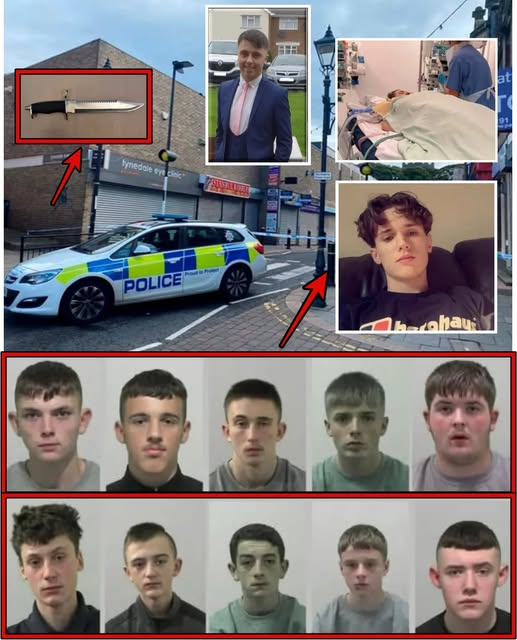
Eighteen‑year‑old Jack Woodley was walking home from the Houghton Feast funfair in Houghton‑le‑Spring, Sunderland on 16 October 2021 when his life was brutally taken in a shocking act of violence.
Jack was attacked by a group of ten teenagers, aged between 14 and 18, who surrounded him, chased him down an alley, and savagely beat him before he was stabbed with a long “Rambo‑style” knife.
Witnesses later described the mob “surrounding and isolating” Jack as though attacking prey, with one of the youths shouting “get the chopper out” — referring to the knife — in footage played at trial.
Despite being unarmed and not looking for trouble, Jack was repeatedly punched, kicked and stamped on before he was fatally stabbed during the violent encounter.
He died shortly afterwards in hospital from his injuries, cutting short a young life with a future ahead.
In June 2022, after a lengthy trial at Newcastle Crown Court, a jury convicted all ten teenagers of murder under joint enterprise — meaning each was deemed responsible for Jack’s death even if only one delivered the fatal wound.
The prosecution, led by Mark McKone QC, argued that the group had gone out on the night “looking for serious trouble” at the fair and were prepared to “create conflict,” attacking Jack as soon as they saw him.
In August 2022, Judge Rodney Jameson QC sentenced the group to a combined minimum of 124 years and six months in prison — life terms with minimum tariffs ranging from eight to 17 years each.
The teenager who inflicted the fatal stab wound was given the longest minimum term — 17 years before eligibility for release — after pleading guilty to manslaughter, though a jury found him guilty of murder.
The other nine defendants received minimum terms from eight to 15 years, with the youngest — who was just 14 at the time of the offence — sentenced to at least eight years behind bars.
Judge Jameson made it clear that if and when the youths are released, they would remain on licence for the rest of their lives — a measure to help protect the public and acknowledge the severity of their actions.
In sentencing, the judge stressed that no punishment can restore Jack to his family or ease the pain they have endured, highlighting that he had “much to look forward to” — including a new job and plans fully in motion when he was attacked.
He described the group’s conduct as “solely for the excitement and pleasure of inflicting serious injury on an entirely innocent and randomly selected stranger.”
The force of the attack was described as “short‑lived but appalling,” and the judge noted that every member of the group played a part in causing Jack’s death — either by encouraging violence or joining the assault.
During the trial, the court was told the attack began shortly after Jack left the funfair, when the group first engaged him, putting him in a headlock and initiating the violence before the situation quickly escalated.
Even though only one boy wielded the weapon, the rest were convicted together — a legal application of the joint enterprise doctrine that has often drawn controversy but was upheld in this case.
In 2023, nine of the convicted teenagers lost their appeals against their convictions. Judges in the Court of Appeal agreed that the trial had been fair and that the evidence supported the verdicts, dismissing claims that the judge had misdirected the jury.
As part of the appeal ruling, many of the teenagers were named publicly for the first time, as they had reached adulthood and the legal restrictions on publication expired.
The brutal killing of Jack Woodley has since become a reference point in discussions about youth violence, knife crime, joint enterprise law and the devastating impact of random attacks on everyday citizens.
Experts on youth crime have noted that such mob attacks are “very unusual” in the UK, particularly involving such young attackers and a weapon like a large knife, though concerns over rising youth violence persist.
Jack’s death sent shockwaves through his local community and beyond, with loved ones remembering him not only for the tragedy of his death, but for the life he was building and the plans he had made for his future.
The Woodley family’s experience also highlighted the emotional toll such violence takes on victims’ families — from being prevented at first from holding Jack’s hand in hospital because his body was evidence, to their ongoing grief and calls for others to think twice about carrying weapons.
As the legal process continues to unfold, with sentences in place and appeals dismissed, the case remains a stark reminder of the consequences of knife crime and youth violence in the UK.