For ten years, the man in Room 701 had not moved.
Machines breathed for him. Screens blinked. Specialists flew in from three continents and left shaking their heads. The name on the door still carried weight—Leonard Whitmore, billionaire industrialist, once ranked among the most powerful men in the country.
But power meant nothing in a coma.
They called it a “persistent vegetative state.” No response to voices. No reaction to pain. No sign that the man who had built empires still existed behind closed eyes. His fortune kept the hospital wing running. His body kept lying still.
After a decade, even hope had grown tired.
The doctors were preparing the final paperwork. Not to end his life—but to move him. Long-term facility. No more aggressive care. No more “what ifs.”
That was the morning Malik wandered into Room 701.
Malik was eleven. Thin. Barefoot more often than not. His mother cleaned floors at the hospital at night, and Malik waited for her after school because there was nowhere else to go. He knew which vending machines ate money. He knew which nurses smiled. He knew which rooms were off-limits.
Room 701 was supposed to be off-limits.
But Malik had seen the man through the glass so many times. Tubes. Stillness. Silence. To Malik, it didn’t look like sleep.
It looked like being trapped.
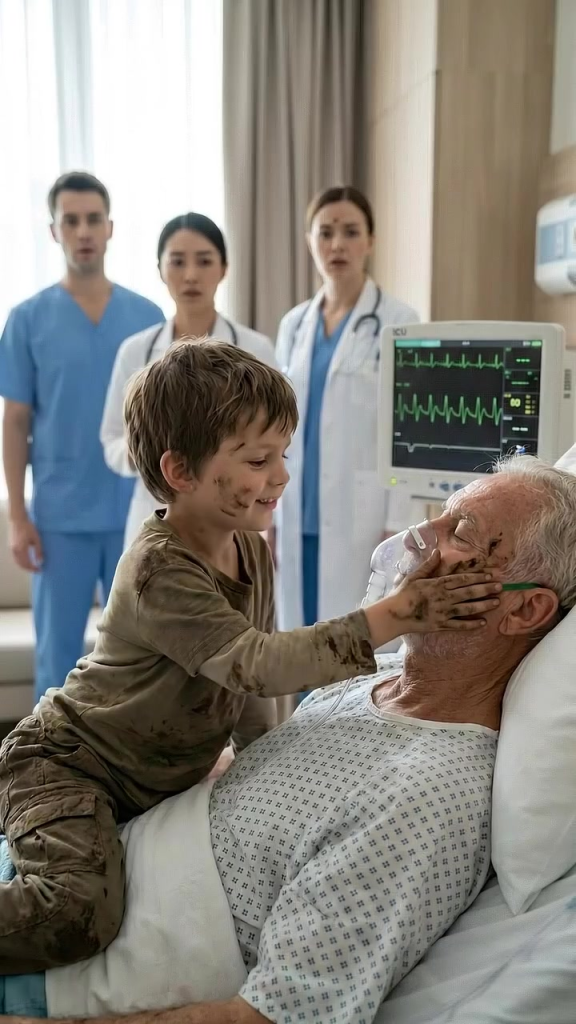
That afternoon, after a storm flooded half the neighborhood, Malik came in soaked. Mud covered his hands, his knees, his face. Security was distracted. The door to 701 was unlocked.
He stepped inside.
The billionaire lay there unchanged—skin pale, lips dry, eyes closed like they’d been sealed shut by time itself.
Malik stood quietly for a long moment.
“My grandma was like this,” he whispered, though no one had asked. “Everyone said she was gone. But she could hear me. I know she could.”
He climbed onto the chair beside the bed.
“People talk like you ain’t here,” Malik said softly. “That’s gotta be lonely.”
Then he did something no doctor, no specialist, no family member had ever done.
He reached into his pocket.
Pulled out wet mud—dark, earthy, still smelling like rain.
And gently, carefully, Malik smeared the mud across the billionaire’s face.
Across his cheeks. His forehead. Down the bridge of his nose.
“Don’t be mad,” Malik murmured. “My grandma said the earth remembers us. Even when people don’t.”
A nurse walked in and froze.
“HEY—WHAT ARE YOU DOING?!”
Malik jumped back, terrified. Security rushed in. Voices shouted. The boy cried, apologizing over and over as they dragged him out, mud-streaked hands shaking.
The doctors were furious.
Sanitization protocols violated. Contamination risk. Lawsuits waiting to happen.
They began cleaning Leonard Whitmore’s face immediately.
That’s when the heart monitor changed.
A sharp, unmistakable spike.
“Wait,” one doctor said. “Did you see that?”
Another beep. Then another.
Leonard’s fingers twitched.
The room went silent.
They ran scans. Brain activity—new, localized, sudden. Not random. Responsive.
Within hours, Leonard Whitmore showed signs no machine had recorded in ten years.
Reflexive movement. Pupil response. A faint but measurable reaction to sound.

Three days later, Leonard opened his eyes.
When asked later what he remembered, his voice cracked.
“I smelled rain,” he said. “Dirt. My father’s hands. The farm where I grew up… before I became someone else.”
The hospital tried to find Malik.
At first, no one could.
Then Leonard insisted.
When they finally brought the boy to his room, Malik wouldn’t look up.
“I’m sorry,” he whispered. “I didn’t mean to make trouble.”
Leonard reached for his hand.
“You reminded me I was still human,” the billionaire said. “Everyone else treated me like a body. You treated me like I belonged to the world.”
Leonard paid off Malik’s mother’s debts. Funded his education. Built a community center in their neighborhood.
But when asked what saved him, Leonard never said “medicine.”
He said:
“A child who believed I was still there… and the courage to touch the earth when everyone else was afraid.”
And Malik?
He still believes the ground remembers us.
Even when the world forgets.