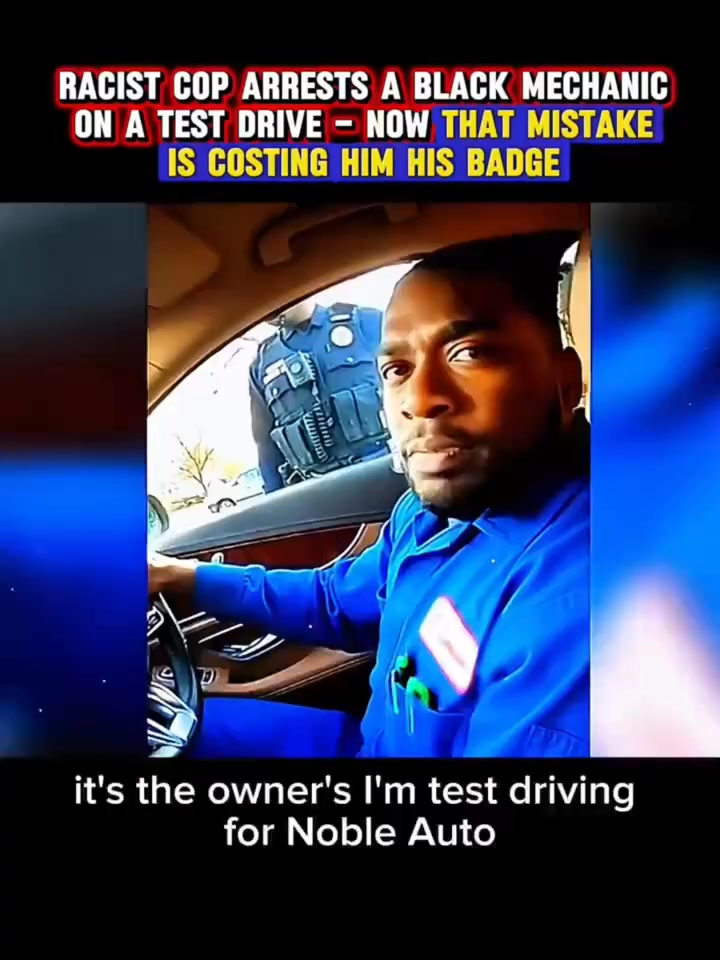
What should have been an ordinary test drive quickly turned into a moment that would change multiple lives — and potentially end a police officer’s career.
The video begins in a way that feels familiar to many drivers. A Black mechanic is behind the wheel of a vehicle he is test-driving, doing what mechanics do every day to ensure a car is safe and functioning properly. There is nothing reckless, dramatic, or unusual about the situation.
Then the police lights come on.
An Assumption Made Too Quickly
From the moment the officer approaches the vehicle, the tone of the interaction feels off. The officer appears skeptical, questioning the driver aggressively despite calm explanations. The mechanic explains that he is test-driving the car as part of his job — a routine practice in auto repair.
Instead of listening or verifying the explanation, the officer seems to dismiss it.
Viewers watching the video immediately notice the imbalance. The mechanic remains calm, respectful, and cooperative. He answers questions clearly and repeatedly explains why he is driving the vehicle.
The officer, however, appears to have already made up his mind.
From Questioning to Escalation
As the interaction continues, the officer’s behavior becomes increasingly confrontational. Rather than checking paperwork or contacting the shop to confirm the test drive, the situation escalates.
What began as questioning turns into detainment.
The mechanic is ordered out of the vehicle. His explanations are ignored. Despite no visible threat or resistance, the officer proceeds with an arrest.
For many viewers, this is the moment where the video shifts from uncomfortable to disturbing.
Why the Arrest Sparked Outrage
The mechanic does not flee.
He does not argue aggressively.
He does not resist.
He simply continues to explain the same thing he has said from the start: he is doing his job.
Yet the arrest moves forward.
Online viewers quickly pointed out how easily the situation could have been resolved with basic verification. A phone call. A check of credentials. A few extra minutes of listening.
Instead, force and authority take precedence over understanding.
The Racial Element Viewers Couldn’t Ignore
As the video spread, many viewers began pointing out a troubling pattern they recognized all too well. The mechanic’s calm explanations were treated as excuses rather than information. His professionalism was met with suspicion rather than trust.
The perception among viewers was clear: had the driver looked different, the situation might have ended very differently.
That perception is what pushed the video into viral territory.
Comment sections filled with people sharing similar experiences — moments where their explanations were dismissed and assumptions were made before facts were checked.
When Body Cameras Become Evidence
What ultimately changed the outcome of this incident wasn’t an argument or confrontation — it was documentation.
The officer’s own body camera captured the entire encounter: the explanations, the tone, the escalation, and the arrest. Everything was preserved exactly as it happened.
Once the footage was reviewed, the narrative began to collapse.
What had been framed as suspicious behavior began to look like a failure to listen. What had been justified as enforcement began to look like bias.
From Authority to Accountability
As attention grew, the incident was reviewed internally. The video raised serious questions about judgment, procedure, and whether bias influenced the officer’s actions.
The same authority that allowed the officer to arrest the mechanic now placed him under scrutiny. Decisions that once felt unquestioned were suddenly being examined closely.
Reports surfaced that disciplinary action followed — with the officer’s badge and career on the line.
A Mistake With Real Consequences
For the mechanic, the incident was humiliating and disruptive. He was arrested while doing his job, treated like a criminal, and forced to prove something that should have been easy to verify.
For the officer, the consequences were even more severe.
What could have been resolved in minutes became a defining moment — one that may permanently alter his career in law enforcement.
Why This Video Matters
This story resonated because it highlights something many people fear: being judged before being heard.
It’s not just about a test drive or an arrest. It’s about how quickly assumptions can override facts, and how power can escalate situations that never needed to escalate at all.
The video became a reminder that professionalism isn’t just about enforcing the law — it’s about listening, verifying, and treating people fairly.
The Bigger Lesson
This incident wasn’t inevitable.
A simple verification could have ended the stop.
A willingness to listen could have prevented the arrest.
A moment of restraint could have saved a career.
Instead, one decision after another turned a routine encounter into a viral example of what happens when bias and authority collide.
Final Thoughts
The mechanic went for a test drive to do his job.
The officer went on duty to do his.
Only one of them walked away with their career intact.
This video serves as a powerful reminder: assumptions are dangerous, and when they guide authority, the consequences can be permanent.