Chapter 1
Four years, two months, and eleven days.
That’s how long it had been since the rain washed away the only clues we ever had.
I sat in my cruiser, the engine idling, the heater struggling to fight off the Oregon chill.
Next to me, Buster whined.
He’s a German Shepherd, twelve years old now. His muzzle is gray, his hips are bad, and his eyes have seen things that would break a human man.
Technically, he’s retired.
Just like I should be.
But Buster knew why we were here.
He knew why we were parked across the street from the nicest house in Blackwood Creek.
The Sheriff’s house.
Silas Thorne.
The man who gave me my first badge. The man who sat in the front row at my wedding. The man who held me while I cried after my wife, Elena, packed her bags and left because I couldn’t stop looking for a ghost.
“It’s time, boy,” I whispered.
Buster’s ears perked up. He didn’t bark. He just let out a low, vibrating growl that rattled in his chest.
I checked my reflection in the rearview mirror.
I looked like hell.
Bloodshot eyes, three days of stubble, and a stain on my collar that I prayed was coffee.
People in town said Jack Sullivan lost his mind when Lily Miller vanished.
They said I needed to let it go.
They said seven-year-old girls don’t just disappear into thin air.
But they do.
I grabbed the leash.
“Let’s go pay the boss a visit.”
We stepped out into the drizzle. The air smelled of wet pine and woodsmoke.
It was a Sunday.
Silas was doing what he always did on Sundays.
He was sitting on his porch, in that white rocking chair, reading the paper.
He looked like the picture of American stability. A grandfather to the whole town.
He saw me coming up the walk.
He didn’t smile.
He folded his paper slowly, deliberately.
“Jack,” he said. His voice was deep, gravelly. “I thought I told you to take the weekend off.”
“I did,” I said. “I went fishing.”
“You don’t fish, Jack.”
“No,” I admitted. “I don’t.”
I stopped at the bottom of the porch stairs.
Buster was tense on the leash. His nose was working overtime, twitching, sniffing the air.
Usually, Buster loves Silas. Silas keeps dog treats in his pocket.
But today, Buster didn’t wag his tail.
He stood rigid. The hair on his back—his hackles—stood straight up.
“What do you want, son?” Silas asked. He took a sip of his coffee. “You’re scaring the neighbors.”
“I found something, Silas.”
“We’ve been over the files a thousand times, Jack. There’s nothing left.”
“Not in the files,” I said. “In the logbooks. The mileage logs from the night she went missing.”
Silas froze.
Just for a split second.
If you didn’t know him, you would have missed it. But I knew him.
“You said you were at the station all night,” I said, my voice shaking. “But your cruiser put on forty miles between 2:00 AM and 4:00 AM.”
“A glitch,” Silas said smoothly. “Faulty odometer. We fixed that years ago.”
“I checked the maintenance records, Silas. It was never fixed because it was never broken.”
Buster let out a sharp bark.
It wasn’t a warning bark.
It was the alert.
The specific, high-pitched yelp he used when he found a scent he was trained to find.
My heart hammered against my ribs.
“Jack, take the dog and go home,” Silas said. His tone changed. It wasn’t fatherly anymore. It was a command.
Buster lunged.
He didn’t lunge at Silas.
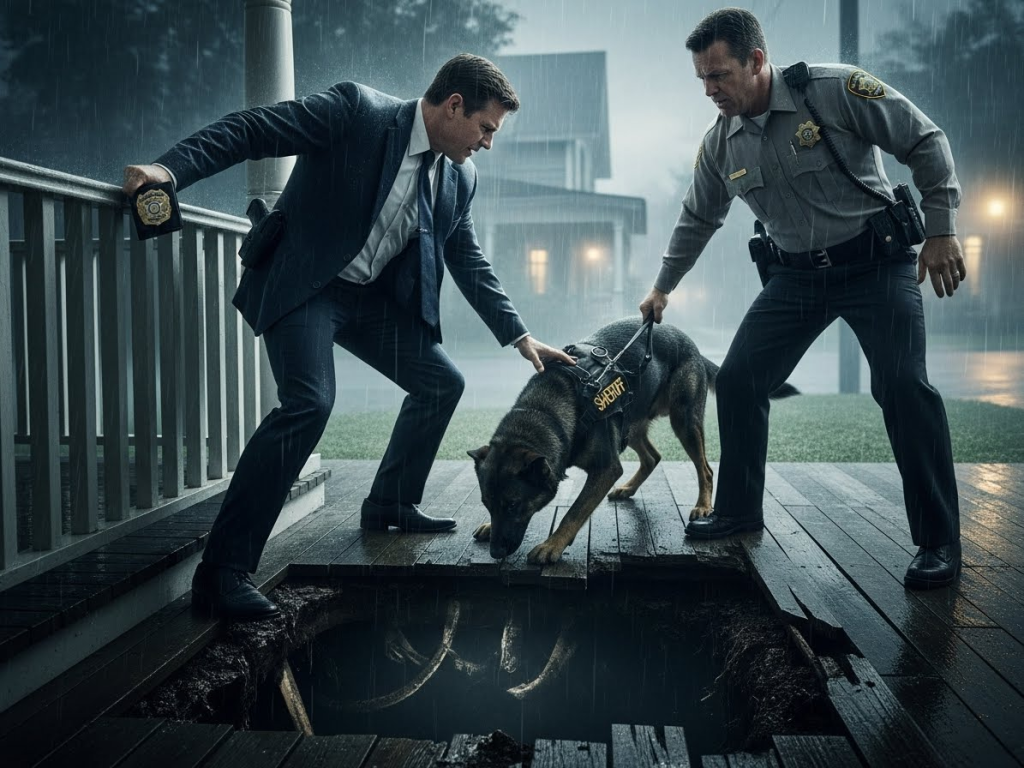
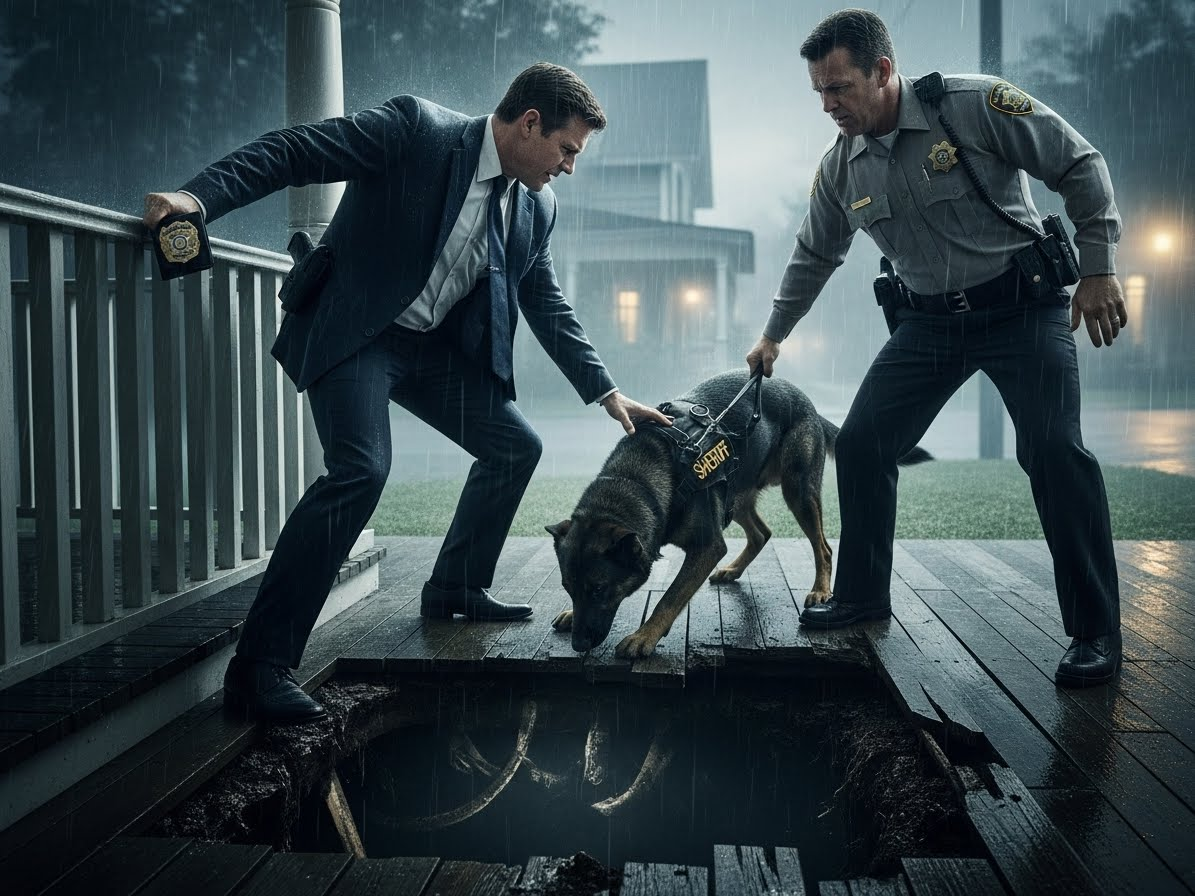
He lunged at the lattice work under the porch.
The wood was old, painted white, covering the crawlspace.
Buster was clawing at the dirt, snapping at the wood, trying to get under there.
“Control your animal!” Silas stood up. He put his hand on his belt.
He wasn’t in uniform, but he was wearing his sidearm. He always did.
“What’s under there, Silas?” I asked.
“It’s a skunk, Jack! Or a raccoon! Get him out of here before I shoot him!”
“He doesn’t alert on raccoons,” I said softly.
Buster was going frantic now. He was digging. Mud was flying backward, splattering my boots.
He was crying.
A mournful, desperate sound that cut through the sound of the rain.
I looked at Silas.
His face had gone pale. The coffee cup in his hand was trembling.
“She’s here, isn’t she?” I whispered.
“You’re insane,” Silas spat. “You’re a drunk and you’re insane. I’m giving you a direct order, Detective. Stand down.”
I looked at the leash in my hand.
I looked at the badge clipped to my belt.
That badge meant everything to me. It was my identity. It was the only thing holding me together.
If I crossed this line, there was no going back.
If I was wrong, I was going to prison.
But Buster… Buster never lied.
I unclipped the badge from my belt.
It felt heavy in my hand. Gold and cold.
“I’m giving you an order!” Silas shouted. He drew his gun. “Back away!”
I walked up the stairs.
Silas aimed the gun at my chest.
I didn’t stop.
I reached the table where his coffee sat.
I raised my hand and slammed the badge down onto the glass table top.
SMASH.
The glass shattered. The coffee cup went flying.
“I don’t work for you anymore,” I said.
Then I turned to the dog.
“SEARCH, BUSTER! SEARCH!”
I dropped the leash.
Buster hit the lattice with the force of a freight train. The wood splintered and cracked.
He disappeared into the darkness under the porch.
Silas lunged for me, but I tackled him.
We hit the wet floorboards hard. He was strong for an old man, but I was running on four years of rage.
I pinned him down.
“Don’t move!” I screamed.
And then, everything went silent.
The wrestling stopped. The rain seemed to pause.
From under the porch, the digging had stopped.
“Buster?” I called out.
There was a whimper.
Then, a sound that stopped my heart.
It wasn’t a bark.
It was the sound of a dog howling in mourning.
I looked down at Silas.
He wasn’t fighting anymore. He was just closing his eyes, a single tear leaking out.
“I tried to save her,” he whispered.
Chapter 2
“Save her?” I snarled, grabbing Silas by the collar of his flannel shirt and slamming him back down against the wet wood. “By burying her under your porch? Is that how you save people, Sheriff?”
Silas didn’t answer. He just closed his eyes, his face a mask of defeat.
My heart was hammering against my ribs like a trapped bird. The adrenaline was starting to curdle into nausea. I reached around to the back of my belt for my cuffs, only to realize I’d left them in the car.
I grabbed Silas’s arm, twisting it behind his back.
“Don’t make me break it, Silas. Give me your other hand.”
He complied, lifelessly. I used his own handcuffs, pulling them from the pouch on his belt, and ratcheted them tight around his wrists. I dragged him over to the sturdy oak railing of the porch and looped the chain through the banister, securing him.
He was the Sheriff of Blackwood Creek, a man who had won the Medal of Valor twice. Now he was slumped like a wet rag doll, cuffed to his own house while his neighbors watched from across the street.
I saw them now—Mrs. Higgins with her umbrella, hand over her mouth. The mailman stopped in his truck. They were frozen, witnessing the collapse of their world.
“Jack,” Silas rasped. “Don’t open it.”
I ignored him. I scrambled off the porch, my boots sliding in the mud.
“Buster?” I called out.
I dropped to my knees in the flowerbed. The lattice was shattered where Buster had broken through. It was dark under there, smelling of damp earth, mold, and something else.
Something metallic.
I clicked on the flashlight from my belt and crawled in.
The crawlspace was tight. Spiderwebs brushed against my face. Buster was lying on his stomach about ten feet in, his nose pressed against the dirt. He was whining softly, his tail thumping a slow, sad rhythm against a wooden beam.
“What is it, boy? What did you find?”
I crawled up beside him.
He wasn’t digging at a body.
He was digging at a handle.
It was a heavy, iron ring set into a square of marine-grade plywood, painted black to blend in with the dirt. A trapdoor.
“No way,” I whispered.
This house was built in the 1920s. A lot of them had root cellars or coal chutes, but this looked newer. The hinges were oiled.
I holstered my flashlight and grabbed the iron ring. It was cold.
“Back up, Buster. Back.”
Buster scooted backward, reluctant to leave.
I pulled. The door was heavy, counter-weighted. It swung open silently, revealing a set of wooden steps descending into absolute darkness.
A wave of air rushed up to meet me.
It didn’t smell like death.
It smelled like lavender.
Cheap, synthetic lavender. The kind used in air fresheners. And… peanut butter?
I drew my off-duty weapon—a snub-nosed .38 I kept in an ankle holster—and clicked the flashlight back on.
“Police!” I shouted down the hole. “Coming down!”
Silence.
I descended slowly. The stairs creaked. Four steps, five, six.
My boots hit concrete.
I swept the light around the room.
I expected a dungeon. I expected chains. I expected a shallow grave.
What I found froze the blood in my veins.
It was a bedroom.
A small, ten-by-ten concrete box. But someone had tried to make it… nice.
There was a twin mattress on a pallet in the corner, made up with a bright pink comforter. There was a small bookshelf crammed with paperbacks—Harry Potter, Percy Jackson. There was a battery-operated lantern on a small plastic table.
And the walls.
The concrete walls were covered in drawings. Hundreds of them. Crayon, marker, pencil. Drawings of the sun. Drawings of trees. Drawings of a dog that looked exactly like Buster.
I stepped forward, my breath hitching.
On the little table, there was a plate. On the plate was a half-eaten sandwich. The bread wasn’t moldy. The crust was still soft.
I touched the lantern. It was warm.
“She’s not dead,” I whispered. The realization made my knees weak. “She was just here.”
I spun around, looking for anything else. In the corner, a pile of clothes. A pair of sneakers. Size 3.
Lily Miller was seven when she vanished. She would be eleven now.
I picked up a shirt. It was a size 10-12.
“She grew up here,” I said to the empty room. “He raised her down here.”
Why? Why would Silas Thorne, a man with no children, a man who led the search parties, keep a little girl in a bunker under his porch for four years?
And where was she now?
I scrambled back up the stairs, tearing out of the hole, banging my head on the floor joists but not feeling the pain. I burst out from under the porch, covered in mud and cobwebs.
The rain was coming down harder now, a deluge.
I ran up the porch stairs to Silas.
He looked up at me. His eyes were red.
“Where is she?” I screamed, grabbing him by the shirt. “The sandwich is fresh, Silas! Where is she?”
Silas looked at me with a terrifying mixture of pity and fear.
“I told you I was saving her, Jack.”
“From who? You’re the monster! You kidnapped a child!”
“I didn’t kidnap her,” Silas said, his voice dropping to a harsh whisper. “I intercepted her.”
“What the hell does that mean?”
“It means,” Silas said, leaning his head back against the railing, “that her father sold her, Jack. He sold her to people you can’t touch. People who own this town. I took her to keep her off the market.”
My brain stalled. Lily’s father was the town pastor. A man who cried on TV every anniversary.
“You’re lying,” I said.
“Am I?” Silas nodded toward the street.
I turned around.
Three black SUVs were pulling up to the curb, boxing in my cruiser. They weren’t police vehicles. They had tinted windows and government plates, but not the local kind.
Men in dark raincoats were stepping out. They didn’t look like cops. They moved with the synchronized precision of a hit squad.
“I kept her safe for four years,” Silas said softly. “But you just led them right to us.”
A laser dot, bright red and trembling, appeared on Silas’s chest.
“Get down!” I yelled.
I dove for Silas, trying to shield him, but I was too slow.
THWIP.
A single, suppressed shot.
Silas jerked violently against the handcuffs. His eyes went wide. The red dot vanished.
He slumped forward, a dark stain spreading on his chest.
“Run,” he gurgled, blood bubbling past his lips. “Find… the… cabin.”
“Silas!” I pressed my hands to the wound, but the blood was pouring out between my fingers.
“Run, Jack,” he whispered, his eyes losing focus. “Save… her.”
The men in the raincoats were walking up the driveway. They weren’t running. They didn’t have to.
I looked at the dying Sheriff. I looked at the SUVs. I looked at Buster, who was barking ferociously at the approaching men.
I had no badge. I had no backup. And I had just gotten the only man who knew the truth killed.
I grabbed the key to the cuffs from Silas’s belt, unlocked him, and let his body slide to the floor. I grabbed his gun.
“Come on, Buster,” I said, my voice breaking.
We weren’t retired anymore. We were fugitives.
Chapter 3
The sound of a suppressed gunshot is deceptive. It doesn’t boom; it snaps, like a dry branch breaking under a heavy boot. But the damage it does is loud.
Silas was gone. The man who had been the closest thing to a father I had left was dead on his own porch, his blood mixing with the rainwater, swirling into the grain of the wood.
Another snap. A chunk of the railing exploded inches from my hip.
“Move, Buster!” I roared.
I didn’t think. Instinct took over—the muscle memory of twenty years on the force, buried under four years of whiskey and grief. I scrambled backward, boots slipping on the slick deck, and threw myself over the side of the porch, landing hard in the mud next to the shattered lattice.
Buster was right beside me, low to the ground, his ears pinned back. He wasn’t barking anymore. He was in survival mode.
Bullets chewed up the floorboards above us. The men in the raincoats were advancing. I could hear their boots crunching on the gravel driveway. They weren’t rushing; they were sweeping the area. Professional. Clinical.
I looked at the hole under the porch. The bunker.
“Down!” I shoved Buster toward the opening.
We crawled back into the darkness, into the smell of damp earth and lavender. My heart was hammering so hard I thought it would crack a rib. I clicked on my flashlight, shielding the beam with my hand.
The room was exactly as I had left it moments ago. The pink comforter, the half-eaten sandwich. But now, with the knowledge of what was happening outside, the room felt different. It wasn’t a prison cell; it was a sanctuary. Silas had built this to keep her alive.
Run. Save her.
“Where did you go, Lily?” I whispered, sweeping the light frantically around the concrete box.
If she had been here when Buster started digging, and she wasn’t here when I came down, there had to be another way out. Silas Thorne was a paranoid man; he wouldn’t build a box with only one door.
I scanned the walls. The drawings covered almost every inch. Suns, flowers, dogs. And there, behind the bookshelf—a draft. The flame of the lantern flickered.
I shoved the bookshelf aside. It scrapped loudly against the concrete.
Behind it was a narrow, corrugated metal pipe, about three feet in diameter. A storm drain retrofit. It disappeared into the darkness, angling upward.
“Go, Buster! Track!”
Buster sniffed the entrance and looked back at me, whining. He smelled her.
I squeezed into the pipe. It was tight, claustrophobic, and smelled of rust and wet leaves. I crawled on my elbows, dragging myself forward, the jagged metal biting into my knees. Above me, I heard the heavy thud of boots entering the bunker.
“Clear,” a muffled voice said. “He’s in the tunnel. Flush him.”
I scrambled faster.
Fifty feet. A hundred feet. The air grew colder.
The pipe opened up into a concrete culvert. We tumbled out into a drainage ditch, knee-deep in freezing runoff water, about two hundred yards behind the Sheriff’s house.
We were in the woods now. The treeline was thick with Douglas firs, their branches heavy with rain.
I pulled myself up the muddy bank, gasping for air. I peered through the brush.
The house was swarming. The black SUVs had pulled onto the lawn. Men were carrying Silas’s body off the porch, wrapping it in a tarp like it was trash.
Rage, hot and blinding, flared in my chest. I wanted to go back. I wanted to use Silas’s Glock and empty the magazine into them.
Buster nudged my hand with his wet nose. He let out a soft woof.
I looked down.
In the mud of the ditch bank, fresh tracks. Small sneaker prints. Size 3.
They were erratic, slipping and sliding, heading deep into the forest.
“She’s alive,” I breathed. “Good boy. Good boy.”
She was out here. Alone. In a storm. Running from men who wanted to sell her to the highest bidder.
I checked the gun I had taken from Silas. Twelve rounds in the magazine, one in the chamber. That was it. No radio. No badge. My car was blocked in.
“We have to move,” I told the dog.
We started to run.
The Oregon woods are unforgiving in November. The underbrush tore at my clothes. The rain turned the ground into a slurry of mud and pine needles. But the tracks were easy to follow. She was panicking. She was running blind.
We covered a mile, then two. The sounds of the suburbs faded, replaced by the roar of the wind in the treetops.
I knew these woods. I used to hunt here before… before everything.
Find the cabin.
Silas didn’t have a cabin. I knew his assets. I had investigated him myself when I was looking for Lily.
Wait.
Not a cabin. A shack.
There was an old Forest Service lookout tower up on Blackwood Ridge. It had been condemned in the nineties. Silas used to take me up there when I was a rookie to drink beer and watch the thunderstorms roll in. He called it “The Crow’s Nest.”
It was five miles uphill.
The tracks were heading straight for it.
My lungs burned. My bad knee, the one I blew out kicking down a door three years ago, was screaming. But I couldn’t stop.
Suddenly, Buster stopped. He froze, lifting a paw.
I dropped to a crouch, hand on the gun.
Silence. Just the rain.
Then, a twig snapped. Not from in front of us. From behind us.
They were tracking us. Of course they were. They had high-tech gear, thermal scopes, numbers. I was a washed-up drunk with a dog.
“Go,” I whispered to Buster. “Quiet.”
We moved off the game trail, pushing into the dense ferns. I pressed my back against a massive cedar tree, trying to slow my breathing.
Two figures emerged from the mist. They were wearing tactical gear, night-vision goggles flipped up. They moved with discipline, scanning the ground.
“Tracks split here,” one of them said. His voice was distorted by a radio earpiece. “The girl went high. The dog and the man went left.”
“Split up?” the other asked.
“No. The target is the girl. The man is just a loose end. We secure the asset first. Leave the drunk for the cleanup crew.”
They started to move up the hill. Toward Lily.
They weren’t looking for me anymore. They were going to kill me later. Right now, they were going to get her.
I stepped out from behind the cedar tree.
“Hey!” I shouted.
The two men spun around, raising their rifles.
I didn’t hesitate. I fired.
Pop-pop.
I hit the lead man in the leg. He went down screaming. The second man opened fire, the muzzle flash bright in the gloom.
Bark exploded next to my head. I dove into the ferns, rolling.
“Get him!” the injured man yelled.
I had their attention now. I was the distraction.
“Run, Buster! Go find her! GO!” I pointed up the ridge.
Buster looked at me, torn. He wanted to protect me.
“GO!” I screamed.
Buster turned and bolted up the hill, a gray streak vanishing into the fog.
I lay in the mud, clutching the gun, listening to the heavy boots coming toward me.
“Come and get me, you sons of bitches,” I whispered.
Chapter 4
The forest exploded with gunfire.
I scrambled on my belly through the mud, bullets shredding the ferns inches above my head. I wasn’t the hunter anymore; I was the prey. I needed to draw them away from the ridge, away from Lily.
I rolled into a ravine, sliding ten feet down a slope of loose shale and wet leaves, landing hard in a creek bed. The icy water soaked through my coat instantly.
“He went into the wash!” a voice yelled from above.
I scrambled up the opposite bank, gasping for air. My shoulder burned—a graze, or maybe a splinter of rock. I didn’t check.
I ran perpendicular to the ridge, making as much noise as possible. I crashed through bushes, snapped branches. Follow me. Look at me.
I led them on a chase for twenty minutes, looping back toward the old logging road. My heart felt like it was going to burst. I was forty-five years old, a smoker, and hadn’t run a mile in three years. My body was failing.
I broke through the tree line onto the gravel road.
Headlights blinded me.
A black truck was idling there. Not one of the tactical SUVs. An older Ford pickup.
A man was standing by the tailgate, smoking a cigarette, holding a hunting rifle. He wasn’t one of the Cleaners. He was local.
It was Pastor Miller.
Lily’s father.
I froze, hand tightening on my gun. The Cleaners were behind me in the woods. The Pastor was in front of me.
“Jack?” Miller squinted through the rain. He looked terrified. His priestly collar was loose, his eyes wide and bloodshot.
“You son of a bitch,” I rasped, walking toward him.
“Jack, stop. They told me to wait here. They said they found her.”
“They?” I raised the gun, aiming it right at his head. “The men who just murdered Silas Thorne? The men you sold your daughter to?”
Miller dropped his cigarette. He fell to his knees in the mud. He didn’t raise his rifle. He just started to weep.
“I didn’t have a choice,” he sobbed. “I was in debt. Gambling. They said… they said they would take her anyway. They said if I gave her to them, she would be treated well. A ‘special school,’ they called it.”
“She was in a hole!” I screamed, the fury making my vision tunnel. “She was living under a porch for four years because the man you hired to catch her couldn’t bring himself to hand her over to monsters like you!”
“I didn’t know!” Miller wailed. “I thought she was gone! Silas told me she ran away!”
“Silas saved her from you.”
Behind me, in the woods, the shouting grew louder. The Cleaners were closing in.
“Give me the keys,” I said.
“Jack, they’ll kill me.”
“If you don’t give me the keys, I will kill you.”
Miller fumbled in his pocket and tossed the keys. They landed in the mud.
“Get out of here,” I said. “Run. If I see you again, Miller, I swear to God…”
I didn’t finish. I scooped up the keys and jumped into the truck.
I peeled out, tires spinning on the wet gravel, just as the tactical team burst out of the tree line. Bullets sparked off the tailgate, shattering the rear window. glass sprayed over the back of my neck.
I floored it.
I wasn’t driving away from the danger. I was driving up.
The logging road wound up the side of Blackwood Ridge. The truck fishtailed on the switchbacks. I pushed the engine to the redline.
Hold on, Buster. Hold on, Lily.
The road ended at a rusted metal gate. I rammed it. The truck smashed through, metal screeching, and I skidded to a halt in a clearing.
There it was. The Crow’s Nest.
A towering wooden structure on stilts, swaying slightly in the storm winds.
I bailed out of the truck, Silas’s gun in my hand.
“Buster!”
I heard a bark. High up.
I sprinted to the base of the tower. The wooden stairs were rotten, slick with moss. I took them two at a time.
“Lily! It’s Jack! Silas sent me!”
I reached the trapdoor at the top and shoved it open.
I pulled myself onto the platform.
The wind was howling up here, rattling the glass windows of the small observation room.
Buster was sitting in the middle of the room. He was calm.
And curled up next to him, shivering violently, clutching a rusty tire iron, was a girl.
She looked wild. Her hair was matted, her clothes were stained with mud. But her eyes… they were the same eyes from the missing posters I had stared at for four years.
She raised the tire iron, terrified.
“Stay back!” she screamed. Her voice was raspy, unused.
“Lily, it’s okay,” I said, holstering the gun and raising my hands. “I’m not with them. Look at the dog. Look at Buster.”
She looked at Buster. The dog rested his head on her knee. She lowered the iron slightly.
“Silas?” she asked. A single word, filled with so much hope it broke me.
“Silas… Silas told me to come get you,” I lied. I couldn’t tell her he was dead. Not yet. “He said you drew pictures of Buster. Is that right?”
She nodded slowly. She reached into her pocket and pulled out a crumpled piece of paper. A crayon drawing of a German Shepherd.
“He said Buster would find me.”
“He did,” I said, stepping closer. “And now Buster and I are going to get you out of here.”
She looked past me, out the window, down at the winding road below.
“The bad men are coming,” she whispered.
I looked down.
Far below, a convoy of headlights was winding up the mountain. Three SUVs. And behind them, a larger vehicle. A tactical SWAT van.
They weren’t just cleaners anymore. This was a siege.
I looked at the girl. I looked at my dog. I had one gun, thirteen bullets, and we were trapped in a wooden box on top of a mountain.
“Let them come,” I said, grabbing a heavy wooden chair and jamming it under the trapdoor handle.
I moved to the radio set on the wall—an old Forest Service emergency band radio. It was covered in dust.
“Do you know how to use this?” I asked Lily.
“Silas taught me,” she said. “He said only for emergencies.”
I clicked it on. Static.
“This is Detective Jack Sullivan,” I said into the mic, my voice steady. “I am at the Blackwood Ridge Fire Tower. I have Lily Miller. I repeat, I have the missing girl.”
I released the button.
“Now,” I said, turning to the window as the first SUV crested the ridge. “Let’s see who’s listening.”
Chapter 5
The radio crackled with static, then silence. I didn’t know if anyone had heard me. I didn’t know if the old channels were even monitored anymore.
Below us, the world was ending.
The tactical team had abandoned stealth. Floodlights from the SUVs cut through the rain, blinding us. They illuminated the rickety wooden legs of the fire tower like a stage.
“Give us the girl, Sullivan!” a voice boomed from a loudspeaker. “And you can walk away.”
I looked at Lily. She was huddled in the corner, her arms wrapped around Buster’s neck. She was trembling, but she wasn’t crying. She was a survivor. She had lived in a concrete box for four years; she was tougher than any of us.
“Don’t listen to them,” I told her. “Cover your ears.”
I crawled to the window.
“Come and get her!” I screamed back.
They opened fire.
Glass exploded inward. I threw myself over Lily and the dog, shielding them with my body as bullets shredded the wooden walls of the cabin. The sound was deafening—a continuous roar of automatic weapons fire.
“Stay down!”
The shooting stopped as abruptly as it began.
“That was the warning,” the voice boomed. “Next round goes through the floor.”
I checked my gun. Six bullets left.
“They’re coming up the stairs,” I whispered.
I could hear the heavy boots clanging on the wet wood. The tower swayed and groaned under the weight of the assault team.
I dragged the heavy iron woodstove toward the trapdoor, reinforcing the barricade. It wasn’t enough. They had breaching charges. They had rams.
“Lily,” I said, grabbing her shoulders. “Listen to me. When they come in, I’m going to fight them. You take Buster and you go out the window. There’s a maintenance ladder on the roof. You climb.”
“No,” she shook her head, clutching my sleeve. “I’m not leaving you.”
“You have to.”
BOOM.
The trapdoor buckled. Dust and splinters rained down.
BOOM.
The chair I had wedged under the handle shattered. The woodstove scraped across the floor.
I leveled the gun at the door.
“Ready, Buster?”
Buster bared his teeth. A low, demonic growl rumbled from his throat. He wasn’t an old dog anymore. He was a weapon.
The door flew open.
A flashbang grenade rolled into the room.
“Eyes close!” I yelled, turning away.
BANG.
A blinding white light, a ringing in my ears that felt like a needle.
Two men in black armor surged through the opening.
I fired blindly. One, two, three shots.
One man went down, clutching his neck. The other raised a rifle.
Buster launched.
He hit the man in the chest, jaws clamping onto the ballistic vest, knocking him backward down the open trapdoor. They tumbled down the stairs together in a tangle of limbs and fur.
“Buster!” I screamed.
I scrambled to the hole. The man was gone. Buster was at the bottom of the first landing, shaking his head, getting back up.
But three more men were coming up.
I raised my gun. Click.
Empty.
I was out of ammo. I was out of time.
The lead operator reached the top of the stairs, leveling his rifle at my forehead. Behind his visor, I could see cold, dead eyes.
“Game over, Detective.”
I stepped back, putting myself between the gun and Lily.
“You touch her,” I snarled, “and I’ll kill you with my bare hands.”
“Unlikely.” He tightened his finger on the trigger.
Suddenly, a sound cut through the storm.
It wasn’t a siren.
It was a horn. A deep, air-shaking blast that vibrated the floorboards.
Then another. And another.
The operator hesitated, glancing toward the window.
The mountain road below, which had been dark moments ago, was suddenly ablaze with light.
Not blue and red police lights.
Yellow lights. LED bars. High beams.
A massive logging truck smashed through the gate at the bottom of the clearing, pushing one of the black SUVs out of the way like a toy car. Behind it came a convoy of pickup trucks, tow trucks, and jeeps.
The radio on the wall, which I thought was dead, suddenly burst to life.
“…This is ‘Big Mike’ with the heavy hauler… we heard the distress call on Channel 9… We got your six, Detective. We got about fifty boys from the lumber yard coming up right now.”
“…This is Miller,” another voice cracked—the Pastor. “I told everyone. The whole town is coming.”
The operator looked at the window, then back at me. Panic flickered in his posture.
Down below, chaos erupted. The locals weren’t asking questions. Men with hunting rifles, tire irons, and chainsaws were pouring out of the trucks, swarming the tactical team. The “Cleaners” were mercenaries, used to fighting in shadows, not facing an angry mob of American blue-collar workers protecting a child.
“Looks like you’re outnumbered,” I said, a grim smile touching my lips.
The operator cursed, lowered his weapon, and keyed his radio. “Abort! Abort!”
He turned to run, but I didn’t let him.
I swung the empty pistol, cracking it against his helmet. He crumbled.
I fell to my knees, gasping for air.
Buster limped back up the stairs, panting, blood on his muzzle—not his own. He licked my face.
I pulled Lily into a hug. She was crying now, burying her face in my coat.
“Look,” I pointed out the window. “Look at the lights, Lily. They came for you. They all came for you.”
Chapter 6
The dawn broke cold and clear, the storm finally passing to reveal a bruised purple sky.
The mountain was crowded. State Police had finally arrived, taking custody of the mercenaries and the corrupt officials who had hired them. The “Cleaners” turned out to be a private security firm hired by a trafficking ring that had deep roots in the state capital.
But the police weren’t the ones who saved us. It was the loggers, the mechanics, the teachers who had driven up that mountain.
I sat on the bumper of an ambulance, a blanket wrapped around my shoulders. A paramedic was stitching up the cut on my forehead.
Buster sat at my feet, chewing happily on a piece of beef jerky a state trooper had given him. He was the hero of the hour. Every cop, every logger, every person who walked by wanted to pat his head.
Across the clearing, I saw her.
Lily was sitting in the back of an ambulance, wrapped in a thermal blanket. She looked small, fragile, but safe.
She wasn’t looking at the chaos. She was looking at me.
I stood up, ignoring the paramedic’s protest, and walked over to her.
“Hey, kiddo,” I said softly.
“Is he really gone?” she asked.
She meant Silas.
I nodded, feeling the lump in my throat swell. “Yeah. He is.”
“He was bad,” she said, her voice trembling. “But… he brought me books. He made me sandwiches. He said he was sorry every single day.”
“He was a complicated man, Lily. He did a terrible thing by keeping you down there. But in the end… he gave his life to make sure you got out.”
She reached into her pocket and pulled out the crayon drawing of the dog. It was crumpled and wet.
“He told me the dog would save me,” she whispered. “He was right.”
I looked down at Buster. He looked up, his tail thumping once against the gravel.
“Yeah,” I said. “Buster never lies.”
THREE MONTHS LATER
The cemetery in Blackwood Creek is quiet in the winter. The snow muffles the sound of the highway.
I stood in front of a fresh headstone.
SILAS THORNE. SHERIFF. BROKEN, BUT REDEEMED.
I didn’t choose the epitaph. The town council did. There was a lot of debate about whether to bury him with honors. In the end, they decided to bury him as a man.
I wasn’t wearing a uniform. I never put the badge back on. The department offered me my job back—with a promotion—but I turned it down. I couldn’t carry a gun anymore. My hands shook too much.
Instead, I opened a small dog training school just outside of town. It’s quiet work. Honest work.
“Come on, boy,” I said.
Buster was sniffing at the flowers on the grave. He looked good. We got his hips treated, and he’s put on weight.
I reached into my pocket and pulled out the gold shield. My old detective’s badge. The one I had slammed onto Silas’s table.
I placed it gently on top of the headstone.
“I don’t need this anymore,” I whispered to the cold stone. “I found what I was looking for.”
I turned to leave.
At the gate of the cemetery, a car was waiting.
A woman stepped out. Elena. My ex-wife.
She looked good. Healthy.
“I heard you were here,” she said, her breath misting in the cold air.
“Just visiting,” I said.
“How are you, Jack?”
“I’m sober,” I said. “Ninety days today.”
She smiled. A real smile. She looked down at the dog.
“Hi, Buster.”
Buster wagged his tail, trotting over to nuzzle her hand.
“Lily is doing well,” Elena said. “I saw her aunt at the store. She’s back in school. She’s… healing.”
“That’s good,” I said. “That’s real good.”
“And what about you, Jack? Are you healing?”
I looked at the gray sky, then down at the dog who had stayed by my side when the rest of the world walked away.
I clipped the leash onto Buster’s collar. Not because he needed it, but because I liked the connection.
“I’m getting there,” I said.
I opened the passenger door of my truck. Buster hopped in, settling into his seat like he owned it.
I looked back at Elena one last time.
“Would you… maybe want to get coffee sometime?” she asked.
I smiled. It felt rusty, but it was there.
“I’d like that,” I said. “But right now, I promised a very good boy a steak.”
I climbed into the truck and started the engine.
As we drove away, leaving the graveyard behind, I looked in the rearview mirror. The badge was still there on the tombstone, glinting in the winter sun.
It belonged to the past.
I looked at Buster. He rested his chin on my shoulder and let out a contented sigh.
We were going home.
THE END.