CHAPTER 1 – THE DAY A COFFEE CUP BECAME A LINE IN THE SAND
By 9:00 a.m., the Mason Mug Café was exactly what Grace Donnelly loved it to be—full, but not loud. The kind of full where people breathed easier because they didn’t have to pretend.
Sunlight slid through the front windows and painted soft rectangles across the worn wooden floor. Veterans gathered at their usual tables. The mayor sat at the counter “by accident” every first Wednesday of the month, just when Heroes Hour happened to be starting.
Grace moved behind the counter like she’d been born there. At thirty-five, she wasn’t flashy, but she had the kind of presence that made people talk softer and sit longer. She knew every name, most of the birthdays, and all the deployment dates. On the wall above the register hung a photo of her late husband, Staff Sergeant Michael Donnelly—jeans, flannel shirt, a mug in his hand, the café door behind him. Two weeks after that photo, he’d deployed to Helmand Province and never come home.
The bell over the door chimed.
Ray McMillan stepped in, shoulders squared by habit, eyes shadowed by years. Late-50s, ex–Marine Corps Recon. At his heel, as always, was Shadow—a black lab–shepherd mix wearing a red vest:
SERVICE DOG – DO NOT PET.
Grace lifted a mug in greeting. “Window table’s open, Ray. Shadow looks ready for his shift.”
A corner of his mouth twitched. “He takes your coffee seriously.”
He guided Shadow to the far corner. The dog curled under the table, eyes tracking the room, one ear always tipped toward his handler.
Grace was just setting out the special ceramic mugs she saved for Heroes Hour when the air changed.
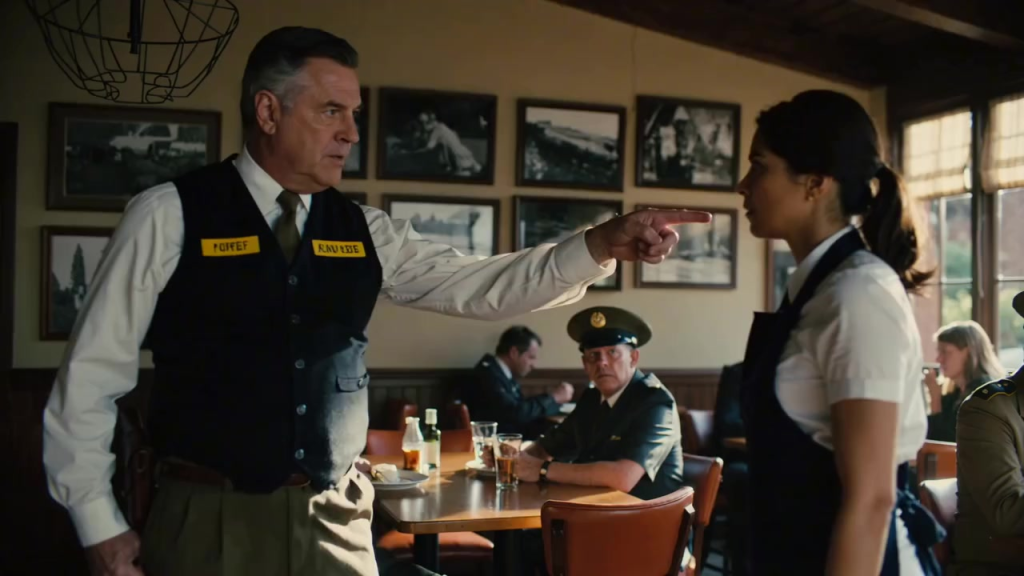
The door swung open with a brisk whoosh. A man in a navy blazer and pressed slacks strode in, clutching a clipboard like it was a weapon. His name tag read: LOGAN PRESCOTT – STATE HEALTH INSPECTOR.
Behind him, almost perfectly timed, came a woman in heels that didn’t belong on Main Street: Deborah Lyall, Regional Manager for the parent company that owned the Mason Mug.
Grace’s smile thinned, but she kept it. “Good morning. Can I help you?”
“Unannounced inspection,” Prescott said flatly, flashing an ID. “Continue as usual. Pretend I’m not here.”
He stalked through the café, lifting lids, peering into fridges, checking expiration dates like he was hunting crime. Grace followed at a distance, heart beating just a little faster, but not from fear—she ran a clean shop and she knew it.
Then Prescott stopped.
Grace didn’t have to look to know why. His gaze had locked onto Shadow.
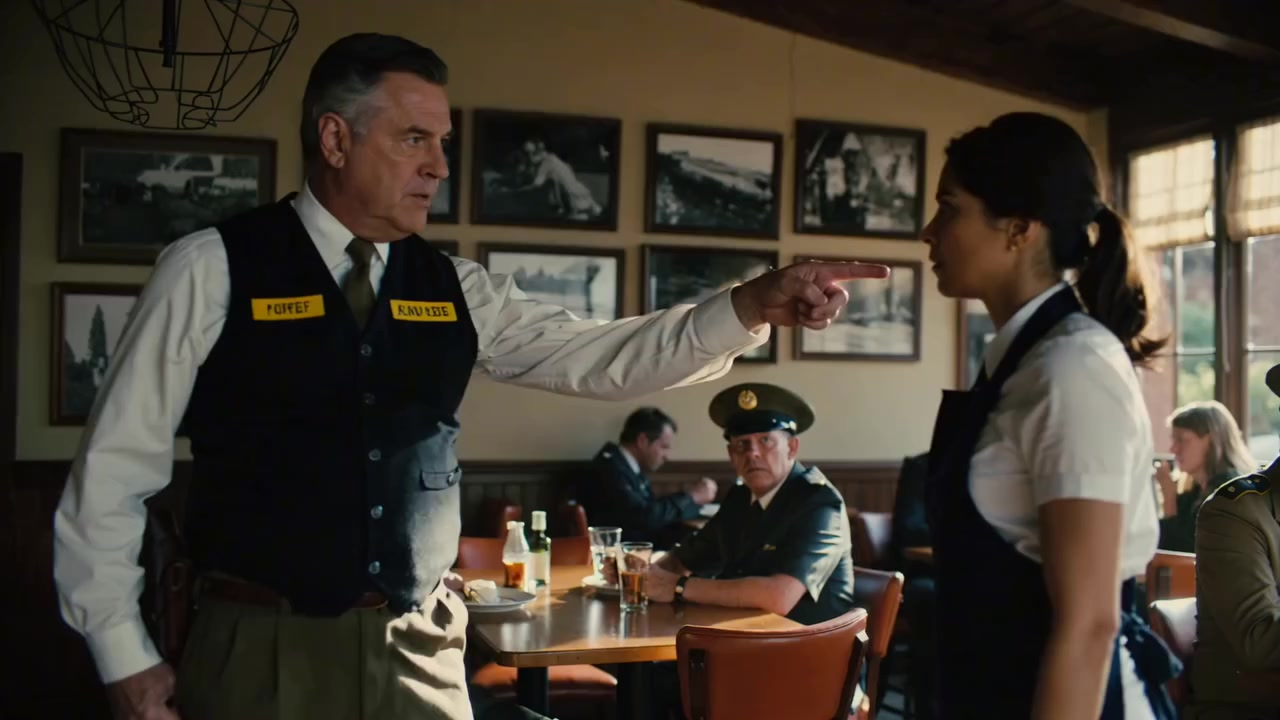
“That animal,” he said, voice suddenly loud, “is in violation of state health code. No animals where food is served.”
The café’s hum died at once. Forks hovered. Chairs creaked softly.
Grace stepped out from behind the counter, wiping her hands on her apron. “He’s a registered service dog, sir. Federal law allows him here.”
“I don’t care what vest he’s wearing.” Prescott jabbed the clipboard in Shadow’s direction. “Dander. Saliva. Hair. This is a food hazard. The dog goes, or I start writing you up.”
Ray’s hand tightened around his mug. Shadow didn’t move, but his eyes flicked between his handler and the stranger, waiting.
Grace could feel everyone watching her now—the veterans, the teenagers, the mayor, the kid restocking sugar packets by the door. She thought of Michael, thought of folded flags and unfinished goodbyes.
She inhaled once, slowly.
“I won’t ask a veteran to leave,” she said, voice calm but iron hard. “And I won’t ask his service dog to leave either. You’re welcome to write your report—but you’ll do it knowing you tried to humiliate a man who served this country, in front of the very people he served.”
Someone at the back muttered, “Damn right.”
Prescott flushed. Before he could answer, another voice cut through the tension—cold, clipped.
“Grace Donnelly.”
Deborah stood by the counter, arms crossed, eyes like glass. “You have just refused to comply with a health directive in front of a state inspector. Pack your things. You’re terminated. Effective immediately.”
A spoon clattered to the floor. No one moved.
Grace looked from Deborah to Ray, to Shadow lying perfectly still, to the chalkboard that read:
HEROES HOUR TODAY – FREE COFFEE FOR VETS.
She untied her apron. Her hands shook, but her voice didn’t as she laid it on the counter.
“Elena,” she murmured to the young barista by the espresso machine, “make sure Ray gets his refill.”
Then she walked out into the bright Georgia morning, the bell jingling once behind her.
What she didn’t see—what she couldn’t see—was the teenager near the door, phone held low, still recording. And somewhere between the café and her truck, that video began to race across town and beyond.
By the time the morning rush should have been peaking, the ground itself would start to tremble.
And Mason, Georgia, would never look at that little café the same way again.
CHAPTER 2 – WHEN THE UNIFORMS ARRIVED
For thirty-five minutes after Grace left, the Mason Mug felt wrong.
People whispered. Some slipped out, coffee unfinished. Others stayed, staring into their cups like the answer might be floating in the steam. Lena—Elena to everyone else, but “Lena” to Grace—kept working the machine with shaking hands.
“I didn’t know what to say,” she would later tell a friend. “I just knew if I walked away from that counter, I’d be letting Grace down twice.”
Ray hadn’t touched his refill. Shadow lay curled at his feet, ears twitching at every sudden noise, sensing the crack in the air.
Then the low rumble started.
At first, it was just a vibration in the floorboards. Sugar packets rattled in their tray. A spoon tinked softly against a mug. A kid near the window pressed his face to the glass.
From the east end of Main Street, four military Humvees emerged from the morning haze, moving in a slow, deliberate convoy. Their tires growled against the pavement. Headlights cut clean beams through the soft light.
They turned into the café’s lot and fanned out in a line, blocking the front.
Conversation died completely.
The café’s bell chimed once as the door opened.
In stepped Colonel Richard Gaines, Marine Corps, full dress blues. Ribbons lined his chest. White gloves were tucked under one arm. Behind him, visible through the glass, two dozen Marines stood at attention on the sidewalk.
The inspector, Prescott, lowered his clipboard like a shield that had just failed him. Deborah went a shade paler.
Colonel Gaines’ gaze swept the room in one practiced pass. It landed on Ray first.
The older Marine pushed slowly to his feet. Shadow followed, sitting precisely at heel.
The colonel gave him a crisp, silent nod—a salute without the hand.
Then he turned to Lena. “Is Grace Donnelly here?”
“N-no, sir,” Lena stammered. “She was fired. For standing up for Mr. McMillan and Shadow.”
A muscle jumped in the colonel’s jaw.
“That woman,” he said, voice low but carrying, “has served the families of Fort Granger better than most agencies with million-dollar budgets. She gave my men a place to breathe when they came home with no words left.”
Prescott swallowed audibly. “I—I didn’t know who she was.”
“You don’t have to know who someone is,” the colonel replied, eyes locking on him, “to treat them with basic dignity.”
Ray cleared his throat. His voice was rough but steady.
“Sir… she never asked what was wrong with me. Didn’t stare at the dog. Didn’t flinch when I had to sit with my back to the wall. She just poured the coffee… and left the chair open.”
A woman near the register wiped her eyes.
The colonel nodded once. “That’s more than some leaders do in uniform.”
He stepped toward the door and lifted a hand—the smallest of signals.
The Marines outside moved as one. Two entered and walked behind the counter. Carefully, almost ceremonially, they unbolted the corporate logo from the wall, folded the vinyl like a flag, and carried it out. Another Marine stepped in and hung a new sign they’d brought, hand-painted in white letters on dark wood:
WELCOME TO GRACE’S HOUSE – WHERE HONOR IS SERVED DAILY.
Deborah finally found her voice. “You can’t just come in here and—”
“You made your decision,” Colonel Gaines said, turning just enough to look at her. “Now we’re making ours.”
He pulled out his phone.
At the counter, Lena’s own phone buzzed. She glanced down, confused.
Her eyes widened.
“It’s… it’s a message from Fort Granger Headquarters,” she said. “They’re requesting Grace report to base. Today.”
Ray exhaled slowly, like something inside his chest had finally shifted. Shadow stood, tail giving one deliberate thump against the floor.
One story at the café had just ended.
Another was about to begin.
CHAPTER 3 – A NEW KIND OF MISSION
Grace sat in her old pickup at the edge of her driveway, keys in hand, engine off.
She’d replayed the morning a dozen times. The inspector’s stare. Deborah’s voice. Ray’s face when she took off her apron. Six years of loyalty erased with one cold sentence—because she refused to betray something warmer.
Her phone buzzed again. Same message.
FORT GRANGER HQ REQUESTING YOUR PRESENCE – COL. GAINES.
She almost didn’t go.
But Michael’s watch was still on her wrist, ticking steadily, same as it had the day she’d watched his coffin come down the ramp. Grace closed her eyes, turned the key, and pointed the truck toward the base.
Fort Granger was its own small city—flags snapping in the wind, cadence calls echoing between long tan buildings. Grace had been here as a military wife once. This time, passing through the gate, hearing the guard say, “Ma’am, good to see you,” she felt like she was stepping into someone else’s story.
Colonel Gaines met her at the entrance to a low admin building, now in khaki utilities, not dress blues.
“Grace,” he said, offering his hand, “thank you for coming.”
“Didn’t feel much like I had a choice, sir,” she admitted, trying for levity and missing by half.
He smiled faintly. “You always have a choice. That’s why you’re here.”
He led her down a hallway lined with photos of ceremonies and deployments. They stopped at a door marked:
VETERAN TRANSITION & WELLNESS INITIATIVE.
Inside, it was… underwhelming. Folding chairs, unopened boxes, whiteboards still wrapped in plastic. A coffee pot sat on an empty table like it was waiting for permission.
“This was supposed to be our pilot program,” Gaines said. “A place where vets could come without needing an appointment or a diagnosis. We had funding. We had forms. What we didn’t have was someone who actually knew how to make a room feel safe.”
Grace folded her arms. “I’m not a therapist. I don’t have degrees or letters after my name.”
“No,” he agreed. “You have something better. We watched that café of yours for years, you know. Men who wouldn’t set foot in the VA would sit in your corner booth for hours. Wives of deployed Marines said your place was the only spot they didn’t feel like they had to be ‘okay’ all the time.”
He nodded toward her. “You built a sanctuary with a coffee pot and a notebook.”
Before she could argue, a young woman stepped out from a side room, sleeves to her wrists despite the Georgia heat. Burn scars curled along her jaw. A golden retriever pup trotted at her feet, vest labeled “IN TRAINING.”
“Is that her?” the woman asked, voice timid but clear.
“Tiffany Rios,” Gaines said, “Army medic. Grace, this is one of the vets we’ve been trying to reach.”
Tiffany swallowed, then met Grace’s eyes. “I saw the video,” she said. “You standing up for that guy and his dog. I… I haven’t been able to sit in a café since I came home. Too many exits. Too many eyes. But if you were running the place…” She shrugged awkwardly. “I think I could try.”
Something in Grace’s chest unclenched.
Gaines took a breath like he’d been waiting for that moment. “We’d like to offer you the position of director of this center. Not as a figurehead. As the person who decides how this place breathes.”
“You’re serious?” she whispered.
“As a heart attack,” he replied. “You already know our three pillars—community, routine, respect. The rest, we build around you.”
Grace thought of Heroes Hour. Of Ralph’s shaking hands, Ben’s drill-instructor bark softening over time, Louisa’s windchime laugh. She thought of Ray and Shadow, of every silent “thank you” ever poured into a ceramic mug.
She exhaled. “Okay,” she said. “I’ll do it.”
Gaines smiled for real this time. “Good. Director Donnelly—turn the lights on.”
She flicked the switch. Warm light flooded the scuffed floor.
Six months later, the walls were no longer bare. Photos of vets lined one side. A whiteboard near the coffee pot read:
WHO NEEDS A RIDE? WHO NEEDS A LISTENER?
Ray came three times a week. Shadow had a favorite spot by the far wall. Tiffany brought her sketches—dogs, hands, homecomings—and taped them up without fanfare. Nick, the angry young soldier, eventually laughed at one of Lena’s terrible jokes and nearly scared himself.
An auditor from D.C. came with a stiff suit and a checklist.
“What certifications do you hold to counsel veterans?” he asked.
“None,” Grace answered. “Just consistency and kindness.”
He stared at the full room—at men and women talking softly, at Shadow asleep, at the coffee pot that never seemed empty. His pen hovered, then dropped something different onto the form.
Two weeks later, Colonel Gaines handed her an envelope with a gold seal.
“You’ll want to sit for this,” he said.
She read the first line three times:
YOU ARE HEREBY NOMINATED FOR THE NATIONAL CIVILIAN COMMENDATION FOR DISTINGUISHED SERVICE TO VETERANS.
In Washington, under bright lights and a bigger stage than she’d ever imagined, Grace stood behind a podium. Ray waited at the back in full dress blues, Shadow at his heel.
“I didn’t set out to build a program,” she told the crowd. “I just refused to throw out a man and his dog.”
She paused. The room leaned closer.
“It was never about coffee. It was about dignity.”
The standing ovation felt unreal. Ray didn’t clap—he just nodded, the smallest, proudest approval.
That night, a gray-haired man pressed an old photo into her hand—Michael standing outside the café years ago with a young soldier she barely remembered.
“You poured me a cup on the day they discharged me,” he said. “You didn’t say a word. That… was the first time I felt like myself again.”
Back home in Mason, there was a banner downtown and speeches waiting.
Grace skipped them.
She drove instead to the wellness center. The halls were quiet, smelling faintly of coffee and floor wax. On the wall of photos, she pinned a new one—a snapshot from D.C., a crowd on its feet. Next to it, she taped the old picture of Michael and the discharged soldier.
Under both, on a small card, she wrote:
HONOR GROWS WHERE KINDNESS IS CONSISTENT.
As she turned to leave, a young vet with shaky hands stepped into the doorway, a service dog pressed to his leg.
“Ma’am,” he asked, “is this… a place for people like us?”
Grace smiled, the same small smile she used to give over a counter.
“No,” she said gently. “This is a place for people. All of us. Come on in.”
The dog’s tail thumped once.
Outside, somewhere in town, a little café bell jingled as someone opened a door.
Inside, Grace reached for the coffee pot.
The mission, she thought, didn’t end when Michael’s deployment did. It just… changed uniforms.