Chapter 1: The Diner at the Edge of Nowhere
The heat in Arizona doesn’t just make you sweat; it cooks you from the inside out. It sits on your chest like a wet wool blanket, making every breath a labor. I was sitting at a corner booth in “Earl’s Last Stop,” a dusty, forgotten roadside diner about forty miles outside of Phoenix, right off a stretch of highway that mostly sees truckers and tumbleweeds.

My cut—the heavy leather vest with my club patches—was draped over the back of the chair, the “colors” facing the room. I was just trying to enjoy a lukewarm coffee and a slice of cherry pie that had probably been sitting in the display case since the Reagan administration. The crust was stale, but the sugar hit was necessary.
I wasn’t looking for trouble. I rarely am these days. I’m too old for bar fights and too tired for drama. I just wanted to rest my legs before the final sixty-mile stretch of the ride to meet the rest of the chapter. The diner was mostly empty, just the rhythmic, dying hum of a failing AC unit and the buzzing of fat flies throwing themselves against the grease-stained windows.
That’s when the bell above the door chimed, a fragile, tinny sound in the heavy air.
She walked in first. A woman, maybe thirty, but looking fifty. Her face was etched with the kind of exhaustion that sleep can’t fix. Her clothes were clean but threadbare, worn thin by too many washes in gas station sinks and too much unforgiving sun. She had that look—the look of someone who is constantly apologizing just for existing, shrinking into herself to take up less space.
But it was the boy who caught my eye.
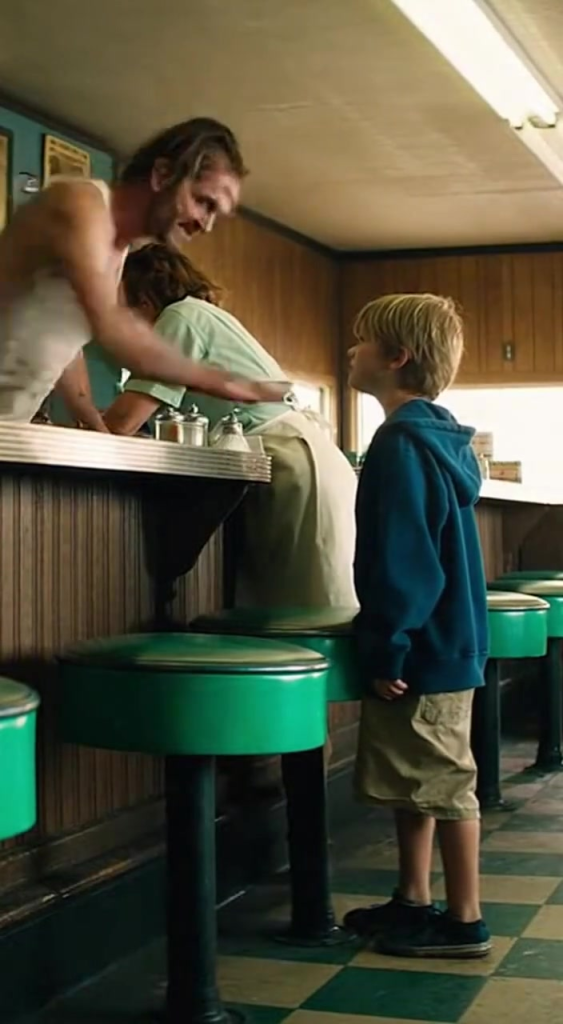
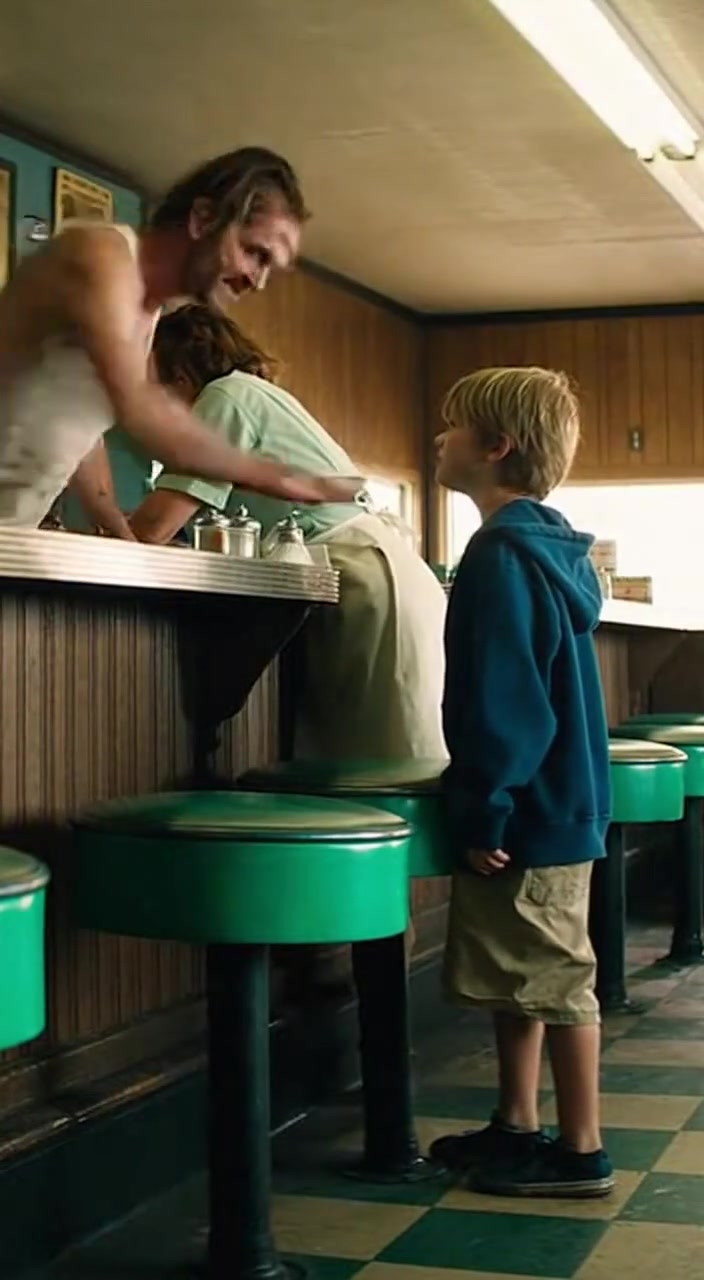
He couldn’t have been more than six years old. He was skinny, the kind of skinny that makes your gut twist, with knobby knees poking out of denim shorts that were two sizes too big and held up by a piece of rope. He had a mop of dirty blonde hair and eyes that were way too old for his face. He held his mother’s hand like it was the only anchor keeping him from floating away into the vast, empty desert sky.
They didn’t sit at a booth. They went straight to the counter. I watched the woman counting change on the Formica surface. Quarters, dimes, a handful of pennies. The sound of the coins clicking was the loudest thing in the room.
“Just a water and… maybe a grilled cheese to share?” she asked the waitress, her voice barely a whisper, cracking with dryness.
I watched the waitress, a kind older lady named Marge who had been serving me coffee for a decade, nod sympathetically. She didn’t count the money. She just swept it into the register. She knew. We all knew. They were homeless, drifting, running from something or running to nothing.
I was about to stand up, maybe “accidentally” drop a twenty-dollar bill on the floor near them so she wouldn’t feel like a charity case, when the door slammed open.
Chapter 2: The Predator
The atmosphere in the diner changed instantly. It went from heavy heat to sharp, jagged tension. The air felt charged, like the sky before a tornado touches down.
Three guys walked in. They weren’t bikers. They were local trash. Meth-heads or low-level dealers, the kind that infest these small desert towns like termites, eating away at the foundation until everything collapses. They were loud, twitchy, and looking for a target to validate their pathetic existence.
The leader was a guy I’d seen around before. Big in a bloated, steroid-pumped way, wearing a stained white tank top that showed off prison tattoos that looked like they’d been done with a guitar string and ballpoint pen ink. He had eyes like a shark—dead, black, and hungry.
They sat two booths down from me, kicking the furniture, making sure everyone knew they had arrived. But their eyes weren’t on the menu. They were on the woman at the counter.
“Well, look at what the cat dragged in,” the leader sneered, his voice grating like sandpaper on concrete. “Hey, sweetheart. You paying for that with money or something else?”
The woman froze. Her shoulders hiked up to her ears. She pulled the boy closer to her leg, shielding him with her body. She didn’t turn around. She just stared at the grilled cheese Marge had placed in front of them, as if wishing she could dissolve into the steam rising from the bread.
“I’m talking to you,” the guy barked, standing up. He kicked his chair back. It clattered against the linoleum, a harsh, violent sound.
I took a sip of my coffee. It tasted like battery acid now. I shifted in my seat, my hand brushing the leather of my cut. I felt the familiar weight of the club patch.
The thug walked over to the counter. He loomed over the woman, smelling of stale beer, unwashed body, and bad decisions. “You got a permit to be this ugly in my town?”
His friends laughed. It was a cruel, high-pitched sound that made my skin crawl.
The little boy turned. He didn’t cry. He didn’t hide behind his mother’s skirt. He stepped in front of her.
He stood barely waist-high to the thug. He looked up, his small hands balled into fists that wouldn’t have hurt a fly. He was shaking, not from fear, but from a rage that was too big for his tiny body.
“Leave my mom alone,” the boy said. His voice didn’t shake. It was clear as a bell.
The thug looked down, mocking surprise. He grinned, revealing yellow teeth. “Oh? We got a hero here? You gonna stop me, little man? You gonna hurt me?”
The thug reached out with a dirty hand and shoved the boy. Not hard enough to hurt him seriously, but hard enough to knock him off balance. The boy stumbled back, hitting the counter, but he stayed on his feet. He didn’t back down.
That was it. That was the line.
I set my coffee cup down. Hard. The ceramic clicked against the table, a sound loud enough to cut through the laughter.
The thug turned his head, seeing me for the first time. He saw the heavy boots. He saw the grey in my beard. Then he saw the patch on the vest hanging on my chair. The Death Head.
But he was too stupid, or too high, to care. Or maybe he just thought one old biker wasn’t a threat to three young toughs.
“You got a problem, old man?” he sneered at me, pumping his chest out.
I looked at the boy. The kid was staring right at me. He wasn’t looking at me like I was a monster, which is how most people look at us when we roll into town. He looked at me like I was a soldier. Like I was his last hope.
He whispered three words, his eyes locking onto mine.
“Protect her… please.”
I reached into my pocket. Not for a weapon. Not yet. But for my phone.
“Yeah,” I said, my voice low and calm, the voice of a man who has buried more friends than he has left. “I got a problem. But I think you’re gonna have a much bigger one in about five minutes.”
I hit the speed dial.
Chapter 3: The Stand
The thug, let’s call him “Snake” because he had that slithering vibe, laughed. It was a dry, hacking sound. “Ooh, he’s calling the cops. You hearing this, boys? The big bad biker is calling 911.”
His two cronies snickered, sliding out of their booth to flank him. They were scrawnier, twitchier, eyes darting around the room like feral rats.
I didn’t break eye contact with Snake. I put the phone to my ear. It rang once. Twice.
“Yeah, boss?” a voice answered on the other end. It was heavy, deep, and sounded like gravel tumbling down a mountain. It was Tiny, my Sergeant-at-Arms.
“I’m at Earl’s,” I said, my voice flat. “I got a situation.”
“What kind of situation?” Tiny asked. I could hear the background noise on his end—engines idling, laughter, the clack of pool balls. They were close. They were at the gas station just two miles up the road, waiting for me.
“Three locals. Harassing a mother and a kid. They put hands on the boy.”
The line went silent for a split second. In our world, there are rules. You don’t mess with kids. You don’t mess with women who aren’t in the game. It’s the code. Even outlaws have standards.
“We’re rolling,” Tiny said. The line went dead.
I slid the phone back into my pocket and stood up. I’m six-foot-four, and while I’ve got a few more grey hairs than I used to, I still carry 250 pounds of muscle and road-hardened grit. I picked up my cut and slipped it on. The leather creaked, a familiar, comforting sound.
Snake’s smirk faltered for a second, but his ego wouldn’t let him back down. “You think your boyfriend is gonna come save you?”
“I don’t need saving,” I said, stepping out from the booth. I walked slowly toward the counter, placing myself between the thugs and the family. “But you might.”
The boy looked up at me. Up close, I could see the grime on his face, the desperation in his eyes. He reached out and grabbed the edge of my jeans. “Are you a bad guy?” he asked, his voice trembling.
I looked down at him. “Sometimes, kid. But not today.”
I turned my attention back to Snake. “Walk away,” I commanded. “Get in your piece of crap car and drive until you run out of gas. Do it now, and you keep your teeth.”
Snake’s face turned red. He wasn’t used to being challenged. In this town, he was probably the apex predator. He pulled a knife from his belt. It was a cheap switchblade, the kind you buy at a flea market, but it was sharp enough to kill.
“I’m gonna gut you, old man,” he spat.
Marge, the waitress, gasped and reached for the phone behind the counter, probably to call the Sheriff. But the Sheriff was twenty minutes away.
“Put the sticker away,” I warned him, keeping my hands open, palms out. “You really don’t want to do this.”
“I do what I want!” Snake yelled, lunging forward.
Chapter 4: The Escalation
He was fast, I’ll give him that. But he telegraphed his move. He swung the knife in a wide arc, aiming for my stomach.
I stepped inside his guard. I didn’t try to box him. I grabbed his wrist with my left hand, twisting it violently outward. There was a sickening pop as the joint dislocated. Snake screamed, dropping the knife.
Before his friends could react, I drove my right fist into his solar plexus. The air rushed out of his lungs with a whoosh. He crumbled to his knees, gasping, clutching his chest.
The other two hesitated. They looked at their fallen leader, then at me.
“Get him!” Snake wheezed from the floor, his face purple.
The two skinny rats pulled weapons. One had a tire iron he must have had tucked in his pants; the other pulled a screwdriver.
I backed up, pushing the boy and his mother behind me. “Stay back,” I growled at them.
I was big, but I was outnumbered. And in a close-quarters fight with weapons, size doesn’t always win. A screwdriver in the kidney kills you just as dead as a bullet.
“We’re gonna mess you up,” the one with the tire iron yelled, swinging it to test the weight.
I scanned the room for a weapon. A ketchup bottle. A chair. Anything. I grabbed a heavy glass sugar dispenser from the counter.
“Come on then,” I taunted, trying to buy time. I needed two minutes. Just two minutes. “Let’s dance.”
They circled me. The mother was sobbing now, a low, terrified keen. The boy was silent, gripping my leg so hard I could feel his fingernails through the denim.
The guy with the screwdriver lunged. I swung the sugar dispenser, smashing it into his shoulder. He yelped but kept coming, slashing at my arm. I felt a sting as the metal tip grazed my forearm. Blood welled up, warm and sticky.
I kicked him back, sending him crashing into a display of potato chips.
But the tire iron guy saw his opening. He swung hard. I raised my arm to block, taking the blow on my forearm. Bone rattled. Pain shot up to my shoulder like a lightning bolt. I grunted, stumbling back.
“Got you now!” the guy yelled, raising the iron for a finishing blow to my head.
I braced myself, preparing to rush him, to take the hit and try to take him down with me.
And then, I heard it.
At first, it was a low rumble, like distant thunder. It vibrated through the floorboards of the diner. It rattled the spoons on the tables.
The guy with the tire iron paused, the weapon held high. “What the hell is that?”
The rumble grew louder. And louder. It wasn’t thunder. It was the synchronized roar of fifty V-twin engines. It was the sound of an avalanche made of steel and chrome.
The sound became a deafening roar that filled the entire world. It was the sound of judgment day approaching at eighty miles an hour.
I grinned, despite the pain in my arm. I looked at the thug, whose eyes were now wide with confusion and dawning horror.
“That,” I said, spitting a little blood on the floor, “is the cavalry.”
The front window of the diner was suddenly filled with headlights. Bike after bike after bike pulled into the gravel lot, kicking up a storm of dust that blotted out the sun. The engines cut, one by one, leaving a ringing silence that was heavier than the noise.
Then, the heavy boots hit the gravel.
Chapter 5: The Eclipse of Earl’s Diner
The silence that followed the cutting of the engines was more terrifying than the roar itself. It was a heavy, suffocating silence, the kind that exists in the split second between the flash of lightning and the crack of thunder. The dust from the parking lot swirled against the glass like a sandstorm, temporarily obscuring the figures outside, turning them into dark, looming ghosts.
Inside the diner, time seemed to warp. The guy with the tire iron—let’s call him Rat-Face—was still holding his weapon aloft, but his arm was trembling now. The adrenaline that had fueled his bravado was rapidly curdling into a cold, sickly dread. He looked at me, then at the window, then back at me. The malice in his eyes had been replaced by the desperate confusion of a prey animal realizing it has wandered into a wolf’s den.
Snake, the leader, was still on his knees, clutching his chest where I’d hit him. He wheezed, trying to pull air into his bruised lungs, his face a mask of pain and dawning realization. He craned his neck, looking toward the door, his eyes widening as the first shadow fell across the threshold.
The bell above the door chimed again. Ding.
It sounded absurdly cheerful, a stark contrast to the darkness that stepped inside.
Tiny ducked to get through the doorway. He had to. My Sergeant-at-Arms stands six-foot-eight and is built like a brick wall that learned how to punch. He was wearing his full colors, the leather vest stretched tight over a black hoodie despite the heat. His face, hidden behind a thick beard and a pair of dark sunglasses, was unreadable. But his presence was loud. He sucked the air out of the room just by standing there.
Behind him came Dutch, a wiry Vietnam vet with eyes that had seen too much; then Hammer, a former powerlifter with tattoos covering every inch of visible skin; then Reno, Jinx, and the rest. They poured in, a river of black leather, denim, and heavy boots. Five. Ten. Twenty.
They didn’t yell. They didn’t run. They just walked. A slow, rhythmic march of boots on linoleum. Thud. Thud. Thud.
They filled the diner. They lined the walls, blocked the windows, and clogged the aisles. The smell of the room changed instantly. The scent of stale grease and coffee was obliterated by the heavy, masculine odors of exhaust fumes, hot leather, road dust, and unwashed menace.
Tiny stopped three feet from me. He looked at the guy with the tire iron. He didn’t say a word. He just slowly took off his sunglasses, revealing eyes that were cold, flat, and devoid of mercy.
Rat-Face dropped the tire iron. It clattered to the floor with a metallic ring that echoed in the silence. He raised his hands, his palms sweating. “Look, man,” he stammered, his voice jumping an octave. “We… we were just leaving. No trouble here. Just a misunderstanding.”
Tiny tilted his head, looking at the tire iron on the floor, then at the cut on my arm where the screwdriver had grazed me. He saw the blood dripping onto the floor. A muscle in his jaw jumped.
“A misunderstanding,” Tiny repeated. His voice was a low rumble, like a subwoofer vibrating in your chest. “You got a tire iron raised at my VP. You got a blade on the floor. And I see a woman and a kid shaking in the corner.”
Tiny took a step forward. Rat-Face took a step back, bumping into a table and nearly knocking over a napkin dispenser.
“We didn’t know!” the third thug, the one I’d knocked into the chips, squealed from the floor. “We didn’t know he was with you guys! We thought he was just some old drifter!”
I stepped forward then, wincing slightly as the movement pulled at the cut on my arm. I looked at the boy. He was wide-eyed, staring at the sea of bikers. He looked terrified, but he hadn’t moved an inch from his mother. He was still standing guard.
“It doesn’t matter who I am,” I said, my voice cutting through the tension. “You don’t touch civilians. You don’t threaten women. And you sure as hell don’t put your hands on a child.”
Snake, who had managed to pull himself up to a sitting position, tried to regain some shred of his dignity. “This is our town,” he spat, though there was no power behind it. “You bikers… you’re just passing through. You can’t just come in here and—”
Tiny moved so fast it was a blur. One moment he was standing still; the next, he had Snake by the throat, lifting him off the ground with one hand like he was a ragdoll. Snake’s feet kicked uselessly in the air. His face turned from red to purple.
“Your town?” Tiny growled, bringing Snake’s face inches from his own. “Son, look around you. Right now, this diner is independent territory. And you are trespassing.”
The mother let out a small sob. The sound seemed to snap Tiny out of his red haze. He didn’t drop Snake; he threw him. He tossed him toward the booth where his friends were cowering. Snake crashed into the vinyl seat, gasping for air, clutching his throat.
“Nobody moves,” Tiny commanded, addressing the room. He turned to me, his expression softening just a fraction. “You good, brother?”
“I’ll live,” I said, grabbing a napkin to press against my arm. “Just a scratch.”
Tiny nodded, then turned his attention to the counter. The other bikers had formed a semi-circle around the thugs, crossing their arms, creating a wall of human intimidation. But Tiny walked past them. He walked straight to the boy.
The room held its breath. The mother looked like she was about to faint. She tightened her grip on the boy’s shoulder, pulling him back.
“No,” the boy whispered. He shook off his mother’s hand.
Tiny stopped in front of the kid. He looked massive, a giant from a fairy tale, but not the kind that eats children. He knelt down on one knee. The leather of his chaps creaked. Even on one knee, he was eye-level with the standing boy.
Tiny took off his leather glove, revealing a hand that was scarred and rough, the knuckles swollen from years of fighting. He held it out, not to shake, but just to show he wasn’t holding a weapon.
“You the one who stood up to them?” Tiny asked. His voice was quiet now, gentle in a way that didn’t match his appearance.
The boy nodded slowly. He swallowed hard. “Yes, sir.”
“You scared?” Tiny asked.
“Yes, sir,” the boy admitted.
Tiny smiled. It transformed his face. “Good. Only fools aren’t scared. A real man is scared, but he stands his ground anyway.”
Tiny reached into his vest pocket. For a second, the tension spiked again—was he reaching for a knife? A gun?
He pulled out a patch. It wasn’t a club patch. It was a small, embroidered American flag that he kept for luck. He pressed it into the boy’s small hand.
“You did good, kid. You held the line until reinforcements arrived. That makes you a soldier.”
The boy looked at the patch, then at Tiny, then at me. A small, tentative smile broke through the grime on his face.
But the moment was broken by the sound of sirens in the distance. The real police.
“Sheriff’s coming,” Dutch called out from the window.
Tiny stood up, the tenderness vanishing instantly. He looked at Snake and his crew. “We ain’t leaving yet. And neither are they.”
Chapter 6: The Tribunal
The Sheriff of this county was a man named Miller. He was a good man, mostly, but he was tired. He walked into the diner about five minutes later, followed by two deputies who looked like they were barely out of high school.
Miller took off his hat when he saw the room. He didn’t reach for his gun. He knew better. There were fifty of us and three of them. Besides, he knew the club. We passed through here twice a year. We spent money, we didn’t wreck the town, and we moved on. We had an understanding.
“Tiny,” Miller sighed, wiping sweat from his forehead. “VP. I leave my station for ten minutes to get a donut, and I come back to a dispatch call about a riot at Earl’s.”
“No riot, Sheriff,” I said, leaning against the counter. “Just a citizen’s arrest.”
Miller looked at Snake, who was currently curled up in the booth, nursing his throat and his ribs. Miller’s eyes narrowed. He knew Snake. Everyone knew Snake. He was the kind of headache that law enforcement dealt with every Friday night—drunk and disorderlies, domestic disturbances, petty thefts.
“Snake,” Miller said, shaking his head. “What did you do this time?”
“They jumped us!” Snake croaked, pointing a shaking finger at me. “That old biker started it! He broke my arm! Then his gang came in here and threatened to kill us!”
Miller looked at me. “That true?”
“He pushed a kid,” I said simply. “Then he pulled a knife on me. I disarmed him. His buddies pulled weapons. I defended myself.”
Miller looked at the mother. She was still trembling, but she stepped forward. “It… it’s true, Sheriff. That man,” she pointed at Snake, “he demanded… things from me. My son tried to stop him. He shoved my boy. This gentleman,” she gestured to me, “saved us.”
Miller nodded. He looked at Marge, the waitress. “Marge?”
“Every word, Sheriff,” Marge said, slapping a dishrag on the counter. “Snake and his boys came in looking for blood. The biker was just drinking his coffee until they went after the little one.”
Miller turned back to Snake. The look of exhaustion on the Sheriff’s face was replaced by disgust. “You pushed a kid, Snake? Really? You’re scraping the bottom of the barrel.”
“He’s lying!” Rat-Face yelled. “It was self-defense!”
Tiny stepped forward. “Sheriff, if we wanted to hurt them, they wouldn’t be breathing. We’re waiting for you to do your job. But if you don’t… we can handle it in-house.”
It was a bluff, mostly. We weren’t going to execute anyone in a diner in broad daylight. But Miller didn’t need to know that for sure. And Snake certainly didn’t know it. The threat hung in the air, heavy and real.
Miller sighed again. “Alright. Deputies, cuff ’em. Assault with a deadly weapon, creating a public disturbance… I’m sure we can find a few outstanding warrants if we dig deep enough.”
As the deputies dragged Snake and his crew out, Snake looked back at me. There was no defiance left in his eyes. Only fear. He knew that even if he got out on bail, he was marked. He had crossed a line that you don’t come back from.
Once the trash was taken out, the atmosphere in the diner shifted. The tension evaporated, replaced by the loud, chaotic energy of fifty bikers needing food.
“Marge!” Tiny yelled. “We’re gonna need about fifty burgers and all the coffee you got!”
The diner erupted into noise. Chairs scraped, laughter broke out, orders were shouted. It was like a family reunion, just with more leather and tattoos.
I stayed at the counter. The mother was still standing there, looking overwhelmed. She looked at the menu, then at her purse. I knew what she was thinking. She couldn’t afford a meal for herself, let alone join a feast.
She started to gather her things. “Come on, baby,” she whispered to the boy. “We should go.”
” hold on,” I said.
She flinched. “We don’t want to be a bother. Thank you for… for everything. Really.”
“You aren’t going anywhere,” I said gently. “You haven’t eaten.”
“I… I can’t pay,” she admitted, shame coloring her cheeks. “I have three dollars.”
I looked at Tiny. He was already watching. He didn’t say anything; he just nodded. He took off his hat—a battered baseball cap—and walked to the nearest table.
“Listen up!” Tiny bellowed. The room went silent instantly.
“We got a guest of honor today,” Tiny said, gesturing to the little boy. “Little man stood his ground against three tangos. He’s got the heart of a lion. But lions gotta eat. And lions gotta sleep somewhere safe.”
Tiny reached into his pocket and pulled out a wad of cash. He dropped a hundred-dollar bill into the hat.
He walked to the next table. Dutch dropped in a fifty. Hammer threw in a twenty.
He went from table to table. The sound of cash hitting the hat was soft, like leaves falling. These men—men who society crossed the street to avoid, men who looked like nightmares—were digging deep. Some of them didn’t have much. Some were living ride-to-ride. But they gave.
Because that’s the code. You protect the innocent. You help those who can’t help themselves. And you respect courage, no matter how small the package it comes in.
Tiny came back to the counter. The hat was overflowing. There had to be at least a thousand dollars in there. Maybe more.
He placed the hat in front of the boy.
“For the road,” Tiny said. “Get your mom a hotel room. Get a hot shower. Get a steak.”
The woman stared at the money. Her hands flew to her mouth. The tears that she had been holding back finally broke the dam. She didn’t make a sound, but her shoulders shook violently. She looked at me, her eyes wide with disbelief.
“Why?” she choked out. “Why would you do this?”
I looked at the boy. He was holding the patch Tiny had given him. He was looking at us not as saviors, but as friends.
“Because he asked,” I said softly. “He asked me to protect you. And I keep my word.”
The boy reached into the hat and pulled out a twenty. He held it out to Marge. “For the grilled cheese, please.”
Marge wiped a tear from her cheek with her apron. “Honey, the grilled cheese is on the house. You keep that.”
The boy looked at me. “Can I sit with you?”
I looked at my brothers. They were watching, grinning.
“Yeah, kid,” I said, sliding over on the stool. “You can sit with me.”
For the next hour, Earl’s Last Stop wasn’t a dusty diner in the middle of nowhere. It was a banquet hall. The boy sat on a stool, surrounded by giants, eating a burger that was bigger than his head. He listened to stories about the road, about the wind, about the freedom of two wheels.
He wasn’t a homeless kid anymore. He was a king.
But as the sun began to dip lower, casting long orange shadows across the desert, I knew the reality was still waiting outside. The money would help, but it wouldn’t fix everything. They needed more than a meal. They needed a way out.
I pulled my phone out again. I had one more call to make. Not to the club this time. But to my sister. She ran a shelter in Albuquerque, three hours east. It wasn’t just a bed; it was a program. Job placement, housing assistance, school for the kid.
“Hey,” I said when she picked up. “I’m sending you two. A mother and a boy. They’re special. Make room.”
I hung up and wrote the address on a napkin.
“You got a car?” I asked the woman.
“An old sedan,” she said. “It overheats, but it runs.”
“Tiny,” I called out. “Have Reno look at her radiator. Top off her fluids and fill her tank.”
“On it,” Tiny said.
As we walked out to the parking lot, the heat had broken. A cool breeze was coming off the mountains. The world felt a little lighter.
But just as I was about to mount my bike, the boy tugged on my sleeve again.
“Are you leaving?” he asked.
“Yeah, kid. We got miles to go.”
He looked down at his shoes. “Will I see you again?”
I knelt down one last time. “Road is a circle, kid. If you need us, just look for the thunder.”
I didn’t know then that the “thunder” would be needed sooner than I thought. Because as we watched their old sedan limp onto the highway, heading East toward safety, I saw a black truck pull out from a side road. It didn’t have headlights on. It lingered, watching them, then slowly pulled out to follow.
It was the same truck I had seen parked behind the diner earlier. The one with the tinted windows.
Snake wasn’t in it. But someone else was. Someone who had been watching the whole time.
I tapped my headset. “Tiny. Change of plans.”
“What’s up, VP?”
“We got a tail,” I said, revving my engine. “Looks like the boy’s trouble is bigger than three local meth-heads. We’re riding escort to Albuquerque.”
The engines roared to life, fifty steel beasts waking up at once.
The fight wasn’t over. It was just beginning.
Chapter 7: The Shadow on the Asphalt
The desert at night is a different beast entirely. In the day, it’s a flat, baking anvil of heat. But under the moon, it becomes a vast, blue-black ocean of shadows and silence, broken only by the ribbon of asphalt that stretches into infinity.
We were in formation. A modified “Diamond” formation, tight and disciplined. I took the point, the tip of the spear. Behind me, flanking the battered sedan, were Tiny and Dutch. Bringing up the rear, guarding the six, were Hammer and Reno. The rest of the pack, forty-five heavy sleds, filled the gaps, creating a rolling fortress of steel and noise around the mother and her boy.
We were doing sixty-five, a steady rumble that felt like a heartbeat. But my eyes weren’t on the road ahead; they were glued to my mirrors.
The black truck was there. It had been there for twenty miles. It wasn’t driving aggressively—not yet. It was hanging back, about four car lengths behind the rear guard, just hovering like a vulture waiting for the animal to die.
“Tiny,” I spoke into the comms system built into my helmet. “What’s he doing?”
“He’s pacing us, VP,” Tiny’s voice crackled in my ear. “Tinted windows. Can’t see the driver. But it’s a heavy-duty rig. Ram bumper. Lifted. That ain’t a soccer mom.”
My gut twisted. The mother, Sarah (I’d learned her name while Reno fixed her radiator), had told me she was running from “bad luck.” But bad luck doesn’t drive a sixty-thousand-dollar truck with government plates and a brush guard designed to push police cruisers off the road. She was running from power.
“Keep it tight,” I ordered. “Nobody breaks formation. If he makes a move, we swarm. Do not let him get near that sedan.”
As we crossed the county line, the road narrowed. The highway dipped into a canyon, the moonlight cut off by towering rock walls. It was the perfect kill zone.
And that’s when he made his move.
I saw the truck’s headlights flare—high beams that blinded the rear riders. The engine roared, a turbo-diesel whine that cut through the sound of our V-twins. The truck surged forward.
“Incoming!” Hammer yelled over the comms.
The truck didn’t try to pass. It tried to plow through. It was aiming for the gap between the rear guard and the sedan. The driver wanted to separate the herd. He wanted to isolate the mother.
“Box him out!” I shouted.
Hammer and Reno reacted instantly. They drifted into the center of the lane, putting their bikes—and their bodies—directly in the path of the speeding truck. It was a game of chicken that only a crazy person plays. A three-ton truck against an eight-hundred-pound motorcycle. Physics wasn’t on our side, but grit was.
The truck swerved violently to the left, trying to overtake on the shoulder.
“Dutch! Left flank!”
Dutch, the Vietnam vet, didn’t hesitate. He swung his bike wide, blocking the passing lane. The truck’s bumper came within inches of Dutch’s rear fender. I could see the sparks fly as the truck scraped the guardrail, refusing to slow down.
Inside the sedan, I could see Sarah screaming. The boy was in the back seat, looking out the window. He wasn’t screaming. He was watching us.
“He’s not stopping!” Tiny roared. “He’s gonna ram her!”
The truck corrected its course and lunged for the back of the sedan. If he hit her at this speed, that old car would crumble like a soda can.
I had to make a choice. A choice that every Road Captain dreads.
“Brake check!” I ordered. “Front guard, slow to forty! Rear guard, engage!”
I rolled off the throttle. The sedan, reacting to my brake lights, slammed on her brakes. The whole formation compressed.
Behind the sedan, the rear guard didn’t brake. They dropped a gear and matched the truck’s speed. Then, in a move that requires absolute trust, four bikers synchronized their movements. They surrounded the truck—two in front, two on the sides. They trapped him in a moving cage.
The truck driver honked, a long, angry blast. He swerved right, but a biker was there. He swerved left, but another biker was there. He was surrounded by a swarm of angry hornets.
“Pull him over,” I commanded. “Now.”
The bikers in front of the truck slowly began to decelerate. They forced the truck to slow down, inch by inch, mile by mile. The driver had two choices: stop, or run over five Hells Angels and trigger a war that would make the national news.
He chose to stop.
The convoy ground to a halt on the shoulder of the dark highway, miles from civilization. The dust settled around us, thick and choking.
“Circle the wagons!” I yelled.
My brothers dismounted instantly. We formed a human wall around Sarah’s car. Fifty men, arms crossed, staring at the black truck idling twenty yards away.
The truck’s engine cut. The silence that followed was heavy, filled with the ticking of cooling metal and the chirping of desert crickets.
The driver’s door of the truck opened.
A man stepped out. He wasn’t what I expected. I expected a thug, a hired gun. But this man was wearing a bespoke suit, despite the heat. He was handsome, polished, and radiated the kind of arrogance that only comes with extreme wealth. He looked like a politician or a CEO.
He adjusted his cuffs, looked at the fifty bikers staring him down, and didn’t even blink.
“Gentlemen,” he said, his voice smooth and commanding. “You have something of mine.”
I walked forward, stepping out from the wall of leather. I stood ten feet from him.
“We don’t have things,” I said, my voice low. “We have people. And people don’t belong to anyone.”
The man smiled, a cold, condescending smile. “Sarah is my wife. The boy is my son. I am taking them home. I suggest you step aside before this becomes… complicated.”
He reached into his jacket. Instantly, fifty hands went to waistbands. Knives, hammers, and darker things were ready.
But the man didn’t pull a gun. He pulled a badge. FBI.
” obstruction of justice,” he said. “Kidnapping. Interstate flight. I can bury every single one of you in federal prison for the rest of your lives. Now, move.”
My heart hammered against my ribs. A fed. An abusive husband with a badge. The worst kind of monster—one the law protects.
I looked back at the sedan. Sarah had rolled down the window just a crack. Her face was pale, illuminated by the harsh glare of the headlights. She shook her head desperately. No. Please, no.
I looked at the boy. He had pressed his face against the glass. He held up the patch Tiny had given him.
The law said I had to step aside. The badge said he had the right.
But the Code? The Code said something else entirely.
I turned back to the agent. I spit on the asphalt between us.
“Your badge doesn’t shine so bright out here in the dark, friend,” I said. “And I don’t see any other agents. Just you.”
The agent’s smile faltered. “Are you threatening a federal officer?”
“No,” I said, stepping closer, towering over him. “I’m telling you that your jurisdiction ends where my family begins. And right now, that woman and that boy? They’re family.”
Chapter 8: The Brotherhood’s Promise
The standoff on the side of that desolate highway lasted an eternity. The wind howled through the canyon, whipping dust around our boots. The agent stood his ground, his hand hovering near the holster on his hip. He was banking on the fear of authority. He was used to people cowering when he flashed his credentials.
But he had never stared down a full chapter of the Angels. We don’t fear the law; we survive it.
“You’re making a mistake,” the agent hissed, his composure cracking. “I will bring the full weight of the Bureau down on this club. I will dismantle you piece by piece.”
Tiny stepped up beside me. Then Dutch. Then Hammer. We formed a line, shoulder to shoulder. A wall of defiance.
“You can try,” Tiny rumbled. “But tonight? Tonight it’s just us and the coyotes. And you’re a long way from D.C.”
It wasn’t a death threat. It was a reality check. In the middle of the desert, power is physical, not political.
The agent looked at us. He looked at the endless line of bikes. He looked at the hard, unforgiving faces of men who had nothing to lose. He did the math. He could shoot one of us, maybe two. And then the other forty-eight would tear him apart before his shell casing hit the ground.
He realized he had no power here.
His face twisted into a mask of pure, impotent rage. He pointed a finger at the car. “This isn’t over, Sarah! You can’t hide from me! I’ll find you! I always find you!”
He screamed it like a curse, his voice echoing off the canyon walls.
Then, he turned, got back into his truck, and slammed the door. He threw it into reverse, spun the truck around with a screech of tires, and roared back the way we came.
We didn’t move until his taillights disappeared around the bend. Only then did the tension break.
“Clear!” I shouted.
A cheer went up from the pack. It was a primal sound, a release of adrenaline and victory.
I walked over to the sedan. Sarah was weeping, her head on the steering wheel. She wasn’t crying from fear anymore; she was crying from relief.
I tapped on the glass. She looked up, her eyes red and puffy. She rolled the window down.
“He’s gone,” I said softly.
“He… he’s an agent,” she sobbed. “He’ll come back. He always comes back.”
“Let him come,” I said. “We know who he is now. We have his plate. We have his face. And I have friends, too, Sarah. Lawyers. Journalists. If he comes near you again, we won’t fight him with fists. We’ll fight him with the truth. We’ll expose him.”
I looked in the back seat. The boy wasn’t crying. He was asleep. He was clutching the patch to his chest, fast asleep in the middle of a war zone. He felt safe. For the first time in a long time, he felt safe enough to close his eyes.
“We need to move,” I said. “Albuquerque is still two hours away.”
The rest of the ride was a vigil. We didn’t speed. We rode in a protective diamond, escorting our charges through the night. The miles rolled by, the stars rotating overhead. It was in these moments, with the wind in my face and the rumble of the engine between my legs, that I remembered why I wore the patch. It wasn’t for the intimidation. It wasn’t for the parties. It was for the brotherhood. It was for the ability to say “No” to the wolves of the world.
We reached the shelter just as the sun was beginning to bleed purple and gold over the horizon. My sister was waiting outside. She saw the fifty bikes and the battered sedan, and she didn’t even blink. She just opened the gate.
We pulled into the courtyard. The engines cut for the last time. The silence of the morning was peaceful.
Sarah got out of the car. She looked different. She stood a little straighter. She walked over to me, and without a word, she hugged me. She smelled like cheap motel soap and exhaustion, but her grip was strong.
“Thank you,” she whispered. “You gave us our lives back.”
“Just doing the right thing, ma’am,” I mumbled, uncomfortable with the gratitude.
Then, the back door opened. The boy climbed out. He rubbed the sleep from his eyes. He saw the shelter—a big house with a garden, with a swing set, with lights on in the windows. It looked like a home.
He walked up to me. I knelt down again, my knees cracking.
“Are you staying?” he asked.
“Can’t, little man,” I said. “The road is calling. We gotta get back.”
He looked sad for a moment, then he reached into his pocket. He pulled out the patch Tiny had given him. He held it out to me.
“No,” I pushed his hand back. “That’s yours. You earned it. You’re a prospect now. When you grow up, if you still want a bike, you come find us.”
The boy’s eyes widened. “Really?”
“Promise,” I said. “But you gotta do something for me first.”
“What?”
“You take care of your mom. You go to school. You grow up strong. You don’t let the world make you mean. You stay brave.”
“I will,” he said solemnly. Then, he threw his thin arms around my neck. “Bye, giant.”
I swallowed the lump in my throat. “Bye, soldier.”
We watched them walk into the house. My sister gave me a wave from the porch, a silent promise that they would be safe here. The door closed, shutting out the dust and the danger of the road.
I put my helmet back on. Tiny was waiting by his bike, smoking a cigarette.
“Good deed for the decade?” Tiny asked, grinning.
“Something like that,” I said.
I fired up my bike. The engine roared to life, a sound that usually meant rebellion, but today sounded like redemption.
We rolled out of the city, back onto the highway, heading west into the rising sun. We were tired, we were dirty, and we were sore. But as I looked in my rearview mirror, at the empty road behind us where no black truck followed, I felt lighter than I had in years.
The world is full of monsters. Some wear dirty tank tops, some wear expensive suits and badges. But sometimes, just sometimes, the monsters are the ones on the Harleys, standing between the innocent and the dark.
And that’s a ride worth taking.