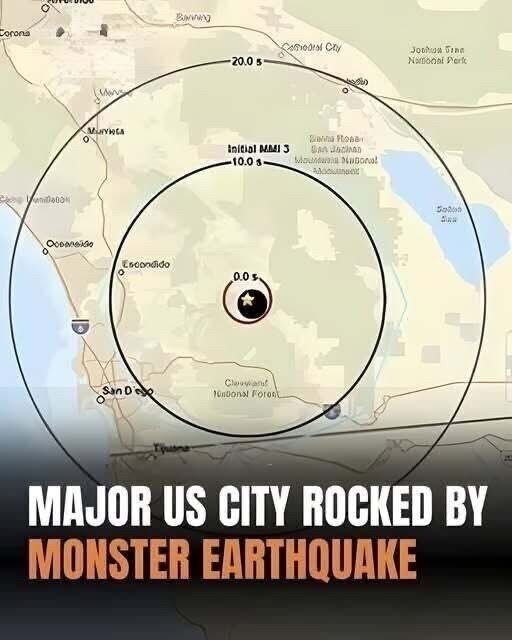
The ground didn’t just shake. It roared.
In the quiet hours before dawn, when most of Southern California was asleep, a powerful reminder of the region’s geological reality surged upward from deep beneath the earth. A 5.2-magnitude earthquake, centered near the mountain town of Julian in San Diego County, sent shockwaves rippling across a vast stretch of the state, waking millions from San Diego to Los Angeles.
For many, it was not the strength of the quake that lingered longest, but the feeling it left behind: a sudden, undeniable awareness of vulnerability.
A Jolt Felt Across Counties
Reports of shaking poured in within seconds. In Julian, residents described a sharp jolt followed by rolling motion. In downtown San Diego, buildings swayed gently but noticeably. In Orange County and parts of Los Angeles, people felt beds move, windows rattle, and hanging lights swing.
Some froze in doorways. Others instinctively reached for loved ones. A few stared at their phones as alerts appeared—simple words carrying immense weight: Earthquake detected. Take cover.
For many, those few seconds of warning made all the difference.
The Power of Early Warning
California’s earthquake early warning system, designed to detect seismic waves before the strongest shaking arrives, issued alerts to countless smartphones across the region. In some areas, residents reported having three to five seconds to react.
That brief window allowed people to drop to the ground, move away from windows, brace furniture, or simply prepare mentally for what was coming. While five seconds may seem insignificant, in an earthquake, it can mean the difference between panic and purposeful action.
Emergency officials later emphasized that the system performed as designed, offering a glimpse into how technology can reduce harm even when nature cannot be controlled.
No Major Damage, But Lingering Unease
As daylight broke, authorities conducted assessments across affected communities. The good news came quickly: no widespread structural damage, no reports of collapsed buildings, and no confirmed serious injuries.
A few items fell from shelves. Some older structures reported cracked plaster. Power flickered briefly in isolated areas, but utilities were largely restored within hours.
Yet despite the absence of major destruction, the emotional impact was undeniable.
Earthquakes have a way of reminding people that stability—both physical and psychological—is sometimes an illusion.
Julian: Close to the Source
Julian, a historic mountain town known for its apple orchards and quiet charm, found itself at the epicenter of statewide attention. Residents there experienced the strongest shaking, with some describing it as abrupt and startling rather than prolonged.
Local officials inspected schools, public buildings, and roads by morning. While minor issues were noted, no evacuations were ordered.
For longtime residents, the quake stirred memories of past tremors and reinforced a familiar truth: living in California means living with seismic risk.
A Region Built on Fault Lines
Southern California sits atop a complex network of faults, including the well-known San Andreas Fault and numerous smaller fault systems. While the Julian quake was moderate in size, scientists note that even mid-range earthquakes can be felt over large distances due to geological conditions.
Seismologists emphasized that this earthquake does not necessarily indicate a larger event is imminent. Earthquakes are notoriously difficult to predict, and most occur independently rather than as precursors.
Still, every significant tremor renews public conversation about preparedness.
Social Media: Humor, Fear, and Reflection
By mid-morning, social media platforms were filled with reactions. Some posts carried humor—jokes about being “rudely awakened” or mistaking the shaking for a passing truck. Others were more serious, describing fear, confusion, or lingering anxiety.
Parents shared stories of children asking questions. Pet owners talked about animals acting strangely before the shaking. Many expressed gratitude that the quake ended quickly and without tragedy.
Actor memorabilia
Beneath the mix of emotions was a shared understanding: this time, the outcome could have been much worse.
Emergency Officials Urge Preparedness
In the hours following the quake, emergency management agencies reminded residents that preparedness remains essential, even after a relatively mild event.
They encouraged households to:
- Review earthquake safety plans
- Secure heavy furniture and appliances
- Maintain emergency supply kits
- Know how to shut off gas and utilities
- Practice “Drop, Cover, and Hold On”
Officials stressed that preparedness is not about fear, but readiness.
The Psychological Impact of Earthquakes
Even when physical damage is limited, earthquakes can leave a psychological imprint. Mental health professionals note that sudden, uncontrollable events can trigger anxiety, especially for children, older adults, or those who have experienced past disasters.
Experts recommend talking openly about the experience, maintaining routines, and limiting exposure to alarming media coverage. Acknowledging fear rather than dismissing it can help individuals regain a sense of control.
Technology Meets Nature
The Julian earthquake served as a real-world demonstration of how far seismic monitoring has advanced. Decades ago, such an event would have arrived without warning. Today, sensors, algorithms, and communication networks work together to provide precious seconds of notice.
While no system can prevent earthquakes, early warning technology represents a shift from reaction to anticipation.
Still, experts caution that alerts are not guaranteed in every situation, reinforcing the need for constant readiness.
Looking Ahead
As aftershocks tapered off and life returned to normal, one question lingered in many minds: What about next time?
California’s history shows that earthquakes are not a matter of if, but when. Each event—large or small—adds to scientific understanding and public awareness.
The Julian quake did not bring devastation, but it delivered something else: a moment of collective pause.
A Quiet Gratitude
By nightfall, the region had largely resumed its routine. Traffic flowed, businesses reopened, and homes settled back into silence. Yet for many, sleep came a little lighter, ears tuned for creaks, hearts still alert.
This time, the earth showed restraint.
Five seconds of warning. A brief roar beneath the ground. A reminder of fragility—and of progress.
No one knows when the next quake will come, or how strong it will be. What is known is that preparation, awareness, and community can soften the impact when the ground moves again.
And for now, Southern California breathes out—grateful, humbled, and watchful.
Lessons Reinforced by a Midnight Wake-Up
As the hours passed and official updates slowed, the conversation around the earthquake began to shift from immediate reaction to reflection. Events like this tend to recalibrate priorities, even if only briefly. People talked about emergency kits they meant to assemble, furniture they intended to secure, and conversations they planned to have with family members about what to do next time.
For many residents, especially those new to California, the experience served as an unfiltered introduction to seismic reality. Unlike storms or fires, earthquakes offer little visual buildup. There are no darkening skies or evacuation warnings hours in advance. The suddenness is part of what makes them so unsettling—and why preparedness must exist long before the ground begins to move.
Schools, Workplaces, and Public Awareness
In the days following the quake, schools across the region revisited safety procedures with students. Teachers explained earthquake drills in calm, reassuring language, emphasizing that preparedness is about protection, not fear. In offices and public buildings, safety managers reviewed evacuation routes and emergency protocols.
These moments of reinforcement are critical. Research consistently shows that people who have practiced emergency responses are more likely to act decisively during real events. Even a brief refresher can reduce panic and confusion when seconds matter most.
Public agencies also used the moment to share educational resources, reminding residents where to find reliable information and how to sign up for alerts. The goal, officials emphasized, is not to alarm but to empower.
The Science Continues Beneath the Surface
While daily life resumed above ground, scientists continued their work quietly below it—analyzing data, mapping fault behavior, and studying wave patterns from the Julian quake. Each earthquake, regardless of size, provides valuable insight into how stress moves through the earth’s crust.
Seismologists explained that Southern California experiences thousands of small earthquakes every year, most too minor to be felt. Occasionally, one reaches the threshold where it becomes a shared human experience. These events help researchers refine models and improve early warning systems, contributing to safer outcomes over time.
Though prediction remains beyond reach, detection and understanding continue to improve.
Community as a Source of Stability
One of the most striking outcomes of the earthquake was the sense of quiet solidarity that followed. Neighbors checked on one another. Messages were sent to friends and family simply asking, “Did you feel that?” In those small exchanges, reassurance traveled faster than fear.
Community organizations, faith groups, and local leaders encouraged people to look out for those who might need extra support, including older adults, individuals with disabilities, and those living alone. Disasters—real or narrowly avoided—often reveal how interconnected daily life truly is.
Living With Uncertainty, Moving With Intention
Earthquakes do not offer closure. There is no clear ending, no final chapter—only the return to normalcy, accompanied by the knowledge that the ground beneath remains active. Learning to live with that uncertainty is part of life in earthquake-prone regions.
What matters most is how that knowledge is carried forward. For some, it will fade quickly. For others, it becomes motivation to prepare, to learn, and to act with intention rather than fear.
A Moment That Will Be Remembered
The Julian earthquake will not be remembered as one of California’s most destructive events. It will be remembered for something quieter: the moment millions of people felt the same movement, held the same breath, and shared the same relief when it passed.
It was a reminder that preparedness is not about expecting the worst, but respecting reality. That technology can offer seconds, but awareness offers strength. And that even in the middle of the night, a region can wake up together—and face uncertainty with calm resolve.
For now, the earth is still again.