hapter 1: The Sound of Silence
The rumble of a Harley-Davidson Milwaukee-Eight 114 engine isn’t just a noise. It’s a physical presence. It vibrates in your chest cavity, rattling your ribs and settling deep in your gut like a second heartbeat. It’s a sound that usually commands attention, turning heads and making conversations stop dead in their tracks.
But on that Tuesday afternoon, cruising past the front entrance of Oak Creek High School, my engine might as well have been a whisper in a hurricane.
I was just passing through. I had no business with the school, no business with the suburban kids in their designer jeans and their parents’ oversized SUVs. I was on a run, heading toward the interstate, minding my own business. My “cut”—the leather vest with the Bandidos patch on the back—was heavy on my shoulders, a familiar weight that usually served as a shield against the mundane world.
But something made me roll off the throttle.
You live the life I’ve lived—twenty years in the club, three stints in state, and more brawls than hot dinners—and you develop a second sight. You can smell trouble. It has a scent like ozone before a lightning strike. It tastes like copper in the back of your throat.
I squeezed the brake lever, the bike diving slightly as I pulled to the curb. I killed the engine.
The silence that followed was unnatural.
Usually, a high school at 3:00 PM is a cacophony of shouting, laughter, engines revving, and doors slamming. But today, the air was thick, heavy, and disturbingly quiet. It felt like the air inside a bell jar before it shatters.
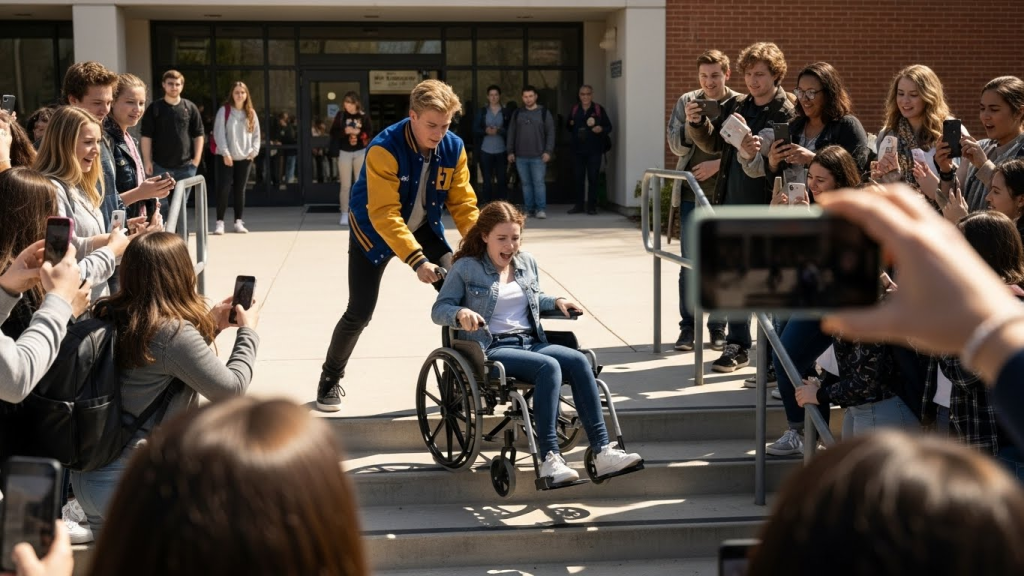
All eyes were focused on one spot: the top of the concrete staircase that led from the main quad down to the student parking lot. It was a steep drop, maybe twelve or fifteen steps, lined with jagged concrete planters.
A crowd had formed. A semi-circle of teenagers, backpacks slung over one shoulder, phones raised high. They were recording. That’s what kids do now. They don’t help; they document. They were vultures circling a fresh kill, waiting for the blood to spill so they could post it for likes.
I squinted against the afternoon sun, taking off my helmet and resting it on the tank. I’m a big guy. Six-four, shaved head, beard greying at the chin, arms covered in ink that tells the history of my bad decisions. Usually, my presence alone clears a sidewalk.
But no one looked at me. They were mesmerized by the drama unfolding at the top of the stairs.
I stood up on the pegs to get a better look, and my stomach turned over.
It was Jaxson Miller.
Even if you didn’t go to the school, you knew the Miller kid. His face was plastered on the local paper every Friday during football season. Golden boy. Quarterback. Son of Mayor Miller, the man who owned half the real estate in the county and the entire police force. Jaxson was the kind of kid who had never heard the word “no” in his life. He wore his varsity jacket like a cape, and right now, he was using his size to intimidate someone who couldn’t fight back.
Sophia.
I knew her from the diner on Route 9. She worked the register on weekends to help her mom pay the bills. She was a sweet kid, always smiling even when the customers were rude, always making sure my coffee was black and strong.
She had been in a wheelchair since she was fourteen. Some drunk tourist had blown a red light and t-boned her mom’s station wagon. Her mom walked away with scratches; Sophia lost the use of her legs.
She was tiny. Fragile. And right now, she was backed up dangerously close to the edge of those stairs.
Jaxson had one hand on the handle of her wheelchair. He wasn’t steadying her. He was rocking her back and forth, teasing the edge.
I swung my leg over the bike and my boots hit the pavement with a heavy thud. I started walking.
“I said, apologize!” Jaxson’s voice carried clearly across the courtyard. It wasn’t just loud; it was cruel. It dripped with the kind of malice that only comes from someone who believes they are untouchable.
Sophia was shaking. I could see her shoulders trembling from fifty yards away. She was gripping the armrests of her chair so hard her knuckles were white.
“Jaxson, please,” her voice was a thin, terrified ribbon of sound. “My bus is here. I just need to get to the ramp.”
“The ramp is for people who matter,” Jaxson laughed, looking around at his audience, soaking in the nervous energy. “This is the express lane. Now, admit it. Admit you’re just a burden. Admit you ruined the prom photos by being in the background with this… contraption.”
He kicked the wheel of her chair.
The chair skidded backward. The rear wheels hovered over the first step for a fraction of a second before finding purchase again.
Sophia screamed. It was a short, sharp sound of pure terror.
I was running now. My heavy engineer boots slammed against the asphalt, my vest flapping open.
“Hey!” I roared.
My voice is known to cut through bar fights and over roaring engines. It’s a command, not a request.
Jaxson’s head snapped up. He saw me.
For a second, the arrogance faltered. He saw a Bandido charging at him—a wall of muscle and leather and rage. He saw the look in my eyes, a look that promised violence.
But then, the entitlement kicked back in. He was Jaxson Miller. This was his school. I was just some biker trash.
He looked back at Sophia. A sick, twisted smile spread across his face. It was the smile of a boy who wanted to break a toy just to see how the pieces would scatter.
“Watch this,” he said to the cameras.
He didn’t just let go. He didn’t just step away.
He leaned forward, placed both hands on the back of her leather seat, and he shoved.
“NO!” I screamed, reaching out as if I could catch her from thirty yards away.
But physics is cruel. Gravity doesn’t care about justice.
The wheelchair tipped forward. Sophia’s hands flew up, grasping at the empty air, her eyes wide with a horror that would haunt me for the rest of my life.
The chair went over the edge.
It wasn’t a movie. It wasn’t slow motion. It was fast, violent, and loud.
Clang. Crash. Crack.
The metal of the wheelchair banged against the concrete steps. The sound of her body hitting the hard edge of the stairs was a dull, sickening thud. She tumbled down, the chair tangling with her limbs, trapping her, crushing her.
She rolled twelve steps down.
She landed in a heap at the bottom of the landing, the wheelchair upside down on top of her shattered legs.
Then, there was silence again.
But this time, it wasn’t the silence of anticipation. It was the silence of death.
Chapter 2: The Hands of Fate
The world seemed to gray out at the edges. My tunnel vision locked onto two things: the broken girl at the bottom of the stairs, and the monster standing at the top.
People started screaming. The paralysis broke. Students at the bottom of the stairs rushed toward Sophia, dropping their phones, finally remembering their humanity.
“Don’t move her!” I bellowed, my voice cracking with rage. “Call 911! Do not move her!”
I didn’t go to Sophia. There were twenty kids down there now, and a teacher was running out from the admin building. She had help.
Jaxson had me.
I hit the bottom of the stairs and looked up. Jaxson was still standing there. He looked… surprised. Not guilty. Just surprised that the outcome of his action was actually physical. He looked like a toddler who dropped a vase and was waiting to see if anyone noticed.
He noticed me coming up the stairs.
I didn’t run up them. I walked. Every step was a promise. Every step was a hammer striking a nail.
The students on the stairs parted like the Red Sea. They pressed themselves against the concrete walls, eyes wide, terrified of the biker with the skull on his back. They should be terrified.
I reached the top landing.
Jaxson took a step back, his varsity jacket suddenly looking too big for him. The golden boy shine was gone, replaced by the pale, clammy sweat of a coward.
“It… it was an accident,” Jaxson stammered, his hands coming up in a pathetic defensive posture. “She slipped. You saw it. The brakes failed.”
I didn’t say a word. I stepped into his personal space, towering over him. I could smell the fear on him. It smelled like urine and mint chewing gum.
“Stay back!” he squeaked. “My dad is the Mayor! You touch me, and you’re dead! You hear me? I’ll have you arrested!”
I reached out. My hand, the size of a catcher’s mitt, clamped around the collar of his jacket. I twisted the wool and leather, tightening it against his windpipe.
I lifted.
Jaxson wasn’t a small kid, maybe 180 pounds. But adrenaline is a hell of a drug, and rage is even stronger. I lifted him until he was up on his tiptoes, his expensive sneakers scuffing the concrete.
I slammed him backward against the brick wall of the school entrance.
Thud.
The air rushed out of his lungs.
“You think your daddy can fix this?” I growled, my face inches from his. “You think money fixes gravity?”
“I… I…” He was gasping, clawing at my wrist with his manicured hands. It felt like a kitten scratching a tree trunk.
“Look at her!” I roared, spinning him around and forcing his face toward the parking lot below.
Sophia was motionless. A pool of dark liquid was spreading under her head. The paramedics were just pulling up, sirens wailing, lights flashing against the brick walls.
“Look at what you did!” I shook him, his head snapping back and forth.
“I didn’t mean to!” he sobbed. “It was just a joke!”
“A joke?” I whispered, leaning into his ear. “Pray she lives, boy. Because if she doesn’t, there isn’t a hole deep enough on this earth for you to hide in. The police might follow your daddy’s orders, but the Bandidos? We follow a different set of laws.”
I heard the heavy tread of police boots behind me.
“Let him go! Now! Hands where I can see them!”
It was Sheriff Miller. Of course. The Mayor’s brother. Jaxson’s uncle. He must have been just around the corner, or maybe he has a radar for when his nephew screws up.
I didn’t let go immediately. I held Jaxson’s gaze for three more seconds, searing my face into his memory. I wanted him to see me every time he closed his eyes at night.
“We aren’t done,” I whispered.
I released him. Jaxson slumped to the ground, coughing and sobbing, instantly transforming into the victim.
“Uncle Roy!” Jaxson wailed, pointing a shaking finger at me. “He attacked me! He choked me! That crazy biker tried to kill me!”
Sheriff Roy Miller, a man with a potbelly and eyes that shifted too much, had his hand on his holster.
“Back away, Gunner,” the Sheriff barked, using my road name. He knew me. We’d danced this dance before. “Step away from the boy.”
I raised my hands slowly, palms open. “I didn’t touch a hair on his head that didn’t need touching, Roy. You better be asking him why that little girl is being loaded onto a stretcher.”
Roy glanced down at the parking lot, then back at Jaxson. I saw the calculation in his eyes. He saw the ambulance. He saw the witness videos. But blood is thicker than water in this town.
“We’ll handle the investigation,” Roy said, his voice hard. “Right now, you’re disturbing the peace and assaulting a minor. Get on your bike and get out of here, or you’re spending the night in the cage.”
“He threw her down the stairs, Roy!” I shouted, gesturing to the scene. “I saw it! Fifty kids saw it!”
“I said move on!” Roy stepped between me and Jaxson, acting as a human shield for the monster. “This is a school matter. We will take statements. If you have evidence, submit it to the station. Otherwise, you’re trespassing.”
Jaxson was already standing up, dusting off his jacket. He looked at me from behind his uncle’s shoulder, and I saw it. The smirk returned. Just a flicker. But it was there.
He knew he was going to get away with it.
I clenched my fists so hard my leather gloves creaked. If I hit the Sheriff, I went to prison for ten years, and Sophia got no justice. If I walked away, I lived to fight another day.
I pointed a finger at Roy. “This isn’t over. You bury this, and I’ll dig it up. And I’ll bring the whole club to hold the shovels.”
I turned on my heel and walked back to my bike. The students were silent, watching me with wide eyes.
I fired up the Harley. The engine roared to life, a thunderous contrast to the sirens.
As I pulled away, I saw them loading Sophia into the back of the ambulance. She looked so small.
I wasn’t going to the interstate anymore. I was following that ambulance.
Chapter 3: The Broken Bird
The waiting room of Oak Creek General Hospital smelled like floor wax and anxiety. It’s a smell I hate. It reminds me of brothers I’ve lost, of nights spent praying to a God I wasn’t sure was listening.
I sat in the corner, a dark stain on the sterile white environment. Nurses gave me a wide berth. Security guards kept glancing at me but didn’t approach. I was still wearing my cut, dust from the road on my jeans, the image of everything this polite society rejected.
Sophia’s mother, Elena, was sitting by the vending machines. She looked like she had aged ten years in the last hour. Her uniform from the diner was wrinkled, her mascara running down her cheeks.
She was staring at her phone, probably waiting for news, or maybe reading the lies already spreading online.
I stood up and walked over. My boots squeaked on the linoleum.
Elena looked up, fear flashing in her eyes when she saw the leather vest. Then she recognized me.
“Gunner?” she whispered. “From the diner?”
“Yes, ma’am,” I said softly, taking off my sunglasses. “I… I was there. I saw what happened.”
She stood up, her hands trembling. “They told me she fell. The police called. Sheriff Miller… he said Sophia lost control of her chair. He said she was reckless.”
My blood boiled. It was happening already. The spin. The cover-up. Not even two hours had passed, and they were already rewriting history to protect the quarterback.
“That’s a lie, Elena,” I said, my voice steady. “She didn’t fall. Jaxson Miller pushed her.”
Elena’s hand flew to her mouth. A sob escaped her throat, raw and painful. “Pushed her? Why? Why would anyone…?”
“Because he’s evil,” I said bluntly. “And because he thinks he owns this town.”
I led her to a chair and sat her down. “Listen to me. They are going to try to bury this. They are going to pressure you to sign things, to agree that it was an accident. They’ll offer to pay the medical bills if you keep quiet. You cannot sign anything.”
She looked at me, helpless. “But… I can’t fight them, Gunner. I’m just a waitress. He’s the Mayor’s son. If I fight them, I’ll lose my job. I’ll lose my house.”
“You won’t act alone,” I said. “I saw it. And I’m not the only one. There are videos, Elena. The kids were recording.”
Just then, a doctor in blue scrubs came through the swinging doors. He looked exhausted.
“Family of Sophia Turner?”
Elena shot up. “I’m her mother.”
I stood behind her, a silent sentinel.
The doctor sighed, rubbing his temples. “She’s stable. She’s awake. But…” He hesitated. “The fall was severe. She has three broken ribs, a punctured lung, and a compound fracture in her left arm. But the worst… the impact to her spine caused further trauma to her previous injury.”
Elena whimpered.
“She’s in a lot of pain,” the doctor continued. “And she’s terrified. She keeps saying… she keeps saying he tried to kill her.”
The doctor looked at me, then back to Elena. “If that’s true, ma’am, you need a lawyer. The police report I was handed by the officer outside lists this as ‘accidental fall due to equipment failure.’ If that goes on her record, insurance might not cover the rehab.”
Equipment failure. They were blaming the wheelchair.
I felt a cold rage settle over me. It was sharper than the hot anger I felt at the school. This was calculating. This was war.
“Can I see her?” Elena asked, tears streaming.
“Briefly,” the doctor said.
Elena turned to me. She didn’t look scared of the biker anymore. She looked like she was drowning and I was the only life raft.
“Gunner,” she said. “What do I do?”
I put a hand on her shoulder. “You go be with your daughter. You tell her she’s safe now. I have to go make a phone call.”
“Who are you calling?” she asked.
I looked toward the exit, toward the darkening sky where a storm was brewing.
“I’m calling the family,” I said.
I walked out of the hospital, into the cool night air. I pulled out my phone. My thumb hovered over the contact labeled PREZ.
The police had the law. The Mayor had the money.
But the Bandidos? We had the numbers. And we had a code. You don’t hurt children. You don’t hurt the disabled. And you definitely don’t disrespect the truth while we’re watching.
I hit dial.
Chapter 4: The Reckoning
The clubhouse was an old converted warehouse on the edge of the county line, far away from the manicured lawns of Oak Creek. To an outsider, it looked like a fortress of criminality, surrounded by a high chain-link fence topped with razor wire. To us, it was home. It was the Church.
I rolled my bike into the compound. The yard was already full. It was “Church Night”—the weekly meeting.
I walked straight to the head of the table where “Iron” Mike sat. He was our President. A Vietnam vet, sixty years old, hard as coffin nails.
“You look like you chewed on a wasp, Gunner,” Mike said, not looking up from his phone.
“I need the floor, Mike,” I said.
Mike looked up then. He saw the intensity in my eyes. He picked up his gavel—a heavy ball-peen hammer—and slammed it onto the table. BANG.
“Church is in session!” Mike yelled. The room went dead silent. Fifty men took their seats.
I stood up. I didn’t sugarcoat it.
“Today, at Oak Creek High, I watched Jaxson Miller—Mayor Miller’s boy—shove a disabled girl in a wheelchair down a flight of concrete stairs.”
A murmur of disgust rippled through the room.
“She’s in the ICU,” I continued. “Broken ribs. Lung. Arm. They’re saying it was an accident. Sheriff Roy is burying it. They’re bullying the mother.” I paused, looking around the table at my brothers. “The girl… she’s Elena’s kid. The waitress at the diner. The one who always gives us the corner booth. The one who saves the bacon scraps for your dogs.”
That hit home. We knew Elena. She was good people. She treated us like humans when the rest of the town treated us like trash.
“What do you want to do, Gunner?” Mike asked, his voice low.
“I want a Green Light,” I said. “Not to kill him. But to kill his protection. I want to expose them. I want to make sure that when Jaxson Miller walks down the street, he knows he’s not the predator anymore. He’s the prey. I want a show of force.”
Mike leaned back, lighting a cigar. “The Mayor has the State Troopers in his pocket. If we roll on the school, it’s a riot waiting to happen.”
“Since when do we care about the cops?” asked “Stitch,” our Sergeant at Arms. “They hurt a crippled girl, Mike. That ain’t right. That’s against the code.”
Mike looked at me. He looked at the men. He saw the anger.
“We don’t let innocents get crushed,” Mike said, smoke curling from his lips. He slammed the hammer down again. “Motion passed. Tomorrow morning, nobody goes to work. We ride.”
“Where to, Prez?” Stitch asked, grinning.
Mike stood up. “We’re going to school.”
The next morning, the sun rose cold and bright over Oak Creek. At 7:30 AM, the sleepy suburb was waking up. Then, they heard it.
It started as a low hum in the distance, like a swarm of angry hornets. Then it grew. It became a roar. It became a thunderstorm rolling across the ground.
Fifty Harley-Davidsons.
We rode in a tight formation, two by two, taking up both lanes of Main Street. I was at the front, right next to Mike. We rolled right up to the front entrance of the high school—the same spot where Jaxson had stood yesterday.
We killed the engines in unison. The silence was sudden and terrifying.
We got off our bikes. Fifty men. We lined up along the sidewalk, arms crossed, staring at the front doors. We weren’t shouting. We weren’t breaking anything. We were just standing there. Watching. Waiting for Jaxson Miller to arrive.
When a silver BMW pulled up to the drop-off zone, driven by the Mayor himself, and Jaxson stepped out… he froze. He looked at the school entrance. It was blocked by a wall of black leather and Bandidos patches.
Mayor Miller stepped out, his face purple with rage. “This is private property! I want you gone! Now! Or I will have every single one of you arrested!”
Mike didn’t blink. “Morning, Mayor. Nice day for an education.”
“Get your gang off my campus,” Miller spat.
“It’s a public school, Mayor,” I spoke up, stepping forward. “We’re just a concerned neighborhood watch. We heard there was a dangerous individual here who likes to hurt people in wheelchairs.”
By now, hundreds of students were watching from the lawns. Phones were up. Livestreams were running.
“Arrest them!” The Mayor screamed at the approaching sirens. Sheriff Roy Miller had arrived with backup. State Troopers, local deputies, even a K-9 unit. It looked like a war zone.
“I’m giving you five minutes to disperse!” Sheriff Roy barked, hand on his Taser.
That’s when the dynamic shifted. It didn’t come from us. It came from the students.
A young girl with purple hair walked out from the crowd. She walked right past the police line. She held up her phone, connected to a portable Bluetooth speaker.
“You say she fell?” the girl shouted at the Mayor. “You say it was an accident?”
“Go back to class!” the Mayor bellowed.
“No!” she screamed. “Not until you see this!”
She hit play.
The audio wasn’t perfect, but it was clear enough. Jaxson’s voice boomed across the parking lot. “Say you’re trash! Say you’re nothing but a cripple who takes up space!”
The Mayor froze.
Then, the sound of the shove. The scream. The crash. And finally, Jaxson’s voice again: “Oops.”
The video ended. The girl looked at the Sheriff. “I recorded that. From the library window. It’s already on TikTok. It has two million views. You can’t delete the internet!”
I stepped forward, closing the distance between me and the Sheriff.
“It’s over, Roy,” I said softly. “The world knows. You can arrest us. You can haul us in. But every second you spend fighting us is a second the world asks why you aren’t arresting the kid who tried to kill a disabled girl.”
Roy looked at his brother, the Mayor. He looked at the screaming students holding up their phones like candles at a vigil. He looked at his own deputies, who were shifting uncomfortably.
He took his hand off his Taser.
“Stand down,” Roy said to his deputies.
“Roy! What are you doing?” The Mayor shrieked.
“I’m doing my job, Bob,” Roy said, his voice flat. He turned to his deputy. “Go inside. Get Jaxson Miller. Bring him out in cuffs.”
The roar that went up from the students was louder than any engine I had ever heard. It was the sound of justice finally waking up from a nap.
We didn’t go home after that. We had one more stop.
Twenty of us rode to Oak Creek General Hospital. We stopped at a florist and bought every rose they had.
When we walked into the ICU, Elena was sitting by Sophia’s bed. Sophia looked terrible—bruised, broken, tubes everywhere. But she was awake. She saw the leather vests and flinched, terrified.
“It’s okay,” Elena said quickly. “It’s Gunner. He’s a friend.”
I walked up to the bed, holding my helmet. “Hey, kid.”
“Hi,” she whispered.
Iron Mike stepped forward and placed a small patch on her blanket. It said: I SUPPORT THE BANDIDOS.
“You keep this,” Mike said gently. “Anyone gives you trouble, you tell them you got fifty uncles who ride Harleys and have very short tempers.”
I handed Elena a thick envelope of cash we’d collected. “For the bills. And for a new chair. Maybe one with a turbo engine.”
Elena sobbed, hugging us.
Six months later, Sophia returned to school.
It was a Monday. I made sure I was there. I wasn’t alone. Ten of us formed an honor guard at the entrance.
Sophia’s mom pulled the van up. The ramp lowered. Sophia rolled out. Her new chair was sleek, titanium, and on the backrest was that Bandidos sticker.
She looked nervous. But then she saw us.
She smiled—a real, bright, confident smile. She rolled up the ramp, past the spot where she had fallen. As she passed me, she reached out, and we bumped fists.
“Ride safe, Gunner,” she said.
“You too, Sophia,” I replied.
She rolled into the school, head held high. The students parted for her, not out of fear, but out of respect. She wasn’t just the girl in the wheelchair anymore. She was the girl the Bandidos rode for.
We pulled out of the parking lot, the thunder of our pipes signaling the end of the lesson. We don’t call the cops. We don’t ask for permission. And we don’t forgive bullies.
We are the Bandidos. And in a world full of noise, sometimes you have to be the thunder.
Chapter 5: The Fall of Rome
The weeks following the standoff at the high school were a blur of flashing cameras, legal depositions, and the kind of public scrutiny that burns everything it touches.
Oak Creek, usually a quiet suburb where the biggest scandal was a homeowner’s association dispute over fence heights, became the epicenter of a national conversation. The video of the “Bandidos Blockade” had been viewed forty million times. You couldn’t scroll through Twitter or turn on CNN without seeing my back patch or Jaxson’s terrified face.
But viral fame is fleeting. The real work—the grinding, ugly work of justice—happened in quiet rooms with expensive lawyers.
I was subpoenaed, of course. Sheriff Roy Miller had tried to pin a dozen charges on us before he resigned—disturbing the peace, intimidation, unlawful assembly. But the District Attorney, a sharp woman named Harper who knew which way the political wind was blowing, dropped them all. She knew that putting the men who stood up for a disabled girl on trial would be career suicide.
Instead, the target was the Millers.
The Mayor’s fall was spectacular. It wasn’t just the cover-up of his son’s assault; the FBI investigation triggered by the incident unearthed a rot that went deep. Zoning permits sold for cash, police funds diverted to personal accounts, intimidated witnesses. Bob Miller didn’t just lose his office; he lost his legacy. His sprawling estate on the hill was seized. The last time I saw him, he was being led out of his mansion in handcuffs, looking smaller and greyer than I had ever seen him.
But the moment that stuck with me—the moment that truly ended the reign of the “Golden Boy”—was the sentencing hearing for Jaxson.
I was there. Elena asked me to come. She sat in the front row, Sophia beside her in a temporary rental wheelchair. Sophia was still in a cast, her breathing shallow due to the healing ribs, but her head was high.
Jaxson sat at the defense table. He had lost weight. The varsity jacket was gone, replaced by an ill-fitting gray suit. He didn’t look like a predator anymore. He looked like a frightened child who had finally realized the world wasn’t his playground.
His lawyer, a shark from the city, tried to plead “affluenza.” He talked about pressure, about a “momentary lapse in judgment,” about a bright future that shouldn’t be ruined by “one mistake.”
Then it was Sophia’s turn to speak.
The courtroom went silent as Elena wheeled her to the microphone. Sophia didn’t need a script.
“He didn’t just push a chair,” Sophia said, her voice trembling but clear. “He pushed a person. He looked me in the eye, he saw my fear, and he laughed. He thought I was disposable because I can’t walk. He thought he was powerful because he could stand.”
She paused, looking directly at Jaxson. He couldn’t meet her eyes. He stared at the table.
“But real power isn’t hurting people who are weaker than you,” she continued. “Real power is standing up for them. I learned that from a group of men the world calls criminals. So, no, I don’t think Jaxson’s future should be ruined. But I think he needs to learn what it feels like to be powerless.”
The judge, a stern man with no patience for entitled antics, nodded.
Jaxson didn’t get prison time—he was a minor with no priors, and the system is still soft on boys like him—but he didn’t walk away. Five years of intense probation. Restitution that would drain his trust fund. And two thousand hours of community service.
When the gavel banged, it sounded like the closing of a heavy book.
Six months later, I was riding down Highway 9, heading out to the clubhouse. It was a scorching July day. The heat radiated off the asphalt in shimmering waves.
Construction crews were working on the shoulder, and traffic had slowed to a crawl. As I idled my bike, waiting for the flagman to turn his sign from STOP to SLOW, I looked over at the grassy median.
A crew of guys in orange vests was picking up trash. It was the hot, thankless work of community service. They were sweating, miserable, stabbing at discarded soda cans and fast-food wrappers with spiked poles.
One of them stopped to wipe sweat from his forehead. He looked up as the rumble of my engine grew louder.
It was Jaxson.
He looked rough. Sunburned, dirty, exhausted. The arrogance had been sweated out of him, replaced by the dull resignation of consequences.
Our eyes met.
I didn’t rev my engine. I didn’t shout an insult. I didn’t need to.
He looked at the Bandidos patch on my chest. Then he looked at the trash bag in his hand.
He looked down quickly, shame burning his face brighter than the sun. He turned his back to the road and went back to stabbing trash.
I shifted into first gear and rolled on. The vibration of the bike felt good. It felt like balance.
The real ending of this story, though, wasn’t on a highway or in a courtroom. It was in a gymnasium.
Spring had come around again. Prom night.
Sophia had invited us. Not to come inside—she knew the school administration would have a heart attack if twenty bikers crashed the prom—but to the “Red Carpet” drop-off.
We met at the diner first. Elena brought Sophia out.
She was breathtaking. She wore a dress the color of midnight, sparkling with silver sequins. Her hair was done up, and she was wearing makeup that made her look older, stronger.
But the best part was the chair. We had pooled our money—me, Mike, Stitch, and even some chapters from the next state over who had heard the story. We bought her a custom rigid-frame chair. Carbon fiber. Lightweight. Purple accents. And yes, painted on the backrest by our club’s artist, a small, subtle winged heart.
“You ready to roll, Princess?” Mike asked, grinning through his beard.
“Ready,” Sophia beamed.
We didn’t take the van. We lifted her into a sidecar attached to Mike’s bike—a special rig we used for charity runs.
We rode through town, a parade of chrome and thunder. People waved this time. They cheered. The fear was gone, replaced by a strange sort of hometown pride. We were their outlaws now.
When we pulled up to the high school, the line of limos and SUVs paused.
Mike pulled the sidecar right up to the red carpet. I hopped off my bike and helped Sophia transfer into her new chair.
The students were there. The same kids who had watched her fall were now lining the entrance.
When Sophia wheeled onto the carpet, a silence fell. But it wasn’t awkward. It was reverent.
Then, someone started clapping.
It was the purple-haired girl—the one who had played the video. Then a football player clapped. Then another.
Within seconds, the entrance to Oak Creek High was erupting in applause. It wasn’t pity applause. It was a roar of respect.
Sophia stopped in the middle of the carpet. She looked back at us—fifty dirty, bearded bikers standing by our machines, watching her like proud fathers.
She blew us a kiss.
Then she turned her chair, grabbed her rims, and pushed forward. Strong. Independent. Unbroken.
She rolled into the dance, into her future, leaving the ghosts of the past at the bottom of the stairs.
I watched until she disappeared inside.
“Alright,” Mike said, his voice a little thick with emotion. “Let’s ride.”
We turned our bikes around. As we headed back toward the highway, the sun setting behind us, I realized something.
They call us the 1%. They call us outlaws. They say we’re the bad guys.
And maybe we are.
But looking at that empty red carpet, and knowing that the girl who rolled down it was safe because of us?
I can live with being the bad guy.