CHAPTER 2: THE SHARKS IN THE SHALLOWS
The moment my boots crossed the threshold from the quiet, sterile hallway into the roaring chaos of the cafeteria, the world shifted into high definition. This was a phenomenon I’d experienced a dozen times in the field—”tactical hyper-awareness.” Your heart rate spikes, but your perception slows down. Every sound, every movement, every flickering fluorescent light becomes a data point.
I wasn’t just a father looking for his daughter anymore. I was a predator who had just walked into a room full of scavengers.
The cafeteria was a sea of noise, a chaotic blend of clattering plastic trays, high-pitched shrieks of laughter, and the rhythmic thumping of music leaking from a hundred pairs of earbuds. To a civilian, it was just lunch. To me, it was a target-rich environment. I scanned the room. My eyes didn’t settle on the posters for the fall dance or the “Go Eagles” banner hanging from the rafters. Instead, I saw the exits. I saw the blind spots. I saw the clusters of hierarchy—the “popular” kids near the center, the outliers near the edges, and the victims hidden in the shadows.
I kept my eyes locked on the back corner.
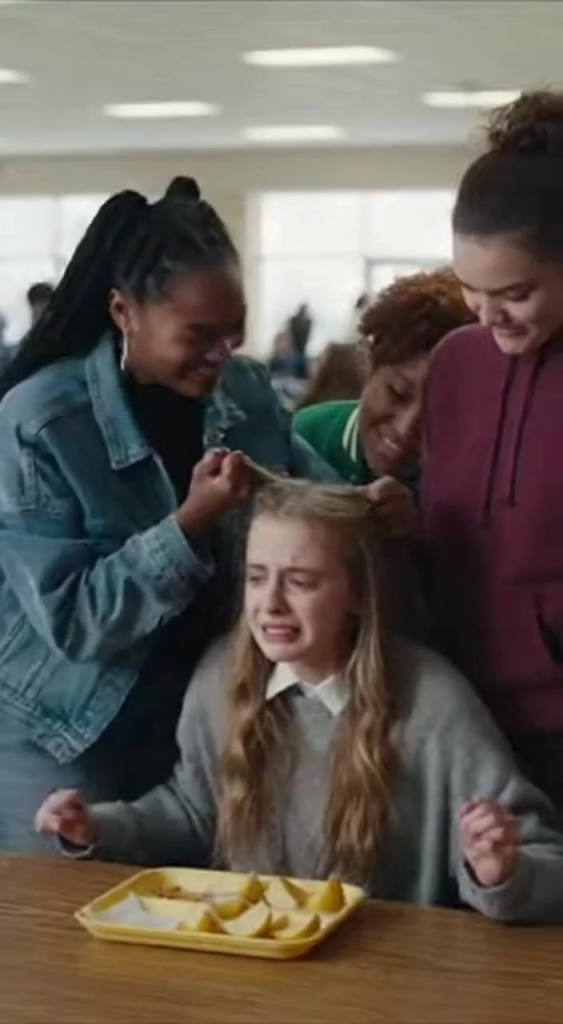
Lily was still there, and the three girls had surrounded her table like a pack of wolves encircling a wounded fawn. The blonde leader—I’d later find out her name was Chloe, a name that sounded too sweet for the poison she carried—was leaning in so close that her nose was inches from Lily’s.
I saw the way Chloe’s hand gripped the fabric of Lily’s hoodie. It wasn’t just a tug; it was a claim of ownership. She was showing the rest of the room that my daughter was her property to break.
I began to walk.
The first few tables didn’t notice me. I was just a blur of camo in their peripheral vision. But then, a group of senior boys near the vending machines went quiet. One of them, a kid with a varsity jacket, stopped mid-bite of his pizza. His eyes widened as he took in the uniform—the Ranger tab, the combat infantryman badge, the stripes. He nudged his friend. The silence began to ripple outward from my position, a wave of sudden, chilling quiet that followed me like a shadow.
Step. Step. Step. My boots hit the floor with a rhythmic, heavy finality. In the Army, we call this the “Command Presence.” It’s not something you can fake. It’s the way you carry the weight of your gear and your history. It’s the way you look through people, not at them.
As I moved deeper into the room, the roar of the cafeteria died down to a murmur. It was the sound of five hundred kids realizing that something “real” had just entered their world of “fake.” I didn’t look left or right. I didn’t care about the whispers. My world had narrowed down to a single point: the hand on my daughter’s collar.
I watched the scene unfold in slow motion as I closed the distance.
The second girl—a brunette with a cruel, thin mouth—reached out and casually swiped Lily’s water bottle off the table. It hit the floor with a dull thud, the cap popping off and water pooling around Lily’s sneakers. Lily didn’t reach for it. She didn’t move. She was paralyzed, her eyes fixed on the table, her bottom lip trembling so hard I could see it from twenty feet away.
“Look at me when I’m talking to you, Miller,” I saw Chloe mouth.
Lily didn’t look up. She was trying to retreat into herself, to find that inner fortress where bullies couldn’t reach. I knew that look. I’d seen it in the eyes of new recruits during hell week, and I’d seen it in the eyes of civilians in war zones who had lost everything. It’s the look of a soul trying to survive by disappearing.
Then, the third girl—the one standing behind Lily’s chair—did something that snapped the last thread of my restraint.
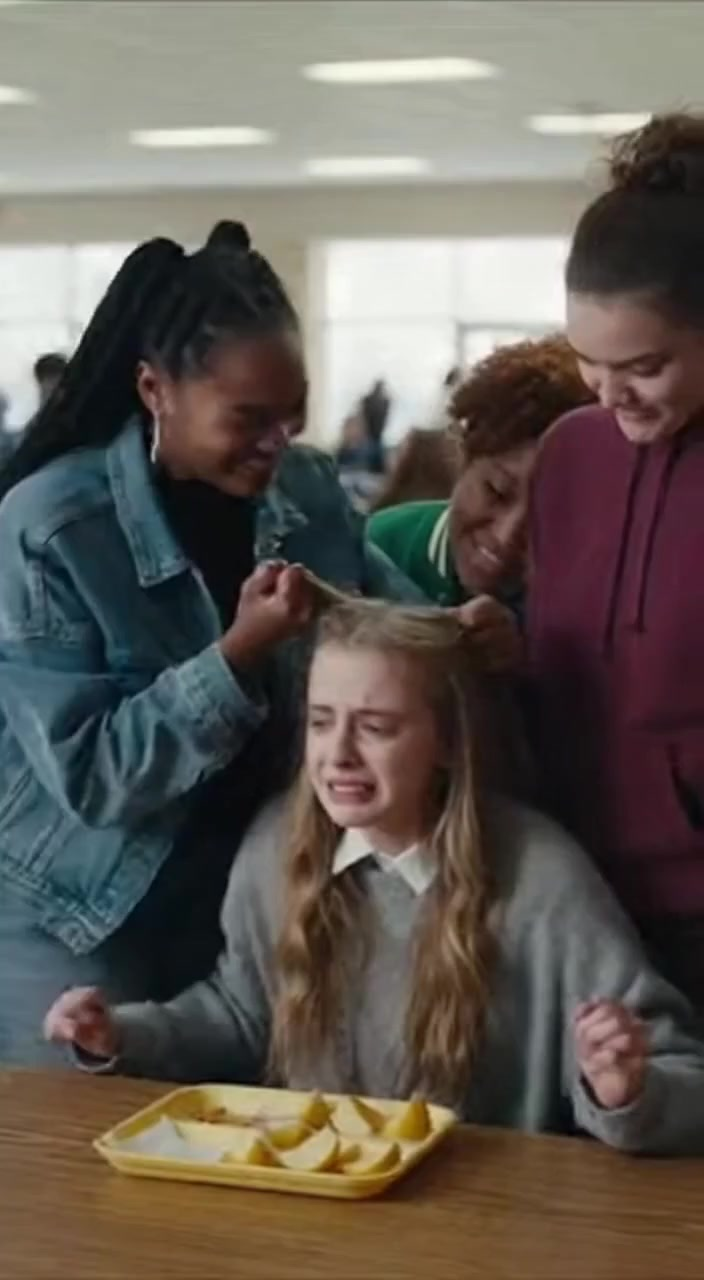
She reached down, grabbed a handful of Lily’s hair, and yanked.
Lily’s head snapped back. A small, sharp cry of pain escaped her lips—a sound that sliced through the remaining noise of the cafeteria like a razor.
The girls laughed. It was a bright, musical sound, completely disconnected from the cruelty of their actions. To them, this was entertainment. This was the highlight of their Tuesday.
“You’re crying? Seriously?” Chloe sneered, her voice now audible as I drew within ten feet. “God, you’re such a pathetic little freak. No wonder your dad stayed overseas. He probably saw what a loser you were and realized he’d rather get shot at than come home to this.”
The air in my lungs turned to ice.
Every instinct I had honed in eighteen months of combat screamed for an “overwhelming force” response. In the field, if someone threatens your unit, you neutralize the threat. You don’t negotiate. You don’t wait. You suppress.
But I wasn’t in the field. I was in a high school cafeteria. I had to be the Sergeant, but I also had to be the Father.
I stopped exactly three feet behind Chloe.
She was still laughing, her back to me, her hand still clutching Lily’s hoodie. Her friends were facing her, and they were the first to see me. The brunette’s smile didn’t just fade—it vanished, replaced by a look of pure, primal confusion. She looked at my boots, then up my legs, then at the massive, shadowed figure of a man who looked like he had just walked off a recruitment poster and into their nightmare.
The girl holding Lily’s hair let go immediately. Her hands flew to her mouth.
Chloe, sensing the change in the atmosphere, frowned. “What?” she asked her friends. “What are you—”
She didn’t finish the sentence. She felt the temperature drop. She felt the “shadow” I had cast over her.
She turned around slowly.
For a moment, she was looking at my chest—at the “U.S. ARMY” tape that sat right at her eye level. She blinked, her brain struggling to process the visual information. She saw the medals. She saw the combat-worn fabric. She saw the sheer scale of the man standing over her.
Then she looked up at my face.
I have been told I have “dead eyes” when I’m angry. It’s a byproduct of the training—you learn to mask your emotions so the enemy can’t read you. But right now, I wasn’t masking anything. I was letting every ounce of my rage, my heartbreak, and my lethality simmer right behind my pupils.
The entire cafeteria was now silent. You could have heard a pin drop on the linoleum. Hundreds of students were frozen in place, forks halfway to their mouths, phones out, recording the moment the world stopped for Chloe.
I looked down at Chloe’s hand. It was still hovering near Lily’s shoulder.
“I suggest you let go of her,” I said.
My voice wasn’t a shout. It was a low, resonant growl that seemed to vibrate the very air in the room. It was the voice I used to call in fire missions. It was the voice of a man who was not asking.
Chloe’s mouth opened, but no sound came out. She looked like a fish gasping for air. Her “power,” which had seemed so absolute seconds ago, was revealed for what it was: a cheap, flimsy mask worn by a child who had never faced a real consequence in her life.
“I… I…” she stammered.
“Now,” I added.
She pulled her hand back as if she’d been burned. She took a stumbling step away from the table, her face turning a sickly shade of white that clashed with her expensive makeup.
I didn’t give her another second of my attention. I turned to the table.
“Lily,” I said.
My daughter finally looked up. The tears were streaming down her face now, carving tracks through the light dusting of freckles on her cheeks. Her eyes were wide, darting from my face to my uniform and back again. She looked like she was seeing a ghost.
“Dad?” she whispered.
The word was so small, so fragile, it nearly broke me right there in front of five hundred people.
“I’m home, baby,” I said, my voice softening just enough for her to hear. “I’m right here.”
She didn’t move at first. She just stared, her brain trying to reconcile the image of the father she’d seen on a 4-inch phone screen with the giant in combat fatigues standing in her school.
Then, the dam broke.
Lily stood up so fast her chair screeched against the floor. She didn’t care about the bullies. She didn’t care about the cafeteria. She didn’t care about the milk on her shirt. She lunged forward and buried her face in my chest, her arms wrapping around my waist with a grip of iron.
I wrapped my arms around her, my large hands covering her back, shielding her from the room. I could feel her shaking—violent, racking sobs that told me everything I needed to know about how long she had been carrying this weight alone.
I looked over her head at the three girls.
They were huddled together now, the “sharks” turned back into scared little girls. They were looking around for an escape, but the crowd of students had closed in, forming a ring of spectators. There was no way out.
“Which one of you flipped the tray?” I asked.
The brunette started to cry. Not the quiet, dignified cry of my daughter, but a loud, performative wail of someone who realized they were in deep trouble.
“We… we were just playing around,” Chloe managed to say, her voice cracking. “It’s not a big deal, we—”
“Not a big deal?” I stepped forward, still holding Lily to my side. I didn’t raise my voice, but I leaned in, letting her feel the coldness of my stare. “You lay hands on my daughter. You humiliate her. You mock her family. And you think it’s ‘not a big deal’?”
I looked at the mess on the floor—the crushed bag, the spilled water, the scattered food.
“Pick it up,” I ordered.
“What?” Chloe blinked.
“The trash. The food. Pick it up. Now.”
“You can’t talk to us like that,” the brunette sobbed. “You’re just… you’re a parent! You’re not a teacher!”
“I’m a United States Army Sergeant,” I replied, and the weight of that title seemed to slam into them like a physical blow. “And right now, I am the only thing standing between you and the most miserable afternoon of your lives. Pick. It. Up.”
They looked at each other, then at the silent, watching crowd. They saw the phones. They saw the judgmental stares of their peers. For the first time, they were the ones being humiliated.
Slowly, painfully, the three “queens” of Northwood High dropped to their knees on the dirty cafeteria floor.
CHAPTER 3: THE LONG WALK OF SHAME
The silence in the Northwood High cafeteria was no longer just a lack of noise; it had become a physical weight. It was the kind of silence you find in the seconds after a flashbang goes off—ringing, heavy, and thick with the scent of ozone and shock. Five hundred students stood like statues, their eyes darting between the three girls on their knees and the towering man in the sand-colored fatigues.
I didn’t move. I stood there with Lily tucked under my arm, her face still pressed into the rough fabric of my OCPs. I could feel her tears soaking through to my skin, a warm, stinging reminder of why I was here. My boots were planted firm, shoulder-width apart, the “soldier’s stance.”
“I’m waiting,” I said.
My voice was a low-frequency vibration that seemed to rattle the plastic trays on the nearby tables.
Chloe, the girl who seconds ago had been the undisputed dictator of this social ecosystem, was trembling so hard her jewelry rattled. Her manicured nails, painted a soft, innocent pink, scraped against the grimy linoleum as she reached for the remains of Lily’s lunch. She picked up the crushed brown paper bag—the one she had flattened with such casual cruelty—and placed it on the tray.
Her two friends followed suit. The brunette was sobbing openly now, a messy, snotty display of fear that garnered zero sympathy from the crowd. They were picking up soggy tater tots and bits of shredded napkin, their expensive jeans soaking up the spilled milk on the floor.
This was the “Correction.” In the Army, when a soldier fails to meet the standard, you don’t just yell. You make them fix the deficiency until the lesson is burned into their muscle memory. These girls had lived in a world where words had no consequences and actions could be deleted with a “block” button.
Not today. Today, they were discovering that the world has teeth.
“Is that all of it?” I asked, my shadow looming over them.
Chloe nodded, her ponytail disheveled, a single tear dragging a line through her foundation. “Yes,” she whispered.
“Stand up,” I commanded.
They scrambled to their feet, clutching the tray of trash like it was a live bomb. They looked small. Without their status, without their digital shields, they were just children—frightened, insecure children who had mistaken cruelty for strength.
I looked at the crowd. I saw the faces of the other students. Some looked terrified. Some looked triumphant. A few looked guilty—the ones who had watched the bullying for months and said nothing. I let my gaze sweep over them, making eye contact with as many as I could. I wanted them to feel the weight of their silence.
“Lily,” I whispered, looking down at the top of my daughter’s head. “Can you walk?”
She took a shaky breath and pulled back just enough to look at me. Her eyes were red and swollen, but for the first time in eighteen months, I saw a spark of something else in them. It wasn’t just relief. It was the realization that she wasn’t the “nobody” they had called her. She was the daughter of a man who would cross oceans to stand by her side.
“Yeah,” she breathed. “I can walk, Dad.”
“Good. Hold your head up. You have nothing to be ashamed of.”
I turned back to the three girls. I pointed toward the double doors at the front of the cafeteria.
“Move,” I said. “We’re going to see the Principal.”
The walk out of the cafeteria felt like a funeral procession for their reputations. As we moved, the students parted like the Red Sea. The only sound was the rhythmic thud-thud-thud of my boots and the frantic, shuffling steps of the three girls.
We exited the cafeteria and entered the “blue wing.” The hallway was empty now, the lockers standing like silent sentinels. Every few yards, a teacher or a janitor would poke their head out of a room, their eyes widening at the sight of the procession.
“Sergeant?” one teacher asked, stepping out of a classroom. “Is everything alright?”
I didn’t stop. “Everything is being handled,” I said, my voice echoing off the metal lockers.
The brunette girl tried to slow down, her eyes darting toward the girl’s restroom as if she could bolt inside and hide. I shifted my weight, a subtle tactical movement that cut off her angle of escape without me even having to say a word. She whimpered and kept walking.
We reached the administration office. Mrs. Higgins was standing behind the counter, her hand over her mouth. She had clearly heard the silence in the cafeteria—or perhaps she’d already seen the first videos being uploaded to TikTok.
“They’re in there?” I asked, gesturing toward the heavy oak door labeled Principal Vance.
“He… he’s expecting you,” she stammered, her eyes darting to the girls, then to the tray of trash they were still carrying. “Go right in, Sergeant.”
I pushed the door open.
Principal Vance was a man who looked like he had been carved out of balsa wood—thin, pale, and easily broken. He was standing behind his desk, his hands trembling as he adjusted his tie. He was the kind of administrator who lived for “conflict resolution workshops” and “restorative justice,” things that worked well on paper but failed miserably when faced with a real predator.
“Sergeant Miller,” he said, his voice an octave higher than normal. “Please, sit down. Girls, what on earth—”
“They’ll stay standing,” I interrupted.
I sat Lily down in one of the guest chairs. I didn’t sit. I stood behind her, my hands resting on the back of her chair. It was a tactical position—I was the barrier between my daughter and the man who had failed to protect her.
“Mr. Vance,” I began, my voice steady and cold. “I just flew six thousand miles. I haven’t slept in thirty-six hours. I came here to surprise my daughter, only to find her being physically assaulted and verbally degraded in your cafeteria while five hundred students watched.”
“Assaulted? Now, Sergeant, let’s not use such strong—”
I slammed my hand down on the back of Lily’s chair. Not hard enough to break it, but hard enough to make the pens on Vance’s desk jump.
“I am an expert in violence, Mr. Vance,” I said, leaning forward. “I know the difference between a ‘disagreement’ and an assault. I watched that girl”—I pointed a gloved finger at Chloe—”grab my daughter by the neck. I watched that one”—I pointed at the brunette—”destroy her property. And I watched the third one pull her hair to the point of drawing a scream.”
Vance went pale. He looked at the girls. “Is this true?”
Chloe started to sob. “She’s lying! We were just… she’s always so weird and quiet, we were just trying to get her to talk to us! He’s crazy, he’s a soldier, he’s got a gun or something!”
I laughed. It wasn’t a happy sound. It was the sound of a man who had heard every lie under the sun from people much more dangerous than a fourteen-year-old bully.
“I’m not carrying a weapon, Chloe,” I said. “I don’t need one. And as for ‘lying’—Mr. Vance, check your email. I’m sure by now, half the student body has uploaded the video of your ‘quiet’ lunch period to the internet. If you don’t have it, I’m sure the local news station will by five o’clock.”
Vance’s eyes bugged out. The mention of the “local news” was the magic phrase. In the world of suburban education, bad PR was a fate worse than death.
“Now,” I said, my voice dropping back to that deadly, quiet growl. “Here is how this is going to go. You are going to call their parents. You are going to explain why their daughters are being suspended. And then, you and I are going to have a very long conversation about why my daughter has spent the last semester in fear while you sat in this office drinking lukewarm coffee.”
The girls looked at each other. The reality of the “Permanent Record” was finally sinking in. The “sharks” had finally run out of water.
CHAPTER 4: THE CLASH OF THE TITANS
The atmosphere in Principal Vance’s office had shifted from a state of shock to one of a simmering, high-pressure standoff. I remained standing behind Lily, my hands anchored to the back of her chair. To her, I was a fortress. To the man behind the desk, I was a ticking bomb.
“Sergeant Miller, please,” Vance said, his voice pleading as he gestured to an empty chair. “We can discuss this rationally once the other parents arrive. There’s no need for… intimidation.”
“I’m not intimidating anyone, Mr. Vance,” I replied, my eyes not leaving the three girls who were now huddled in the far corner of the room, still holding that tray of garbage like a cursed relic. “I’m standing guard. It’s what I do. If my presence makes you uncomfortable, perhaps you should reflect on why a man in uniform is more threatening to you than the three predators you’ve allowed to roam your halls.”
Vance opened his mouth to retort, but he was interrupted by the sound of the office door slamming open.
In walked a man who looked like he had stepped straight off a golf course—expensive polo shirt, khaki slacks, and a gold watch that caught the fluorescent light. Behind him was a woman in a tailored power suit, her face a mask of practiced indignation. These were Chloe’s parents. The “power couple” of Northwood.
“What is the meaning of this?” the man demanded, not even looking at the Principal. He looked at me, his eyes sweeping over my worn fatigues with a look of profound distaste. “Who is this man? And why is my daughter crying?”
Chloe let out a fresh wail of performative grief and ran to her father. “Dad! He’s crazy! He threatened us! He made us get on the floor!”
The father, whose name tag at a corporate retreat probably read ‘Brad,’ stepped toward me. He was several inches shorter, but he carried the unearned confidence of a man who had never been told ‘no’ by someone he couldn’t fire.
“Listen here, Sergeant or whatever you are,” Brad spat. “I don’t care where you’ve been or what you think you’re doing. You do not touch my daughter. You do not speak to her. Do you have any idea who I am? I sit on the board of this school’s foundation.”
I didn’t move an inch. I didn’t blink. I let him get right into my personal space, the scent of his expensive cologne clashing with the faint smell of jet fuel and CLP oil that clung to my uniform.
“I don’t care if you own the school, Brad,” I said, my voice coming from the bottom of my lungs. “Your daughter put her hands on mine. She humiliated her. She assaulted her. And then she mocked the fact that I was overseas serving this country.”
“That’s a lie!” the mother shouted, stepping forward. “Chloe would never do that. She’s an honor student! She’s the captain of the cheer squad!”
“She’s a bully,” Lily’s voice suddenly cut through the room.
I felt a surge of pride so strong it nearly brought a tear to my eye. Lily was standing up. She wasn’t shouting. She was trembling, yes, but she was looking Brad and his wife right in the eye.
“She’s been doing it for months,” Lily continued, her voice gaining strength. “She calls me a ‘soldier’s brat.’ She says my dad is probably dead because he doesn’t love me enough to come home. Today, she threw my lunch on the floor and pulled my hair until I screamed. Ask anyone in the cafeteria. They all saw it.”
The room went deathly quiet. Even Brad seemed to deflate for a fraction of a second. But then, the entitlement returned.
“Teenage drama,” Brad dismissed, waving a hand. “Vance, surely you aren’t going to take the word of a… emotional child over my daughter’s? This man—this ‘soldier’—invaded a school building and terrorized students. That’s the real story here.”
I smiled. It was the smile of a hunter who had just watched his prey walk into a deadfall trap.
“Actually, Brad,” I said, pulling my smartphone from my pocket. “The real story is already trending on X and TikTok. While you were driving your European SUV over here, three hundred students were uploading the footage of your daughter on her knees, picking up the trash she threw at my child. They’re also uploading the footage of the ‘assault’ that preceded it.”
I turned the screen around. It was a video shot from a few tables away. It showed Chloe’s face, twisted with malice, as she yanked Lily’s head back. It showed the laughter. It showed the cruelty in high definition.
The mother let out a strangled gasp. Brad’s face went from tanned to a mottled, angry purple.
“Delete that,” Brad hissed. “I will sue you for everything you have.”
“You can’t sue the internet, Brad,” I said. “And you certainly can’t sue the truth. Mr. Vance, I believe you were about to discuss the terms of their expulsion?”
Vance looked like he wanted to crawl under his desk and stay there until the next decade. “Expulsion? Sergeant, surely we can look at a long-term suspension and counseling—”
“Expulsion,” I repeated. “If these girls are on this campus tomorrow, I will be here with a lawyer and the local news crew I spoke to ten minutes ago in the hallway. I’ve spent eighteen months fighting for people’s rights in a desert. I’ll be damned if I won’t fight for my daughter’s right to go to school without being hunted.”
I looked at Chloe. She was no longer crying for show. She was staring at the video on the screen, seeing herself through the eyes of the world for the first time. She looked horrified.
“Lily,” I said, reaching for her hand. “Gather your things. We’re going home.”
“But Sergeant, we need to sign the paperwork—” Vance started.
“Send it to my house,” I said over my shoulder as I led Lily toward the door. “I think you’ve done enough ‘administering’ for one day.”
As we walked out of the office, the hallway was lined with students. They weren’t whispering anymore. As we passed, a few started to clap. Then more. By the time we reached the front doors, the sound was a roar.
I didn’t stop to bask in it. I just kept my arm around Lily, walking her out into the crisp autumn air, toward the truck and the life we were going to rebuild together.
CHAPTER 5: THE WEIGHT OF THE SILENCE
The heavy glass doors of Northwood High closed behind us with a pneumatic hiss, cutting off the lingering echoes of the cafeteria’s roar and the Principal’s frantic excuses. The crisp Virginia air hit my face, a sharp contrast to the stagnant, recycled oxygen of the school’s hallways. I took a deep, shuddering breath. It was the first time in nearly forty-eight hours that I didn’t feel like I was choking on the dust of a foreign land.
Lily was silent beside me. She walked with her head down, her hands buried deep in the pockets of her oversized hoodie—the one I noticed was still damp with milk and stained with the remnants of her lunch. Every few steps, her shoulder would brush against my arm, a subtle check to make sure I was still there, that I hadn’t vanished back into the fog of war.
We reached the rental truck. I unlocked it, the electronic chirp sounding unnervingly loud in the quiet parking lot. I opened the passenger door for her, a gesture she accepted with a small, fleeting look of gratitude. As she climbed in, I noticed how much she had actually grown. She wasn’t the little girl who played with plastic dinosaurs anymore. Her limbs were longer, her face more angular, but the vulnerability in her eyes was ancient.
I walked around the front of the truck, my boots crunching on the gravel. I caught my reflection in the side mirror. I looked like a ghost—eyes sunken, skin weathered by sun and stress, the OCPs looking like a costume against the backdrop of an American suburb. I looked like a man who was built for a world that Lily should never have to know existed.
I got in and started the engine. The heater kicked on, blowing a lukewarm breeze into the cabin. I didn’t pull out of the parking spot immediately. I just gripped the steering wheel and stared through the windshield at the school building.
“I’m sorry,” I said. My voice sounded like gravel grinding together.
Lily looked over, startled. “For what? Dad, you saved me.”
“I’m sorry I wasn’t here,” I said, finally turning to look at her. “I’m sorry I left you in a place where people could treat you like that. I’m sorry you had to spend eighteen months thinking you were alone.”
Lily’s lip trembled. She looked away, staring out the side window at the rows of yellow buses lined up like sleeping giants. “It wasn’t your fault. You were doing your job. You were… you were being a hero.”
I let out a short, bitter laugh. “Heroism is for the people who aren’t there to see the mess. Being a father is the only job that matters, Lily. And I went AWOL on that one.”
“You didn’t,” she whispered. “Mom was here. But… it was different. Mom tries to fix things with talk. And those girls… they don’t care about talk. They like it when you talk because it gives them more things to use against you.”
I felt that familiar, cold knot of rage tighten in my chest again. I thought about Chloe and her father, Brad. I thought about the sheer, unadulterated entitlement that allowed a child to think she could break another human being for fun.
“How long?” I asked. “How long has it been going on?”
Lily pulled her knees up to her chest on the seat, making herself small again. “Since the beginning of the year. It started with little things. Comments about my clothes, or how I didn’t have the newest phone. Then they found out you were deployed. They started calling me the ‘Abandoned Kid.’ They said you probably volunteered for another tour just to get away from a freak like me.”
I squeezed the steering wheel so hard I heard the leather groan. I wanted to go back inside. I wanted to find Brad and show him exactly what “abandonment” felt like. But I stayed still. My daughter needed a father right now, not a soldier.
“They told me if I complained to the teachers, they’d make it ten times worse,” Lily continued, her voice small. “And they did. Once, I told a counselor, and the next day, someone had keyed ‘Loser’ into my locker. They have everyone on their side, Dad. Everyone is afraid of them.”
“Not anymore,” I said firmly. “That cycle ended today. I promise you, Lily, they will never breathe the same air as you in that building again.”
“Brad is powerful,” Lily said, her voice laced with a fear that had been conditioned into her over months of abuse. “He has money. He don’t like to lose.”
“He’s a man who hides behind a checkbook,” I countered. “I’ve faced men who hid behind machine guns and mountains. Brad doesn’t scare me. And he shouldn’t scare you. Not anymore.”
I put the truck in gear and slowly navigated out of the school lot. As we drove through the familiar streets of our neighborhood, the silence between us changed. It wasn’t the heavy, suffocating silence of the school; it was the quiet of a wound beginning to be cleaned.
I watched Lily out of the corner of my eye. She was looking at my hands—the scars on my knuckles, the wedding ring that had grown loose on my finger during the long months of MREs and high-intensity patrols.
“Did you really see the video?” she asked suddenly.
“I saw enough,” I said. “And I saw the way you looked. That was the part that hurt the most. You looked like you believed them, Lily.”
She didn’t answer for a long time. We turned onto our street—Oak Lane. The houses were decorated with early Halloween pumpkins and fall wreaths. It looked like a postcard. It looked like peace.
“Sometimes,” she said as we pulled into our driveway, “when everyone says the same thing about you every single day… you start to think they see something you don’t. You start to think maybe you are the problem.”
I killed the engine and turned fully in the seat to face her. I took her hand in mine. My hand was twice the size of hers, calloused and rough, but I held her with the gentleness of someone holding a glass bird.
“Listen to me,” I said, my voice thick with emotion. “You are the strongest, most resilient person I know. You survived a war zone right here in suburbia without a rifle, without a unit, and without a father. You are not the problem. You are the survivor. And from this moment on, we don’t just survive. We live.”
Lily looked at me, and for the first time since I had stepped off that plane, a real smile—small, tentative, but real—tugged at the corners of her mouth.
“Welcome home, Dad,” she said.
“I’m home, baby,” I replied. “Now let’s go see your mother. I think she’s about to have a very surprising afternoon.”
CHAPTER 6: THE STORM ON THE HORIZON
The driveway of our house felt like a sanctuary, but as I stepped out of the truck, the weight of the day began to settle into my bones. The adrenaline that had carried me through the school gates was receding, leaving behind a jagged exhaustion. I looked at our home—a two-story colonial with a porch swing and a blue front door. It was the physical manifestation of everything I had fought to protect, yet it felt fragile now, as if the peace it offered was a thin veneer over a brewing storm.
Lily didn’t wait. She ran to the front door, her boots thudding against the wooden porch. She didn’t have her keys, so she pounded on the wood.
“Mom! Mom, open up!”
I followed behind at a slower pace, my mind still running through tactical contingencies. Brad wasn’t the type to go away quietly. A man with that much ego and that much money would view today not as a lesson, but as a declaration of war.
The door swung open, and there stood Sarah. She was wearing an old university sweatshirt, her hair pulled back in a messy bun, holding a wooden spoon. She looked tired—the kind of tired that comes from eighteen months of solo parenting and constant worry.
“Lily? Why are you home so ear—”
Her voice died in her throat as her eyes drifted past Lily to the man standing on the sidewalk. She dropped the spoon. It clattered against the hardwood floor, but she didn’t notice. Her hands went to her mouth, and for a second, I thought she might faint.
“Jason?” she whispered.
“Hey, Sarah,” I said, my voice cracking.
She didn’t run at first. She just stood there, her brain struggling to catch up with her heart. Then, with a sob that tore through the quiet of the neighborhood, she lunged forward. I caught her mid-stride, lifting her off her feet as she buried her face in the crook of my neck. She smelled like home—vanilla, laundry detergent, and the faint scent of the garden.
We stood there for a long time, a tangled mess of camo and civilian clothes, while Lily watched from the doorway, crying and smiling at the same time. It was the moment I had dreamt of in the mud and the dark, but it was colored by the bitterness of what had happened at the school.
“You’re home,” Sarah sobbed into my chest. “You’re actually home. Why didn’t you call? Why are you… why is Lily crying?”
She pulled back, her maternal instincts finally overriding her shock. She looked at Lily, noticing the stained hoodie and the red-rimmed eyes for the first time.
“What happened?” Sarah asked, her voice turning sharp with protective instinct. “Jason, what’s going on?”
“We should go inside,” I said, my eyes scanning the street. A neighbor’s curtain flickered. People were watching. “We have a lot to talk about.”
Inside, the house was exactly as I remembered, yet strangely smaller. I sat at the kitchen table—my chair—while Sarah hovered over Lily, cleaning the milk stains from her shirt with a damp cloth. I told her everything. I started from the moment I walked into the school and ended with the confrontation in Vance’s office.
As I spoke, I watched Sarah’s face go through a transformation. The joy of my return was replaced by a cold, simmering fury. Sarah wasn’t a soldier, but she was a mother, and in many ways, that made her more dangerous.
“I knew something was wrong,” Sarah whispered, her hands shaking. “I knew she was being quiet, but she kept telling me it was just ‘freshman stress.’ I went to the school three times, Jason. I talked to Vance. He told me Lily was just having trouble ‘adjusting’ and that I should give it time.”
“He lied to you,” I said. “He was protecting the school’s reputation and Brad’s donations.”
“Who is Brad?” Sarah asked.
“A man who’s about to find out that money can’t buy back a reputation once it’s been burned,” I replied.
I pulled out my phone. I hadn’t checked the internet since we left the school. I opened a local community app, and my heart nearly stopped.
The video was everywhere.
It wasn’t just one video; it was a dozen. There was the “Assault” video, showing Chloe’s cruelty. There was the “Soldier’s Entrance,” showing me walking through the cafeteria. And then there was the one that was currently sitting at 500,000 views: “The Reckoning.” It showed the three girls on their knees, picking up the trash, while I stood over them like an avenging deity.
The comments were a battlefield. “About time someone stood up to those bullies!” “Who is this Sergeant? He’s a legend.” “Look at Chloe’s face—she finally got what was coming to her.”
But among the cheers were the shadows. “This soldier should be court-martialed for intimidating minors.” “Brad Henderson is going to sue that school into the ground.”
“Jason,” Sarah said, looking over my shoulder at the screen. “This is going viral. Like, really viral.”
“Good,” I said. “Let the world see them.”
“No,” Sarah said, her voice trembling. “You don’t understand how these people work. Brad Henderson doesn’t just sue; he destroys. He’ll go after your career. He’ll go after our house. He’ll make it look like you attacked those girls.”
I looked at my wife. She was scared, and she had every right to be. We were a middle-class military family. Brad was a tycoon. In a fair fight, I could take him. In a legal fight, he had the heavy artillery.
“I didn’t touch them, Sarah,” I said. “I didn’t even raise my voice that much. I used the truth as a weapon. If he wants a war, he can have one, but he’s fighting on my terrain now.”
Just then, the house phone rang. Then my cell phone. Then Sarah’s.
I picked up my cell. It was a blocked number.
“Miller,” I answered.
“Sergeant Miller?” The voice was male, professional, and cold. “This is Marcus Thorne. I represent the Henderson family. My client is prepared to offer you a one-time settlement of fifty thousand dollars to sign an NDA and release a public statement saying the video was a ‘misunderstanding’ and that no bullying took place.”
I felt a ghost of a smile touch my lips. “Fifty thousand? Is that what his daughter’s soul is worth these days?”
“I suggest you take the offer, Sergeant. By tomorrow morning, my client will be filing a multi-million dollar defamation suit against you and the school district. Your military record won’t protect you from a civil judgment that will garnish your wages for the rest of your life.”
“Listen closely, Mr. Thorne,” I said, my voice dropping into that deadly, quiet range. “I’ve spent the last eighteen months in a place where people tried to kill me every single day. I’ve walked through minefields. I’ve buried friends. Do you really think a ‘civil judgment’ from a man in a polo shirt scares me?”
“You’re making a mistake,” Thorne said.
“No,” I replied. “Brad made the mistake when he let his daughter touch mine. Tell him I’m not taking the money. Tell him I’m taking the truth. And tell him I’ll see him at the school board meeting on Thursday.”
I hung up.
I looked at Sarah and Lily. They were both staring at me. The house was quiet, but the air was electric.
“What happens on Thursday?” Lily asked.
“On Thursday,” I said, “we stop playing defense. We’re going to the school board. We’re going to show them every video, every text, and every lie. And we’re going to make sure that Northwood High is a place where girls like you can breathe again.”
I stood up and walked to the window. Outside, a black SUV was idling at the end of the block. They were already watching us.
I didn’t close the curtains. I stood there, in full view, let them see the uniform. Let them see the man who wasn’t afraid.
CHAPTER 7: RALLYING THE TROOPS
The forty-eight hours leading up to the school board meeting felt like the “quiet before the breach.” In the military, we call this the staging phase. You check your gear, you verify your intel, and you brace for the impact you know is coming. But instead of cleaning a rifle, I was sitting at my kitchen table with Sarah, surrounded by stacks of printed emails and a laptop that wouldn’t stop chiming with new notifications.
The “Henderson machine” had started its counter-offensive. By Wednesday morning, local news blogs were running stories with titles like “Local Hero or Local Bully? Questions Raised Over Soldier’s Conduct at Northwood High.” They had found a disgruntled private from my old unit who claimed I was “hot-headed.” They were trying to paint a picture of a man suffering from “combat stress” who had snapped and traumatized three innocent young girls.
“They’re trying to turn the town against you, Jason,” Sarah said, her eyes red from lack of sleep. She showed me a post on a community Facebook group. It was from a fake-looking account, claiming I had “aggressively lunged” at the students.
“Let them try,” I said, sipping a cup of black coffee that tasted like oil. “In a war of words, the truth is the only ammunition that doesn’t run out. How are the other parents responding?”
Sarah’s face softened. “That’s the thing. Brad didn’t count on the ‘Silent Majority.’ Since the video went viral, I’ve had thirty-two messages from parents whose kids were also bullied by Chloe and her friends. They were too afraid to speak up before because of Brad’s influence. But now? They’re angry.”
I looked at the list Sarah had compiled. It wasn’t just Lily. There was a boy who had been pushed into a locker so hard he needed stitches. There was a girl who had changed schools entirely because of the cyberbullying. These weren’t “misunderstandings.” This was a pattern of systemic abuse enabled by a school administration that was too scared to lose a donor.
“We don’t just go in there with Lily’s story,” I said, my tactical brain clicking into place. “We go in there with an army.”
I spent the afternoon on the phone. I didn’t call lawyers; I called the parents on that list. I spoke to them not as a Sergeant, but as a father who had seen the look of defeat in his daughter’s eyes. I told them that the only way to break a bully’s power is to stand together so firmly that there’s no room for them to wiggle through.
By Wednesday night, we had a “Unit.” Seventeen families had agreed to show up at the meeting. We had a folder full of dated incidents, unanswered emails to Principal Vance, and screenshots of the cruelty that had been happening under the school’s roof for years.
Lily spent the evening in her room. I went up to check on her and found her looking at her old photo albums—the ones from before I deployed.
“You okay, Lil?” I asked, leaning against the doorframe.
“I’m scared of tomorrow,” she admitted. “Everyone’s going to be staring at us. Brad is going to say mean things. What if the board sides with him? He’s always won, Dad. Always.”
I walked over and sat on the edge of her bed. “He’s won because he’s been fighting people who didn’t have backup. Tomorrow, you have me. You have your mom. And you have sixteen other kids who are standing right behind you. Do you know what happens to a bully when the ‘nobodies’ stop being afraid?”
“What?” she asked.
“They realize they’re actually the smallest people in the room.”
The morning of the meeting, the tension in the house was thick enough to cut with a combat knife. I put on my Class A uniform—the “Greens.” If I was going to represent the Army and my family, I was going to do it with the full weight of my service behind me. The medals were polished, the creases were sharp, and the silver “U.S. ARMY” insignia gleamed.
As we walked out to the car, the black SUV from Brad’s legal team was gone. In its place was a sea of blue ribbons tied to the trees on our street. Our neighbors—the ones who had been silent for eighteen months—were standing on their porches. No one cheered, but they nodded as we drove past. It was a silent formation.
When we arrived at the school board headquarters, the parking lot was packed. There were three news vans with satellite dishes raised toward the sky. Reporters were milling about, microphones ready.
I saw Brad Henderson pull up in a silver Mercedes. He stepped out, looking sleek in a thousand-dollar suit, flanked by two lawyers in dark coats. He looked at the crowd, then at me. For a second, his mask of confidence slipped. He saw the seventeen other families standing in a phalanx near the entrance. He saw the blue ribbons pinned to their chests.
He tried to walk past us with his head held high, but the crowd didn’t part this time. They stood their ground, forced him to weave through them like a common man.
“This is it,” I whispered to Sarah and Lily. “Stay tight. Keep your eyes up.”
We walked into the auditorium. The air was heavy with the smell of old wood and nervous sweat. The board members were seated at a long elevated table, looking overwhelmed by the sheer number of people filling the seats.
The meeting was called to order. The room fell into a jagged, expectant silence.
Brad’s lawyer stood up first. He spoke for twenty minutes about “due process,” “character assassination,” and the “unfortunate trauma” his client’s daughter was suffering due to the “hostile actions of a military professional.” He used big words and legal jargon, trying to bury the reality of the situation under a mountain of paperwork.
Then, it was my turn.
I stood up. I didn’t go to the podium immediately. I looked at Lily, then at Sarah, then at the rows of parents behind me. I walked to the microphone, the sound of my dress shoes echoing in the hall.
“My name is Sergeant Jason Miller,” I began, my voice clear and projecting to the back of the room. “I’ve spent the last eighteen months defending the values of this country in a place where people don’t have the luxury of a school board or a legal team. I came home to find that while I was fighting for the safety of others, my own daughter was being hunted in the place she was supposed to be safest.”
I opened the folder. “Mr. Henderson’s lawyer called this ‘teenage drama.’ I call it a failure of leadership. And in my world, when a leader fails to protect their people, they are relieved of duty.”
I turned around and looked directly at Principal Vance, who was sitting in the front row, looking like he wanted to dissolve into the floor.
“I’m not here for money,” I said, my voice dropping into that quiet, lethal tone that made the reporters lean forward. “And I’m not here for an apology. I’m here for accountability. And I’m not the only one.”
One by one, the other seventeen parents stood up.
CHAPTER 8: THE NEW COMMAND
The sight of seventeen families standing in unison was the visual equivalent of a thermal shock. The board members, who had been leaning back in their padded chairs, suddenly sat bolt upright. Brad Henderson, seated in the front row, stiffened as if a cold blade had been pressed against his spine. He turned his head, looking back at the sea of faces, and for the first time, I saw the flicker of genuine realization in his eyes: he was outnumbered.
“What is the meaning of this?” the Board Chair, a woman named Mrs. Gable, asked, her voice wavering.
“These are the casualties of your silence, Mrs. Gable,” I said, my voice echoing through the silent auditorium. “Each of these families has a story. Each of these children has been a target of the culture allowed to flourish at Northwood High under Principal Vance’s watch. We aren’t here for a debate. We are here to present the evidence you’ve ignored for years.”
For the next two hours, the room became a courtroom of the soul. I didn’t do all the talking. One by one, the other parents stepped to the microphone. A mother spoke about how her son started stuttering after Chloe’s group filmed him in the locker room. A father described the three thousand dollars he spent on a private tutor because his daughter was too terrified to walk through the school’s front doors.
As each story was told, I watched Principal Vance. He looked smaller with every word, his face transitioning from pale to a ghostly, translucent grey.
Finally, I signaled to Lily.
She stood up, her hands shaking, and walked to the podium. The room went so quiet you could hear the hum of the air conditioning. She didn’t look at the cameras or the crowd. She looked at the board.
“I used to love school,” Lily whispered into the mic, then cleared her throat and spoke louder. “I used to think my dad was a hero for protecting people. But when he was gone, I felt like being his daughter made me a target. I was told I was nothing. I was told I was alone. I’m not here because I want those girls to be hurt. I’m here because I want to be able to eat my lunch without wondering if someone is going to pull my hair or throw my food on the floor. I just want to be a student again.”
When she finished, there wasn’t a dry eye in the spectator section. Even one of the board members was dabbing at her eyes with a tissue.
Brad Henderson’s lawyer jumped up, sensing the total collapse of their position. “This is a circus! This is an orchestrated emotional ambush! My client’s daughter is being unfairly maligned for—”
“Sit down, counselor,” Mrs. Gable snapped. The steel in her voice was new. She looked at Brad. “Mr. Henderson, your daughter’s actions were captured on video. The reports from these other parents are backed by emails that were sent to this administration—emails that went unreturned. This isn’t an ambush. It’s an audit.”
The board went into a private executive session that lasted only thirty minutes. It felt like thirty years. We waited in the hallway, the seventeen families huddled together like a battalion in a trench. We didn’t talk much; the bond was already formed.
When we were called back in, the atmosphere had changed. The tension was gone, replaced by a grim, professional finality.
“The board has reached a decision,” Mrs. Gable announced. “Effective immediately, Chloe Henderson and her two associates are expelled from the Northwood School District. They will not be permitted on any district property for the remainder of their academic careers.”
A gasp went through the room. Brad stood up, his face purple, his mouth opening to shout, but Mrs. Gable held up a hand.
“Furthermore,” she continued, her voice rising, “the board has accepted the immediate resignation of Principal Vance. An interim principal will be appointed by Monday morning to begin a full internal investigation into the culture of bullying at Northwood High. We have failed our students. That ends tonight.”
The room exploded. People were cheering, crying, and hugging. Brad Henderson stormed out of the side exit, his lawyers trailing behind him like discarded shadows. He had lost the town, his influence, and his pride in a single evening.
We walked out of the building into the cool night air. The news cameras were buzzing, but I steered Sarah and Lily away from them. I didn’t want this to be about the media. I wanted it to be about us.
As we reached the truck, I felt a hand on my shoulder. It was the father of the boy who had been pushed into the locker. He didn’t say much. He just shook my hand, his grip firm and trembling.
“Thank you, Sergeant,” he whispered. “For coming home when you did.”
“I was late,” I said. “But I’m here now.”
The drive home was different than the one two days ago. Lily was leaning against the window, watching the streetlights pass by. She looked exhausted, but the weight was gone. The “Ghost in the Hallway” had finally been laid to rest.
A week later, I walked Lily to school for her first day back. I wasn’t in uniform this time. I was just a dad in a flannel shirt and jeans. As we approached the front doors, a group of students was standing near the entrance. They saw Lily and didn’t look away. They didn’t smirk.
A girl Lily’s age stepped forward. “Hey, Lily,” she said, a bit shyly. “Do you want to sit with us at lunch today? We’re at the round table near the windows.”
Lily looked at me, her eyes wide. I gave her a small nod and a wink.
“Yeah,” Lily said, her voice steady. “I’d like that.”
I watched her walk through those glass doors, her backpack high on her shoulders, her head held up. She didn’t look back. She didn’t have to. She knew I was standing right there, and she knew I’d be there when the bells rang at the end of the day.
I walked back to my truck, the Virginia sun warming my back. My deployment was over. My mission was accomplished. I was finally, truly, home.