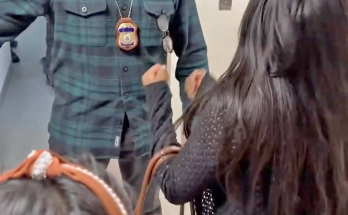
Master Gunnery Sergeant Vance Cutler’s voice cut across the range like a blade drawn slow, meant to be seen before it was felt.
“Put a rifle in her hands and she’ll probably shoot herself in the foot before she hits anything downrange.”
A few Marines laughed. Not loudly. Not openly. The kind of laughter that stayed in the chest and leaked out through smirks and exchanged glances.
Staff Sergeant Lenox Thorne didn’t react.
She stood on the thousand-yard line with her M40A6 grounded beside her, sling loose, chamber flag still in. The rifle was an extension of her body—weight familiar, balance memorized, every nick in the stock known by touch alone. Her breathing was slow, measured, the way it had been trained into her when panic meant death.
She was twenty-eight years old and carried three thin scars carved into her left forearm. Parallel. Deliberate. Permanent.
Promises.
Promises made over blood-soaked Afghan dirt, with rotor wash flattening grass and the smell of burned metal hanging in the air.
She had killed fourteen men in eighteen minutes with a rifle just like this one.
Cutler didn’t know that.
And the four Navy officers standing beside the black Suburban at the edge of the range absolutely did.
Marine Corps Base Camp Pendleton woke slowly under a late-September dawn. The Pacific air was cool, heavy with salt, but the inland desert wind already carried grit that stuck to skin and crept into weapons. Diesel engines idled in the distance. Somewhere behind the hills, artillery boomed—training fire, routine, comforting.
The sniper range stretched long and flat, targets barely visible as pale dots far downrange. Steel silhouettes waited at distances most Marines never shot beyond. Seven hundred. Eight hundred. One thousand yards.
Lenox Thorne stood alone at the line.
She was five-foot-seven, lean and dense with muscle built by ruck marches and mountains. Her dark hair was pulled into a regulation-tight bun. Her gray eyes were steady, unblinking, tracking wind through mirage and dust the way other people watched traffic.
Stillness clung to her. Not stiffness. Not nerves.
Control.
Behind her, thirty meters back, a small group of Marines waited. Three Lance Corporals—young, sharp, handpicked by Cutler after months of screening. They wore the hard confidence of men who believed suffering automatically equaled superiority.
At their center stood Master Gunnery Sergeant Vance Cutler.
Forty-six. Twenty-four years in uniform. A legend, depending on who you asked. He ran the toughest scout-sniper screening program on the West Coast and made sure everyone knew it. His reputation was built on breaking candidates publicly, weeding out weakness through humiliation as much as through skill.
He chewed gum like it owed him money.
“She don’t belong here,” he muttered, loud enough to carry. “This isn’t a diversity slot. This is a killing program.”
Lenox heard him.
She always heard everything.
She had grown up in Fossil, Oregon—population seventy-three on a good day. One gas pump. One diner. Endless timber and snow.
Her father ran a gunsmith shop out of a weather-beaten barn. Her mother worked as a surgical nurse at a hospital forty miles away. Between them, Lenox learned two things early: tools mattered, and mistakes cost blood.
She fired her first rifle at six.
By eight, she hunted elk.
At twelve, her father blindfolded her and had her field-strip an M1 Garand in the cold.
“Feel it,” he told her. “Your hands know before your eyes do.”
The lesson that stayed came when she was fourteen.
She rushed a shot at a mule deer standing broadside at three hundred yards. Clean miss. The animal vanished into timber.
Her father said nothing. Just took the rifle.
Then he made her sit in the snow for an hour, staring at the empty clearing.
“In shooting,” he finally said, “you only ever get one chance to be right.”
She never rushed again.

At eighteen, she enlisted in the Marine Corps.
At twenty, she volunteered for reconnaissance.
At twenty-two, she was selected quietly—no ceremony, no explanation—for a joint special operations task force that officially did not exist. She learned quickly not to ask questions.
She learned faster how to survive.
Helmand Province, Afghanistan. March 2021.
The mission had been overwatch. Routine. The kind of job that lulled men into thinking today would be boring.
Then the helicopter took an RPG through the tail rotor.
Metal screamed. The aircraft yawed hard and slammed into a dry riverbed in a storm of dust and fire.
Taliban fighters were five minutes out.
Quick Reaction Force was twenty.
Lenox ran toward the wreck.

She took position on a low rise with her spotter, Gunnery Sergeant Brooks. Wind variable. Mirage heavy. Targets moving.
Fourteen enemy fighters fell in eighteen minutes.
Ranges from two hundred to six hundred meters.
No wasted shots.
When the last one dropped, Brooks took a PKM burst through his plates. Subclavian artery. Ninety seconds.
Lenox held pressure until his pulse faded.
She dragged two wounded operators—Delta—four hundred meters through a minefield to extraction.
Later, alone in a medical tent, she used a scalpel to carve three lines into her arm.
One for Brooks.
Two for the men who lived.
She received the Navy Cross.
Then she vanished into administrative shadows.
Now, six months later, she stood on Cutler’s range.
Cutler wanted her gone.
He arranged a public qualification.
One thousand yards. Five rounds. Witnesses.
“Line ready,” the range safety officer called.
Lenox dropped prone.
She loaded.
Wind. Elevation. Breath.
Five shots.
Five impacts.
Perfect.
Cutler’s jaw tightened.
Still not enough.
So he escalated.

The seventy-two-hour sniper indoctrination was designed to break people.
Sleep deprivation. Stress shoots. Stalks through cactus and shale. Instructors screaming inches from faces. Failure punished publicly.
Lenox didn’t break.
She moved like water.
During the final stalk, she disappeared so completely that Cutler walked past her position—eight feet away—and never saw her.
Until she stood.
Silence fell.
That was when the black Suburban rolled up.
Four Navy officers stepped out.
Captain Marcus Hale introduced himself.
Then he told Cutler exactly who Lenox Thorne was.
The Helmand engagement.
The Navy Cross.
The reason she had been placed quietly at Pendleton.
Hale’s voice was calm. Surgical.
“Public humiliation isn’t standards,” he said. “It’s abuse of authority.”
Two weeks later, Cutler was reassigned to logistics.
Quietly.
Permanently.
Staff Sergeant Lenox Thorne was promoted to Gunnery Sergeant and made chief instructor for the sniper screening program.
She ran it hard.
Unforgiving.
But fair.
Because shooting had never been about ego.
It was about the one shot that mattered.
That night, alone in her quarters, Lenox traced the three scars on her arm.
She didn’t know if Brooks would be proud.
But she knew he would understand.
And that was enough.